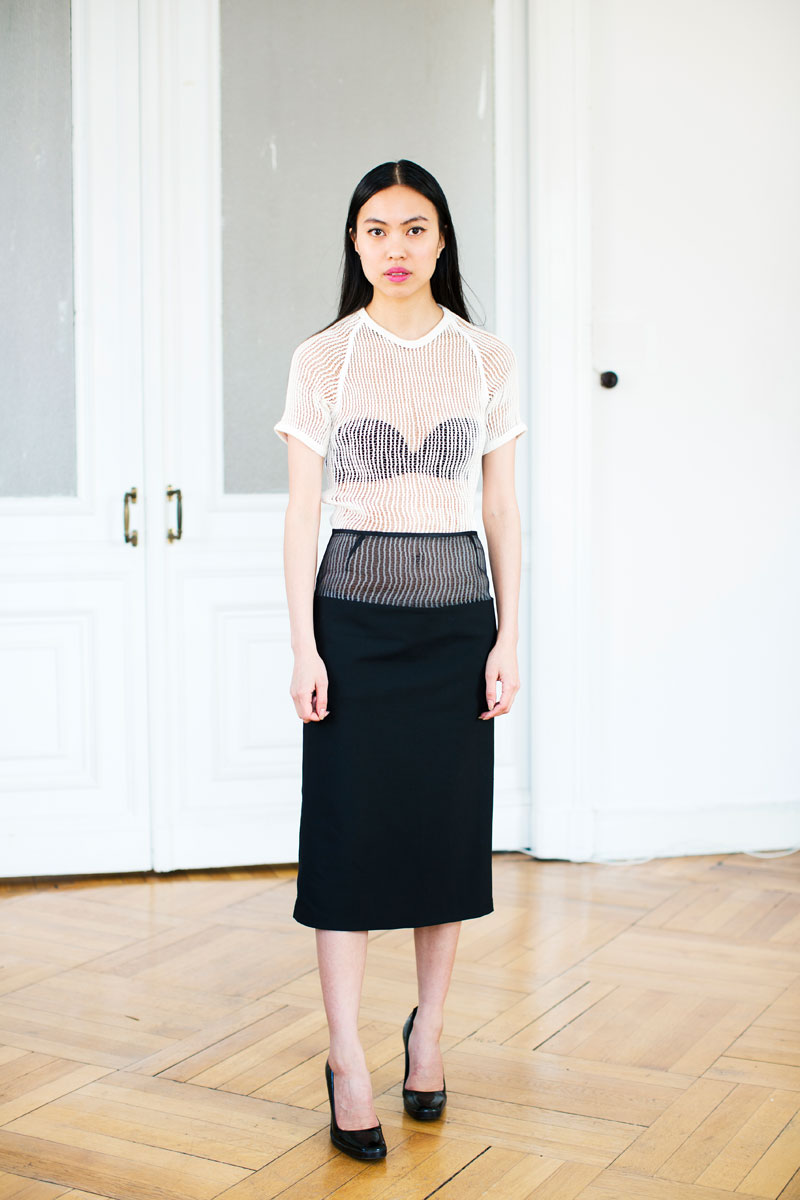
 Nhu Duong photographed in Schöneberg. Photo © Belaid le Mharchi
Function as fashion in the work of Berlin’s rising design talent.
Text by Finja Rosenbaum
Things have been happening for one-to-watch fashion de- signer Nhu Duong since she moved to Berlin. “Being here has allowed me to situate my work in a larger cultural field and a younger generation of artists, musicians and designers,” she says, “and break away from the category of Swedish minimal design.”
Along with designing her own eponymous label, she was hired by fashion behemoth H&M to create the 1440 collection for Weekday which was launched in March: the name refers to the number of minutes in the day, and the collection was created with the concept of a transition from gym to club. There’s a personal interest here: Duong says she enjoys yoga and dance, and does cross- training workouts with her pal Nik Kosmas of artist duo Aids-3D.
The way Duong describes it, the look was inspired by high-performance, extreme sports apparel and multi- functional garments, with an element of the classical: co- lour ranges include discreet blacks and whites with neon and silver highlights. All in all, very techno, very progressive – and very Berlin.
If her clothes reflect something of the city that adopted her (“There is a sense of anti-fashion in Berlin, which used to be political but isn’t any longer,” she notes), then the other strands in her work come from a life well- travelled. Duong was born in Ho Chi Minh City and lived in Scandinavia from the age of seven, while in Sweden she worked as a design assistant at ACNE and was the first recipient of the Mercedes-Benz Young Fashion Industry Awards.
However, she’s clearly moved on: “You might recognise different cultural influences in my work, but it’s not really something I think about or try to thematise,” she says. “My points of reference are much more complex and fragmented. I feel more inspired by my generation and an international scene of artists or designers than the clichés of Scandinavian or Asian fashion.”
Further influences come from rather more unlikely places: the martial arts, for instance. “I come from a traditional kung-fu family and have a strong affinity towards con- temporary dance and ballet,” says the designer, “but in my work I am more interested in sports on a technological and conceptual level.”
The young designer uses materials and details from sportswear and street-wear, and pushes them until they look, in her own words, “sophisticated”. Working on two labels simultaneously gives her the chance to try out a range of new ideas: “the possibilities in terms of production allow me to create garments and try out techniques that would otherwise not be possible. In terms of inspiration, the collection for 1440 is very close to my own collection, but applied in a completely different way.”
Function, it seems, is a key preoccupation: “it’s at the core of fashion,” she explains. “When is a wed- ding dress functional? I’m very much interested in this question of functionality, of what fashion can do, its potential. In a sense, the clothes I make are quasi-functional, pushing functionality into abstraction.”
It will be fascinating to see where her talents and obsessions take her next – somewhere be- tween the gym, the club and the catwalk is a space she’s making her own with an uncompromising focus that goes beyond “trends” and “seasons”, just like her role model, Azzedine Alaïa.