
Image Courtesy of the Author.
More and more people around the world are living in cities. While only 12 percent of humanity was located in cities in 1950, current projections suggest that this number will rise from 55 to 70 percent by 2050. This means that cities are not just random places, but the living space for the majority of the world’s population. This is where art and culture condense; where the globalised economy meets social and political struggles for the good life for all; where debates around a sustainable future are tested in practice. Cities are thus a relevant indicator that can be used, as if with a magnifying glass, to read which challenges are present in today’s world. Similarly, urban realities are to be understood as powerful key factors that influence how tomorrow’s life will be shaped.
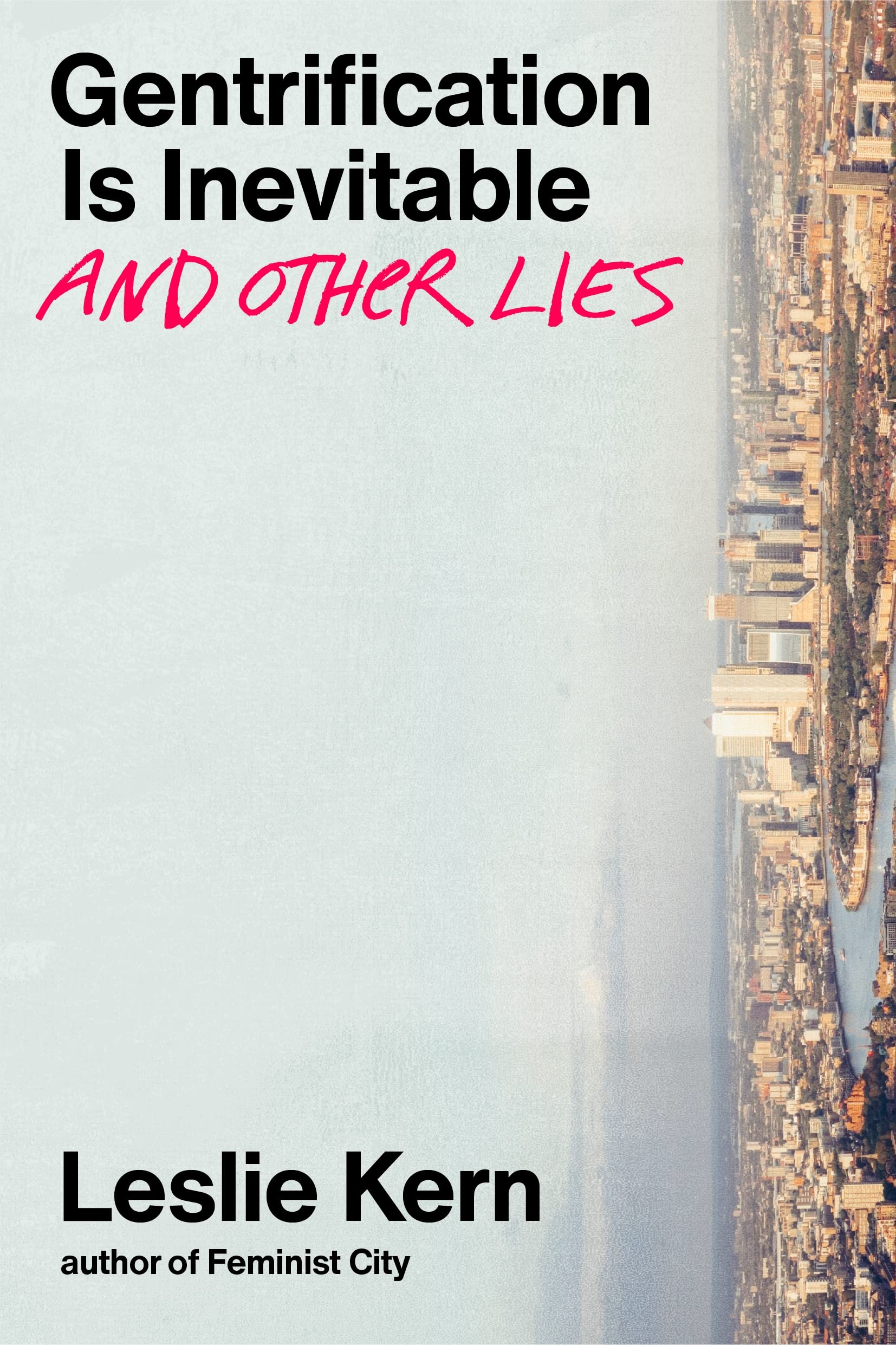
This complex subject area is where Leslie Kern – author, professor, and academic career coach – who recently published her exciting follow up to her 2020 book “Feminist City: Claiming Space in a Man-Made World (2020)”, titled “Gentrification is inevitable and other lies.” Active at Mount Allison University in Sackville, Canada she focuses on the connecting elements between Geography, Environment, Women’s and Gender Studies, which she puts on the agenda in activist as well as academic contexts.
In order to develop concepts and dream ideals, it is important to first venture an analysis of the status quo, that reveals which problems shape current life in cities. With reference to the Global North, the following come to her mind: “The housing crisis, both in terms of cost of housing, cost of rent, and cost of home ownership, and also a lack of availability. The ongoing inequality and the rise or the renewal of old hatreds that are creating a charged atmosphere of fear and danger in cities. Climate change, of course – cities are scrambling to figure out how to protect their infrastructure and protect people and their wellbeing from these impacts.
While there can be no simple answers to these big questions, Kern nevertheless has approaches at hand that, if stringently implemented, can lead to solutions in the long term. One issue that the scientist is working on intensively is to change the narrative around housing. Most who have ever embarked on the search for affordable and adequate housing in cities know that this task can quickly feel like a project of impossibility – and for many people who occupy a precarious position in the competitive market due to (multiple) marginalisations, it is indeed a project of impossibility. In order to counteract this, housing would have to be understood as a human right in the future and manifested politically accordingly. “If we compare systems of universal healthcare or universal education that we have in many countries, there’s an understanding that healthcare and education are human rights. And what that entails then is a great deal of government spending and subsidising of those systems to ensure that there is a universal access,” Kern says. “If we were to start thinking of housing along similar lines, then we would ensure that everybody has some access to housing.”
Another issue is the matter of the climate crisis. Heat waves in particular are clearly felt in large cities due to crowded living conditions and the heat dome effect of urban environments, so that in many metropolises attempts are being made to counteract the disastrous effects by greening facades, urban gardening, environmentally compatible building materials or car-free zones. However, these processes are often accompanied by value increasing mechanisms – also known as gentrification – which entail the danger of exchanging the heterogeneity of neighbourhoods for exclusive high-income groups. Kern therefore believes that climate change improvements need to be paired with anti-displacement policies: “If you were targeting a particular neighbourhood for environmental improvements, then that neighbourhood needs rent stabilisation, it needs tight policies around evictions and regulation to help ensure that people can stay in their homes and receive the benefits of climate change mitigation, whether it’s more tree cover in their neighbourhoods, more green space, or better water services. I think there is a growing awareness that these issues have to be tackled together, that all of these things are intertwined.”
"If you were targeting a particular neighborhood for environmental improvements, then that neighborhood needs rent stabilization, it needs tight policies around evictions and regulation to help ensure that people can stay in their homes and receive the benefits of climate change mitigation, whether it's more tree cover in their neighborhoods, more green space, or better water services."
Leslie Kern
What is implicit in all these debates, but of explicit relevance, is the way we think about community, about new ways of living together as a society. In her aforementioned book Feminist City, Kern – inspired by the series “Sex and the City” – devotes a chapter to friendship between women, in which she recognises the potential to destabilize both built and social space. She conceives of friendship between women as “world-making.”
Taken from queer theory, this world-making involves creative, disruptive, and even utopian engagement with practices or relationships that challenge norms and thereby create worlds that are detached from long-established structures. Friendship as a way of life can therefore be such a world-building activity, since, according to Kern, new systems and forms of interconnectedness and kinship emerge that make the heteronormative nuclear family as the building block of our society fragile. Thus, she says: “If we start to shake that up by encouraging or making it possible for people to live in other sorts of arrangements without contorting themselves to fit into this box – whether that’s through different kind of forms of housing, whether that’s through the legal recognition of different kinds of relationships – then we start to shake that ground up and open the possibilities for other networks of care to evolve.”
Because, she says, people who don’t, either by choice or by circumstance, have a long-term romantic partnership throughout their lives face barriers to owning a home or saving on taxes: “Why can’t a friend be your designated medical proxy? Why can’t a friend receive your pension when you pass away? Opening up these options means that some people will no longer be punished for not fitting into existing models.”
One factor that can complicate alternative forms of cohabitation is the built environment, which reflects the ideas and needs of the hetero-patriarchal nuclear family. And thus finds itself in a permanent loop that constantly feedbacks architecture and social norms: “It’s difficult for other sorts of families and relationships to fit into that form. For example, multi-generational families or two families that want to live together and share childcare. If we were to change the form of housing, or at least create more options, then we can start to encourage different ways of living together and looking after each other.” Some of these utopian potentials are already being lived out, whether it’s through co-housing, building collectively used places in public, or safer spaces that make marginalized people feel that others present “will respect your identity and understand something about your life experience,” as Kern explains.
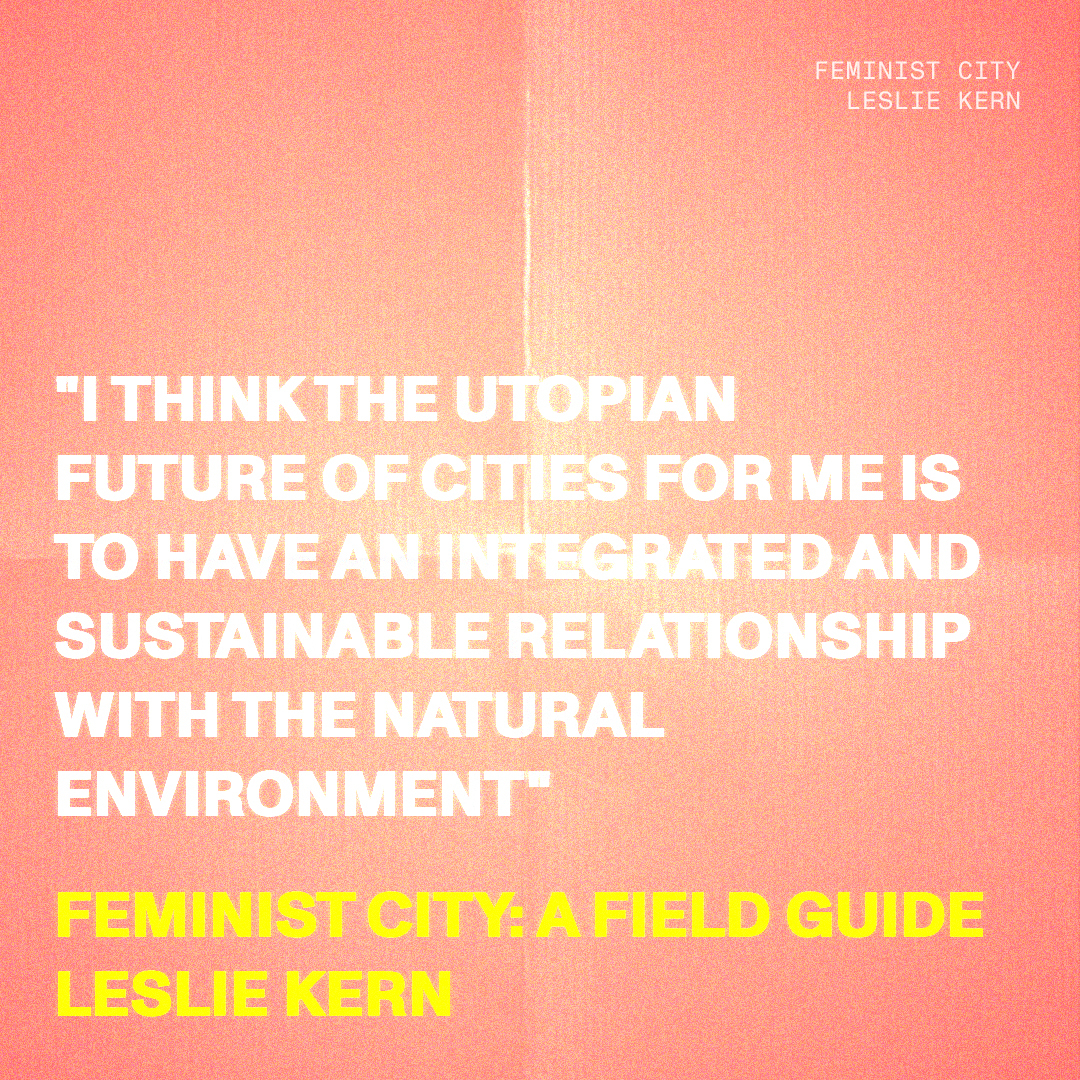
And this is just the beginning of an urban utopia as Leslie Kern envisions it. “I think the utopian future of cities for me is to have an integrated and sustainable relationship with the natural environment,” the researcher says. Implemented, she thinks, could be this closer connection to nature through different kinds of urban design, bringing different kinds of nature into the city. And, she continues, it could mean the end of certain ways of living, such as suburbia or the detached single-family home, which are known for wasting energy and resources: “I think that aspect also raises the question of other types of relationships.
Will there be more shared or communal forms of living? That could allow us to live with friends, to live in community with older people, it could mean more diversity in the communities that we have.” In this context she comes back to her concern to understand housing as a human right in order to solve the problem of homelessness. What may well sum up her work and thinking at its core is also reflected in her utopia: “We need a great deal of support and relationships of care to transform society to live in more sustainable and collective ways.”