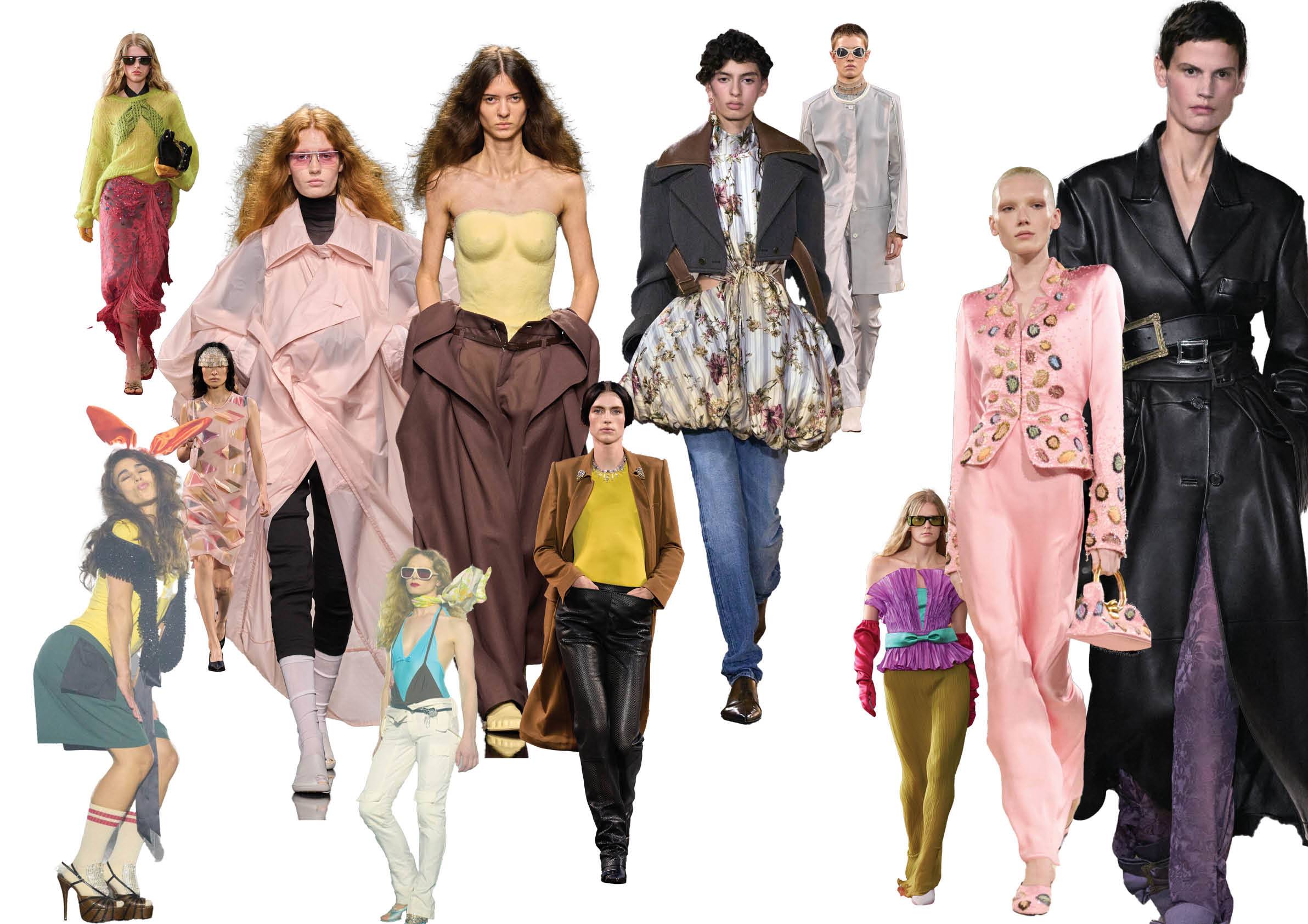
In fashion, all timelines coexist. A rococo bow can sit next to a spaceship. Jane Austen can meet Anna Wintour. Marie Antoinette might be wearing jeans. And Umberto Eco and his library are alive forever. Nobody even blinks. That’s what makes this industry such a good time machine: every designer picks an era to speak through, and what they say is always about now.
And now was busy. Paris Fashion Week’s women’s ready-to-wear shows for Spring/Summer 27 took place while the Pope was in the city, high school students were protesting on the streets and the internet was still discussing the robots of Vogue World. Purple unsurprisingly ruled the runways, while the so-called “high-heel index” suggested turbulent times. It sounds chaotic, but it oddly makes sense: faith, rebellion and machines, all asking what comes next.
And fashion’s answer was mostly to look back. Why? One explanation is that the future has become harder to imagine, while the past at least offers shapes, references and a certain comfort. Another is that the past helps us understand who we are now. Faded brocades, Hollywood glamour, wartime embroidery: this season, the past was everywhere.
Out of all the shows at Paris Fashion Week, six told us the most about where we are. So, to hear what they were really saying, we went backwards through time, from the 2050s all the way to the Big Bang, and gave each collection the year it seemed to belong to. The rule: every year has to be anchored in something we actually saw on the runway. Fasten your seatbelts.
Courtesy of Louis Vuitton
2050s: Louis Vuitton
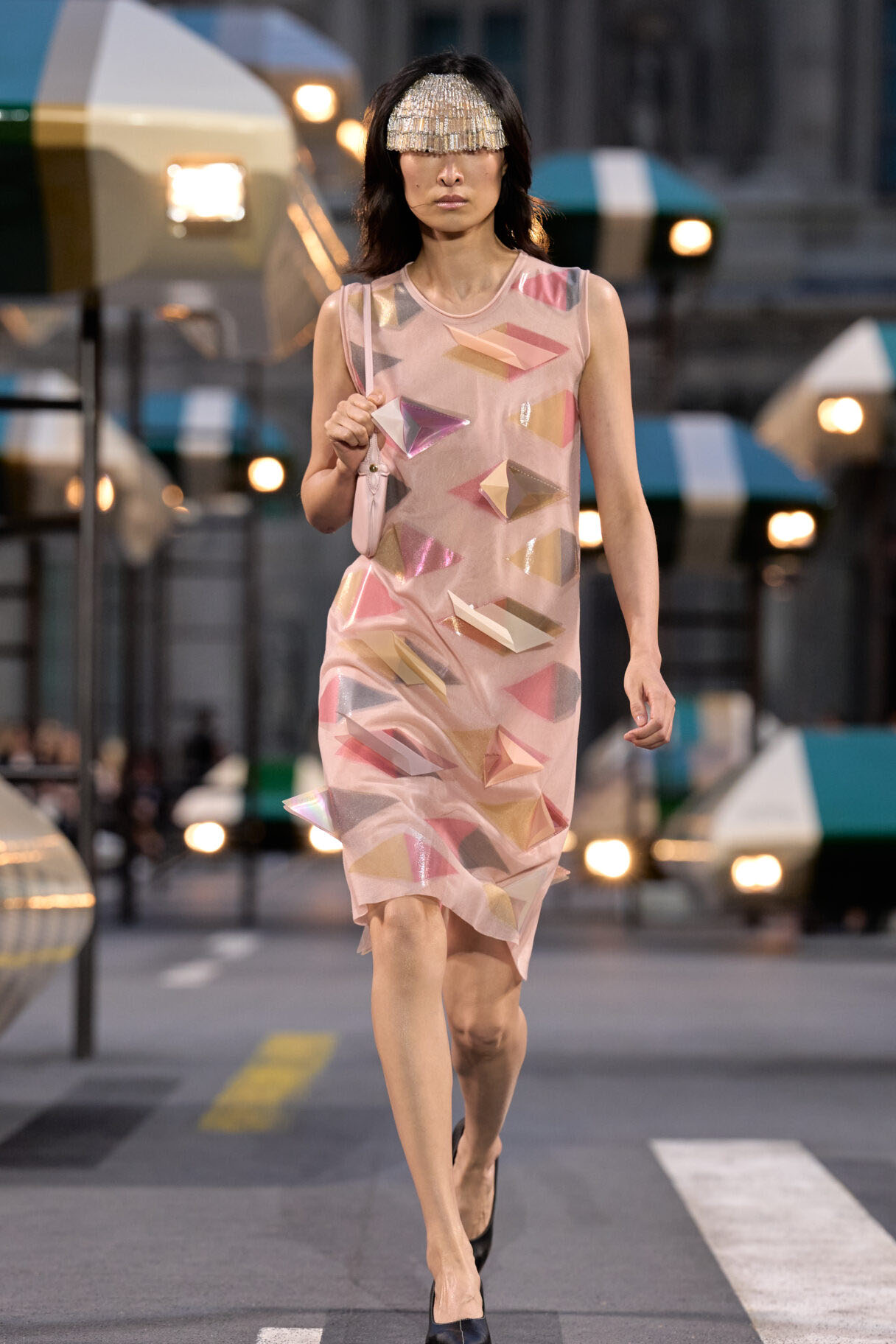
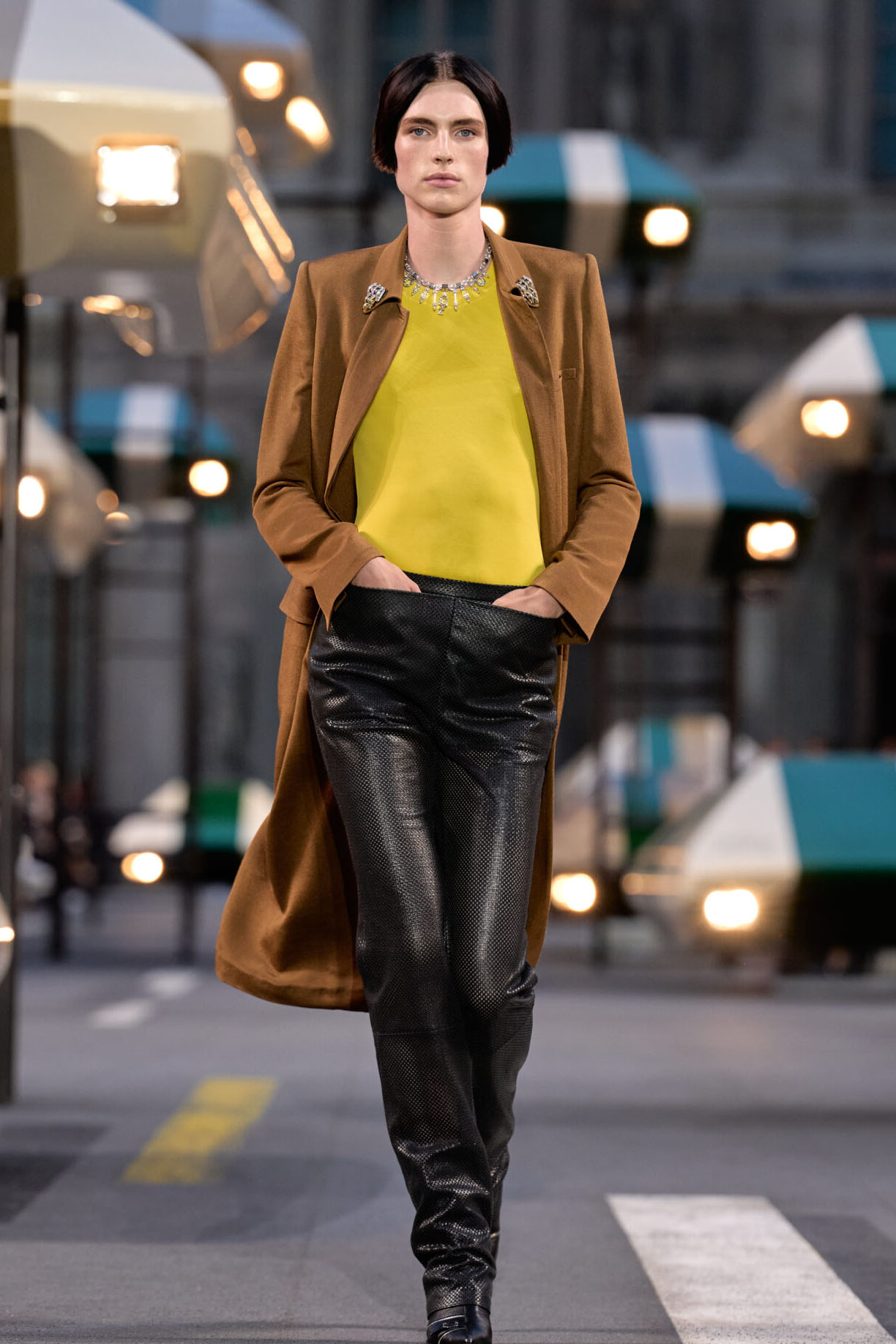
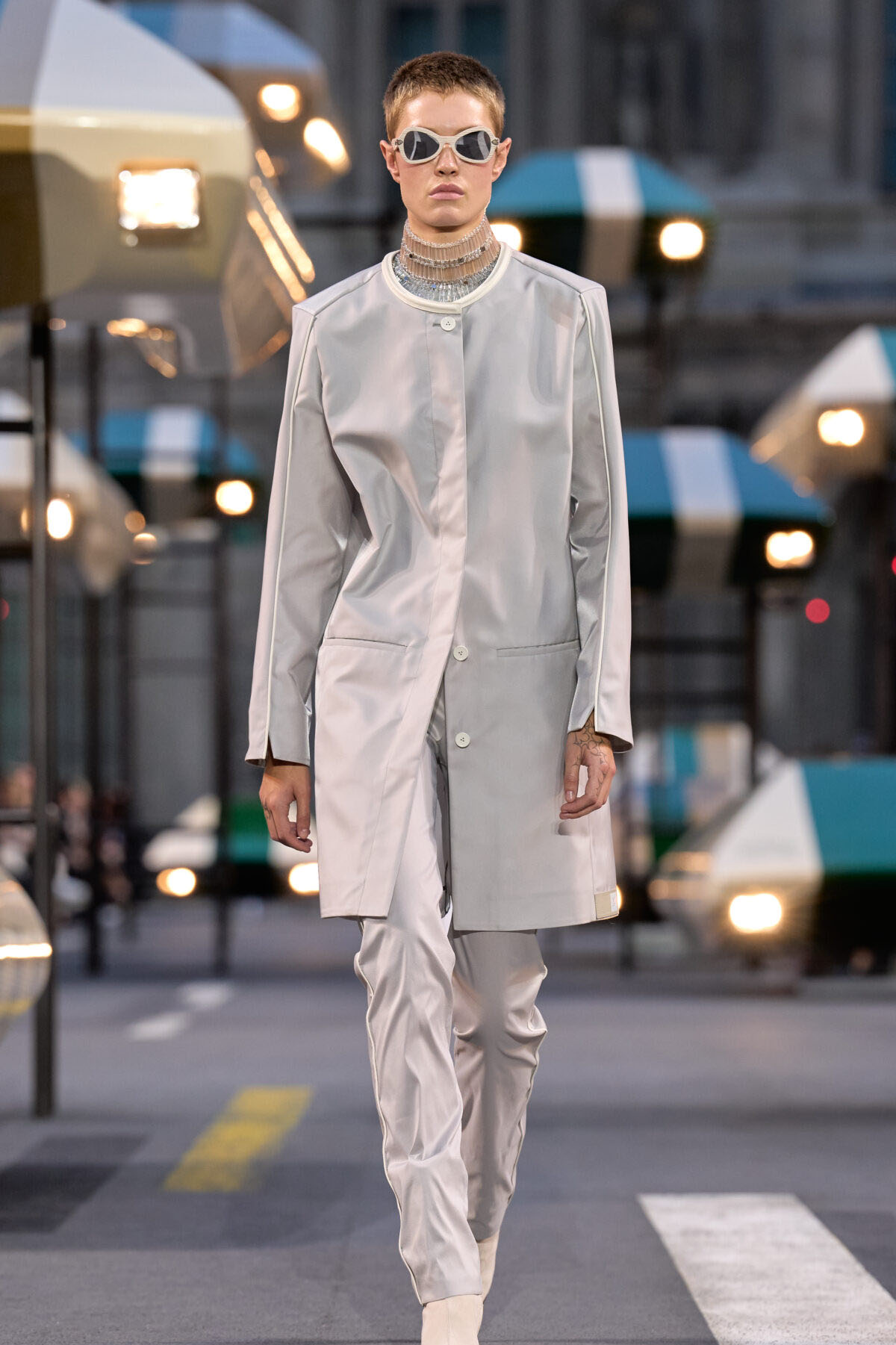
Let’s start with the future, and not a faraway one. The 2050s are close enough to be real, which is exactly the point of Louis Vuitton’s Spring/Summer 27 collection. It may feel apocalyptic, yet also retro-futuristic and nostalgic, but above all it talks about a future that is not abstract and not just a vague possibility. At the core of Nicolas Ghesquière’s ready-to-wear collection was one question: what will clothing be like when weather phenomena only get stronger and more unpredictable because of global warming? What do people really need, and how can garments fulfil that purpose?
The answer: streamlined silhouettes that leave only the essentials and caress the body like swimwear, like a second skin. The colours blend into the surroundings a human might find themselves in, whether forest, city, desert or storm. The trouser pockets sit right above the crotch, easily accessible and close to the centre of the body, where the heat gathers. Even footwear and bags were stripped of every embellishment, down to a bag that looked like a plain envelope. Only the silver fringes on some models’ foreheads disrupted the militant minimalism.
The retro-futuristic concept continued in the setting: the Louvre’s Cour Carrée, filled with an army of hovering cars resembling spaceships, above a runway that looked like a highway. Urban chaos and noise, a huge contrast to the quieter designs.
Overall, the collection was unusually simple for Ghesquière, especially considering his time at Balenciaga. It might be neither the best collection the industry has seen from the maison nor from its creative director, and a show this loud around clothes this quiet does not entirely add up. Still, if even Ghesquière is stripping things back and reflecting on the future, maybe we should do the same.
Courtesy of Valentino
1980s: Valentino
The second collection is Valentino’s Spring/Summer 27 show, Antilibrary. The 80s come later, because first the concept: knowledge is measured not by how many books you have read, but by how many you haven’t. Sounds strange, but it makes sense. Alessandro Michele quotes Nassim Nicholas Taleb’s The Black Swan on Umberto Eco’s library: “Indeed, the more you know, the larger the rows of unread books.” In other words, the more you know, the more you look for new things to learn.
“This consideration about the antilibrary often comes to mind when I think about fashion,” Michele continues, and he’s right. Some garments will never be worn, some will be shown only once, some will be cherished like relics and others worn to death. Just like books, clothes embody possibilities that exist whether you take them or not, and judging a garment by its use alone would be as reductive as measuring knowledge by books read.
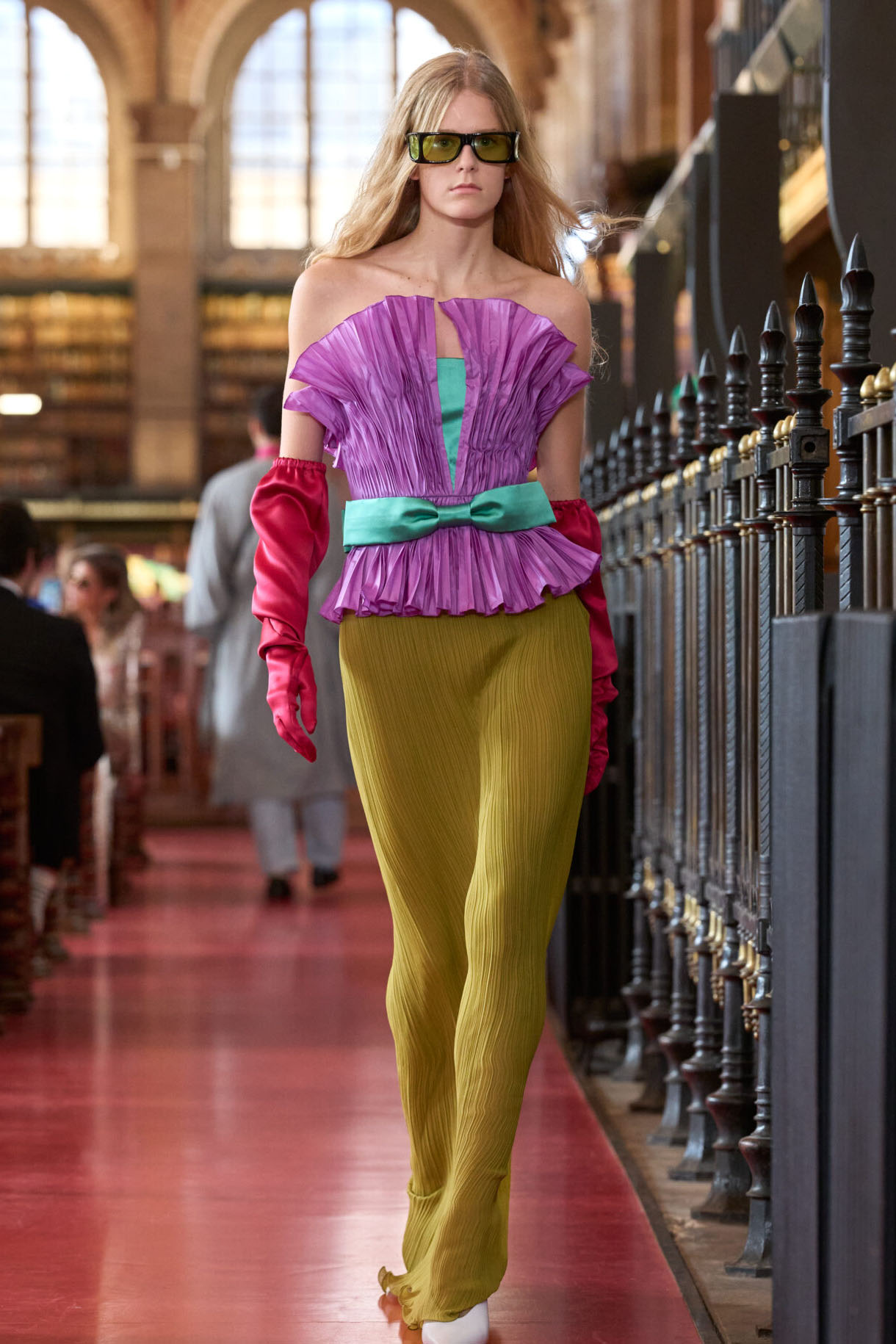
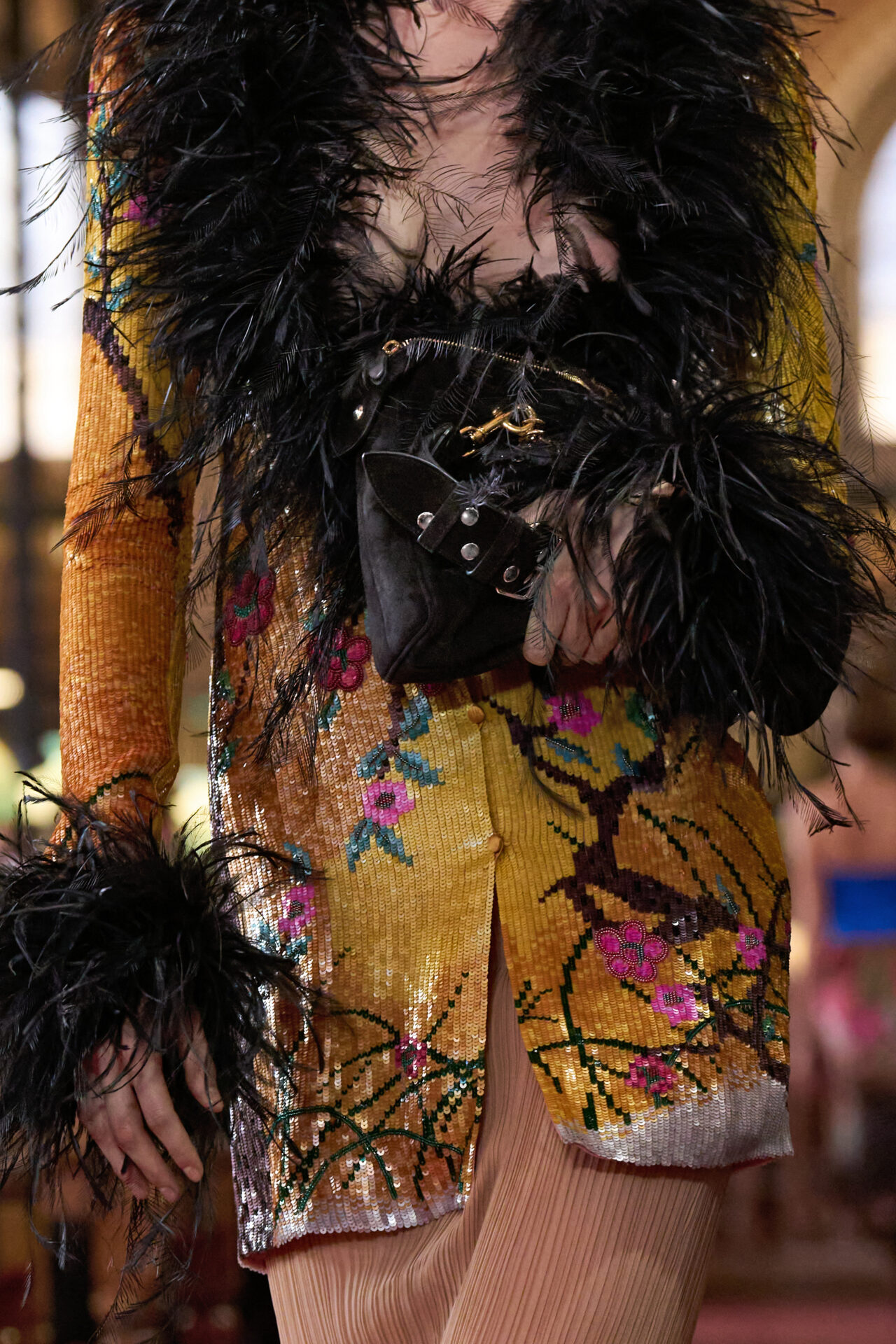
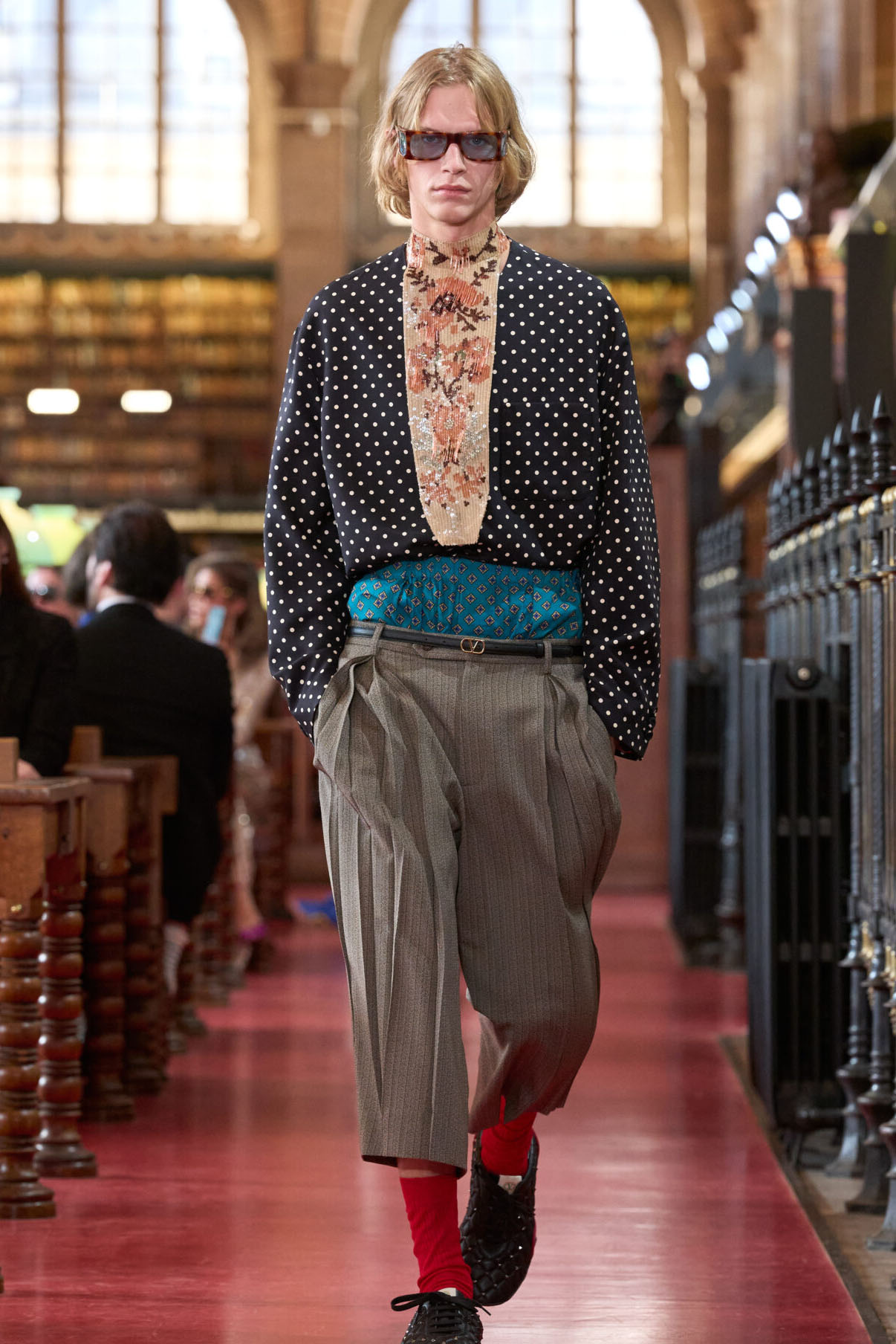
So, Michele created a collection that is a bit mismatched, where no piece is too repetitive and some silhouettes seem unfinished. A pink gown has a train that spreads like wings, and you might think of seaweed or an elegant fish tail, if it weren’t for the black bow in the middle disrupting the thought. Polka dots meet rich lace, a “villain teen” cap sits beside pencil skirts, and rusty orange stands next to purple, black and pastels. The result is a glorious, playful chaos, and not every look earns its place.
Chaos this big needs a thread to hold it together, and the 80s provide it: the purple that was popular back then, vibrant turquoise, bright pink and mint, epic lettuce ruffles and chunky belts. The more-is-more attitude fits the decade just as well as the colours. Michele completely outdid himself (and proves that the human mind is far from exhausted when it comes to creativity). Every garment, just like every book, “makes the world wider, richer, more liveable”, he states in the show notes. Guests were also invited to bring a book to be distributed to public libraries in Paris and other cities. An internet favourite: Anna Wintour brought Pride and Prejudice, a satirical dig at the fashion industry, maybe?
Courtesy of August Barron
1970s: August Barron
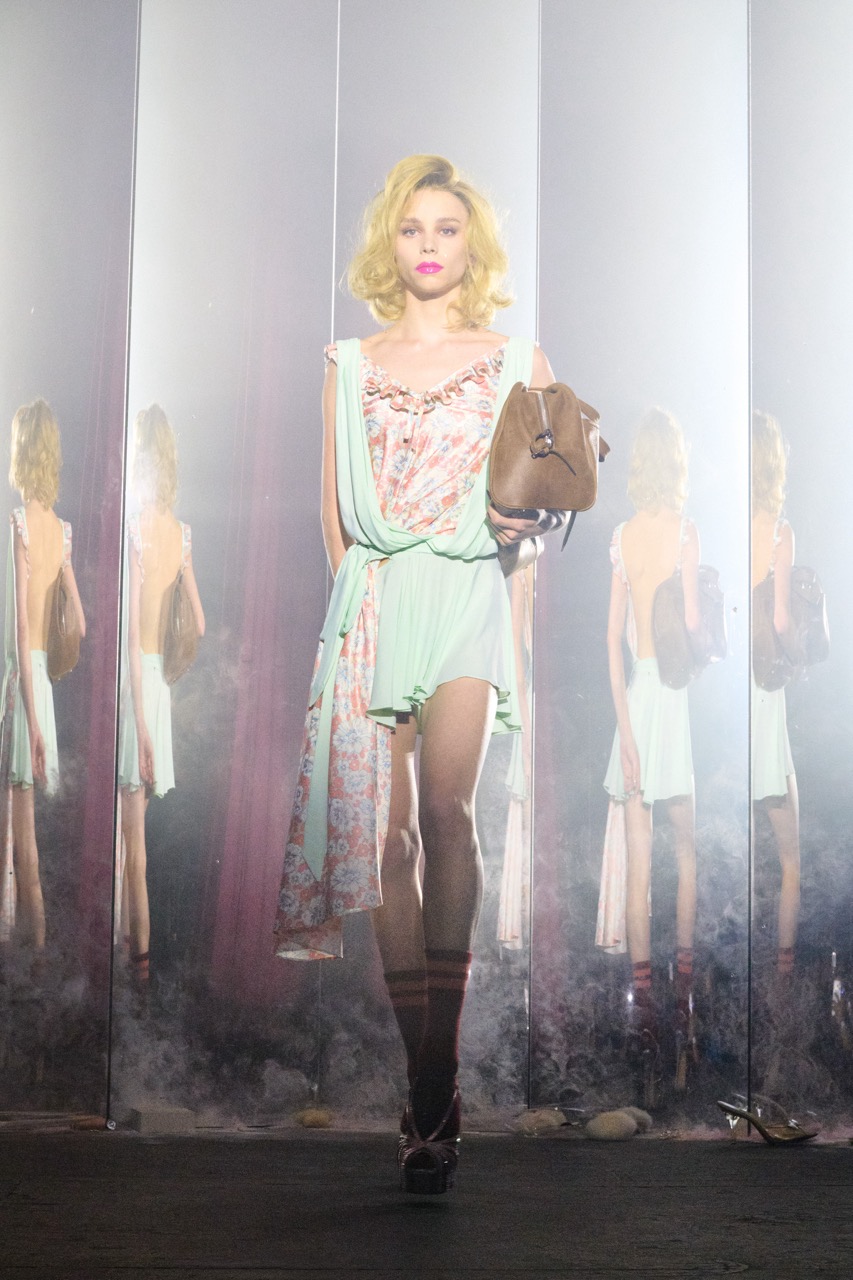
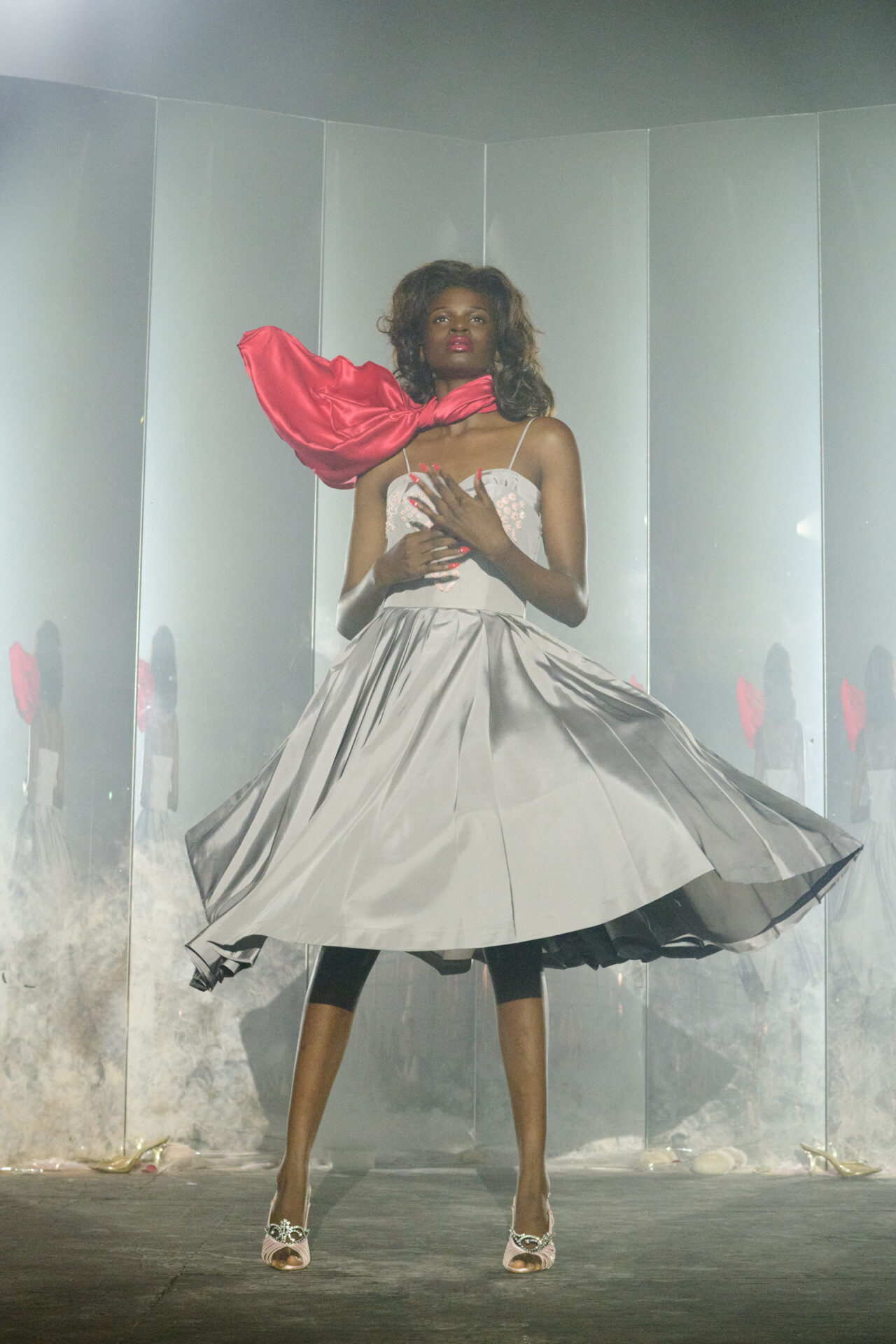
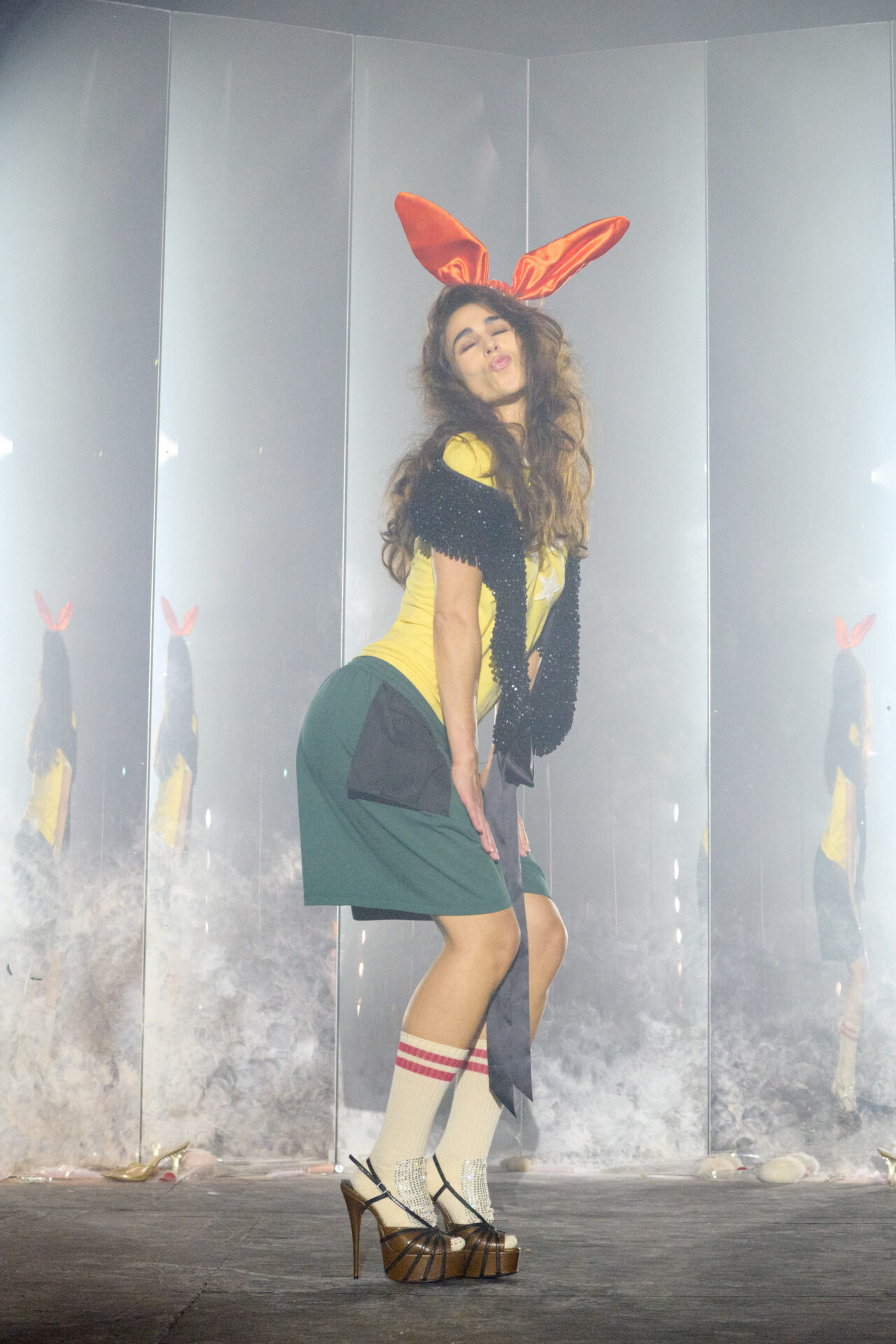
Speaking of time travelling, there’s one era we cannot not talk about, so luckily, August Barron already did: the days of old Hollywood and San Fernando Valley glamour. You know, Marilyn Monroe in that white dress that threatens to be blown away, mixed with cigarettes, spotlights and a character who is young, a bit naïve and delusional, and above all a dreamer. Titled Walk of Fame, the brand’s Spring/Summer 27 collection explores the pursuit, performance and preservation of stardom and cinema.
The looks feature scarves frozen in the wind like a moment on screen, slip dresses, crystal-covered skirts and platform peep-toe heels that suggest something sensual, until colourful socks awkwardly disrupt it. The footwear is clearly inspired by dance shoes, yet the slightly uncomfortable combination reminds you how young some people start out in Hollywood, giving the character something vulnerable. Exposed layers, undone bustiers and cropped jackets resemble the act of getting into and out of character, and the black sunglasses (of course) protect the eyes and the attitude from the paparazzi. Add purple, sapphire, stars and a lot of glitter.
The founders, Benjamin Barron and Bror August Vestbø, drew much of their inspiration from films such as They Shoot Horses, Don’t They? (1969), Sunset Boulevard (1950) and Boogie Nights (1997). None of these are actually from the 70s, so why this decade? Because the collection’s central motif is 70s sportswear, which also marks the point where fashion and media got louder and more colourful, and the appetite for endless options started to grow.
Courtesy of Schiaparelli
1940s: Schiaparelli
“It blows my mind to think about how different the world felt when I last sat down to write notes for a ready to wear collection,” says Daniel Roseberry, creative director of Schiaparelli, in the show notes. And he’s right. The world around us feels faster and less controllable than we have ever experienced. So, what does a good creative director decide to do in that moment? Right, create consistency and trust. And how do you do that? Right again, by looking into the clear, distilled essence of the maison’s legacy.
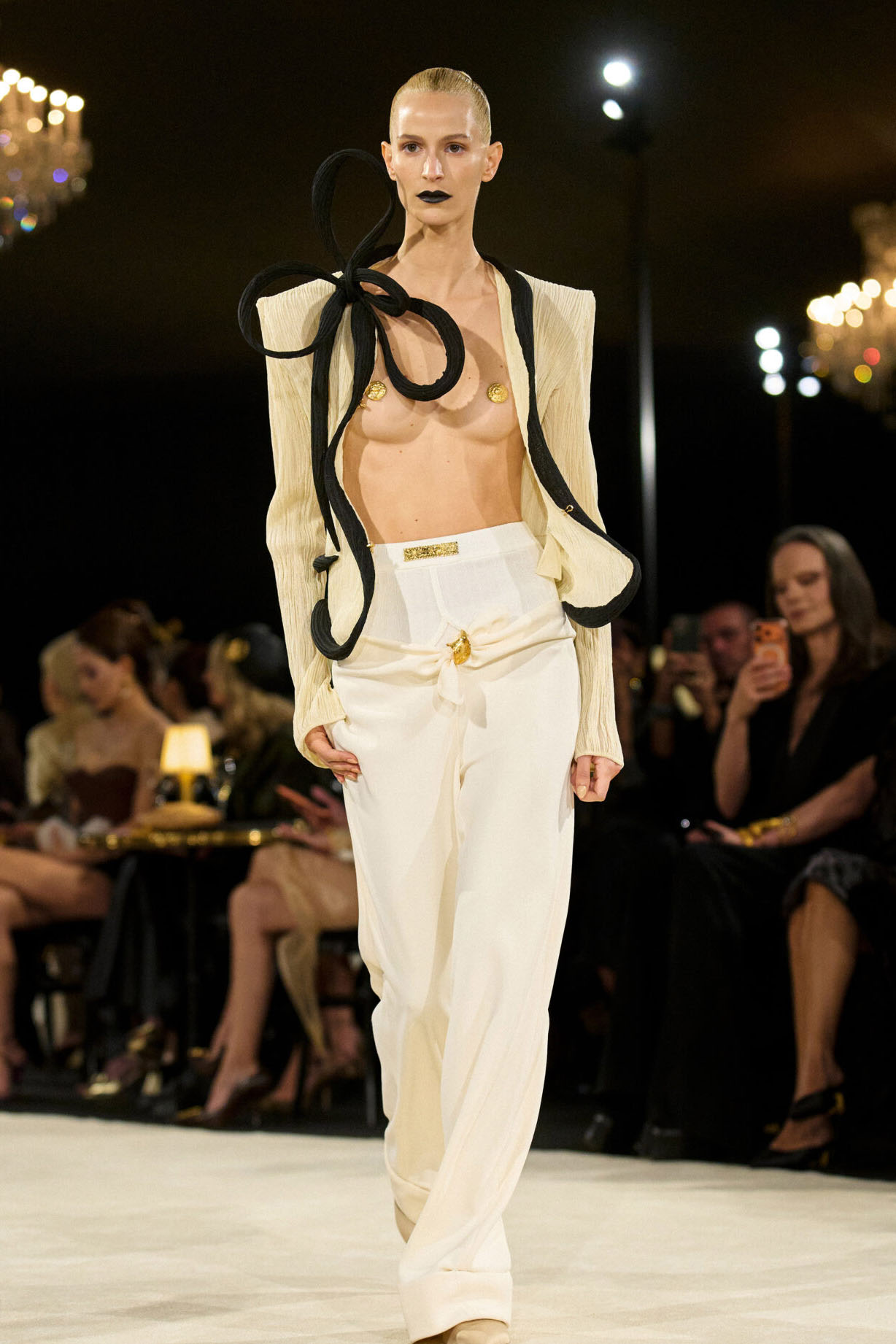
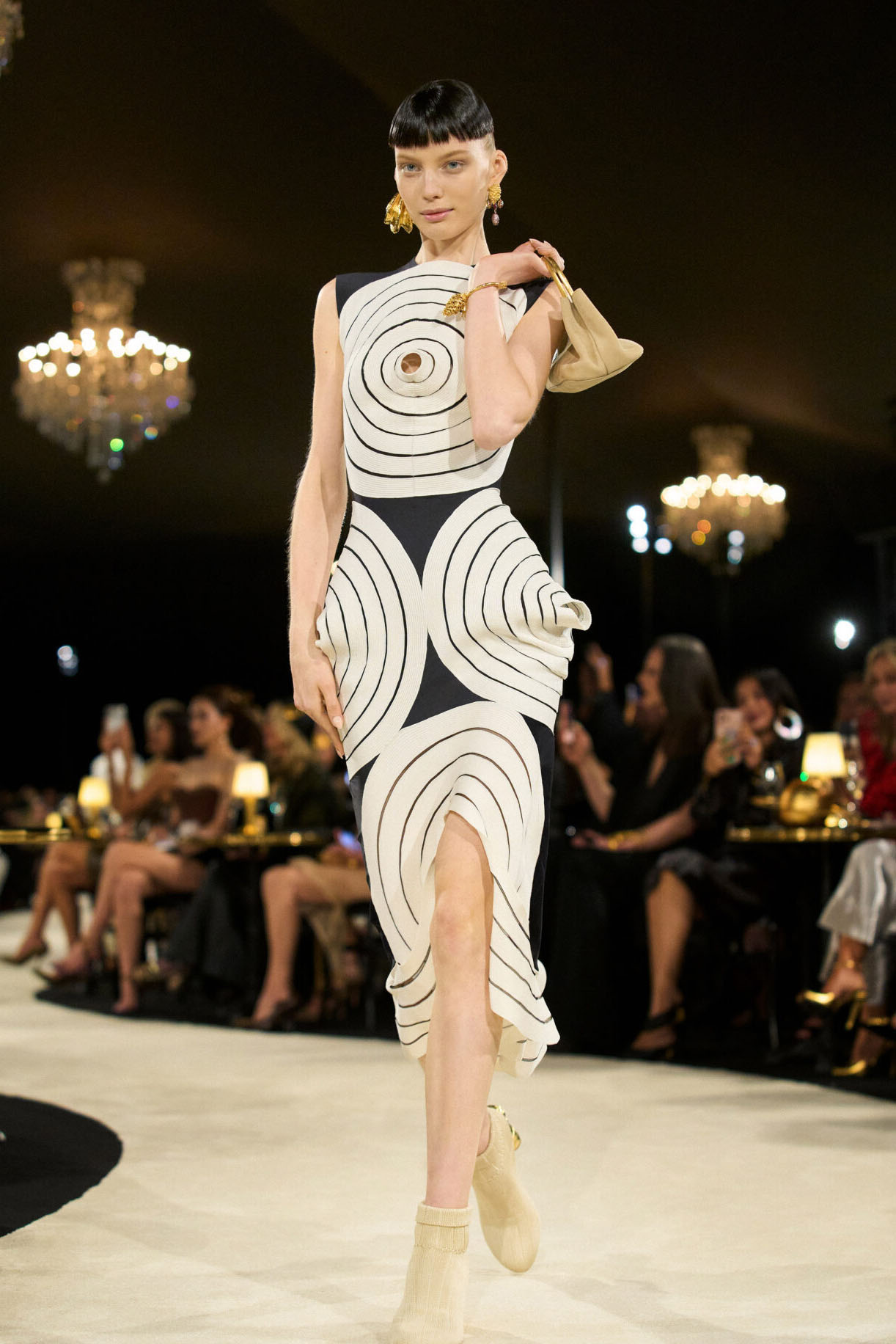
For Going Clear, Roseberry took the spirit and sharpness of Elsa Schiaparelli’s couture and made it lighter, more accessible and more at ease, which is exactly the purpose of classic ready to wear. The result is a modular wardrobe to mix and match, in relaxed black, bone and butter, with bold stripes and asymmetrical openings. But before you get underwhelmed, Roseberry once again intertwines his own language with Schiaparelli’s: golden nipple and brass mouth details pay tribute to the founder’s surrealism, a sheer viscose tree bark knit references a fabric Elsa developed early on, and a linen dress with black leather ruffles echoes the curtains of her atelier. In between sit traces of Roseberry’s Texan roots, American sportswear and what he himself calls “choose your own adventure dressing”.
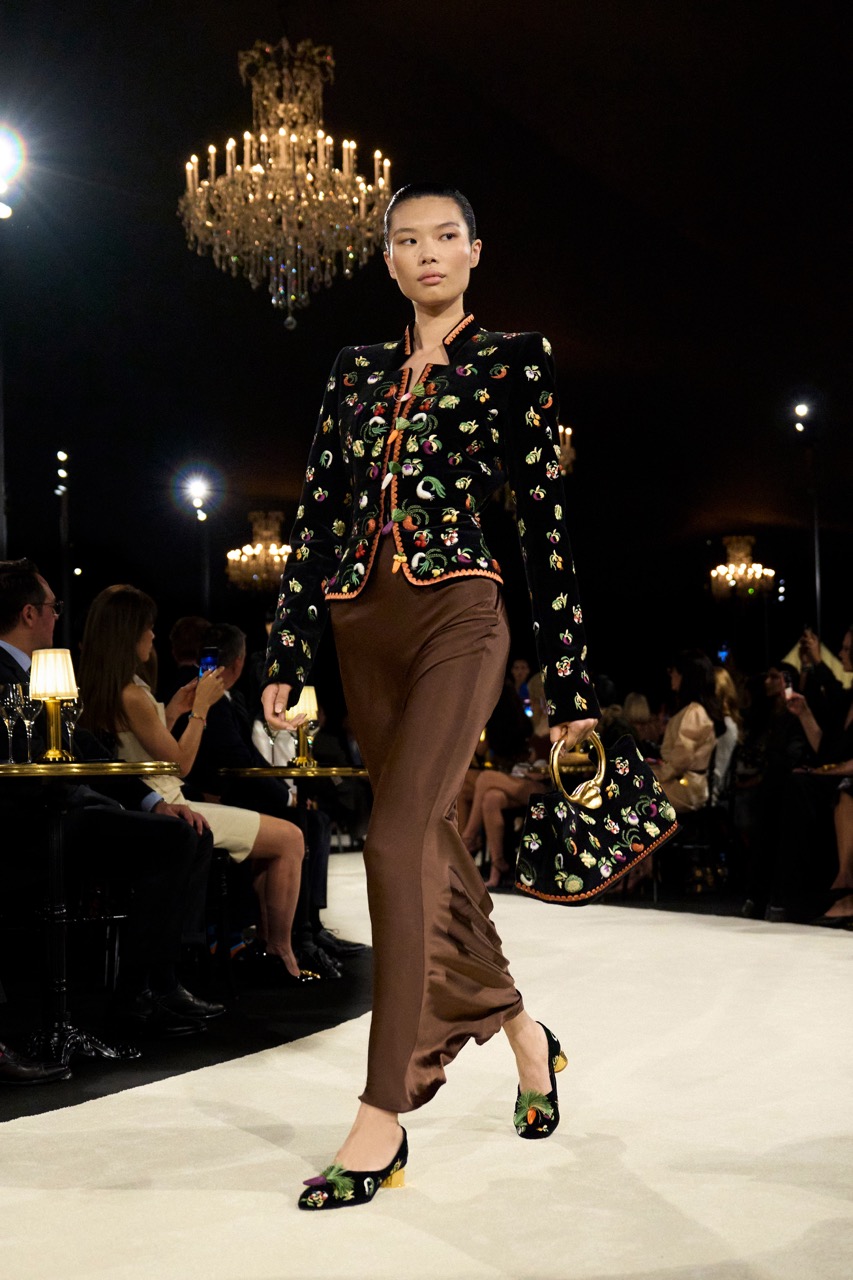
Everything is very clear, as the title already told us, obviously. But there are also truly breathtaking details: the Schiap jackets. Eight new interpretations were presented, each remade from an archival embroidery. One is a vibrant kingfisher blue, another moss green, and the closing look, a salmon pink one, is embellished with what look like big colourful stones on shimmering satin.
So why the 1940s? Because Roseberry’s search for consistency in uncertain times has a precedent, and one jacket shows it best: the black Schiaparelli jacket decorated with vegetables, which Elsa created with the embroidery workshop Lesage during those very years. Originally designed for a red waistcoat, the embroidery was born out of the Second World War, a time of food shortages and rationing, when growing your own vegetables was encouraged to support France’s food supply. A subject that today could hardly be more ordinary became a luxurious couture object, a symbol of wealth, so to speak. It’s a lot of weight for one jacket, but it is the one that gets the collection into the 40s.
Courtesy of Acne Studios
1780s: Acne Studios
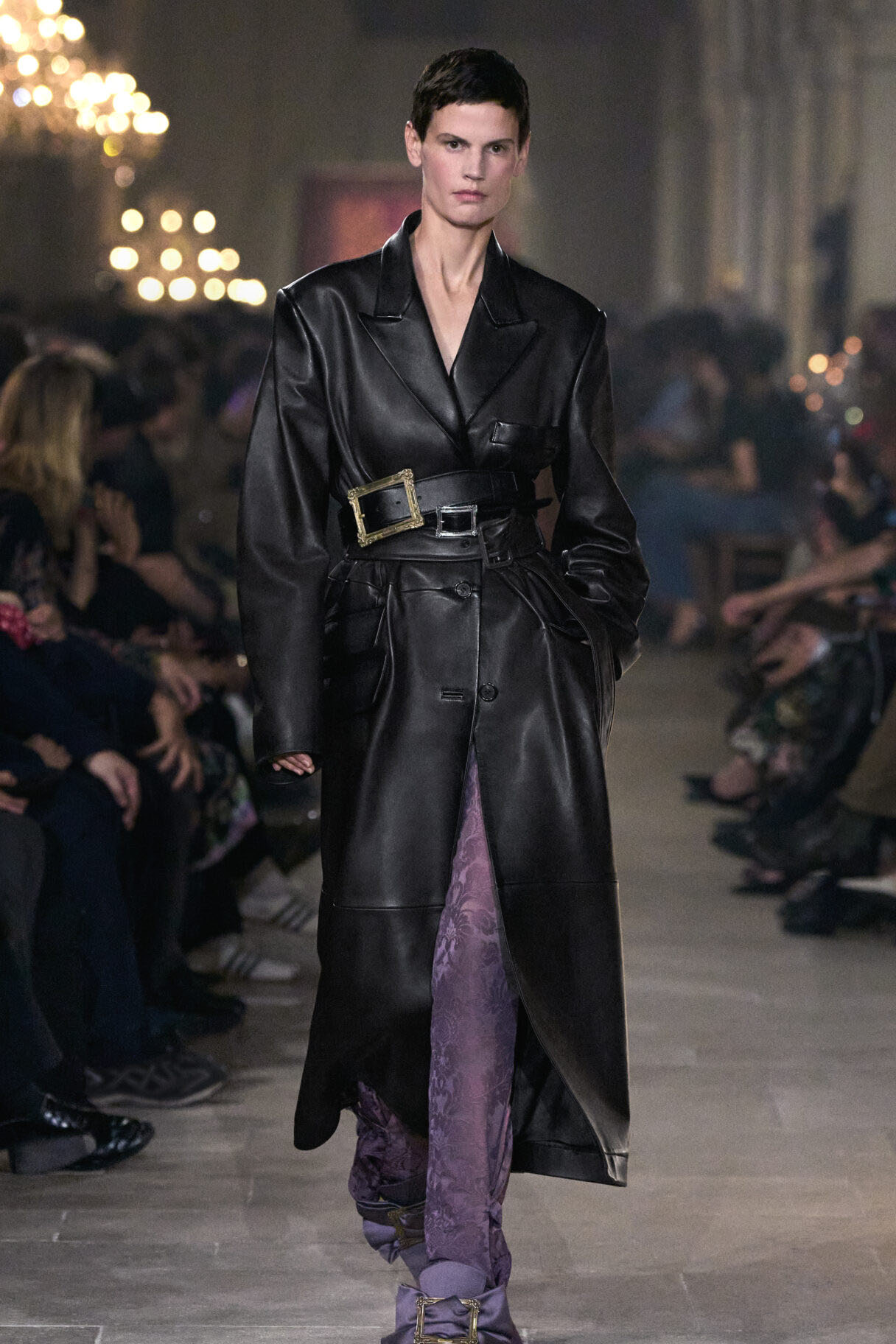
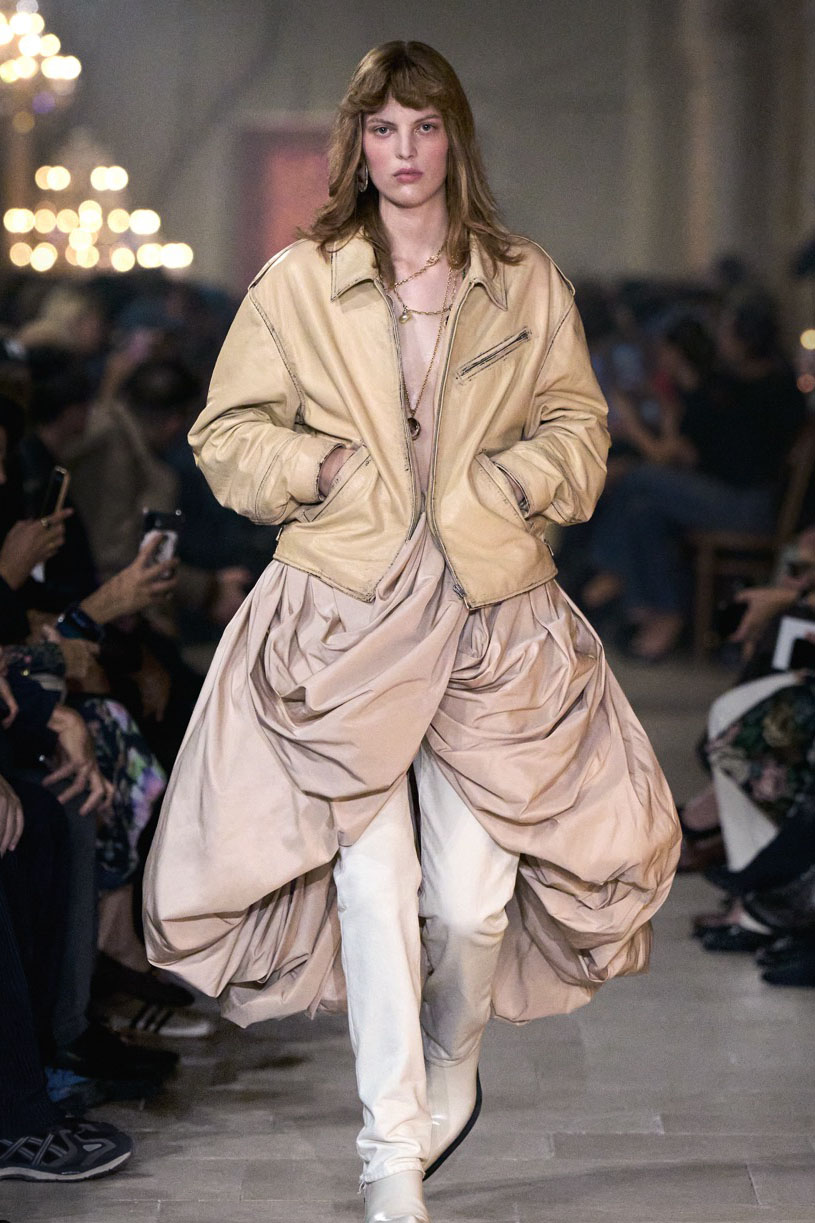
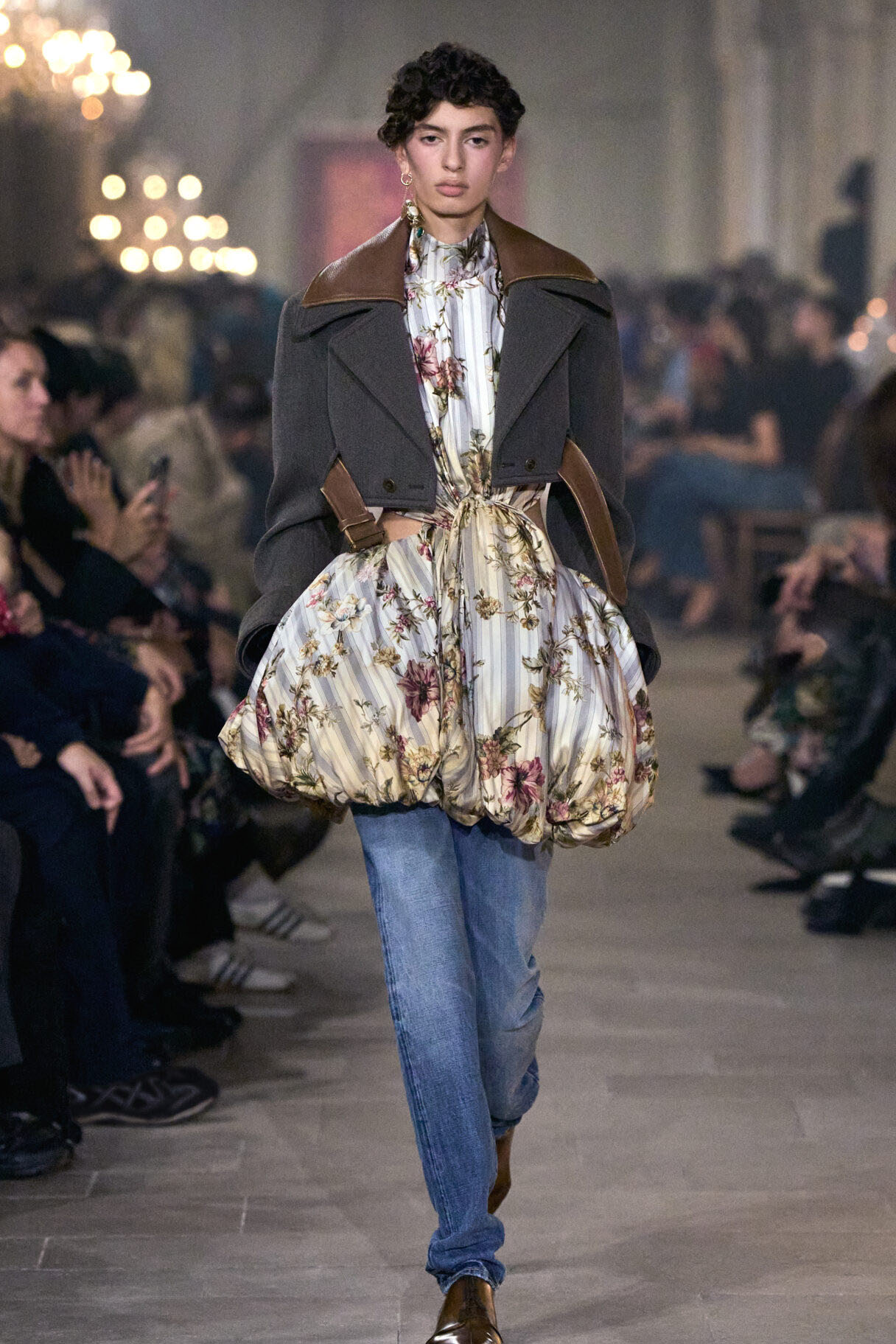
With Acne Studios comes our first big time jump, and suddenly we’re in the 1780s. Just some context for anyone who’s a bit rusty on history: 1780 is nine years before the French Revolution, so we’re talking rococo bows, wigs, extravagance and luxury reserved for the aristocracy. Denim Hystoria evokes exactly that, because creative director Jonny Johansson took the jeans (Acne Studios’ most important legacy piece) along on the time jump and placed them between historical shapes, decadent fabrics, ruffles and faded brocades. “I wanted to keep exploring the energy released by bringing together two things that don’t belong,” he says, making denim “a canvas that moves through time”. Would Marie Antoinette have worn it? Probably not, but the results could be part of the behind the scenes of a Sofia Coppola film.
At the same time, deconstructed taffeta tops and twisted miniskirts give the looks something weathered, something raw. Brooches and golden bracelets feature cutouts from old paintings: a zoomed in eye, for example. Is it staring at us from the past, or letting us look into it? Both would make sense. These romantic elements are framed by western ones, which sounds weird at first, but is a surprisingly smooth red thread connecting denim, modernity and history: leather with a rich patina, heavy cowboy boots and crumpled hats, battered by the sun, the rain, worn out by time (just like us?).
All these thoughts are elegantly broken by the venue: a vast hall with gothic stone arches, candles and chandeliers, and a single vertical, vibrant red carpet melting into the cold stone floor. The artwork was created by Faig Ahmed, a Baku-based artist known for transforming traditional Azerbaijani carpets into sculptural works. There are many ways to interpret the collection. Did Johansson want us to look into the past and reflect? To create an alternative version? To reconsider what we want? Whichever it is, each interpretation mirrors something else, and each is just as real and relevant.
Courtesy of Issey Miyake
The Big Bang: Issey Miyake
While all the other shows were loud and straightforward, Issey Miyake’s Spring/Summer 27 show resembled a dark, satisfying poem or a hypnotising melody, the image of ever moving waves or that moment when the leaves rattle in the morning wind beneath a purple sky.
The collection, Figure of Ma, which stands for the space in between, was presented at the Dojo de Paris and explores the origin of the relationship between body and cloth. It doesn’t get more original than that, and that’s why it resembles the Big Bang. As a little sneak peek, creative director Satoshi Kondo and his team added a piece of chewing gum (purple again) to the invitation, a tasty trinket that revealed its symbolism at the very beginning:
Guests were seated around a rectangular space shimmering like the still, black surface of a lake, with one lone dancer in the middle. When a beam of light opened up, she approached an arriving group of dancers, and together they interacted with an immense, naturally undyed white fabric, creating huge geometric waves that swallowed them, a bubble that seemed to be fighting, a tornado or a sleek surface. Accompanied by the pianist Koki Nakano, it resembled, put drily, that activity some of you might remember from preschool: holding a huge colourful tarpaulin and suddenly hiding underneath it. If you think that sounds funny, you’re wrong, because for children these moments felt like entering a new, unknown world, and everyone knows that children sometimes understand the most important things best.
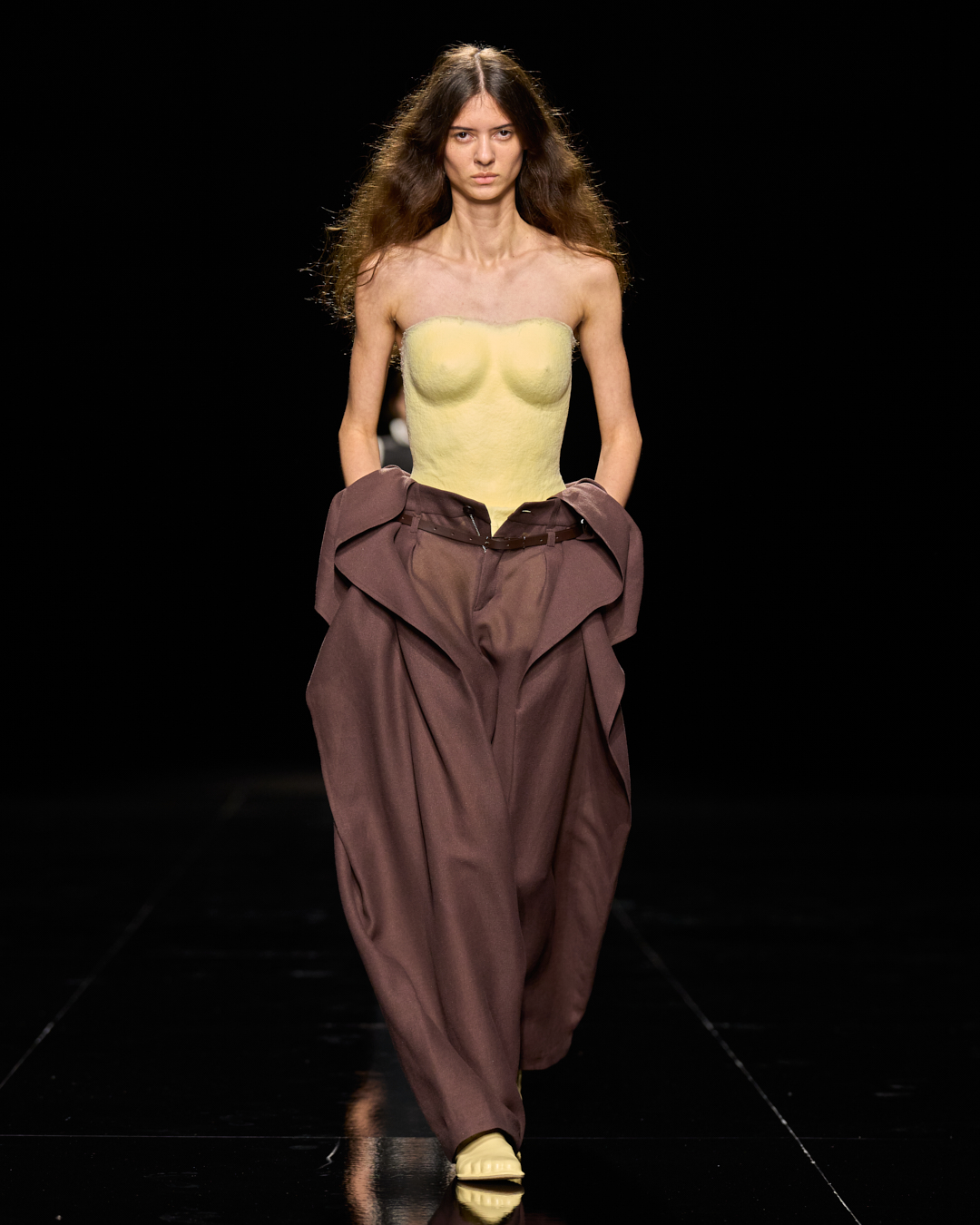
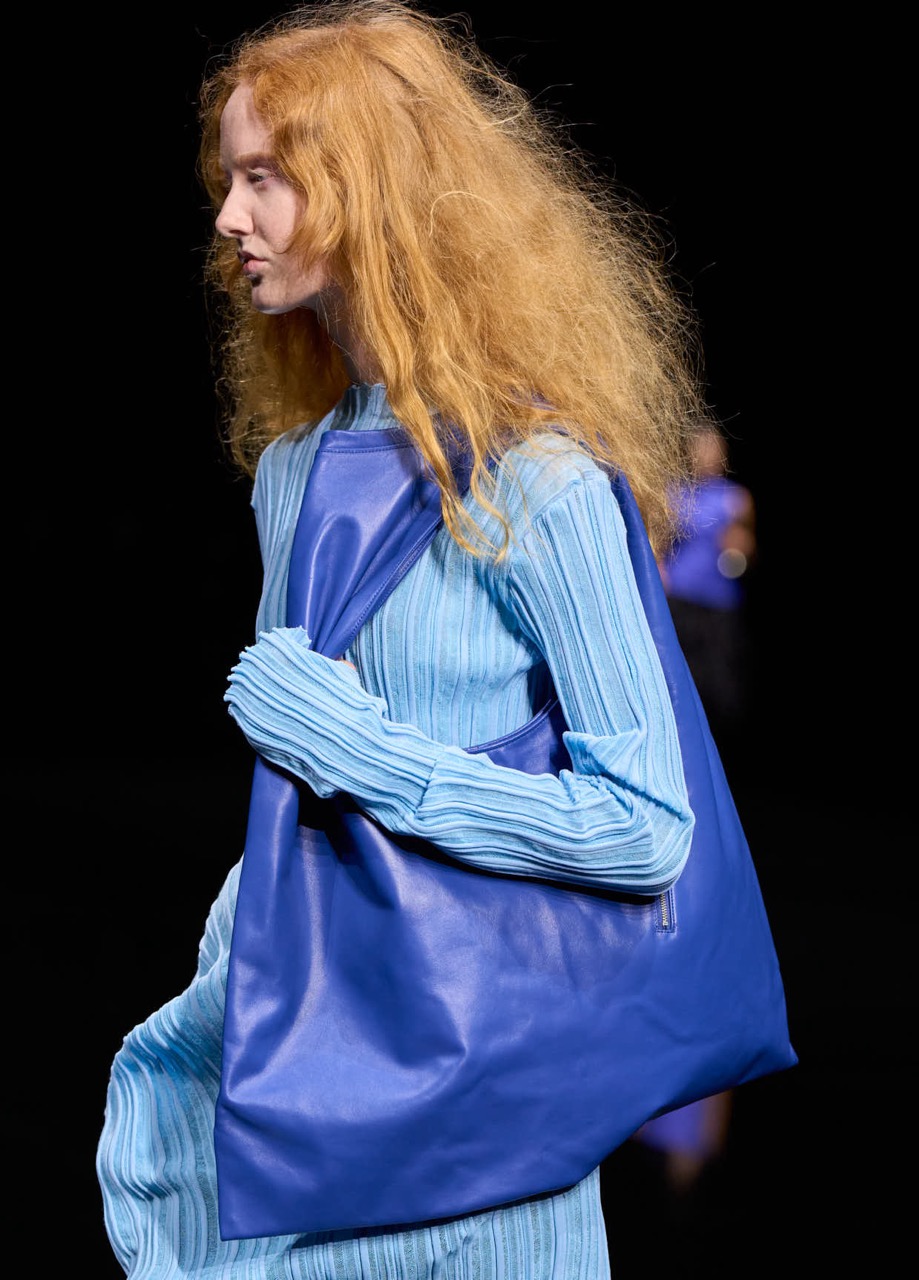
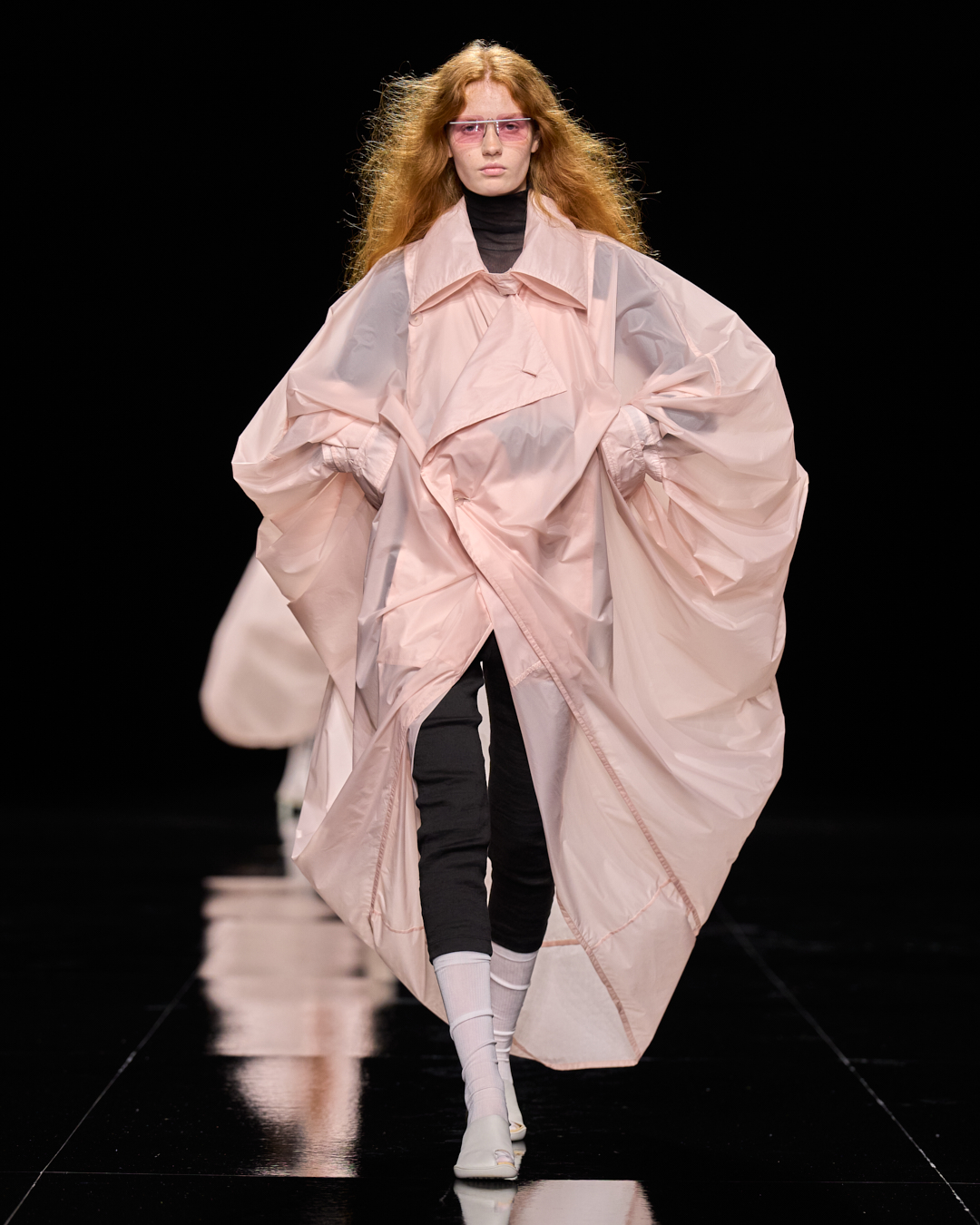
The clothes continued this thought, with Ballooning trains literally hovering behind the models, pleated pieces from the Caprice series and loose cuts that let the air move between fabric and body. The Bubble prints, ink marbling on translucent organza, looked like soap bubbles frozen on fabric and were hand-painted by artisans in Kyoto by dripping pigment onto water. There was more, such as the seamless knit Fluiglyph and the Cocoon bodies, wearable forms moulded from melted resin like a silkworm spinning its cocoon, but that would exceed the space here.
So, let’s mention, at last, the colours: deep purple, light blue, crème, black, vibrant turquoise and raw yellow. The show closed with a look moving through the air like a white, natural ghost, just like the fabric at the beginning. One could say it reduced all the colours to their most basic form, but let’s rather say that the white united them in their lightest, brightest form (which is, scientifically, exactly what white is: all colours combined). The last look embodied the entire idea of the show: fabric and body, both in their most primitive, fundamental and free form, natural and still untouched by society. A fitting end to a journey backwards, because after the Big Bang there is nowhere left to go.