We all know the precursor of photography: the camera obscura, a dark box with a tiny hole that projects an image onto a wall. If that sounds unfamiliar, think of the homemade boxes everyone used for the solar eclipse this summer. People have been fascinated by it since the 11th century, but photography as we know it is far younger: exactly 200 years old.
First, a bit of context: in 1826, Joseph Nicéphore Niépce captured the view from his house in Le Gras using a camera obscura and an asphalt coated pewter plate. After eight hours, he washed away the less exposed areas with lavender oil and petroleum. What remained was a light resistant image, now recognised as the first photograph.
Photography soon became a means of portraiture and documentation before gaining recognition as an artistic medium around the turn of the 20th century. Basically, by the time of Dorothea Lange, Andy Warhol and Cindy Sherman, photography knew no limits anymore.
To celebrate the anniversary, the fifth edition of Art Basel Paris, directed by Karim Crippa, presents an extensive photographic programme: the MEP is showing an Irving Penn retrospective, while the Bourse de Commerce presents 700 works by more than 80 artists in Remember Me. Among the 211 exhibitors at the Grand Palais, further pieces of photographic history await.
So now that the programme has already kicked off, we have picked five highlights from this almost overwhelming offer. They question reality, explore the meaning of images and document society across photography’s 200-year history. From Bernd and Hilla Becher to Eileen Quinlan, these are the works to look out for.
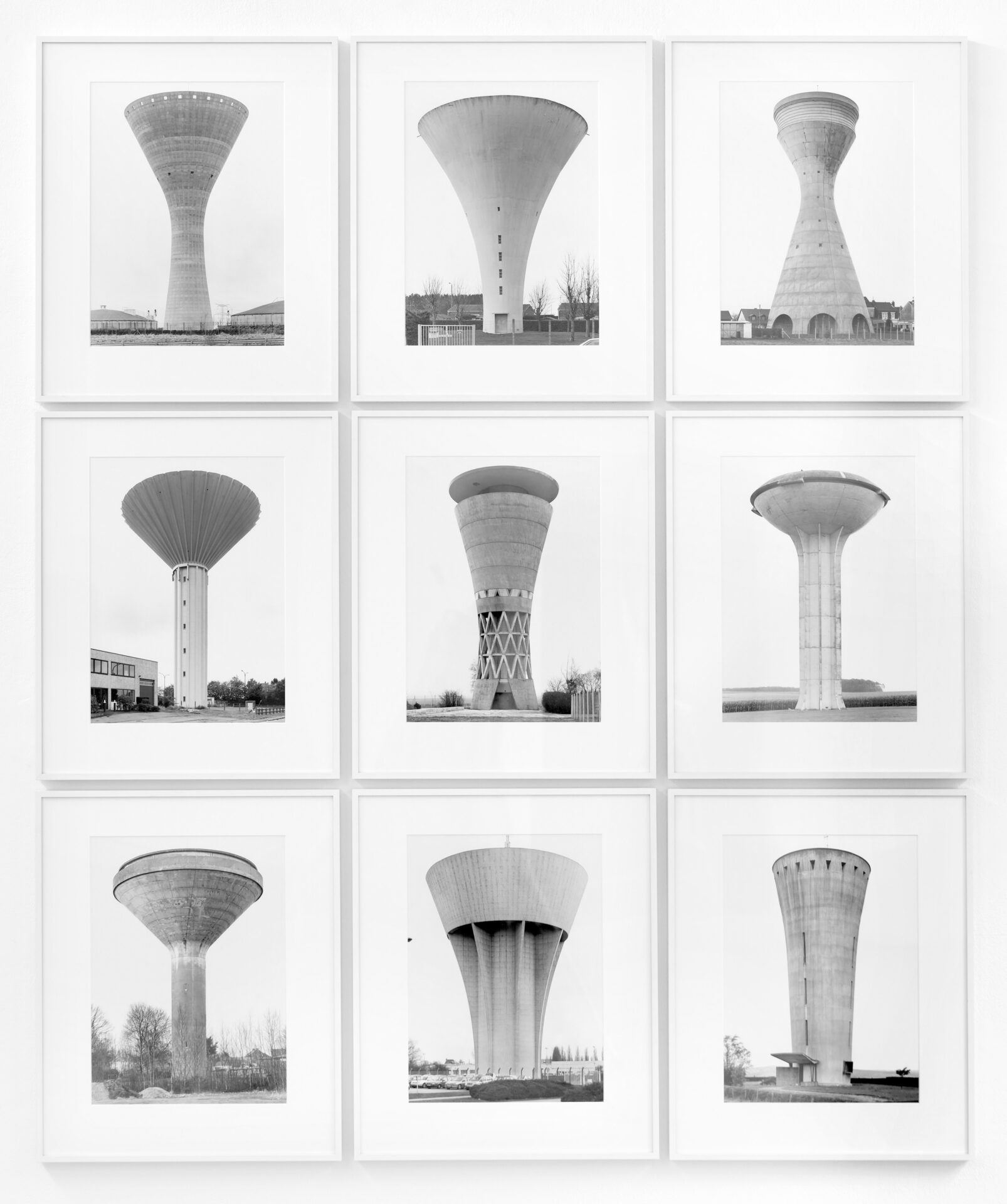
'Typology Watertowers' (1975-2010) Courtesy of Konrad Fischer Galerie
Bernd & Hilla Becher (Booth C47)
The works of Bernd and Hilla Becher are always very similar, and always strict: black and white gelatin silver prints, shot frontally with a large format camera, showing one type of industrial structure at a time, such as a coal bunker, a gas tank or a barn. At Konrad Fischer Galerie, visitors can now see their typology of water towers, photographed between 1975 and 2010.
What you can’t tell from the series is that the duo began working together in 1959, or that they were married in real life. But what you can see is that their rigorous compositions and patient repetition draw attention to details that might otherwise go unnoticed. Although each building serves a practical purpose, its design can appear surprisingly artistic, even poetic. These structures tell stories of the people who built and used them, revealing a distinctly human appreciation of form.
Obviously, when we talk about photography, we have to talk about documentation. But what makes documentation interesting if not the power it can hold? By recording industrial buildings across Europe and North America, the Bechers highlighted the need to preserve structures that bear witness to working class life and industrial history. And it worked: their efforts contributed to the Zollern II/IV Colliery in Dortmund-Bovinghausen being designated a protected landmark.
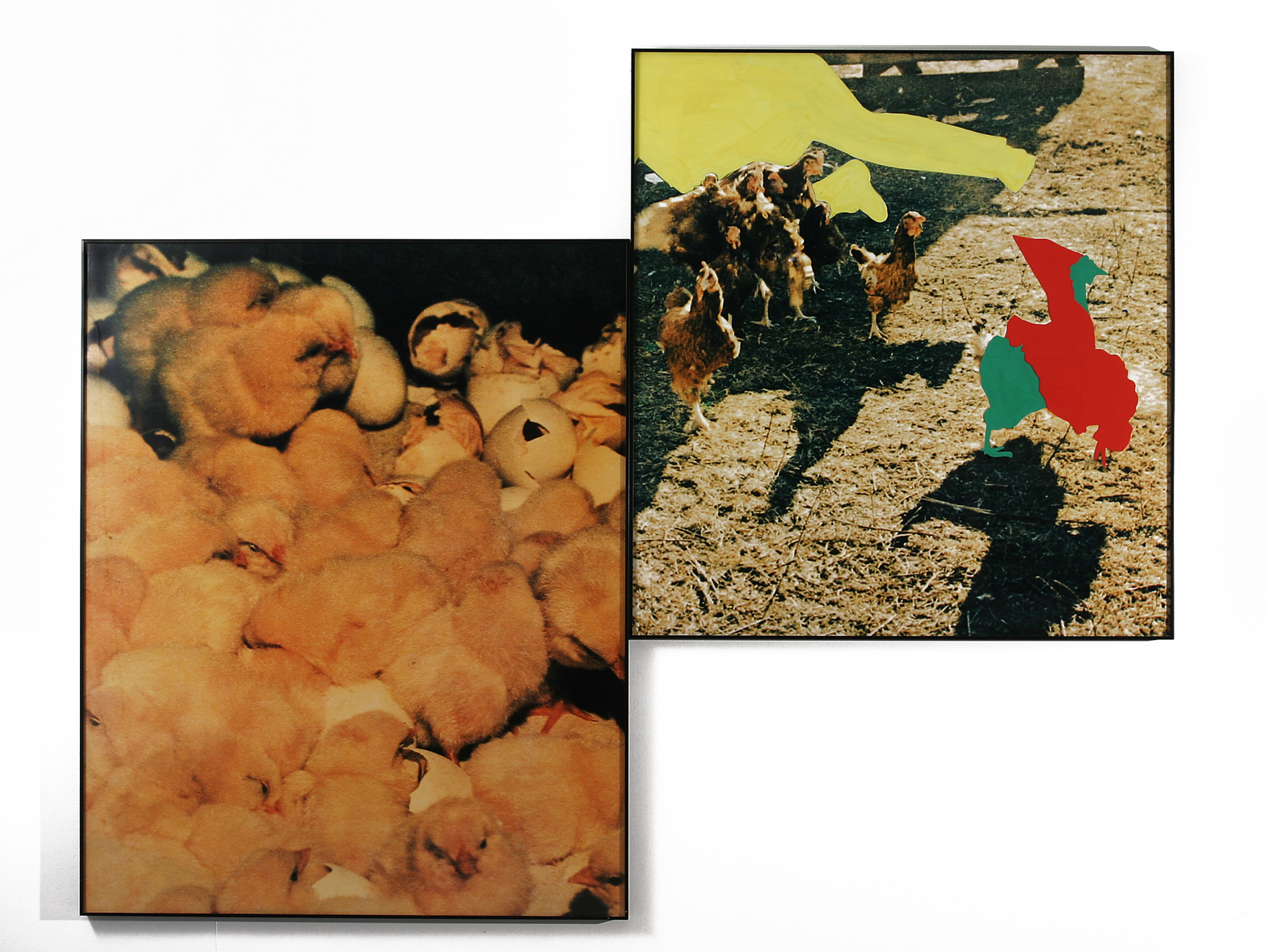
'Two Chickens (Red/Green) With Fleeing Figure', 'Observed by Newly Born Chicken(s)' (1990), Courtesy of 1990–2026 John Baldessari Family Foundation Courtesy Estate of John Baldessari; Sprüth Magers
John Baldessari (Booth A22)
In Two Chickens (Red/Green) With Fleeing Figure Observed by Newly Born Chicken(s) (1990), John Baldessari demonstrates photography’s playful potential. A pioneer of American conceptual art, he challenged artistic and philosophical paradigms with visual humour. From the 1980s onwards, he combined cropped photographs with acrylic or vinyl paint, creating hybrids of photography and painting.
The work we can see at Art Basel Paris consists of two parts: on the left, newly hatched golden chicks face a group of adult chickens on the right, accompanied by two colourful silhouettes seemingly escaping the frame.
By covering these two escaping figures with paint, Baldessari conceals the scene’s central characters. What remains unseen must be imagined, giving the work its humour and ambiguity. Freedom, family, farming, mass production or generational change: all are possible interpretations, yet none is confirmed. Paint transforms a simple photograph into an open question, leaving the answer to the viewer.
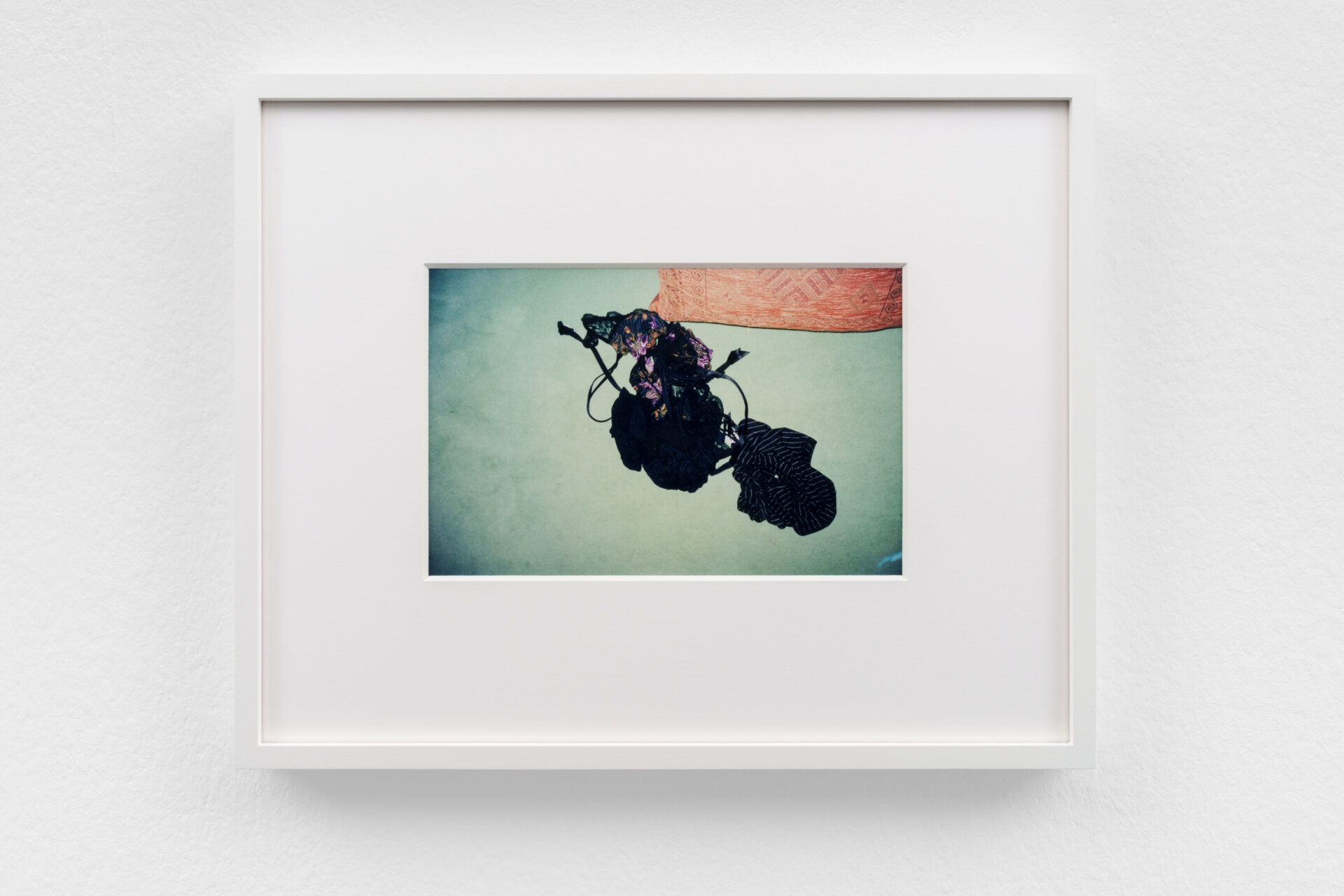
'Bedroom, Christmas Morning, Continued' (2003), Courtesy of the artist and Galerie Isabella Bortolozzi
Annie Ernaux (Booth C7)
You might know Annie Ernaux as the 2022 Nobel Prize in Literature laureate and author of The Years (2008). But you might also know her for The Use of Photography (2005), a visual and textual diary she created with Marc Marie, exploring memory, love, illness and death.
This diary consists of fourteen photographs of clothes and shoes left on the floor after intimate encounters, accompanied by writing. Together, they document Ernaux and Marie’s relationship during her treatment for breast cancer.
At this year’s fair, Galerie Isabella Bortolozzi presents Bedroom, Christmas Morning, Continued (2003), a saturated photograph of black lace underwear against a bright bluish green background. Within the larger series, the image feels intimate yet strangely cold.
Ernaux is usually very direct, but in her work with Marie, things stay somewhat cryptic. They explore love, desire and taboo as sources of both constraint and temporary freedom, without revealing much about Ernaux’s own perspective.
Interestingly, the diary opens by describing, rather than showing, their first photograph together. It could be interpreted as a male counterpart to Gustave Courbet’s The Origin of the World (1866). If you know what that painting shows, you know what the photograph shows.
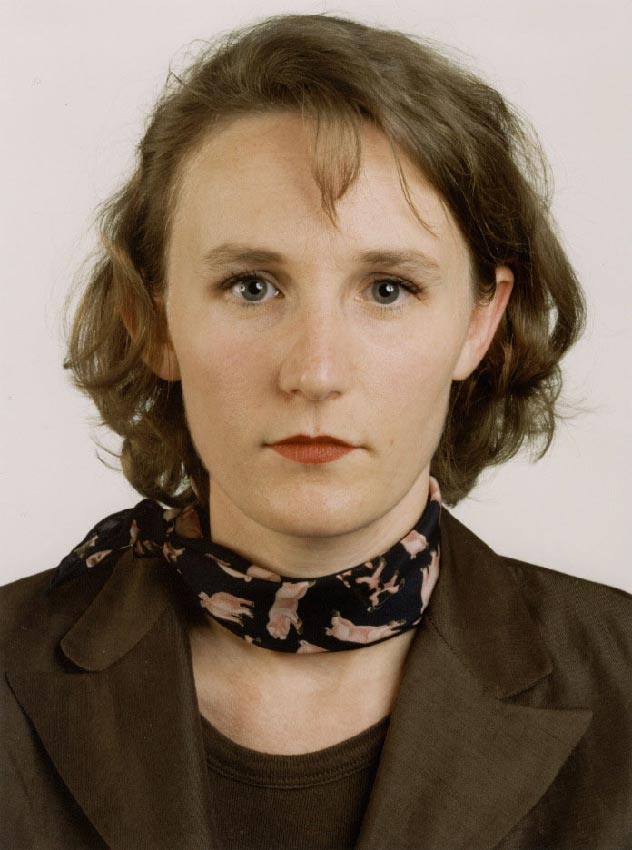
'Porträt V.Liebermann' (1975-2010), Courtesy of Konrad Fischer Galerie
Thomas Ruff (Booth C47)
What is a portrait actually for? Thomas Ruff’s Porträt (V. Liebermann) (1998) complicates the answer. From a distance, it resembles a passport photo: a woman, frontal, close up, no expression at all. Up close, however, it gets unsettling. At 210 by 165 cm framed, the image is huge, and suddenly you see everything: skin, pores, makeup, every tiny irregularity.
The image blurs the distinction between an intimate portrait and an anonymous identification photograph. V. Liebermann was an acquaintance of Ruff. Still, he photographed her with complete neutrality, creating both familiarity and estrangement.
Ruff began his portrait series in 1981, while studying at the Kunstakademie Düsseldorf, initially photographing friends and fellow students. Alongside Andreas Gursky, he belonged to the generation following Bernd and Hilla Becher, expanding their serial, conceptual approach through new subjects, formats and techniques. In 1998, he returned to the series to see whether young people of a new generation behaved differently in front of the camera than his earlier sitters.
For Ruff, a portrait need not tell a sentimental story. Instead, it can simply record a surface. Back to the question from the beginning: this is the power of portraiture. Even when a picture refuses to tell us anything, we keep searching the face for a person, for a connection, a resemblance, a character. Sometimes we find it, sometimes we don’t.
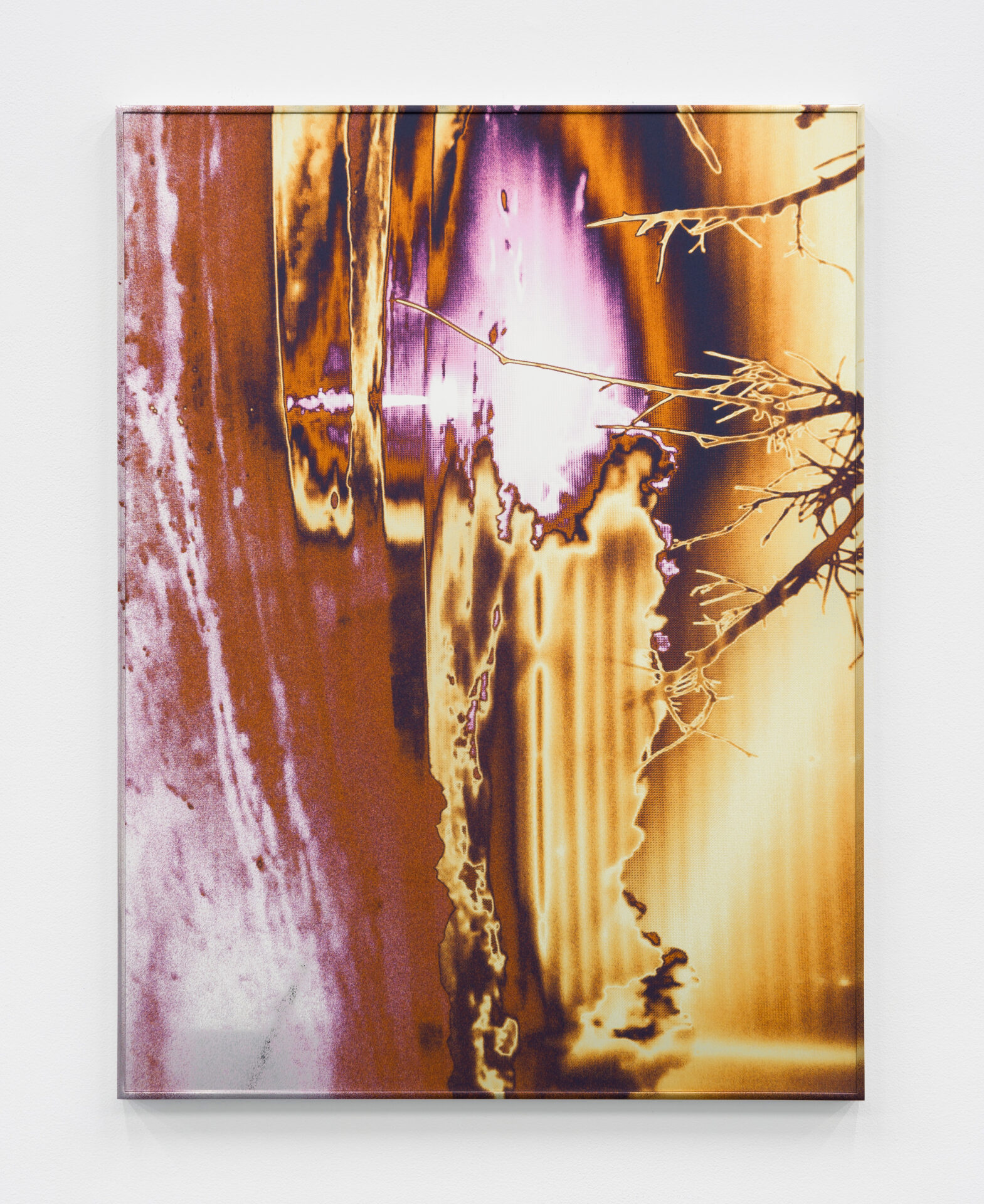
'Survivor Moon (Hell's Kitchen)' (2020/2026), Photography by Stephen Faught, Courtesy of Miguel Abreu Gallery
Eileen Quinlan (Booth B3)
Eileen Quinlan pushes the medium beyond the usual formats with Survivor Moon (Hell’s Kitchen) (2020/2026), a UV cured inkjet print on a mirror with an aluminium frame.
At first glance, the work appears abstract, with vivid colours and striking contrasts. The background story makes it even stranger: Quinlan photographed a moon appearing on television while watching Survivor. Therefore, what we see is not a real moon, but a photograph of a televised image, creating a surreal distance from something seemingly natural.
Like René Magritte’s The Treachery of Images (1929), the work questions representation. Its mirrored surface adds another dimension, allowing the image to compete with the viewer’s reflection.
For Quinlan, it hardly matters whether the original subject was a moon or a sunset. Both function as generic decorative elements in the media, signalling the passage of time. Her practice examines how images acquire meaning, change and become interchangeable. In the end, a simple or not so simple question comes to mind: what else in our daily lives is exchangeable, and do we really know what we see?
Art Basel Paris takes place this weekend from 23 to 25 October 2026.