DR. KATHARINA GARBERS-VON BOEHM is both an art collector and a lawyer specialising in art law, giving her a unique perspective on art. With her selection for ‘Collector’s Favourite’, she tells us about a work that brings these two worlds together.
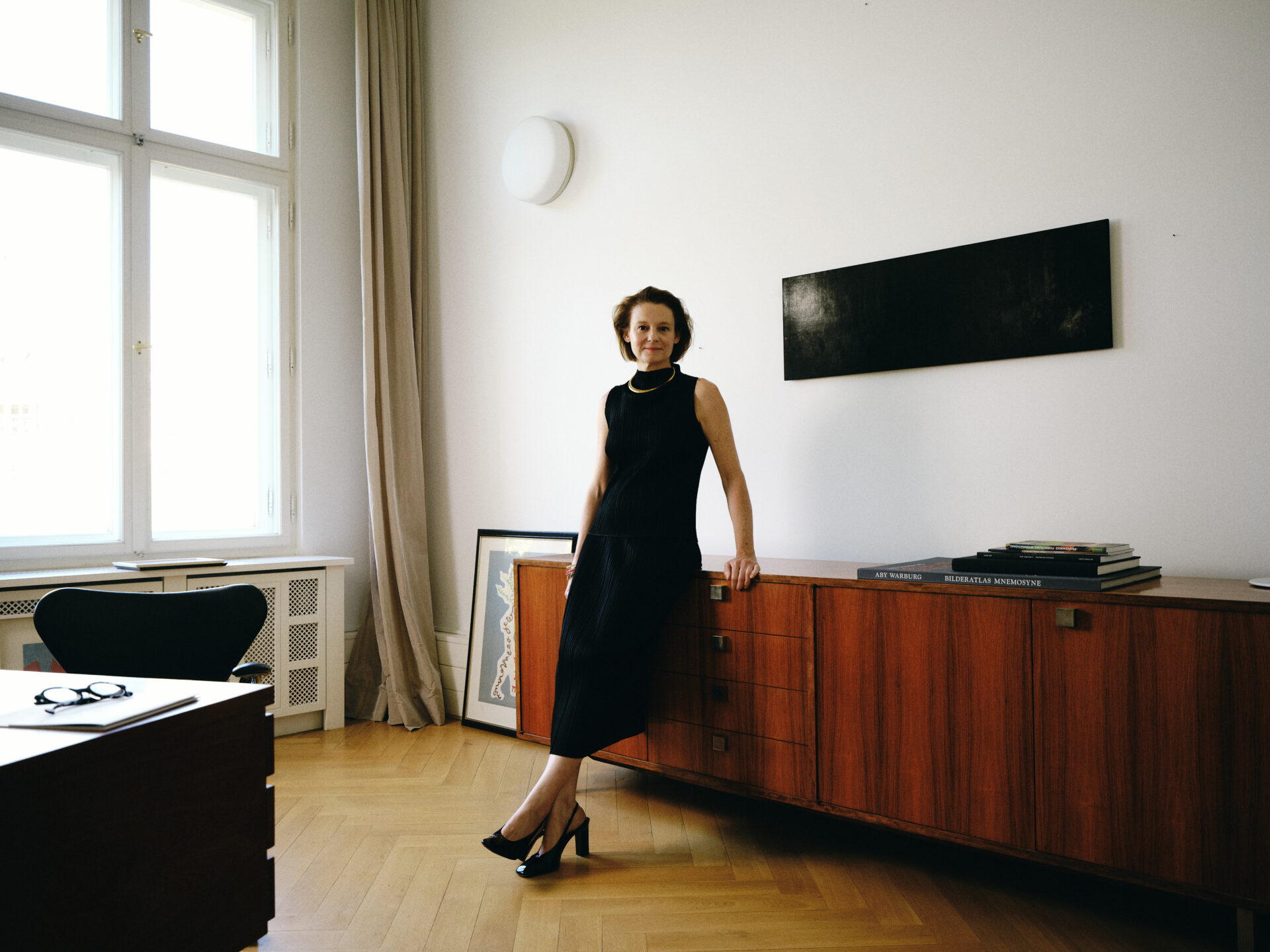
SLEEK What does living with art mean to you?
KATHARINA GARBERS-VON BOEHM I like being surrounded by art because I find that it really transforms the atmosphere of a room. Even as a student, I felt the need to decorate the spaces I lived in as a way of making them my own – back then with art postcards and prints. Over the years, partly through my professional involvement with art, I’ve had many opportunities to discover new things. And at some point, being able to make the decision what to live with. I’m a firm believer in the aura of the original. When I stand in front of a work and get close, that’s when it begins to have an effect on me and becomes tangible.
SLEEK Is there a particular logic behind your collection, or do you tend to follow your intuition?
KGVB Many of the works I own are indirectly related to the body. Not necessarily the human body, but physicality in a broader, even spatial sense. Since recognising this common thread, I’ve become even more conscious of it when choosing works. I would describe my approach as intuitive. I usually know directly whether I connect with a work. I think good art captures a feeling, a moment or a question, and in doing so creates a certain tension. After all, that is one of our great human desires: to somehow capture moments, even though it is ultimately impossible. In recent years, more works by female artists have entered my collection. At the last Art Basel, however, I bought two works by male artists. I’m not dogmatic about it.
SLEEK For our conversation, you’ve chosen a work by Dirk Braeckman with a fascinating story behind it: a dense, monochromatic play of light and shadow depicting another painting that is actually colourful.
KGVB I bought this work for my office after having had my eye on it for many years. It depicts a work by Antoine Watteau, Les Plaisirs du bal, which is held in the collection of the Dulwich Picture Gallery in London. As the original could not travel, photographer Dirk Braeckman was commissioned to create a work for the Bozar Museum in Brussels. In his works, Dirk Braeckman makes longing visible and absence tangible. If you look closely, you can see within the deep, matt black that the subject he photographed – the absent Watteau painting – is actually depicted twice, under different lighting conditions. By transforming it into a work with a materiality of its own, Braeckman creates a new aura around the original, capturing far more than the subject alone. For me, the work speaks to the provenance of artworks and the constant movement of artworks, which is often accompanied by legal complexities. Permission may be required to transport a work, for example, and as soon as it crosses a border, it can suddenly become subject to a different legal system. These are issues I also deal with professionally. I find it equally fascinating that Watteau’s original is a historical work, specifically, a work of French Baroque art – that is now in the public domain and therefore no longer protected by copyright. Through Braeckman’s photograph, however, it acquires a new layer of protection: a new work is created that contains the old.
DR. KATHARINA GARBERS-VON BOEHM is a solicitor, art collector and volunteer for organisations including KW Institute for Contemporary Art in Berlin. In her legal practice, she specialises in advising stakeholders across the international art world’s value chain, as well as on matters of copyright law.