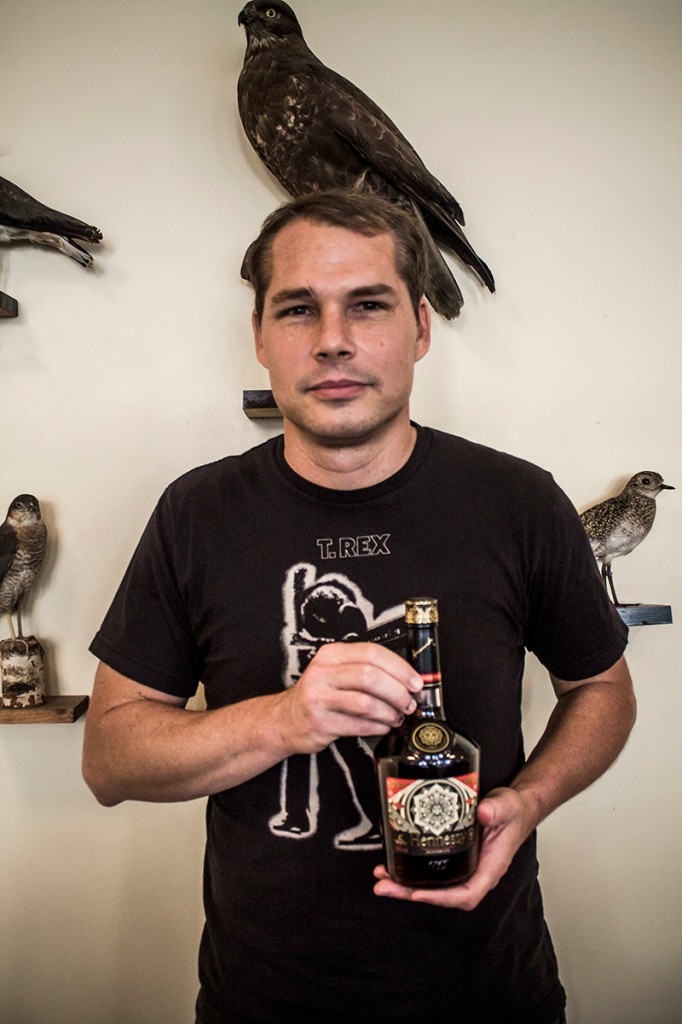
 Shepard Fairey. Photo © Julien Barret
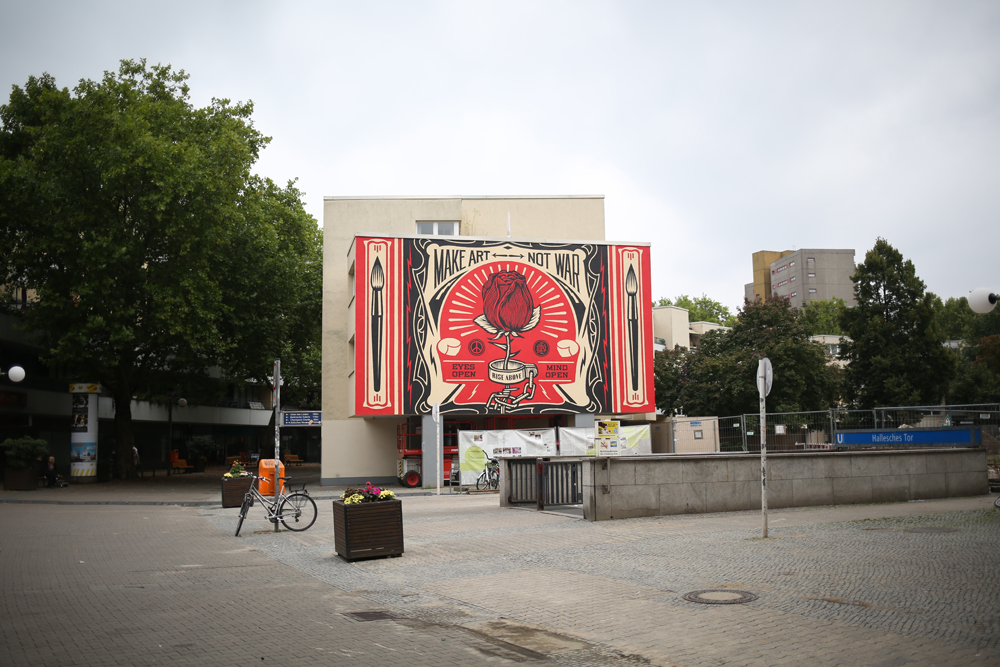
Street artist Shepard Fairey stopped over in Berlin earlier this week while on a world tour with Hennessy. The cognac producer has recently commissioned the street artist to design a limited edition bottle for Hennessy’s Very Special. While in Berlin, Fairey unveiled a brand new mural in collaboration with Urban Nation, and joined journalists from across the city for a press lunch. Here, Fairey explained that his work with Hennessy was a natural collaboration, as he believed the company strives to always produce a high quality product, with a passion for craftsmanship.
Today much of your work has a clear message, whether that is for peace or the promotion of the creative arts, it wasn’t always so. You describe your first “Andre the Giant” sticker that helped made your name as a “happy accident”. Tell me a bit more about that.
When I made the Andre sticker, there wasn’t any sort of grand plan behind it at all. But then seeing the reaction of the people and then looking deeper into how unique experiences affect people and that was where my research into phenomenology came in. I also looked at this happy accident as a starting point that I could work from. It’s not that I was trying to retro fit it to be some sort of brilliant concept. I think I had enough sensitivity to the dialogue that was created by it to see an opportunity to evolve what I was doing in a way that was a little more serious.
You created the poster of Obama with the words “HOPE” standing strong underneath his proud upward gaze, which went on to become the visual representation of that campaign. How did it feel to get so close to a political movement.
My endorsement of Obama was mostly based on the information I had at the time. But I worked with the image again by using it to make a couple of spoofs, one of which was in support of the Occupy movement and another for this fake candidate for the Kentucky senate race, Gil Fulbright. I did this to illustrate how politicians do anything to cultivate an image that will make them appealing, but really in the end they are going to pander to their biggest corporate donors.
You have been criticized for accepting commissions from big corporations and working with big name musicians. But money is essential to a successful career, and music is something that influences much of your work. How do you deal with those criticisms and what is it like when you are creating an image through another’s vision and not your own?
Yeah, well when I did the album cover for the Black Eyed Peas I did need the money, and will.i.am is a nice guy who gives a lot to charity. So while I might not be so much into the music, I did feel good supporting him. Yet when I was commissioned to design the package of Led Zeppelin’s concert album “Celebration Day”, that was a dream come true! I would have done that project for free. But the fact that I can also get paid to do work for an artist that I love, is a win-win, because it allows me to apply the money that I get to other things that I believe in plus I am proud to be associated with Led Zeppelin.
You know, I think that people have a problem when something is big or mainstream, but in reality that is a really unsophisticated approach to an idea because I feel that it should be more about quality. If you look at the Beatles, I don’t think that they ever pandered to the lowest common denominator in pursuit of their art. I think that they just naturally had a sense of melody that was pretty universal and an element of quirkiness, which ended up being an earth shattering combination. So anybody that says they don’t like a band like the Beatles because they were too big is just a ridiculous hater, and I have no interest in having a conversation with that person. It all boils down to the question: What is the quality of the art?
As an artist that primarily uses public space to display work, what differences to you see in street art culture in a city like Berlin, in comparison to a US city?
I love the use of public space and I really enjoy the vibe in Berlin and it is quite different. Once I did a bunch of art in Flagstaff, Arizona and the local sheriff wanted me to come back and apologize to the town, so I ended up giving a lecture at the school there. But everything I did was on abandoned spaces like gas stations, so nothing that was destructive. I think that in the United States that there are a lot of superficial reactionary attitudes. It’s as if someone saw a tag or some type of graffiti, there is a mindset that goes “if we don’t stop this movement, there will be total anarchy and the world will end”. So what I try to convey to people is that freedom is intertwined with chaos and chaos is the only thing that is a sure thing in life. People love to manicure everything in life but it’s impossible. The moment that you get comfortable that you aren’t going to be able to control everything, you are going to be a lot happier and you can embrace the chaos.
Shepard Fairey and Urban Nation’s collaborative piece is now on view at Mehringplatz.
Interview by Amanda Gray