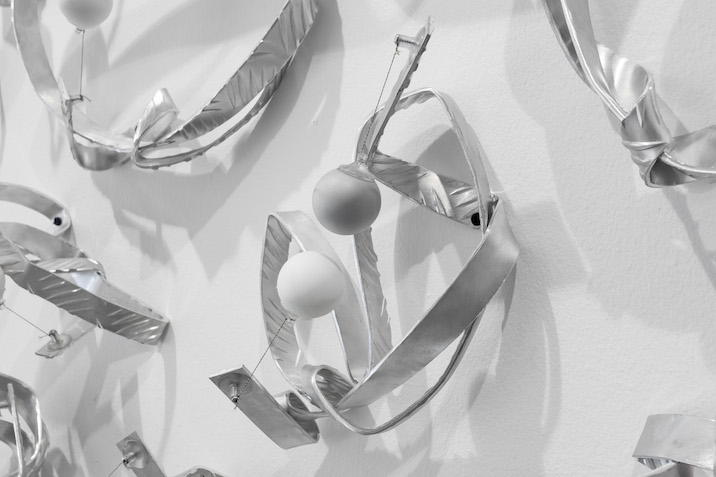
 Luca Pozzi, Wall String #8, 2013. Installation view, LEAP. Copyright IG Photography, 2014
“It’s not that you have something that you want to say and then you find a person and you say it. You think as you speak to this other person. That person is not just the receptacle of what you might want to say: they make it possible for that thought to exist.” This is what Amalia Pica said (fittingly, in a conversation) to Courtney Fiske, in Art in America.
It’s been quoted in a conversation of its own between curators Elisa R. Linn, Lennart Wolff and Hicham Khalidi of km temporaer, available only in printed version at LEAP, Berlin, where this very conversation has mutated into an exhibition of its own, “One Step Ahead Moving Backwards”, the curators basing their programme on the 14-page exchange. Linn and Wolff, who work as a duo, said “We didn’t know Hicham before, only his practice [he curated the Marrakech Biennial]. We started in the beginning of the year, and it was a continuous process.”
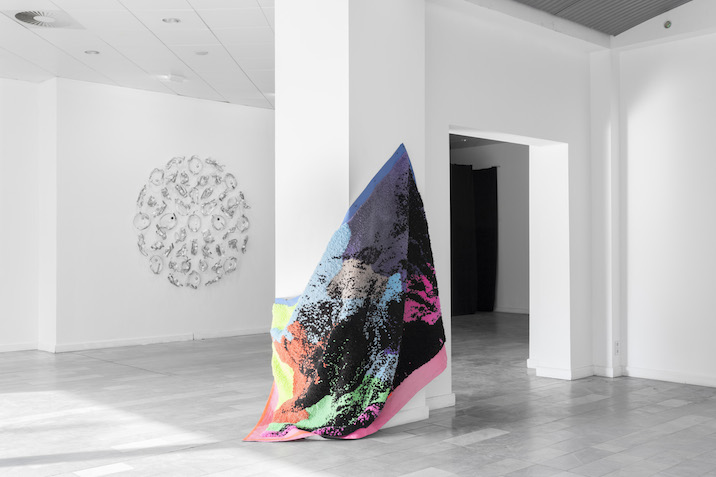 Luca Pozzi, Wall String #8, 2013, Tina Kohlmann, Mattak, 2014. Copyright IG Photography, 2014
It’s a wide-ranging conversation that covers everything from the validity of installation views such as those which accompany this article, to Kurzweil’s notion of the singularity. To paraphrase, though, the conversation deals with layers of time: how the accelerationist world we live in creates both instantaneous and more process-fuelled interactions alike. We are all living outside of time somewhat, referring to an “immortal” time that the Internet both attempts and denies by its very changeability: think of Wikipedia – the ever-changing compendium of concrete fact. “It’s about seeing exhibitions as situations you construct,” Linn says. “How social life accelerates and how this influences art production. This was the connection to LEAP and their progressive focus also.” The project space is now filled with a set of space-defining works – such as a fluorescent rug hung on a column in Tina Kohlmann’s “Mattak”, 2014 or Tiril Hasselknippe’s “29 Palms”, whose free-floating plastic/sand sections are dotted around the entrance. Mariechen Danz’s curtain work, covered with medieval illustrations of the body who seem to be flipping off the viewer, stands in front of a graffiti-esque spray-on by Debo Eilers/Kerstin Brätsch.
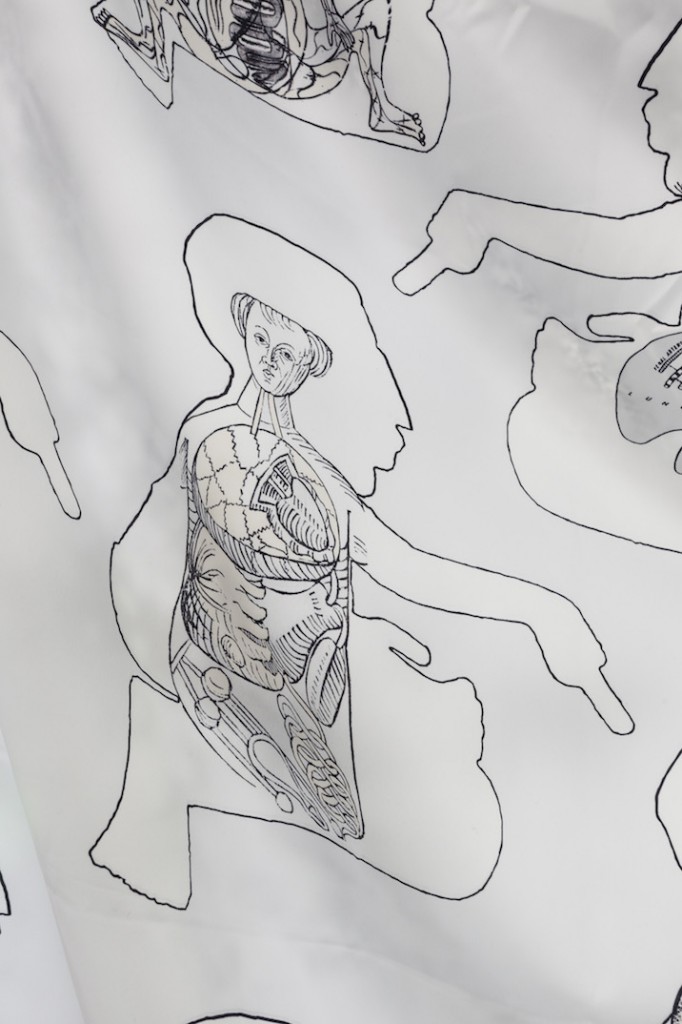 Mariechen Danz, Tower Vessel Tooth, Book B / Book C, 2013. Copyright IG Photography, 2014
The printed conversation attempts to draw a line through the works, while the concept of artistic gesture is what draws them together within the space: “The gesture was our first thought in thinking about time: because it is visible as a trace in art pieces, it’s the only thing you can see as a narrative. When Hicham answered though, there was a lot of misunderstanding and clarifying terms, because he came from such a different art scene. This expresses how communication can fail…”
Ultimately, this is an exhibition about the process of curating, which is, in itself, a translation, a communication. Most of all though, it’s a continuous mechanism: “We had in mind a narrative for the show, and also needed to step back and talk about the show, so it became a very different process. This translates into the exhibition title: One Step Ahead, Moving Backwards. There’s always a missed moment of understanding. The dialogue is ongoing – it’s never really closed…”
Text by Josie Thaddeus-Johns
Read a profile of Linn and Wolff in our feature on young curators from Sleek #43 Youth & Truth