 Nástio Mosquito, Comédia da Tragédia, 2012, film still, from the album Deixa Me Entrar, 2012, copyright the artist
NOW YOU SEE ME…
May 2015, Venice: It’s the preview of the 56th Biennale and proceedings are in full swing. Critics, journalists, photographers and collectors are beginning to arrive, and people are gossiping about the hottest acts in town. One name keeps cropping up: Nástio Mosquito, an Angolan artist, musician and performer whose unique approach to the politics of representation is as refreshing as his frankness. This may be so, but it hasn’t stopped the performer from giving Sleek the slip about an interview. For the few past weeks, attempts to contact him have received no response. It seems as if the hype has sent the 34-year old to ground. Yet amid all this there he is: emerging from a crowd of art goers, wearing sunglasses and dressed head to toe in black, posing like a member of the Velvet Underground.
This Lou Reed-esque swagger is entirely intuitive: he began his career as a musician and writer. His early efforts, however, were not well received. “I’m very happy I’ve found a place where what I do makes sense,” he says. “Before this I was creating content for TV and radio that no one wanted. Now it’s like, ‘This shit makes sense here.’ So I’m contributing my perspective.”
Taken from Sleek 48, buy copy here
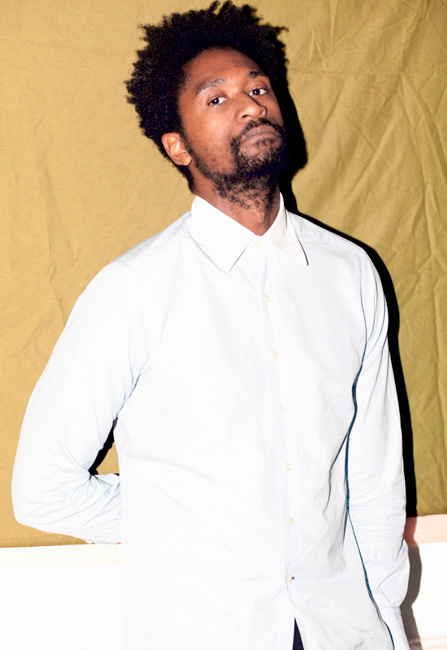 Portrait of Nástio Mosquito
Perspective is an important part of Mosquito’s practice, which ranges from video and audiovisual installations to live performance. His videos focus on global political issues, but with the tongue-in-cheek delivery of a stand up comedian, zooming in and out of his subject without getting tangled in it.
In doing so, he proves that humour can bring transcendence to art even when addressing ‘serious’ issues such as identity, politics, post-colonialism and contemporary culture. He’s also not afraid to shock. As the Guardian’s Mark Brown reported in February, his first solo show “Daily Loving Making” at Birmingham’s Ikon gallery featured a work entitled “Fuck Africa” opposite another which compared and contrasted the ‘audacity’ of Hitler and Mandela. Despite this he has continued to generate buzz, which last year culminated when he, along with Colombia’s Carlos Motta, was named joint winner of the International Future Generation Art Prize for artists under 35. And it’s easy to see why: his performances are oddly disarming, and it’s hard to remain immune to the charisma he’s cultivated on stage.
One such beguiling instance from his oeuvre is his 2010 video “3 Continents”, in which he reads out a speech about Africa, Europe and America in the guise of an inebriated politician: “I bought Europe in all it’s various shades of white,” his character says. “I bought it. Do not worry, just like the previous owners I have no intention of making Europe’s people less ignorant, less lazy… and no, Bill Gates is not an associate in this exciting new venture.” Although the performance clearly has very serious intentions, it delivers them with a pinch of salt, pulling the rug out from under our feet just when his act threatens to become candid.
In others, such as “Cusps: A Performance”, staged at Minneapolis’s Walker Art Center in 2013, Mosquito incorporated 3 Continents with boisterous live speeches, song recitals and recorded material. It’s surreal, and demonstrative of the complexity of his work in which meaning is dispersed through the interplay of his physical performance, its presentation and its ambiguous verbal content. Multiple readings of his shows are therefore inevitable, and further the confusion that Mosquito thrives on. Discussing this, he admits that he’s not interested in protecting how his art is interpreted, or even where it’s displayed.
“I have no particular restrictions on where to show or how to show,” he says. “I can’t do everything, I can’t do Britney Spears or Miley Cyrus. I’m limited by my own sensibilities and abilities, and that’s enough. Once I’ve created something I want it to go everywhere it can. Why not?”
This no holds barred attitude extends throughout his work, too. In 2015’s “Demo da Garcia”, Mosquito plays a singer who’s having a nervous breakdown as he’s trying to record a music video, which ends with him struggling to pull up his trousers. A meditation on the frailty of identity, it’s a darkly comic piece which Mosquito uses to pose certain questions about Angolan pop music and culture in general. “What is this ‘Angola’? Why is it, that when it comes to music, it is all about doing kizomba?”, he asks, referring to a popular form of modern Angolan dance. And further: “How weird are you, if you don’t do it? This is about an individual kind of having a breakdown in connection to what is expected of him.”
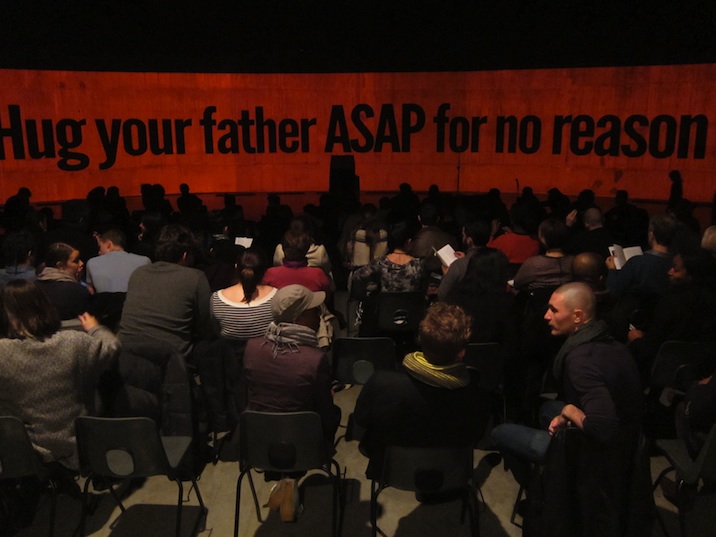 Flourishing Seeds, 2012, live performance at Tate Modern, London, copyright the artist, courtesy the artist
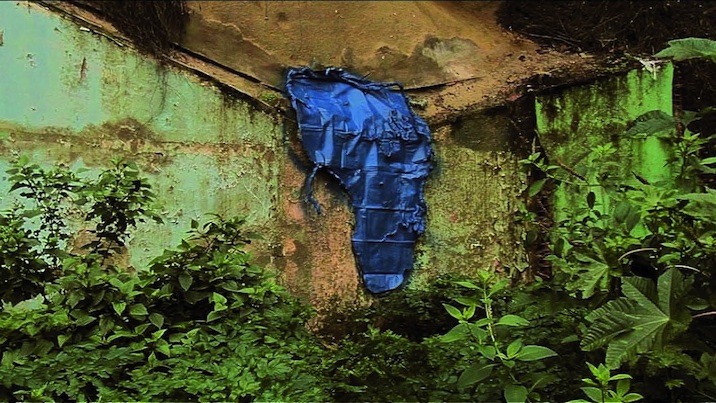 3 Continents, 2010, copyright the artist, courtesy the artist
… NOW YOU DON’T
Mosquito’s demeanour is no less impenetrable in person. On the one hand he’s contemplative and laid back, yet on the other he fends off any probes into his life and work. Attempts to dig deeper by engaging him in Portuguese also end in failure as he swiftly switches the conversation back to English; there’s no messing about with Mosquito. But it’s also difficult to tell why he’s so evasive. Is he trying to fuel speculation? Or is he just protecting the integrity of his work and his alter egos, such as “Nástia Mosquito”, a foul-mouthed Russian, and “Nastivicious”, a collaboration with Spanish artist Vic Pereiró?
Direct answers are thin on the ground, but these references to pop music offer some clues. Today, he’s still working as a musician, and in 2013 he released “Se Eu Fosse Angolano” (“If I Was Angolan”), which blended synth-laden sounds with bossa nova and songs with narratives. The year before he’d been developing this style with singles such as the semi-autobiographical “Bebi Beberei Bebendo” (“Drank Will Drink Drinking”) and “Comédia da Tragédia”(“Comedy of the Tragedy”), about a difficult relationship, the video to which Mosquito stars in as the submissive client to a dominatrix. As with many popstars, the line between Mosquito the performer and Mosquito the real person is unclear, and it seems as if he’s projecting this ambiguity into his art, especially through the way in which he refuses to distinguish between his music videos and his art. “My music is as commercial as it can be,” he concedes.
Moreover, his healthy disregard for the saleability of his records is reflected through his disdain for the boundaries between commercial and fine art. In fact, this is all part of his strategy. In other hands things could seriously backfire, but Mosquito has made it work. After group shows in London’s Tate Modern and Berlin’s Haus der Kulturen Welt in 2012 and 2013, this year he’s shown at both the Venice and Gothenburg biennales, and in November he performed “The Age I Don’t Remember” commissioned by the Emdash Foundation at the ICA.
“I’ve been learning how to deal with physical space,” he says discussing his recent London show. “I keep listening to people around me, telling me to try a few things out. When it comes to audiences, me not leaving them alone is a sign that they matter to me.” Despite this success, he swears he’d rather be elsewhere: “I feel very uncomfortable with the whole context of the biennale,” he says. “I have to come to grips with the fact that this is the tribe where me and my work make sense. The invitations confirm that in a way, but this is my work, not necessarily who I am.”
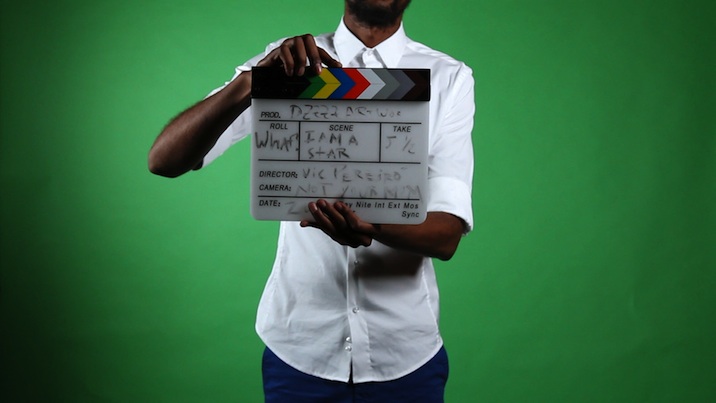 Demo da Garcia, 2013, copyright the artist, courtesy the artist
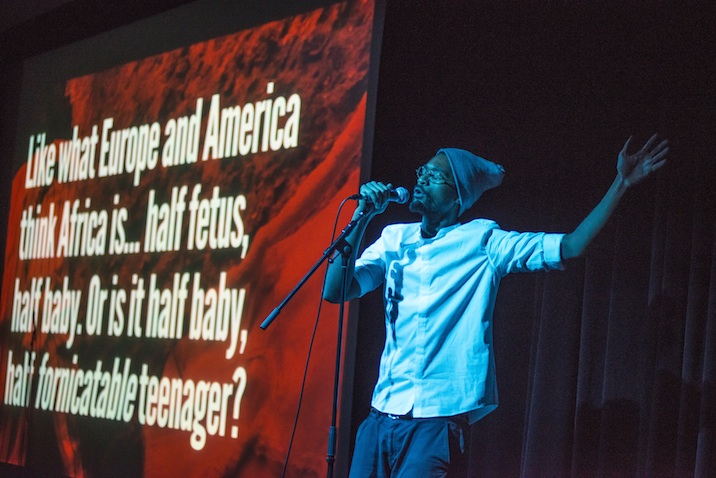 Buehnenabend in der Tischlerei der Deutschen Oper Berlin. 21.03.2013, photography by Marcus Lieberenz/bildbuehne.de
Mosquito’s home nation has recently experienced an upturn, too. Since 2010 its GDP has increased nearly 30% – no mean feat considering the global downturn – and the country has become a centre for foreign investment, which has driven up the cost of property in the capital. Nonetheless, he doesn’t agree that this economic surge has driven his popularity. “I think all kinds of things are behind African artists receiving more recognition,” he says. “The art world is driven by the financial markets; it also moves within a political sphere, too. But I can’t give any accurate answers. There’s a bunch of speculation about it but I think that, in general, it’s ultimately good for artists.”
Speaking via email several months later, Mosquito is even cagier than in Venice, and questions about the details of his forthcoming exhibitions in Spain and the Netherlands receive short shrift. “It’s about authority,” he says. “Whomever or whatever you recognise as an authority, rules you… We all give it to someone, or something. If you think you don’t, you’re more fucked than you think.” Speaking to him like this online it’s impossible to know which Nástio is speaking – the artist, the musician, the writer, the performer, Nástia or Nastivicious. But this is probably the point. After all, the beauty of his work is its ability to defy easy categorisations – the reason why it keeps audiences coming back for.
Text by Will Furtado
Portraits by Hendrik Schneider
“My Father Has No Surname”, a solo show with works by Nástio Mosquito and Nastivicious is at, Espai d’art contemporani de Castelló, Castellón, Spain, until February 2, 2016
The video installation: “Ser Humano, I Am Naked” is at Possitions #2, Van Abbemuseum, Eindhoven, The Netherlands, until April 3, 2016
More: Frances Stark Brings Hip Hop and Opera Together in L.A.
More: Print Features