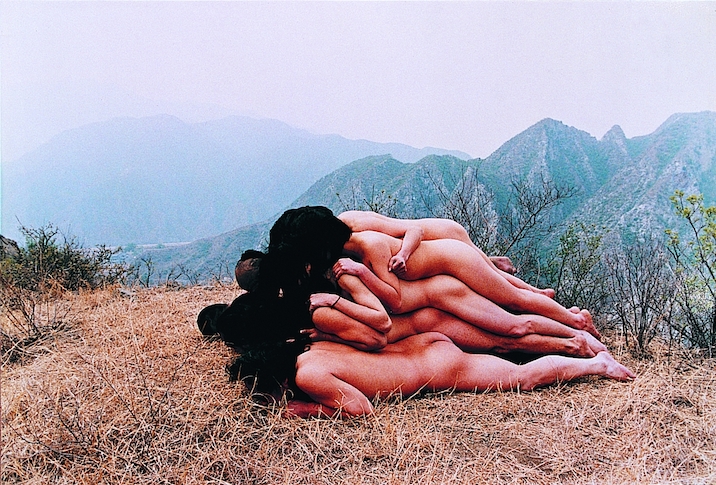
 To Add One Meter to an Anonymous Mountain by Zhang Huan, 1995, M+ Sigg Collection, Hong Kong, by donation, courtesy of the artist and West Kowloon Cultural District Authority
During this year’s edition of the Art Basel Hong Kong art fair, breathless parties followed press launches, champagne flowed in rivers and Prada-clad collectors clanked cheekbones in luxury-branded VIP rooms. But beyond the air-conditioned floors of the convention centre and the five star hotel lobbies, the city told a different story. From the industrial skyscrapers of suburban Aberdeen, the residential towers and offices of Quarry Bay and the malls of Sheung Wan, art spaces in all possible guises were showing innovative historical, political, and even poetic art.
ArtisTree Gallery
I began my Hong Kong art journey by getting lost somewhere near the ArtisTree gallery in the Quarry Bay residential area, which was hosting an exhibition of the renowned art collector Uli Sigg’s formidable collection of Chinese art. It was pouring down with rain, the mildewed high-rises were wreathed in low cloud. Google Maps led me in circles, past a vegetable market, cheap clothing stores and lunch restaurants where I could only guess at the food on offer. Just as I had given up hope, I found a staircase leading to the entrance of a gleaming office complex, each tower incongruously named after an English county – Cornwall and Devonshire featured. The museum was hidden near the back of the array, past Starbucks and Pret a Manger. ArtisTree was thronged with visitors: 40 Years of Chinese Art was a big draw.
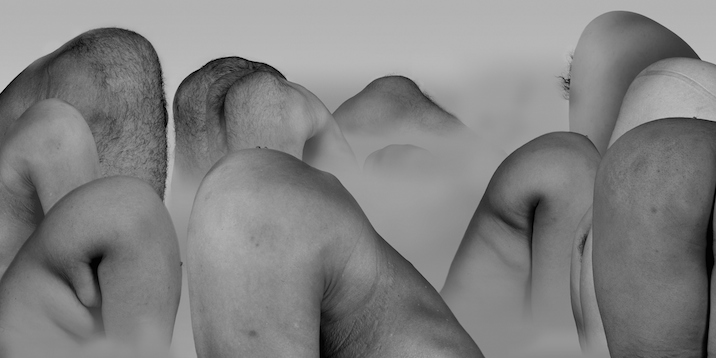 It Looks Like a Landscape by Liu Wei, 2004, M+ Sigg Collection, Hong Kong, by donation, courtesy of the artist and West Kowloon Cultural District Authority
In 2012, Sigg donated his 1400 piece collection to the M+ Museum, the yet uncompleted project in West Kowloon. As curator Lars Nittve noted in his introductory talk, Chinese art only rediscovered its voice after the end of the cultural revolution. Collectives such as the No Name Group, Xiamen Dada and Stars Group took Conceptual practices as a starting point during the late phase of the Cultural Revolution. Their early video works were of great interest, documenting small acts of subversion, and their practice stood in opposition to government-sanctioned socialist realism painting. A large-scale photograph of a couple embracing underneath a bridge during the Tiananmen Square uprising plays a double role as documentation of both the political upheaval and a reminder that Sigg specifically donated his collection to a Hong Kong institution due to censorship concerns. Zhang Peili’s video “Water (Standard Version from the Cihai Dictionary)” shows the State Television newsreader Xing Zhibin reading the definition of water from a standard dictionary in a monotone voice – a comment on the information value of official news.
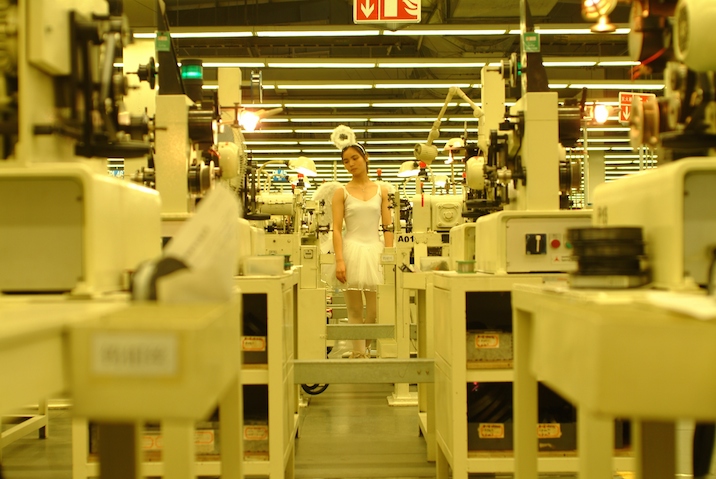 Whose Utopia by Cao Fei, 2006, M+ Sigg Collection, Hong Kong, by donation, courtesy of Cao Fei and Vitamin Creative Space
While the early work intrigues, the second chapter of the exhibition (1990-1999) is less interesting, as Cynical Realism gains traction, and large-format figurative paintings such as those by Zheng Fanzhi become the dominant medium, and critique moves from metaphor to representation. The final chapter (2000- present) documents the effect of rapid urbanisation and economic growth. Here Cao Fei’s film “Whose Utopia”, which shows factory workers dressed as idealised versions of themselves in their places of work contrast with tongue-in-cheek pieces such as Liu Wei’s photograph of knees manipulated to look like a traditional Chinese ink landscape.
A timeline detailed China’s turbulent recent past, from Chairman Mao’s demise to the country’s slow opening up to the West and the recent economic boom, and how each of these stages related to artistic practice in China made for an intriguing crash course.
ParaSite
Just down the four-lane highway from ArtisTree ParaSite, one of Hong Kong’s best known project spaces is located on the 22nd floor of a grey concrete high rise. Migrant, often low-skilled, labour plays a key role in Hong Kong’s development, from Filipino domestic workers to unskilled mainland Chinese labourers. These communities live in often precarious conditions, with little security or contact to their families at home. Entitled “Afterwork” and curated by Freya Chou, Cosmin Costinas, Inti Guerrero and Qinyi Lim, the exhibition includes 30 artists, from Harun Farocki and Santiago Sierra to Maria Taniguchi. The ambition is to tell the stories of migrant domestic workers, and to look at the larger issues of race and class in highly polarised Hong Kong society and beyond that, South Asia. Alfredo Jaar’s piece “Opening New Doors” (1991) projects the phrase in seven different languages onto an image of a barbed wire concentration camp enclosure.
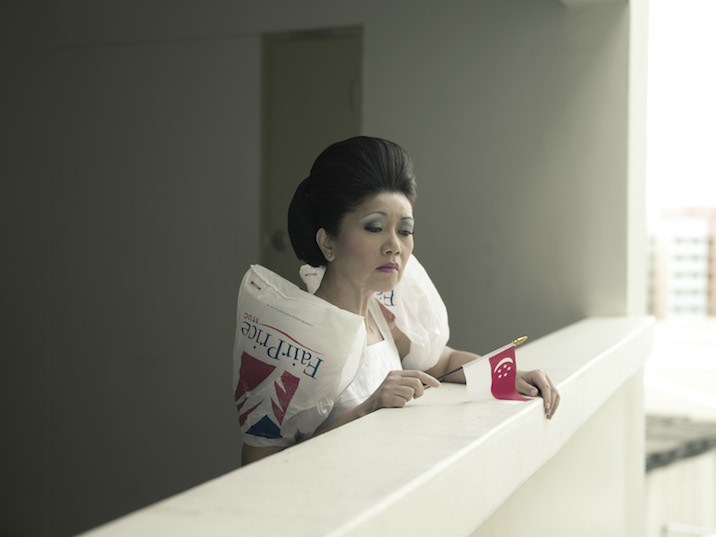 Imelda Goes to Singapore by Brian Gothong Tan, 2006, image courtesy of Para-Site Gallery
Brian Gothong Tan’s video work, “Imelda Goes to Singapore” (2006), recasts a domestic worker as Imelda Marcos, the Filipino dictator’s wife, whose disastrous economic policies resulted in a mass exodus of working age adults to earn remittance abroad. Dressed in trash – plastic bags – she sings “Feelings,” an idealistic love song, while performing domestic tasks. Daniela Oriz, in her digital iPad slide-show “97 House Maids” (2010) showed family snapshots sourced from Facebook. Cropped out, cut off, relegated to the background, the mainly darker-skinned domestic workers are relegated to the margins of the family and the image. Köken Ergun’s piece “Binibining Promised Land”, an installation of magazines targeted at Tel Aviv’s population of Filipino domestic workers and a video of a beauty pageant, in contrast, shows the leisure activities of the often invisible population. Each Saturday, workers assemble in Tel Aviv’s Brutalist Central Bus Station, to recreate beauty pageants, a popular source of entertainment in the Philippines.
Mill6 Foundation
Mill6, a non-profit foundation dedicated to re-examining Hong Kong’s culture and heritage, particularly its textile heritage, is currently located at a pop-up space situated in the Annex mall in Central Hong Kong. Artist in residence Mariana Hahn spent two months researching silk workers of Lantau island, unmarried women who’d retained their independence by labouring in the silk mills. Hahn takes the medium of silk as a starting point for her calcified dresses hung throughout the exhibition space, her videos and performances. The Berlin-based artist forges links between the city’s history as a site of commerce and industrial production and the current-day outcome. In another series of works, she addresses the plight of the Tanka boat dwellers, another traditional community based on the island. The Tanka are forbidden to fish beyond the reaches of Lantau, but pollution has denuded the water of fish, decimating the community. Hahn’s works touch up the carelessness of economic development and the orphaning of traditional lifestyles.
The exhibition, curated by David Elliott, also includes works by the leading Hong Kong conceptual artist Kwan Sheung Chi. In an arresting large-scale installation, the artist created a trap: motion-activated mirrored sliding doors permit a visitor to pass into a chamber, then another, where a globe of the map of Hong-Kong hangs, illuminated by a single spot-light. However, there is no going back: only when the next visitor activates both sets of doors is an escape possible. The entrance to the installation is carpeted with cheap metal Chinese flag pins. The artist aims to give a clear perspective on the effect of Chinese politics within the uncertain context of Hong Kong today.
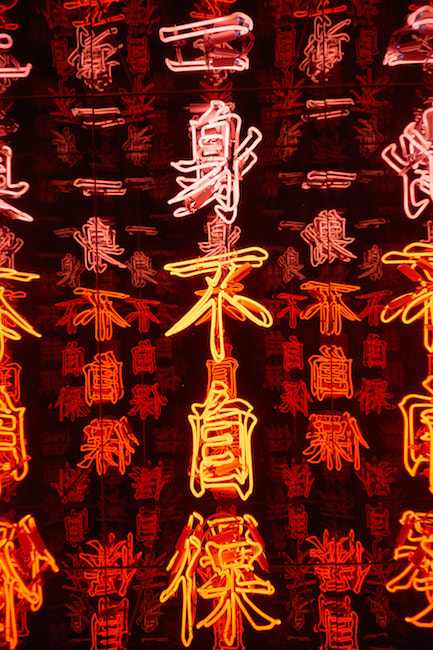 One life, not preserved, 2016, by Wu Tsang, courtesy of the artist and Spring Workshop, Hong Kong. Photo: MC
Spring Workshop
Sited in a high-rise in the industrial suburb (and new art hub) of Aberdeen, the only hint of Spring Workshop was a gaggle of international art people near the gaping maw of an unloading bay. Inside, Wu Tsang’s newly commissioned film Duilian, based on the story of the revolutionary feminist, poet and sword fighter Qiu Jin and her relationship to her female calligrapher Wu Zhiying. Active against the Qing dynasty rulers in the late 19th and early 20th century, she studied sword-fighting in Japan, where she participated in planning the uprising against the Chinese rulers. She wore Western male dress, and is regarded as heroine by the Chinese. She was executed aged 31 upon her return to China. Boychild plays a contemporary Qiu Jin, and Wu Tsang casts herself as the calligrapher. While at times guilty of the very problems it sets out to critique – oversimplification of received histories – Duilian nevertheless marks Tsang’s rephrasing of queer histories, of re- and mis- translating received narratives, forming a plurality of readings of Qiu’s history.
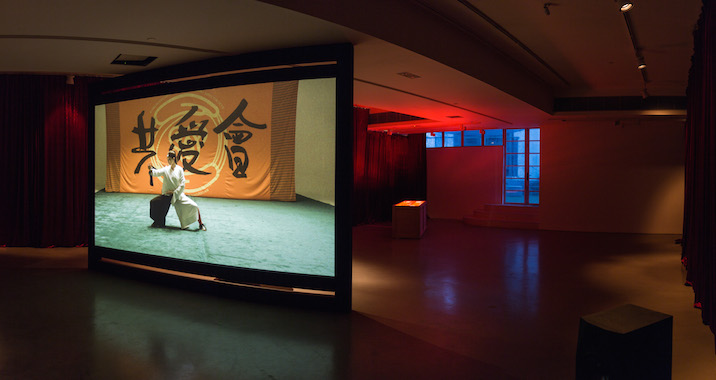 Duilian, 2016, by Wu Tsang, installation view, courtesy of the artist and Spring Workshop, Hong Kong. Photo: MC