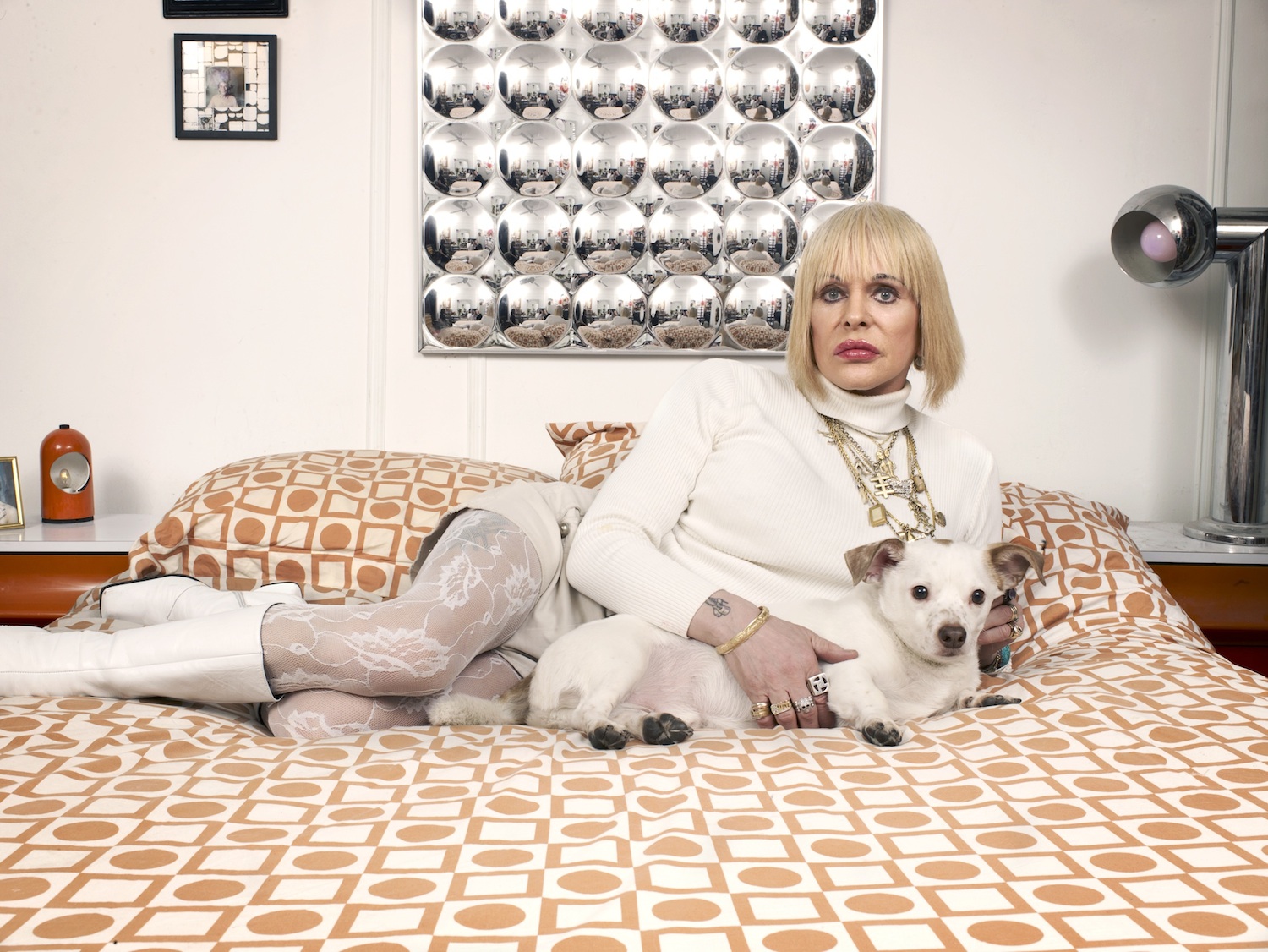
 Photo by Perou
Very few living artists can boast a near mythical status. Genesis Breyer P-Orridge — who prefers the pronouns “s/he” and “h/er”– is the Godparent of Industrial music and co-pioneer of the term pandrogeny. Once declared a “wrecker of civilisation” by the House of Commons, s/he has now formalised h/er physical shapeshifting in the new show “Try to Altar Everything” at the Rubin Museum in New York. The show is framed by themes of devotion, exchange, and community – concepts that have long permeated P-Orridge’s enduring practice – and incorporates talismanic offerings left by exhibition visitors.
The same used tampons now rest alongside works by Turner and Rothko in the Tate National Collection of Fine Art
P-Orridge emerged from a samizdat culture: a politicised British youth who spread alternative media such as zines and other socially conscious art forms. The subversive act was intended to call oppressive systems to account and dismantle binary notions of personal identity. From the rich political wasteland of 1976, s/he formed the Industrial band Throbbing Gristle, whose idiosyncratic, experimental sound was uncompromising and loud. ’76 was the same year that P-Orridge infamously made national headlines with h/er first show entitled “Prostitution” at London’s Institute of Contemporary Arts. The exhibition featured a piece called “It’s That Time of the Month” which comprised a plastic art deco clock filled with used tampons. This was the event that prompted Conservative MP Nicholas Fairbairn to posit P-Orridge and h/er cohorts as “civilisation wreckers”. It was an ironic echo of his own involvement in several sex scandals and underscored a hypocritical establishment that P-Orridge and h/er community opposed. Brilliantly, the same used tampons now rest alongside works by Turner and Rothko in the Tate National Collection of Fine Art.
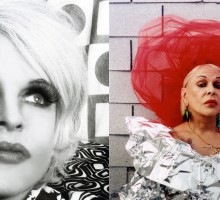 Left: image by Laure Leber, right: image by Marie Losier and Bernard Yenelouis
P-Orridge has long been guided by the 19th-century English occultist Austin Osman Spare and founded the artists’ collective Thee Temple ov Psychick Youth in the early Eighties, which drew on Spare’s philosophy of the conscious and unconscious self. The fellowship linked this to the psychic capabilities of the human brain and the potential for guiltless sexuality. It was an important self-reinvention for P-Orridge that s/he used to overthrow h/er reputation in the tabloids as a Satanist and corrupter of children, which s/he recalls during a recent interview with the New Yorker.
Context is essential to understanding the evolution of Genesis P-Orridge. England in the Nineties was emerging from Thatcher’s stranglehold and was coloured by a political malaise and sense of moral panic that P-Orridge agitated. After h/er home was raided, and archive plundered by Scotland Yard, P-Orridge fled to California with h/er then-wife and two young daughters.
This led Genesis P-Orridge to perhaps h/er most career – and life – defining period. P-Orridge would regularly visit New York during h/er arduous divorce to unwind, and it was after three days of partying that s/he first caught sight of Jacqueline Breyer (also known as Lady Jaye): a statuesque, leather-clad woman moving between various torture instruments. The couple fell in love immediately and were inseparable collaborators until Lady Jaye’s death in 2007. From that point on, P-Orridge referred to h/erself in the plural to commemorate Lady Jaye.
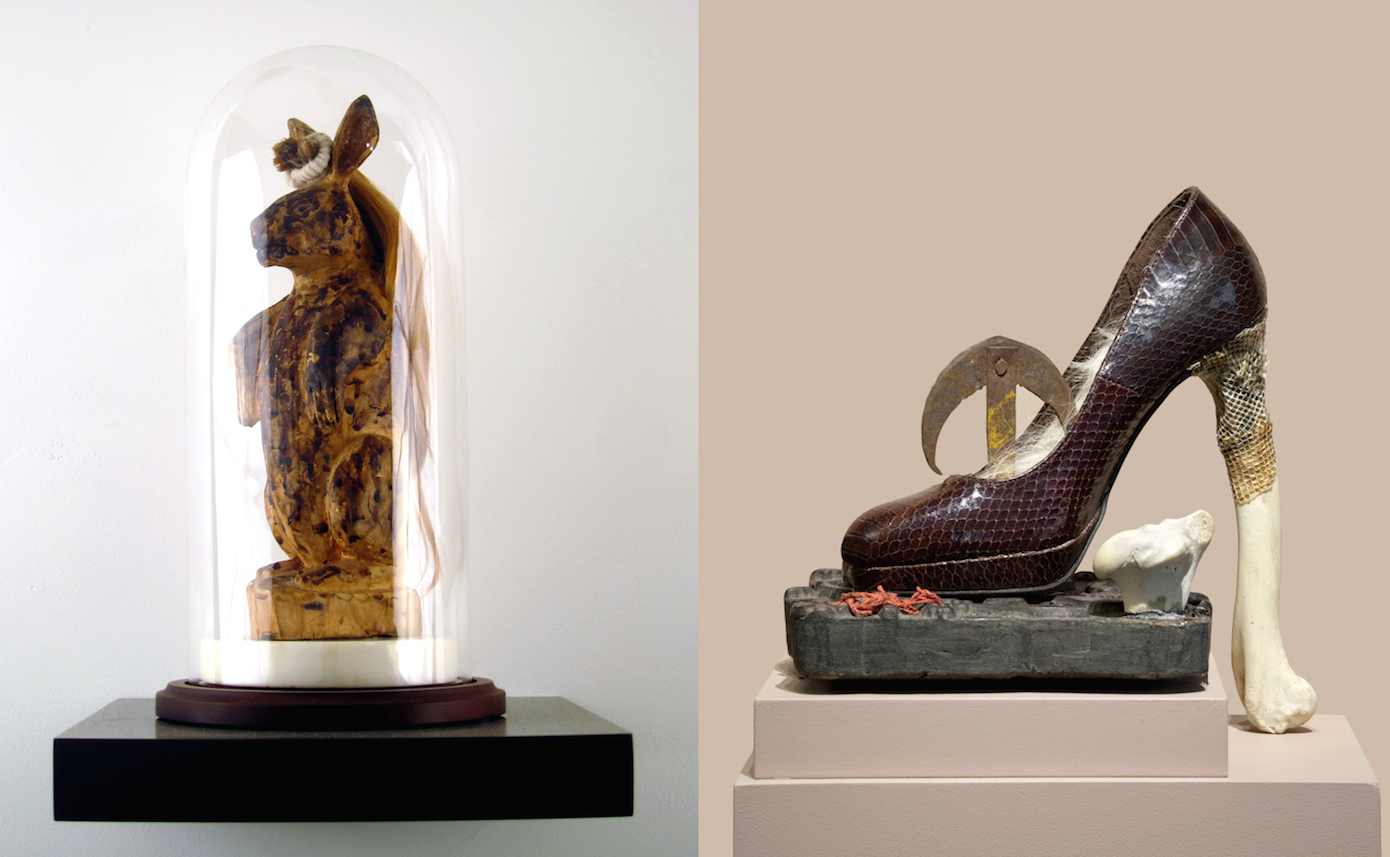 Left: “Blood Bunny” by Genesis Breyer P-Orridge, 1997-2007, image courtesy of Invisible-Exports; right: “Shoe Horn” by Genesis Breyer P-Orridge, courtesy of the artists and Invisible-Exports, photography by David De Armas
The plural is bound up in P-Orridge’s radical identity politics and acts as a performative extension of h/er creative practice. In the early 2000s, P-Orridge and Lady Jaye embarked on a deeply personal project entitled “pandrogeny” in order to physically look like each other. The couple underwent $200,000 worth of elective surgeries which, the Rubin catalogue explains, sought “to break down the limitations of biological sex and express their unconditional love for each other.”
“Try to Altar Everything”, brings into view Genesis P-Orridge and Lady Jaye’s lifelong commitment to “trans visibility” and freedom from binary terms such as “him” and “her”. The show reflects on this liberation through the lens of Nepalese traditions, which often synthesise Hindu and Buddhist belief systems, rather than demanding a sole commitment to one or the other. Many of P-Orridge’s exhibited works are made from bodily elements, becoming vessels for a person’s spiritual power: “Blood Bunny” is a carved wooden rabbit splattered with Lady Jaye and P-Orridge’s blood; “Mousetrap” is made from tampons cast in resin. And while these objects might not be divine, per se, they do, in h/er words, represent someone who’s spent their life considering existence, mystery and meaning. What are the true qualities of perception and how might we change learned patterns of human behavior? Genesis P-Orridge has dedicated a lifetime to challenging notions of acceptability in society and art, and while doing so s/he carved a place in history as one the last true cultural revolutionaries living today.
“Try to Altar Everything” by Genesis P-Orridge is on display at New York’s Rubin Museum until 1 August 2016