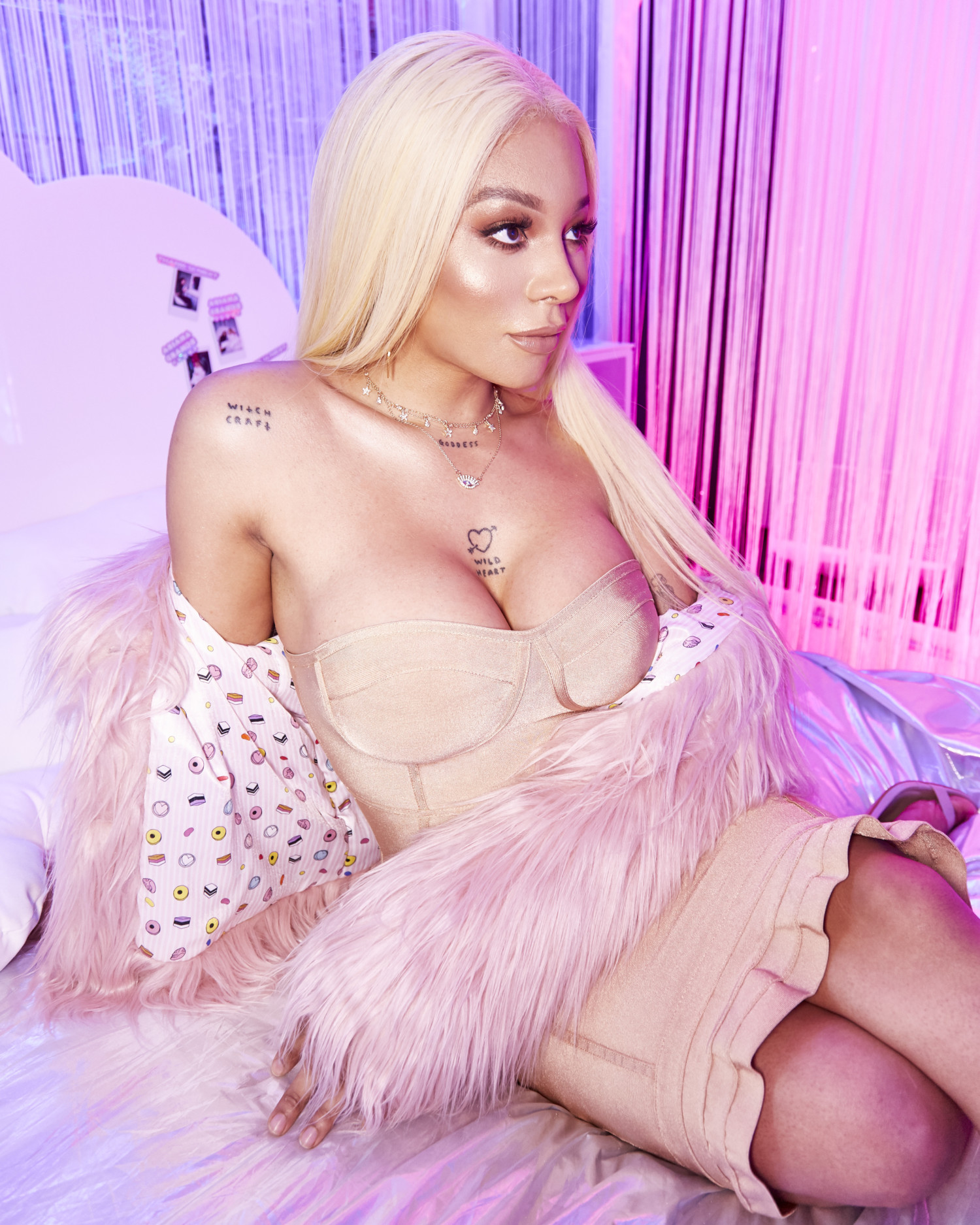
While we should be celebrating women everyday, International Women’s Day is a good time to remember all the work women have done to fight for rights, while thinking about where we’re headed as a sisterhood. To mark the occasion, SLEEK caught up with activist and model Munroe Bergdorf, who has been fighting for inclusivity at a time when trans-exclusionary politics are on the rise. She gives us a modern take on IWD, from gender fluidity to education and the need to celebrate all women.
SLEEK: What does International Women’s Day mean to you in 2019, and how would you like to see it celebrated?
Munroe Bergdorf: Women’s Day is a great opportunity to celebrate all women in our different entities and guises. It is a time to celebrate women who haven’t been recognised in academia or in the collective consciousness of society. I like to bring awareness to unsung heroes, personal heroes and those who have allowed me to understand who I am as a person and as a woman. I also want to amplify the trans narrative, because it is only recently that it has been included in the women’s narrative.
Who are some of the women you’ll be honouring?
MB: I am so keen to amplify the voices of the youth. Emma Gonzales, who was involved in the [Parkland] school shooting, is such a force of nature and an amazing voice. She is displaying an incredible amount of awareness of what needs to happen in society in terms of organisation – that’s what’s missing from my generation in particular. We have a lot of conversations, but we are not very organised. The younger generations seem to have the voice and the know-how; they just need the support.
Do you worry about the influence that trans-exclusionary figures across academia and politics, particularly in the UK, can have on a younger generation of women?
MB: The problem lies in the older generations and the education of the older generations. It’s concerning because a lot of those people have the potential to be gatekeepers. They are in senior positions within companies and institutions, as well as the ones creating the legislations. There is a likelihood that they could do real damage being exclusionary under the guise of what they think that they’ve learned. The younger generations are more clued-up when it comes to gender, race and class.
What are the hurdles to overcome with making the media less transphobic?
MB: It comes down to education and we are in serious need of education reform on a base level. The curriculum for primary school needs to be reformed so that the experience of LGBTQ people, women, people of different faiths or races and trans people need to be taught in the same capacity as white history – it needs to be accurate. LGBTQ people need to be taught same-sex sex – everybody needs to be taught same-sex sex. At the moment we are sending kids out into the world, completely unprepared for what it means to be an adult. A lot of adults are beyond help because people have made up their minds and it is so much harder to change a mind than form a mind.
As we progress towards more gender fluidity, do you expect to witness a shift in women’s rights?
MB: It is not going to impact men’s rights, so it shouldn’t impact women’s rights. Fluidity operates within a spectrum. You can still be a woman and identify as somewhere on the spectrum. I don’t see any issue with how women are going to be affected by trying to find a society or trying to work towards a society that includes everyone. If it comes down to women feeling unsafe because of trans people, it means that there needs to be more education. It seems that a lot of the issues women feel are going to be overlooked in terms of women’s safety are actually directed at men so we need to focus on what we are going to do about the male community that is making everyone else feel unsafe.
Do you think that feminism still has a complicated relationship with femininity?
MB: I see a lot of issues. Feminists are not always inclusive of sex workers and see porn as exploitation, when really we need to acknowledge the reality of people’s existences. Not everyone goes into the sex industry willingly, but some people do. It is not fair to put a blanket statement on everything being the male gaze and that we should eliminate and ostracise women who participate in that. I do think that we need to be intersectional and nuanced with understanding every woman’s experience.
Do you feel that there is a lot of pressure about how to be a feminist?
MB: Yes, but this this because feminism has been exclusive for so long. We should have patience with each other, but I don’t think that we should be putting up with lackluster versions of feminism. Ultimately it is dire times. We should be speaking to each other before calling each other out publicly, but with problematic people like Lena Dunham, if we don’t hold these people accountable for what they say, it does hold us back. We need to demand more from ourselves as a sisterhood to move forward.
How are you celebrating International Women’s Day?
MB: I have a lot of panels and conversations, but I will be sharing exciting stories of women who have impacted me throughout my life and women I find inspirational. None of us know it all and we are all works in progress that have to live under the patriarchy. We all learn things in different time frames. The primary objective is to try. Try to understand women who are different from yourself. The goal is equality on our terms and not equality behaving like men. We need to behave like a sisterhood and not a patriarchy.