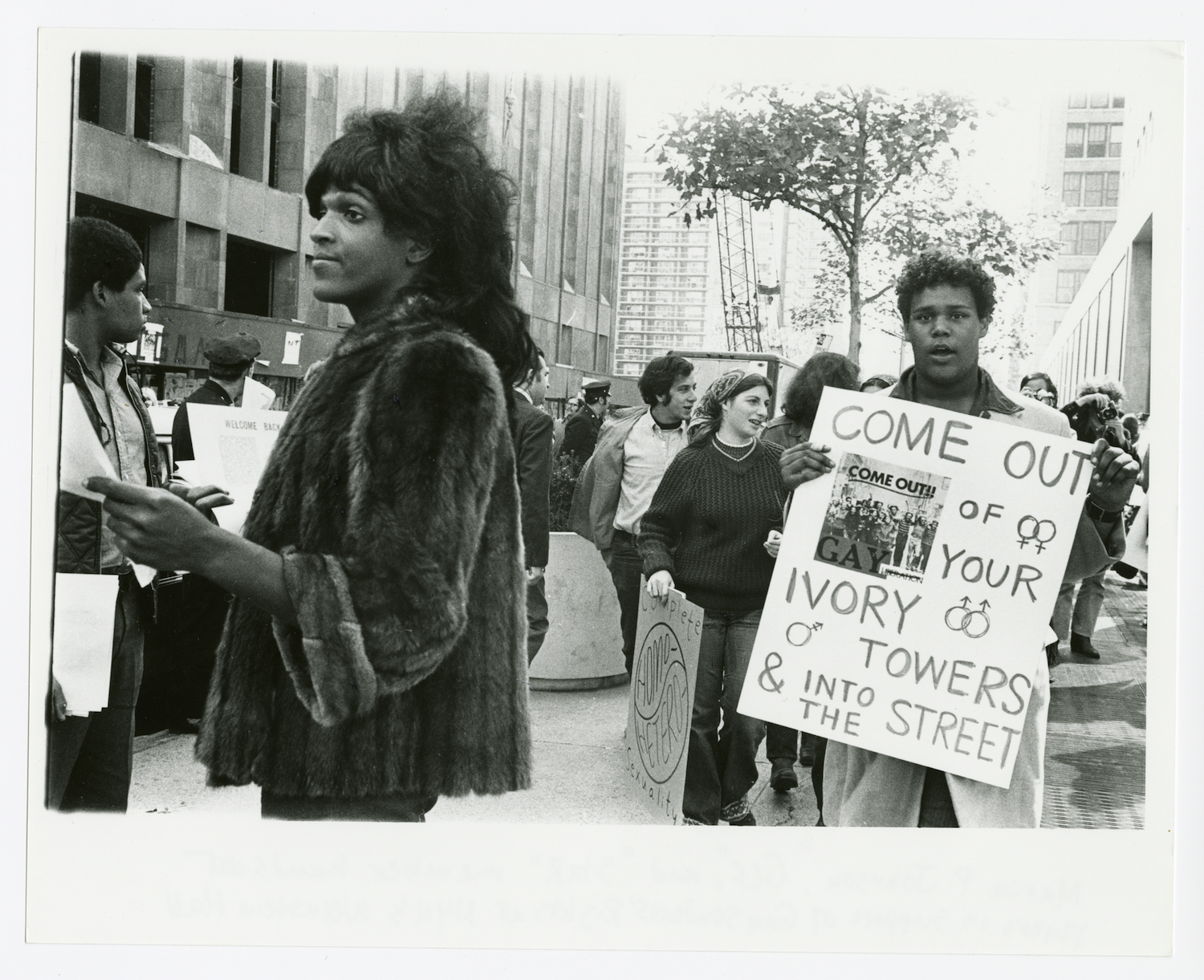
Diana Davies, Untitled (Marsha P. Johnson Hands Out Flyers for Support of Gay Students at N.Y.U.) c. 1970 © The New York Public Library:Art Resource, New York
Reportedly the only place in late ‘60s New York where men were permitted to slow dance together, the Stonewall Inn was a safe space for members of the local LGBTQ+ community to meet and socialise — despite the constant threat of aggressive police visitations (due to the fact it had no liquor licence). These raids, characterised by both physical and sexual assault at the hands of officers often lead to the arrests of transgender and gender non-conforming individuals under anti-drag laws.
As was commonplace, Stonewall was stormed by police on 28 June 1969; however, the raid didn’t exactly go to plan. Key figures — predominantly trans women, gender-non-conforming people and sex workers of colour — like Martha P Johnson, Stormé DeLarverie, Sylvia Rivera and Miss Major Griffin-Gracy led a resistance against the police which escalated into riots, galvanising activists to lay the foundations of the modern LGBTQ+ rights movement.
Whilst we cannot understate the bravery of the individuals who took part in the rebellion, it’s also important to note that Stonewall was certainly not the first incident in US history where LGBTQ+ people pushed back against the police — so what made it such a tipping point for the queer liberation movement? For artist and art historian Jonathan Weinberg — curator of the ongoing two-part exhibition Art after Stonewall 1969-1989 — it’s because the events prompted an interconnected change in queer activists’ methods and the community’s modes of self-expression. “The decision to make a march a year later [the first Pride parade on 28 June 1970] and celebrate that as an anniversary was absolutely crucial. The way that [Stonewall] was conceptualised as a turning point in images, in writing and in marching turned it into this important event.”
Weinberg has been able to explore this representational shift through the process of curating Stonewall 1969-1989, a project undertaken by the Columbus Museum of Art in Ohio. Currently showing in New York, the exhibition can be found between the Grey Art Gallery and the Leslie-Lohman Museum in Lower Manhattan and features iconic LGBTQ+ artists like Andy Warhol, Vaginal Davis, Keith Haring, Laura Aguilar and Barbara Hammer, alongside the work of activists groups like Gran Fury and the Gay Liberation Front. In celebration of its 50th anniversary, SLEEK asks Weinberg to select five works that explain key elements of the uprising and its subsequent impact on the LGBTQ+ community.
1. Elevating LGBTQ+ experiences
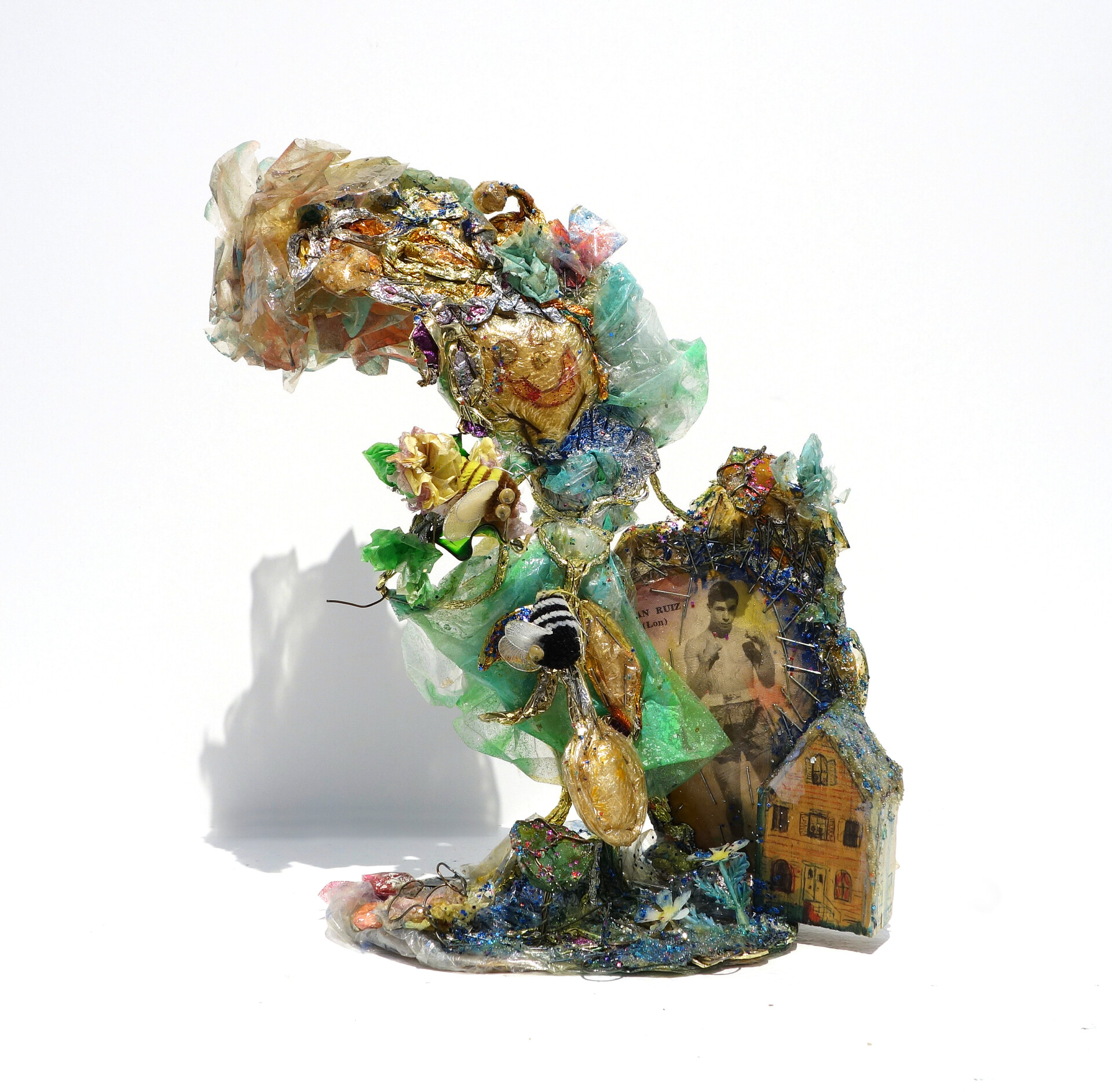
Thomas Lanigan-Schmidt Allegory of the Stonewall Riot (Statue of Liberty) Fighting for Drag Queen, Husband and Home, 1969. Courtesy the artist and Pavel Zoubok Gallery, New York
Dismissed as perverted, or just plain wrong, LGBTQ+ individuals were absent from North American media and censored from Hollywood cinema under the Hays Code (enforced from 1930-1968) — discussed only in documentaries that painted queer people as ill or immoral. The act of representing queer history or culture was in itself radical and in the aftermath of Stonewall more artists began dealing with LGBTQ+ themes and honing an overtly queer aesthetic.
Thomas Lanigan-Schmidt is one of the few visual artists who was present during the raid and his sculpture Allegory of the Stonewall Riot (Statue of Liberty) Fighting for Drag Queen, Husband and Home (1969) memorialises the event. The kitsch assemblage of found and discarded objects apes the Statue of Liberty in its shape and form, and is at once a parody and a direct descendent of that emblem of American freedom. As Weinberg explains, Lanigan-Schmidt’s work reconsiders hierarchies of value through its materiality: “his work is literally put together out of things that people throw away and that they don’t think is valuable.” The petite sculpture repurposes this monument to freedom in order to represent the bodies that are often deemed disposable and, in doing so, exposes America’s definitions of civic liberty as fragile, hypocritical and exclusionary. In a landscape where queer experiences, lives and history were thoughtlessly discarded or destroyed, Lanigan-Schmidt tentatively asserted their importance and value — if not yet to mainstream society than to others in the LGBTQ+ community.
2. Visibility — for the privileged few
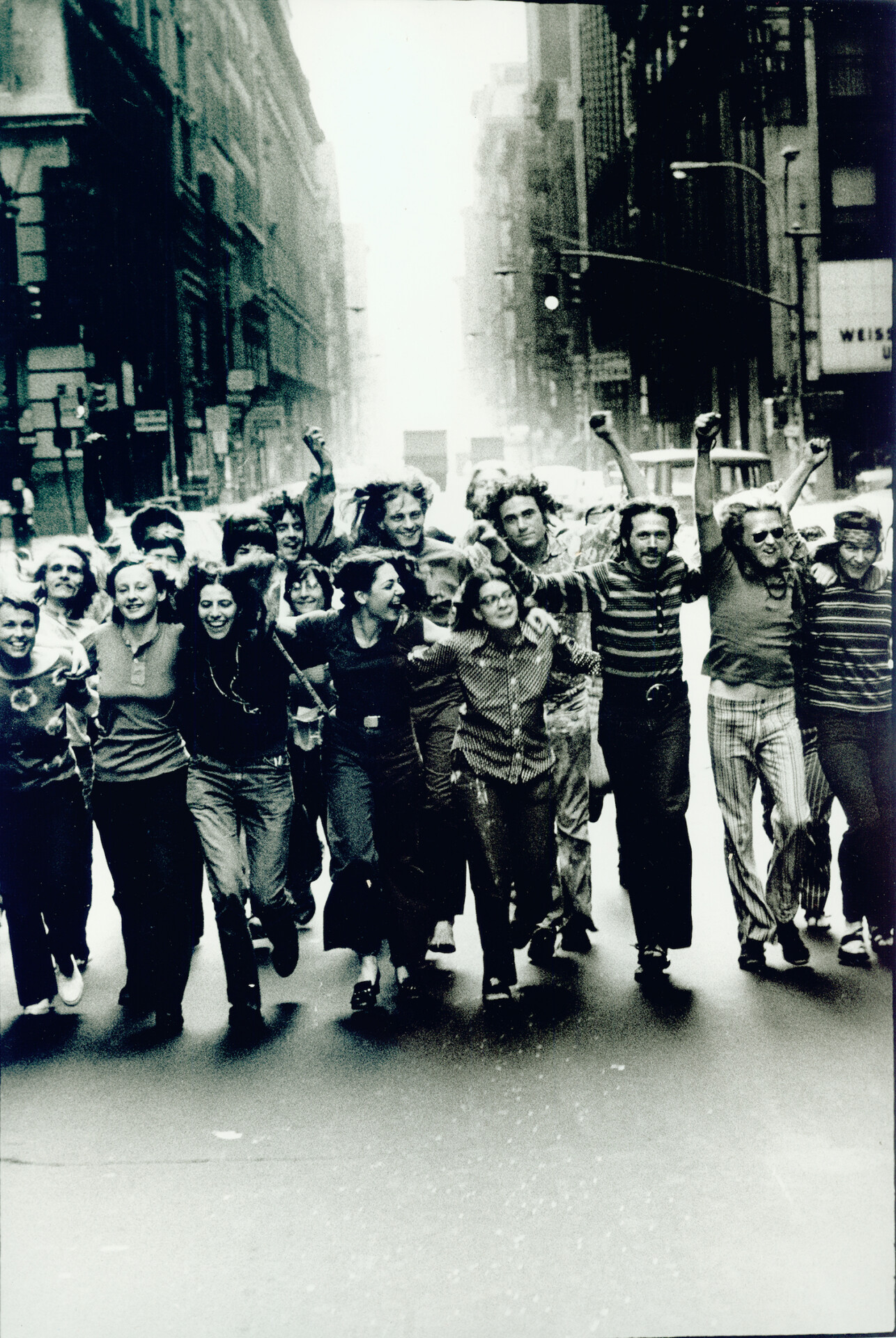
Peter Hujar Gay Liberation Front Poster Image, 1970. Gift of the Peter Hujar Archive, LLC. Collection of Leslie-Lohman Museum
One of the major changes that Stonewall instigated is something that we still talk a lot about today: visibility. Weinberg explains that, pre-Stonewall, ‘coming out’ only meant revealing your sexuality or gender identity to other queer people and remaining closeted in the wider world. After the uprising, however, activists encouraged publicly coming out as a political tool to show that queer people really were everywhere. Although earlier writing on LGBTQ+ art focuses on uses of subtext and suggestion, post-Stonewall art has it’s own ‘coming out’ in terms of adopting a more explicit language of queer expression.
Ukrainian-American photographer Peter Hujar’s image of joyful youths spilling onto the street, used in the Gay Liberation Front’s posters, is a prime example of this. “Gay Liberation Front got all these people together and staged them to look like they’re happy and cheerful and they’re taking over the streets. It’s all about visibility.” However, looking at this sea of smiling white faces, one can’t help but notice the alarming lack of diversity in the image — a particularly disarming detail when we consider who spearheaded the Stonewall resistance. This, Weinberg explains, is all to do with privilege, in ways that still resonate today. “One of the things you have to realise about coming out is that it’s not always easy and it may have to do with your particular privilege.”
3. Strategies of persuasion
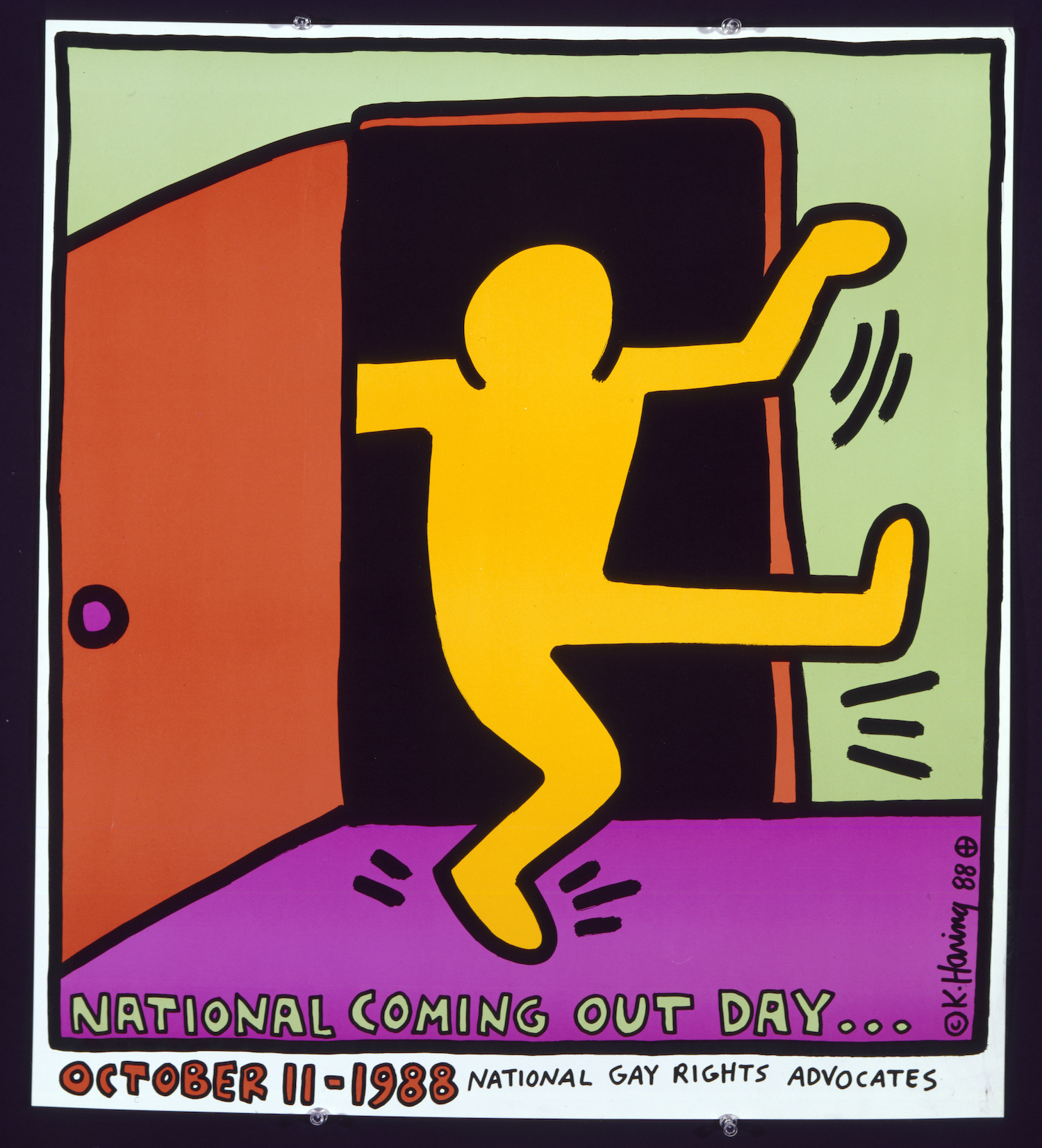
Keith Haring National Coming Out Day, 1988 © Keith Haring Foundation
In the years preceding Stonewall, queer activism took an “easy does it” approach but the uprising showed that peaceful protest doesn’t always get the necessary results — anger sometimes being the only effective tool to hand. Yet the riots didn’t show that radicalism is the only answer, rather that activists must adapt to the specific set of circumstances before them. The commemorative march one year later, and the ongoing impact this has had on the queer liberation movement, has shown that activists, above all, need to be creative with their methods.
Weinberg highlights a piece by Keith Haring, created for National Coming Out Day in 1988. Depicting a stickman dancing its way out of the closet, Haring’s sprightly work gestures towards queer futurity and beckons the closeted subject to join in the creation of an alternate reality: “The coming out poster is imagining a world in which it’s joyful to come out. It might not have actually been a joyful thing in that moment but in making a representation of it in that way promotes other people to do it.” Speaking of Haring’s work more generally — in particular a giant “safe sex” painting also on display in the exhibition — Weinberg notes: “[it’s] sweet and upbeat and funny but always a bit subversive, and a lot of his work is incredibly obscene. This is to charm you.” Using bold colours and a contagious sense of play, Haring’s work convinces you to look, but also infects you with the spirit of change.
4. Subversive sexuality
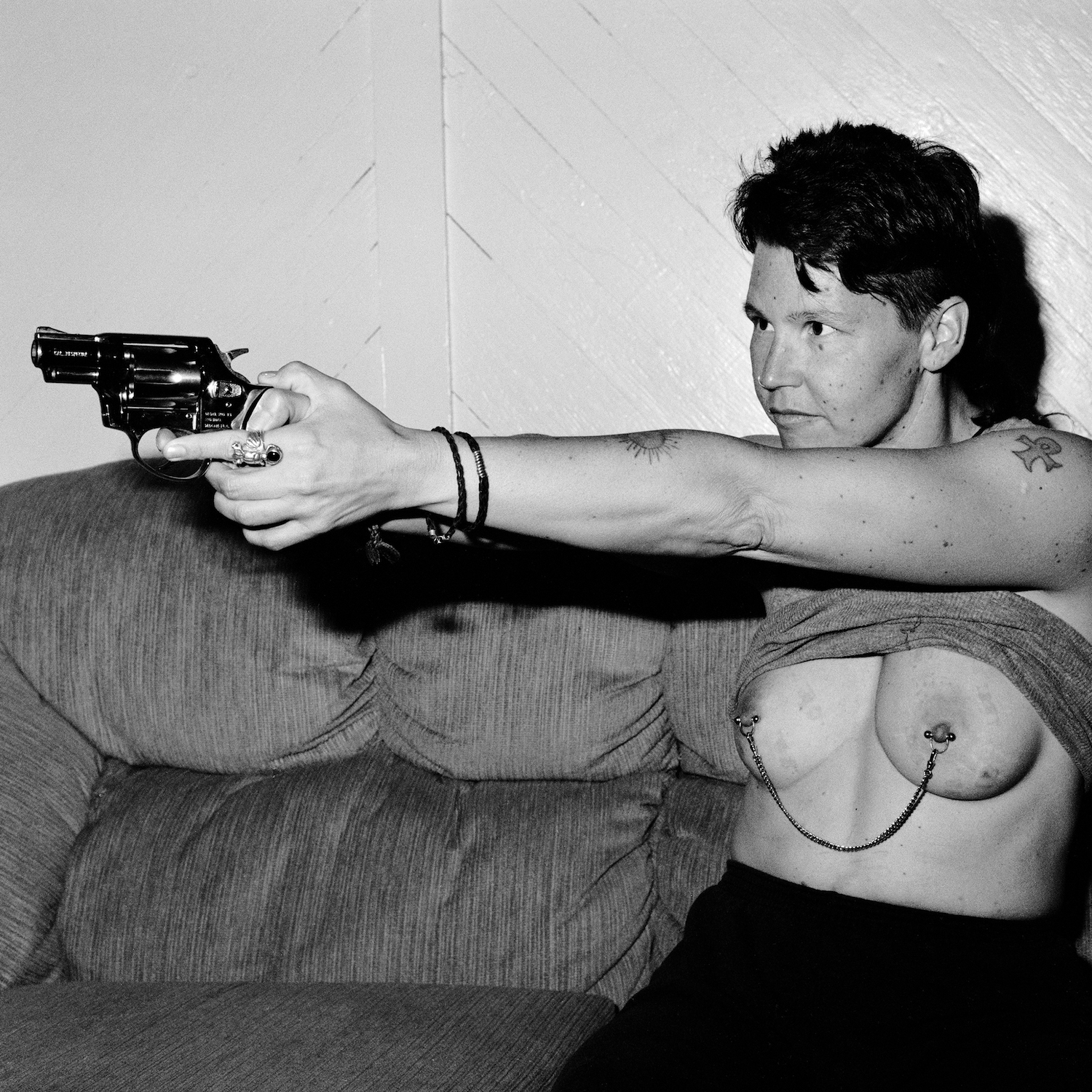
Catherine Opie, Raven (gun), 1989 © Catherine Opie. Courtesy Regen Projects, Los Angeles and Lehmann Maupin, New York and Hong Kong
The spirit of rebellion fostered by Stonewall led more queer individuals to consider their gender identity and sexuality on their own terms. Eschewing respectability politics, they embraced non-conformity, self-styling themselves as queer outlaws. Amongst these are the participants of the leather and bondage scenes immortalised in the photography of Robert Mapplethorpe. Weinberg decries the fact that “although Mapplethorpe is very famous for his work in the leather scene, many people are not aware that there are artists like Catherine Opie or Morgan Gwenwald who were making images that were also involved with leather.”
Additionally, some female artists turned to photography to explore versions of female eroticism that don’t privilege the male gaze. “Photographers like Gwenwald and Tee Corinne were trying to make erotic, even pornographic, images for women that weren’t commodified for men.” Vastly different to the passive models in mainstream pornography, the subject of Catherine Opie’s Raven (Gun) (1989) embodies this outlaw mentality. With the sitter’s fixed gaze staring out beyond the confines of the image, body primed for action and finger on the trigger, there’s no pandering to the spectator’s gaze. Charged with an eroticism and the potential for action — or danger — the image brings the power and spectacle of sexuality to the fore.
5. Wilful imagination
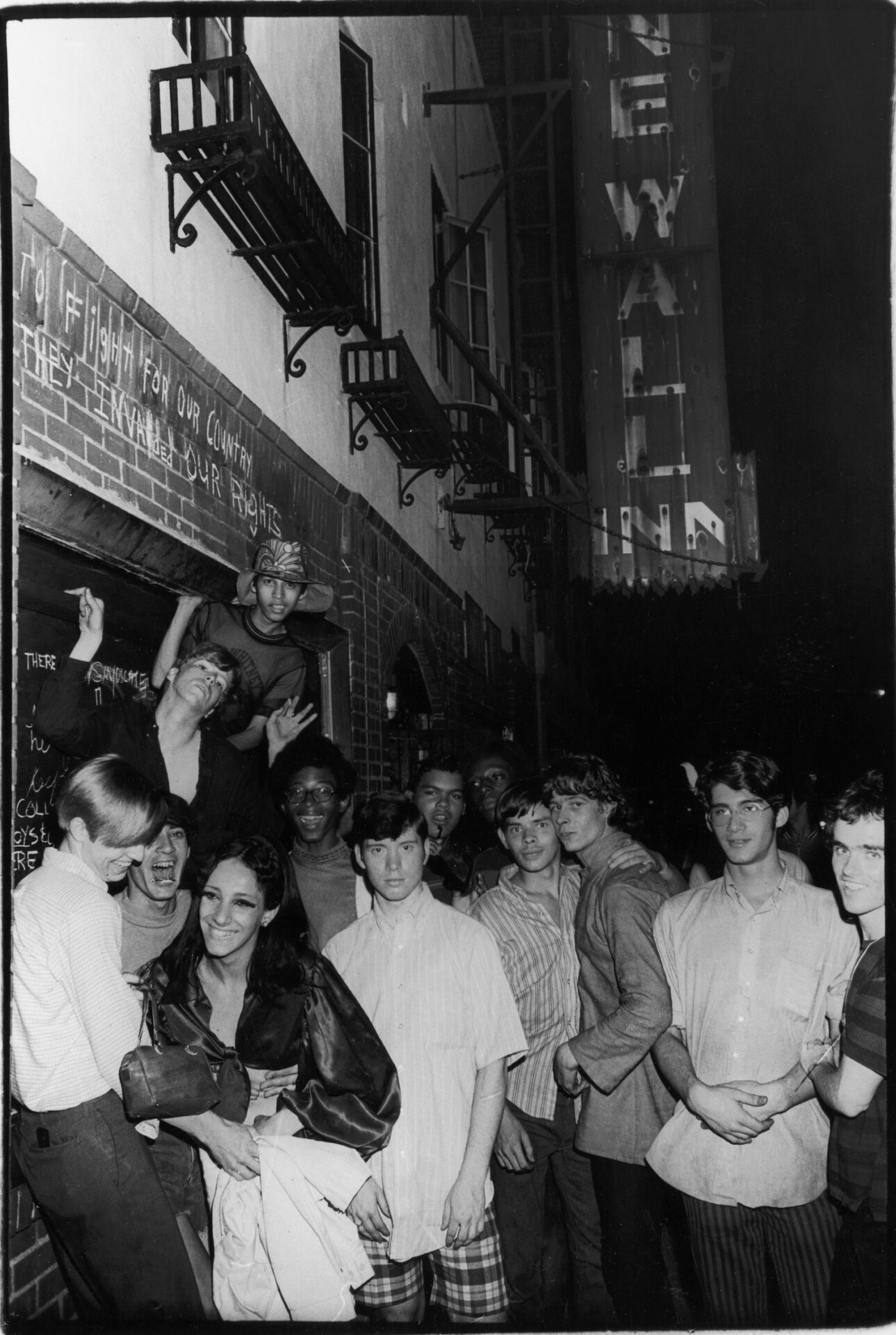
An unidentifed group of young poeple celebrate outside the boarded-up Stonewall Inn (53 Christopher Street) after riots over the weekend of June 27, 1969. The bar and surrounding area were the site of a series of demonstrations and riots that led to the formation of the modern gay rights movement in the United States. (Photo by Fred W. McDarrah/Getty Images)
What might strike you as odd about Stonewall is that, despite being such a pivotal event for the LGBTQ+ movement and having inspired so much visual art, no images of the momentous evening exist. This is what has left its legacy vulnerable to white-washing — as in Roland Emmerich’s 2015 film Stonewall, which erroneously centres on a white, middle class protagonist. Much more representative is Celebration After Riots Outside Stonewall Inn, a photograph taken shortly after the riots by Village Voice photographer Fred McDarrah. In lieu of any visual documentation of the actual event, the snapshot’s diverse subjects and atmosphere of wary optimism serves as a partial placeholder. Yet Weinberg argues one of Stonewall’s greatest representational strengths is, paradoxically, this lack of photographic evidence: “The riot is an image in our heads. Even the fact that we’re celebrating the 50th anniversary is an act of representation, an act of imagining. In a certain way, we were all there: we’ve made Stonewall into the origins of who we are.”
Art after Stonewall 1969 – 1989 runs through to 21 July at the Grey Art Gallery and the Leslie Lohman Museum.