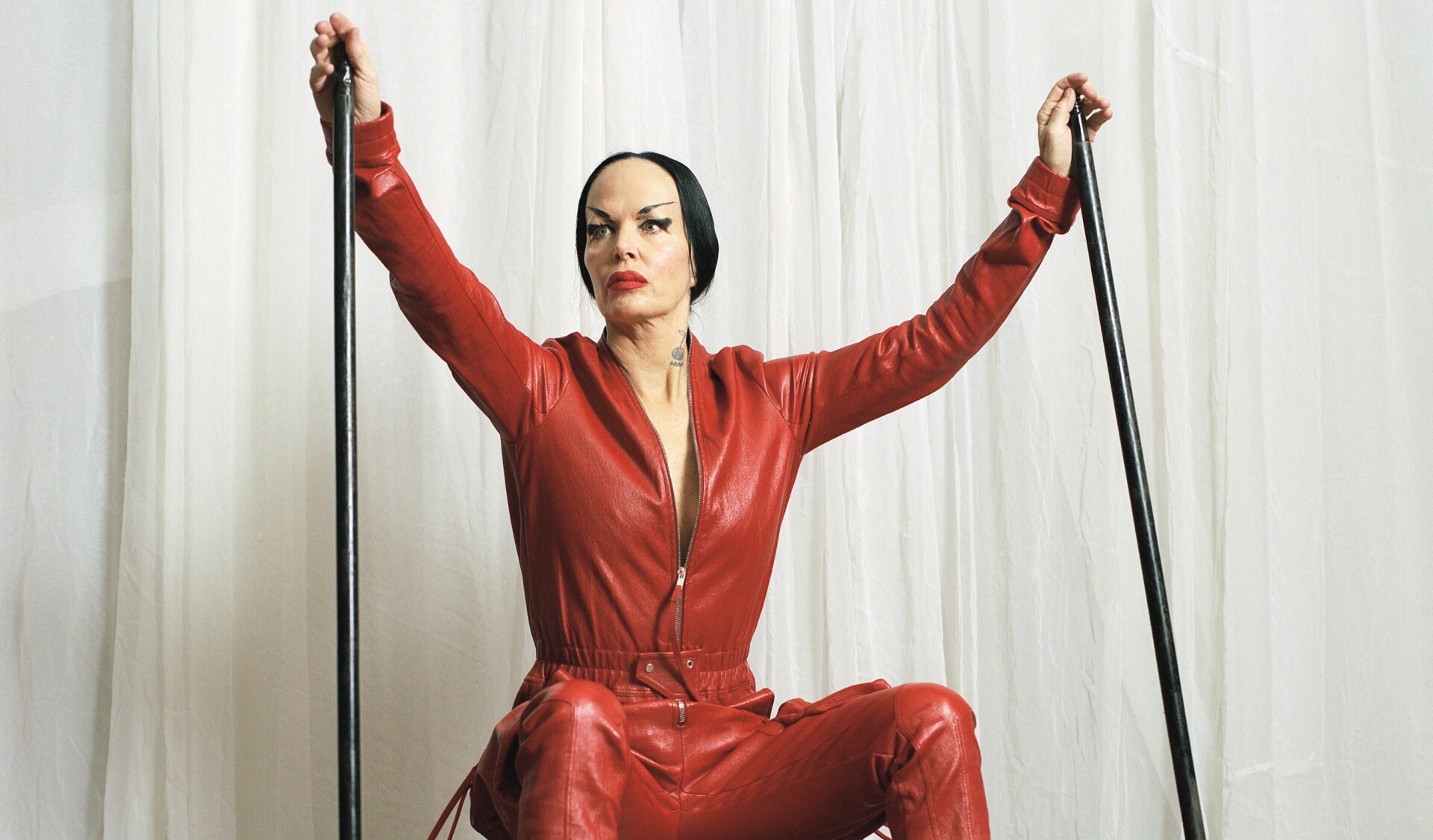

Photo: Fumi Nagasaka. Total look: Rick Owens AW19.
In 1992, she had her vulva sewn shut in Richard Kern’s Sewing Circle, a feat she performed again, twice, most recently for Penthouse in 1998. Elsewhere, Kembra Pfahler has exhibited paintings, portraits and curated exhibitions under her concept of ‘availabilism’, the practice of making art with whatever is close to hand. In 2014, she also co- organised Future Feminism in New York alongside singer Anohni, musicians Sierra and Bianca Casady from CocoRosie, and performer Johanna Constantine, an art, music and performance event that later toured Europe. Here, actor, model and writer Stoya recounts her conversation with the artist at Pfahler’s New York home, including discussions on the relationship between art and dissent, artistic personas and the exact way she feels about gender equality.
The Manhattan air is cool. The apartment walls are a warm red. Three black cats of varying builds splay and frolic. Nina, the smallest, hops onto my lap and digs her claws into my jeans for grip. I’m in the presence of Kembra Pfahler, in the space she has lived in and worked from for decades. She’s an artist—largely known for her band The Voluptuous Horror of Karen Black—who transcends genre and medium. She’s also the originator of availabilism and a teacher, currently at Columbia. She’s jet-lagged from bouncing between art gigs in Europe and her class in NYC, and warms up to my questions quickly.
Stoya: Do you think rebellion is important for art?
Kembra: Yes, I do, but I don’t think it needs to be necessarily destructive rebellion. It could be like spiritual rebellion where you’re just pushing yourself towards the unknown. You know, and maybe that would be, in some cases, towards what’s transgressive or not acceptable to mainstream identities or mainstream acceptance. It’s exhilarating, to use your vernacular. I do think rebellion is necessary. But again, a sort of tempered rebellion that doesn’t kill you. I never really believed in an art practice that was romantic, that would cause harm because I saw so much harm done to artists growing up in the Lower East Side as a teenager there, and surviving the ‘AIDS Apocalypse’, and seeing so many great people having to die. You know, the culture was genocidal pretty much because such a large percentage of our artists were ‘taken away’ because of AIDS. So I think because I saw so much death in my early-20s and my teens, it felt like such a privilege to still get to produce and still get to be here after we lost everyone in the late Eighties … I never really wanted Romanticism to be part of my practice the way Mary Shelley and Blake and all of those Romantic poets used to.
To have to qualify as if you’re an artist, you have to be practically willing to die. And so that really changed me a lot in the Eighties, getting to experience that. And that gave me an appreciation to still be here and to honour all of my friends who died, like my best friend, Gordon Kurtti. They died, and we did an art show for him 26 years after his death at [New York’s] Participant Inc gallery, where we showed all of his work and I was able to finally honour him. But I remember in the late-Eighties when Gordon died, he was someone who really was my first best friend. As an artist, I don’t know if you’ve had that person in your life, but they’re usually very ‘catalystic’.
Stoya: Yeah, you like, hang out with them and you come up with 50 amazing ideas that you never could have come up with yourself.
Kembra: Exactly, that was Gordon and he died when he was 26. And I should get you the book that we made for him. I’m trying to remember to get it, I don’t have any books or anything here. I don’t keep any books, any pictures up on the wall, even in my apartment. Not to switch subjects but I work really monastically here, I just have nothing on the walls. I’ll strip the whole apartment and then start a new piece. And I’ve done that my whole life here. I don’t have any sentimental things on the wall. No pictures. Nothing. I’m not a collector.
I ask about a quote from her on the bifurcation of Marilyn Monroe’s public and private personas, and how she manages to move between contexts so easily.
Kembra: In art and films, to have a different name is pretty common, you know, to have a different persona just as far as like having a poetic identity. It’s called a poetic identity. It’s an intelligent way to handle all that stuff. Do you know, I think it makes it a little bit easier, actually, to have separate names for things. I don’t think that I’m being a character when I’m in my Karen Black costume at all, I just think I’m Kembra in costume.
Stoya: What’s a persona, and what’s just an extension of who you are? And actually are those things the same at the end of the day?
Kembra: I do feel like, you know, I mean, my physical transformation is really extreme. And a lot of times people can’t really believe that it’s me because I’m such a … just a regular gal, regular person. When they see me in my Karen Black costume, they’re like, “Oh, okay. That’s something else.” Because it creates such a larger persona, so much bigger.
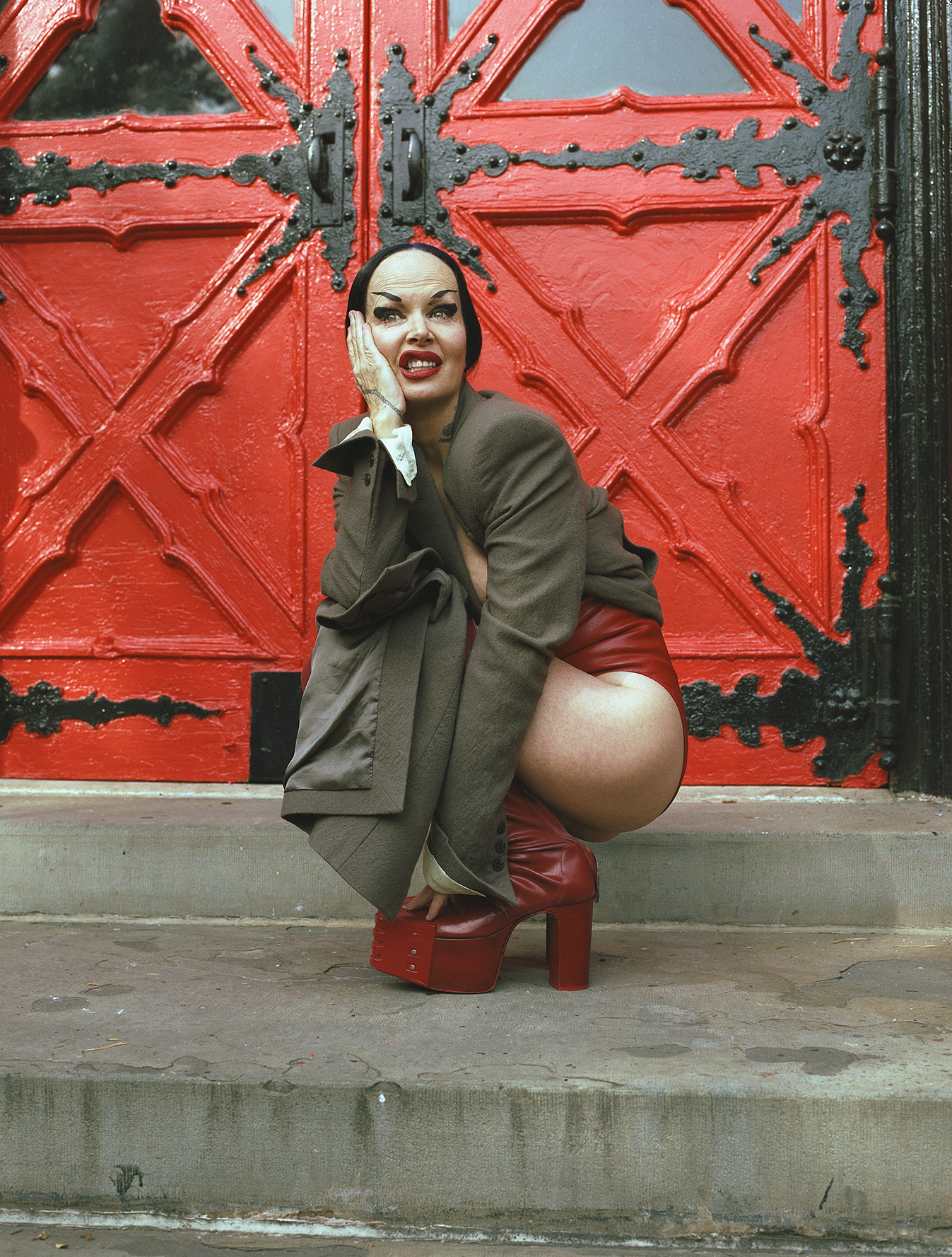
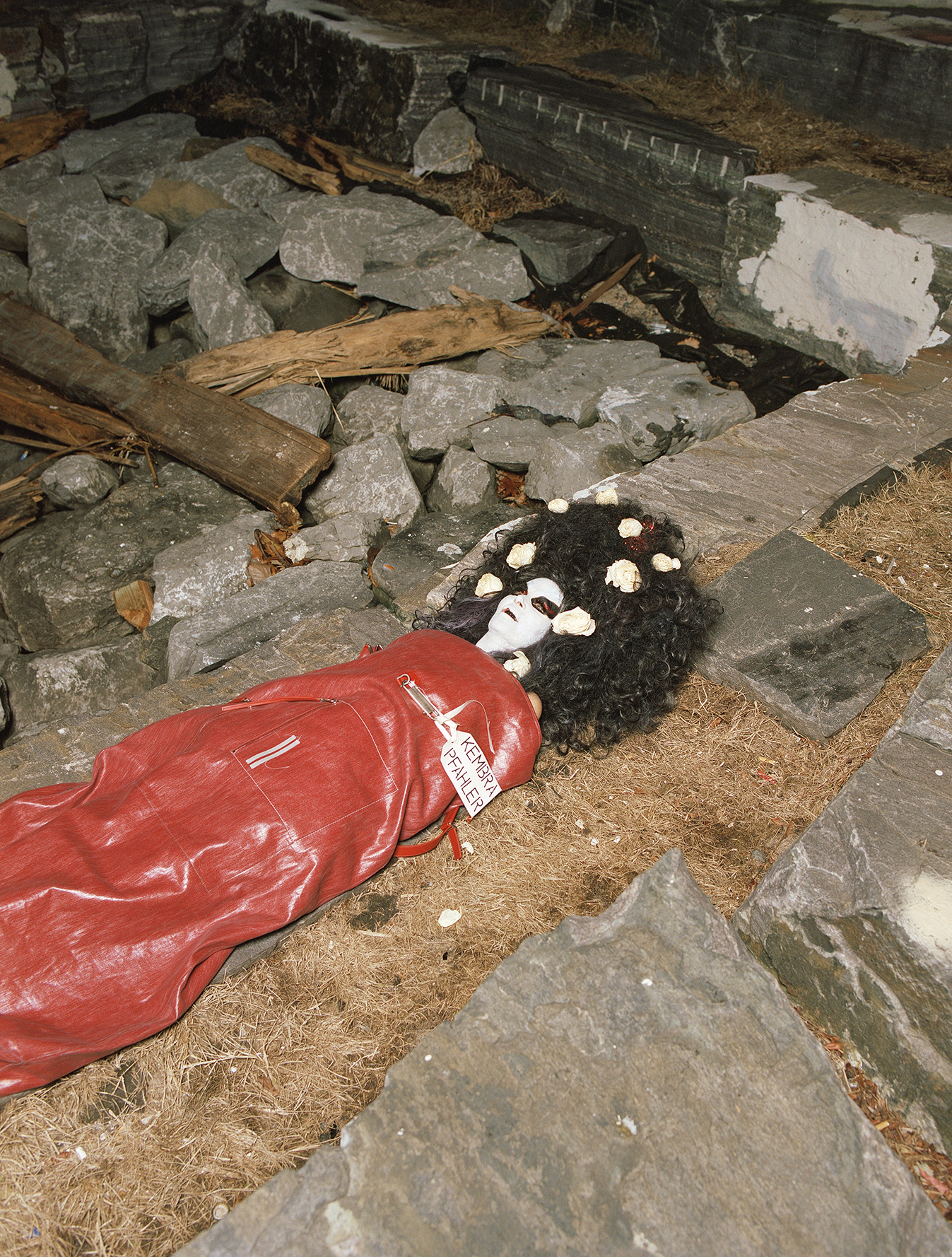
Stoya: The hair alone.
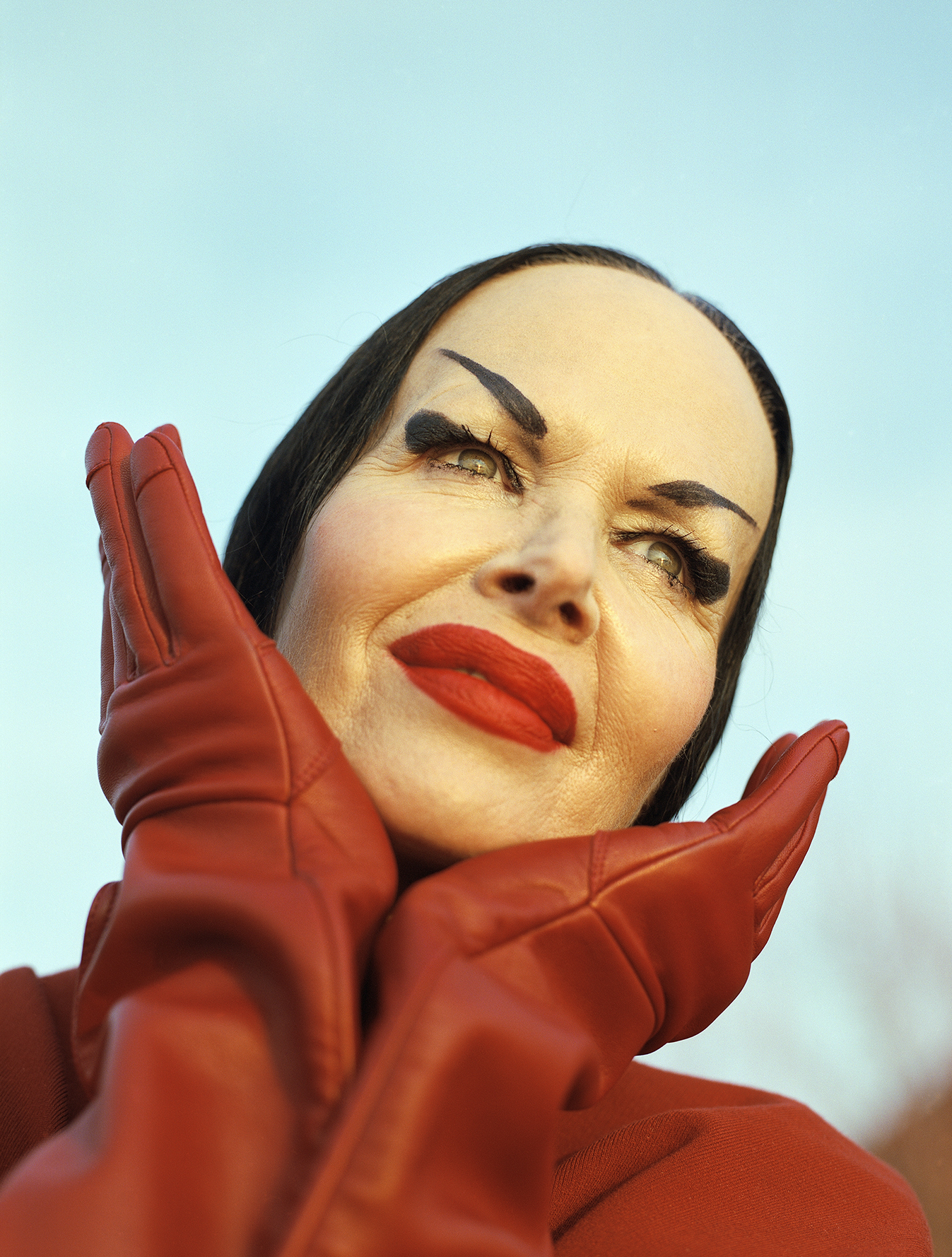
Kembra: The hair alone. But I do feel that it is simply me and costume and it’s coming from examining what my idea of beauty is to me. That is my idea of beauty—the wig, the teeth, the eye makeup, the colour on my body. It really is what I find to be beautiful. So it’s an expression of beauty to completely transform like that. And it also is part of a great way to deal with being very shy, having a different persona. And it helped me with that because I am very shy actually, I never really wanted to be in show business. But I did love the idea of sharing ideas and stories through art and costume.
Stoya: How were the fashion interactions for you?
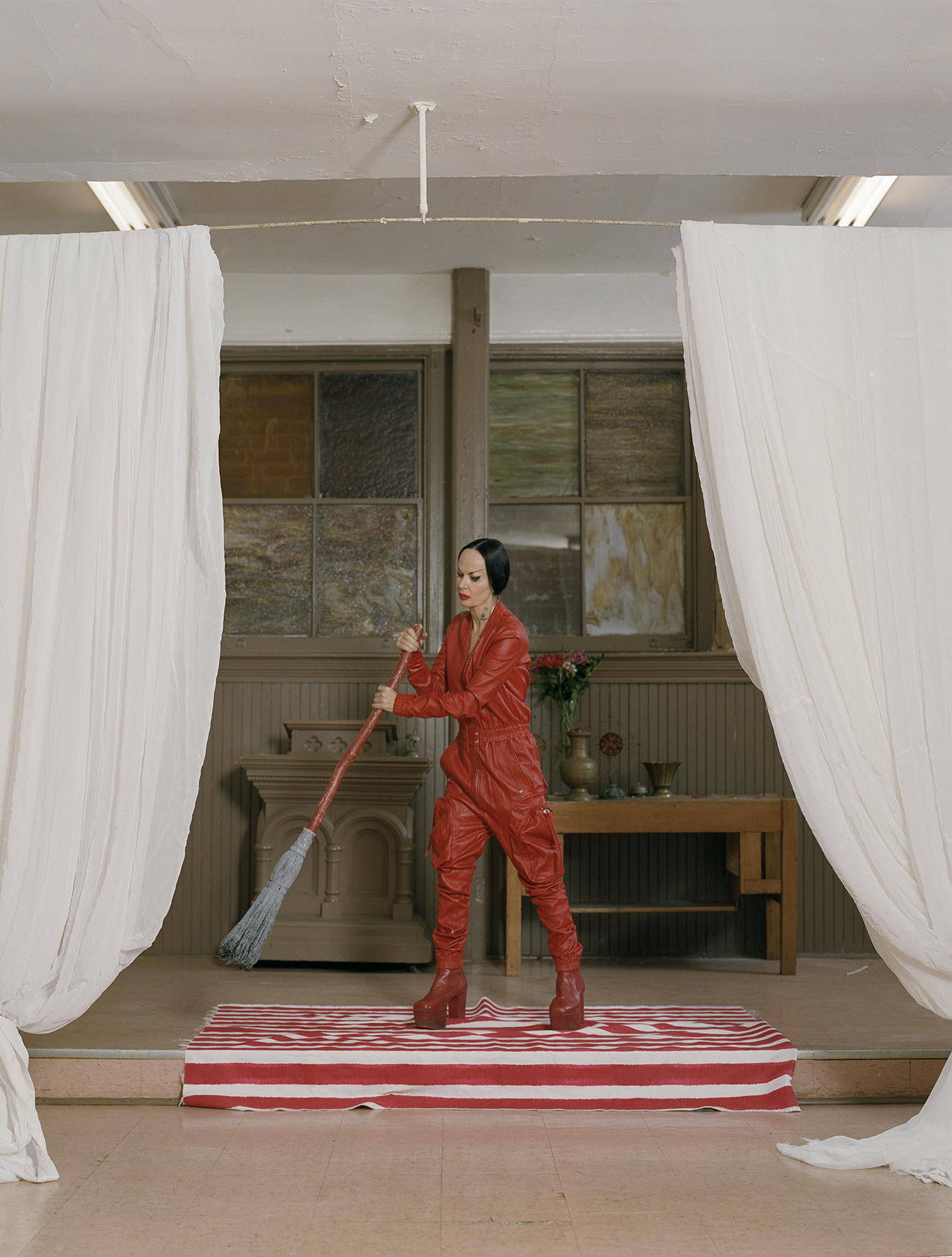
Kembra: The fashion world interactions have been amazing because to go into the fashion world, to me, is like taking a glamorous vacation. And I don’t really ever take vacations. When I go and visit other people’s work, that’s kind of my time off. It’s a working time off. It’s a working vacation. So I just love to see how other artists work. And the people that I’ve worked with in fashion are artists working in fashion, they’re artists working with materials and textiles and cloths, and they’re really good artists. So I’ve got to work with some really great fashion people like Rick Owens. I just did the Rick Owens show with him in the Pompidou Centre in Paris, and I’ve known him for almost 25 years. Yeah, for my whole adult life. So it’s just also another examination of what people are finding beautiful. And for me, art isn’t that much about… I mean, it’s political. And it has, of course, many different functions in our civilisation, in society. But I guess for me, it’s about making life more beautiful. And creating an identity and a lifestyle around me that I find tolerable and beautiful. And a life that is rife with history and mythology and ritual. And that’s what performance is about. For me, it’s about bringing that into my life where there was none.
Stoya: So early on you worked with Penthouse and Calvin Klein. How was that, being so shy?
Kembra: Well, that was me also making the best use of what was available because I thought to myself, “Who gets invited to do a Penthouse spread?” And I was someone who made a decision very early on that it was alright for me to show my whole body. And that, to me … It gave me power. I didn’t do it because it made me an object, or someone who was exploring adult sexuality. To be naked to me was a beautiful gesture. Because I felt there was so much beauty in the naked body and so much classic fine art. You know, look at the statue of [Michelangelo’s] David, everyone’s naked in sculpture. So to me it, it was never intended … I was always surprised when people took it as a gesture from me that was wanting to be a ‘nudie cutie’ or something. To me, it was just about being a serious, more provocative artist. And that’s why I sewed my vagina shut in Penthouse which really turned a lot of heads [1998, photographed by Michael Halsband].
Performance art wasn’t as popular as it is now, in the Nineties. And I was coming from being sort of a famous rock person at the time. I wasn’t as involved in the fine art world. When [Penthouse founder] Bob Guccione asked me because my band was famous. And you know, magazines need fodder. They need content. So they needed to get around to me just because they needed to fill the pages too. No one else would do it. It was a great spread. at was a 20-page spread and I sewed my vagina shut and the fire department guys saw [it], and they said to me, “Is that you in Penthouse? What on earth were you doing?” because it was such a mixed message. It wasn’t exactly like beat-off material.
"It’s an expression of beauty to completely transform."
We talk for a considerable amount of time about what porn can do and how awesome not-exactly-beat-off material is. We head out to grab a cup of coffee, and Kembra has some parting words about the support she’s received from galleries in recent years.
Kembra: Emalin gallery I met just a few short years ago and did Capital Improvements (2016) with them in London. After we did Future Feminism in NYC [at The Hole in September 2014], I moved all of my business headquarters to Europe. I’ve learned a lot from Leopold Thun and Angelina Volk [coordinators at Emalin]—my two gallery owners that have essentially been the strongest advocates for what I do since I began. I never liked Europe because I always thought everywhere looked like World War Two. And I didn’t like the idea that they would like me more in Europe. As a contrarian, I stayed in the USA where I was most unwanted. Record companies asked me to put on clothes and act more satanic—it would sell more records.
The art business devalued performance. There is now a tiny little window that opened for me where a crevice of light seeps through. Even an inch of light will propel me to finish more, do more and to stick around longer. I’ve never had too much support, so when it does come, I appreciate it and don’t take it for granted. I like the idea of proliferation, not just flipping the script. Now women’s voices are being heard louder than a whisper. A proliferating voice can obfuscate all others.
I am not an equality seeker. I like the idea of only women being heard for the next century. I can’t imagine any real change could happen otherwise. Having compassion to men’s crimes and misogynies will sink the ship, the world won’t last as we know it. It’s women who give birth to men. It’s women who should create a new directive and a new understanding of how we’ll survive as a species.
As for a roadmap, the tenets of Future Feminism seem like a great place to start.
This article originally appeared in SLEEK 64, out now.
CREDITS
PHOTOGRAPHY: Fumi Nagasaka
All Looks: Rick Owens AW19
MAKE-UP: Ebele Anueyiagu
HAIR: Kembra Pfahler, with wigs by Marcowigs
PROPS: Kembra Pfahler
PRODUCTION: Gillian Doyle @ Home Agency PHOTO ASSISTANT: Matt Ba
PRODUCTION ASSISTANT: Bradley Ahlstrom