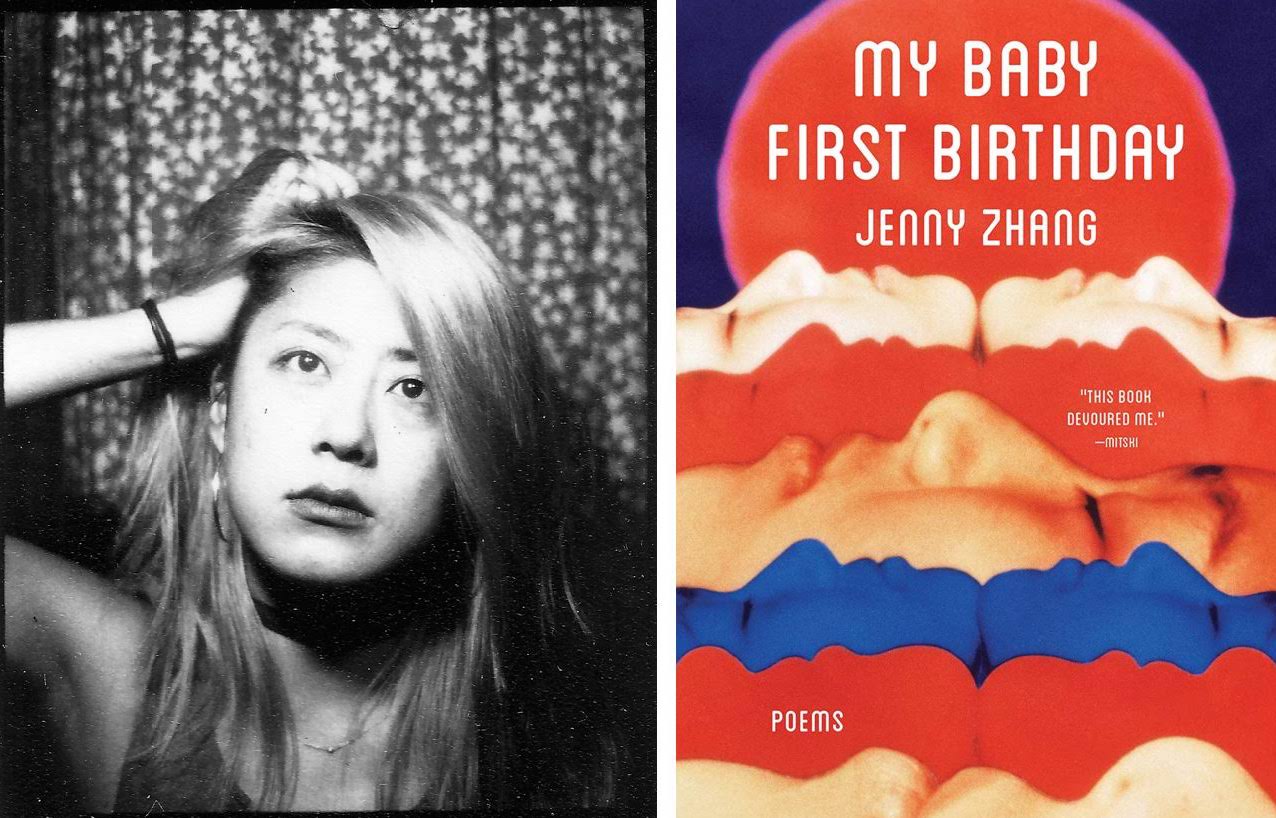
Courtesy Jenny Zhang
“I feel everything,” writes Shanghai-born and New York-based poet and author, Jenny Zhang in a poem from her new collection, My Baby First Birthday (out now from Tin House Books). In another (the sagely titled “The Universal Energy Is About To Intervene In Your Life” she states, “I am pure emotion and you must pour me”. Zhang’s poems deal in the knotty currency of feeling. Of feeling lonely and hurt, sad and soft, of wanting to be desired and babyed at the same time, heard and understood. They are leaky—they release emotions in sad dribbles and great, gut-wrenching gushes (“I leak blood memory,” she writes in “Instant Classic”). “These poems are about oozy, gooey feelings, persistent feelings,” she explains over Zoom. “There’s a hotness to them…I guess I never thought it was a bad thing to have a poem make you feel a lot.”
The 97 poems in My Baby First Birthday were written by Zhang between 2012 and 2018. During this time, she also published her first short story collection, Sour Heart (2017) to much critical acclaim. Recipient of the Los Angeles Times Book Prize and PEN/Robert W. Bingham Prize for Debut Fiction among others, Sour Heart collects eight stories written from the perspectives of first-generation Chinese-American women as they look back over their girlhood. Praised as “obscene, beautiful, moving” by The New Yorker, for one, Sour Heart was a coming-of-age quite unlike any other—the private lives of girls are unspooled as gross as much as they are beautiful, dappled with the love and generosity of friendship and family at the same time as they are smeared with bodily horror (in Sour Heart ‘intimacy’ frequently veers towards the scatological in terms of describing the inner lives of its characters). Reading Sour Heart alongside My Baby First Birthday it is possible to think that there might be a relationship between the two, if only because Zhang’s voice is so instantly recognisable as hers. “I feel like in some ways the speakers of these poems are like their mothers,” she says. “Not always in the literal, biological sense as though they have given birth to them…but I feel that they are older, they are like nurturers in a way, so I think it’s a different voice, but it’s still a continuum of womanhood.”
I never thought it was a bad thing to have a poem make you feel a lot.
Even if Zhang considers the voice in these poems to be older than Sour Heart’s speakers, much of the collection operates on a pre-social or linguistic plane—words frequently dissolve into baby babble—“goo goo baby”— and impulsive cries of “whyyyyyyyyyy me?”. There are guttural squeals of “This is how I became a gaaaaaaaaaaaaaaaah” and frequent outbursts. The speakers bemoan “bad days” and having nothing to say, and whimper “I guess I am lonely still”. Here, Zhang takes the concept of ‘intimacy’ to uncharted territories—it is not so much like reading someone’s diary, squirming with the ickiness of secrets, or even getting a look inside their head, it’s like existing somewhere in the speaker’s deepest innards, nestled between blood and bone, goo and gunk, muscle and flesh.
If Sour Heart and My Baby First Birthday do share a common thread it is precisely in conveying the light and shade and chaotic particularities of the “continuum of womanhood”. In her short stories this manifests as presenting the “constant paradoxes and dualities” of growing up, whereas her poems swing between—as she calls it— “extreme poles” of existence. “One is like: why was I ever born and the other is: thank God I got to live this life, thank you so much the blessings!” Zhang explains. (Others include: the oscillation between “the pain” and “wild joys” of being a girl, the liberation and violation of touch, or the wonder of love as opposed to its suffering, she says.) But although the poems grapple with these contradictions, they are not conflicting forces; more so they are fluid, dichotomous ideas that run alongside and within each other. The opening poem, “I keep thinking there is an August”, sets the scene: “… like how life is both impossible and happening at the same time.”
Zhang starts from the beginning, dwelling on birth and giving birth and fixates on dying. “We want to mean something to the world,” she writes in “The Universal Energy Is About To Intervene In Your Life”, and this could be the central cord running through the collection. When asked what sort of things she was inspired by when writing these poems, her answer is surprising. As well as films that “play with nostalgia, memory and time” (such as the 2010 Thai feature Uncle Boonmee Who Can Recall His Past Lives) Zhang also says she was “drawn to things that seem to come from a place outside or before, or after the systems we have created to communicate meaning”, such as tarot and the ancient Chinese divination text, I Ching.
“Tarot for me is a medium to have a conversation with myself, mediated through this thing that uses archetypes and various ways of interpreting meaning to open up possibility,” Zhang says. “I like systems that are not just about beginning, middle and end, but are also about synchronicity and how something has meaning because of the meaning you impart on it …. light is not something that cancels out shadow, darkness is not something to fear, just as brightness is not something to lust after, they are just parts of a whole—that was very, very influential for me.”
The only way to access fears and despair is to really go into them, and poetry provides a safe way to do that.
In spite of her own admission of being influenced by pre- and after-states to describe the wobbliness feeling, Zhang’s poems are planted very much in the struggles and pains of reality. As the title suggests, the act of mothering is a preoccupation throughout. “Motherhood to me is about nurturing and caring…that can happen in any relationship, any place and any time,” she says. “I wanted to open that up and love motherhood in all its forms, love what it takes to be a mother and also to be real about the labour of motherhood.” But many of the poems also engage with bleak societal problems, namely rampant racism and misogyny and the violent current of feelings these injustices incite. A stand-out poem, “needs revision!” delivers a furious takedown of rape culture, one which is perpetrated by a wealthy white patriarchy. Other poems recount what it is to be the only non-white person “at the poetry reading”, for example, or what it is to be praised for speaking “perfect English, there’s no accent at all”.
In a 2015 essay for Poetry Foundation, “How it feels”, Zhang wrote about her desire to have poems to describe every little moment in life, not just the big, important ones when someone dies or gets married:
“But I want elegies while I’m still alive, I want rhapsodies though I’ve never seen Mount Olympus. I want ballads, I want ugly, grating sounds, I want repetition, I want white space, I want juxtaposition and metaphor and meditation and all caps and erasure and blank verse and sonnets and even center-aligned italicised poems that rhyme, and most of all — feelings.”
Zhang’s words take on new potential in the coronavirus era, where, ostensibly, poetry is having a renaissance (for example, many continue to share poems under the hashtag #PandemicPoems on Twitter, or post uplifting snippets on Instagram Stories). Zhang’s unsurprised by this. “I think that people want to access feeling because there’s a lot of feeling right now, and the only way to access fears and despair is to really go into them, and poetry provides a safe way to do that.”
Jenny Zhang contributed to our spring issue, out now. Read her essay, “Just a Girl” here.
My Baby First Birthday is out now from Tin House Books.