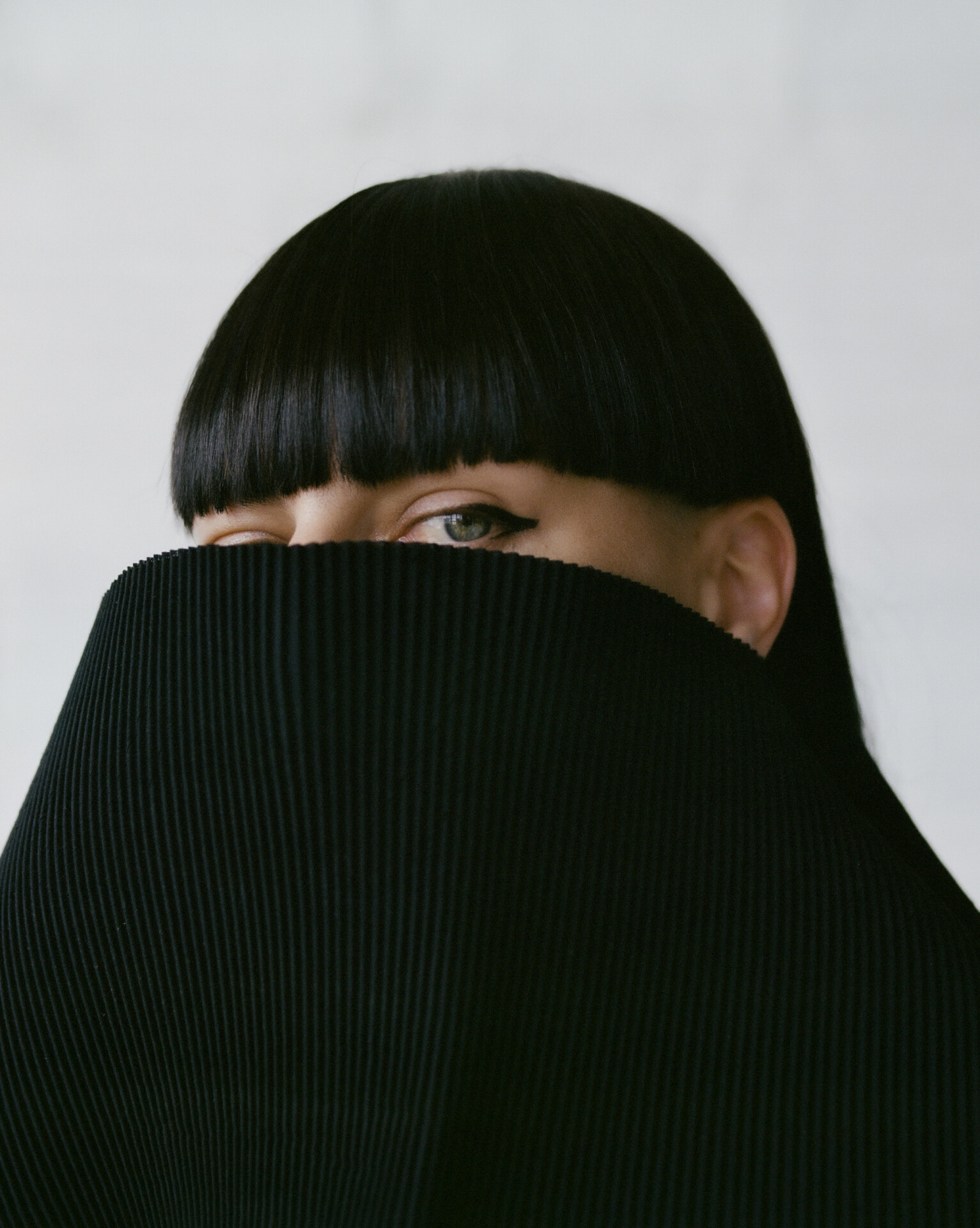
Photography by Felix Aaron.
SLEEK: Your designs are very sensual. Can you recall the moment – or moments – when you first began to forge this ‘signature’?
Melitta Baumeister: My last work as a master’s student was also my first work as a brand, and it was crucial. The sculptural approach was my fundamental drive. Handwriting was therefore never a fixed plan, but an active process that continues to progress. Working with unusual, non-fashion, form-giving materials fascinated me early on. It also has a lot to do with finding these very specific materials, because it’s the materials that make it possible for me to achieve the aesthetic connection between form and body. Maybe it’s a kind of ’fine-tuning’ that you can make everything very sharp and bring it to a point if you just screw with something long enough.
S: When I look at your designs, I immediately think of sculpture, Camille Claudel’s work in particular. In yours, I perceive a tension between limitation and deep interiority. Does this ring true for you?
MB: [Before this conversation] I was not familiar with the work of Camille Claudel. Now that I Google her, I see a kinship in the atmosphere her work creates. In my world, it’s something like [the aesthetic of] Barbara Hepworth – whose work is large-scale, smooth, and round – that takes place. Sculpture, specifically contemporary sculpture, already plays a big part in my work, though I like to think of the term in broader terms. A Hepworth work standing on a Lamborghini hood in a kitchen – that would be my animal familiar right now.
S: As you seem to acknowledge, for me, your work exists between fashion and art. But what does art mean to you? And what about fashion? How do they unite in your work?
MB: I don’t use the term art in connection with my work. What I find exciting is the idea of applied art, of things that are created with an intention to be used in everyday life and that, in the best case, are transformative.
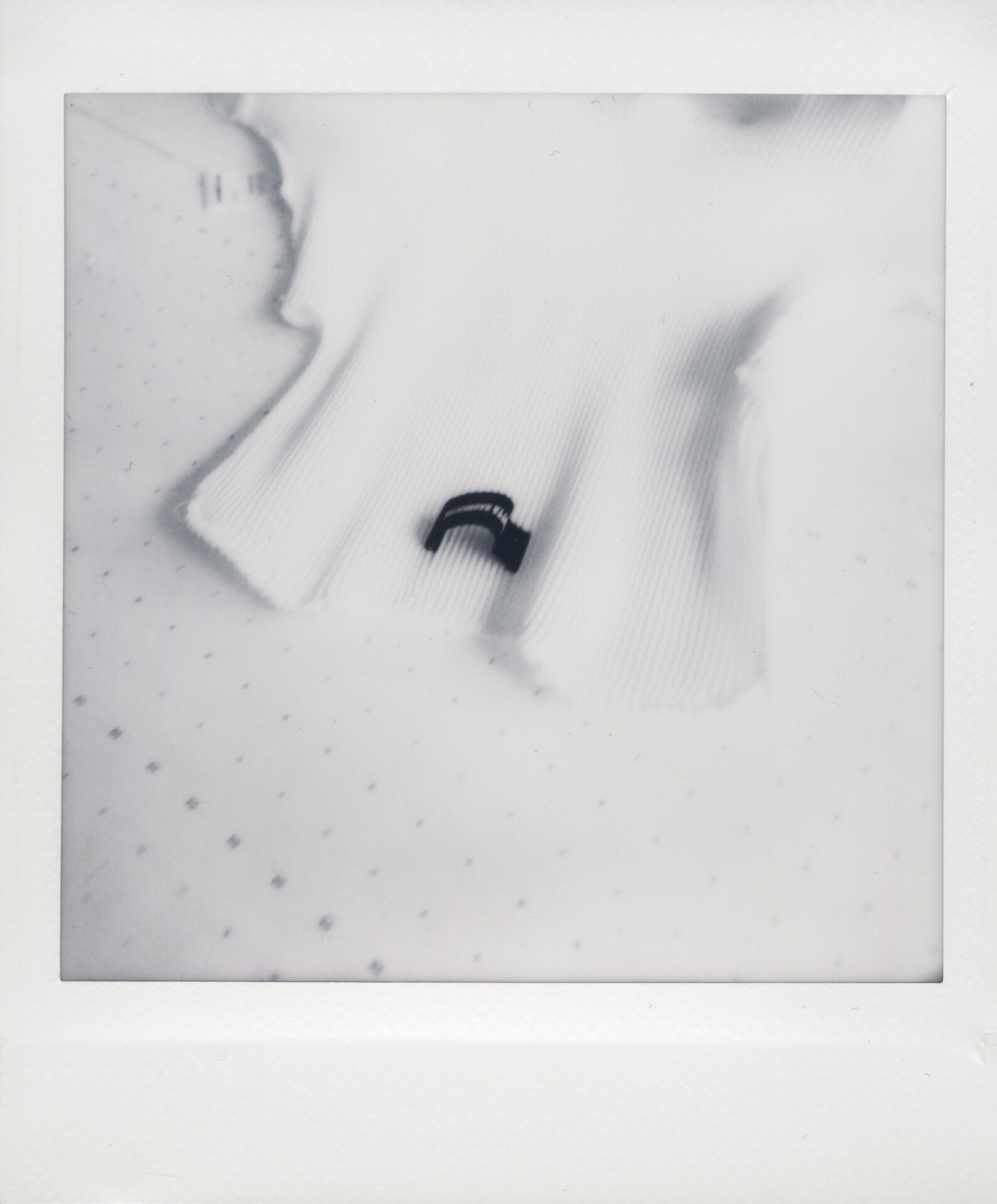
Photography by Felix Aaron.
S: I’m charmed by your silhouettes and the aesthetic. What is the path you take to arrive at them?
MB: Although I run the risk of disenchantment, the most appropriate answer I can think of is: on a bike. My process takes place in reality, which I record, observe, and then try to respond to. I ride my bike to the studio, often with a detour through Times Square to the Garment District, where we produce our clothes. As a consumer, you don’t usually see the world behind-the-scenes, but it is crucial to what is possible in the end. Ideas are one thing. But making them ethically, sustainably, and without compromise is a matter of long-standing relationships that must be nurtured. Just two blocks past the tourist center of New York, highly-talented seamstresses bring my silhouettes to life, and that’s where magic happens for me.
S: What about the body fascinates you?
MB: The body, decoupled from any identity, fashions and stereotypes, awakens the clothes. As sculptural as our pieces are, they are not finished without the body to make them move. It is the body that activates the real meaning.
S: Do you need stories to go with your collections, or is the story of a collection written as you work?
MB: I’m not so much interested in stories or big concepts, but more in playful experiments and attempts to evolve clothing and form. It gets exciting when it comes to decision-making, whether it’s while cycling, in galleries, or via music – and especially what happens in between that, and how it unconsciously ‘takes influence’.
S: What do you want to offer people through your designs?
MB: I want our customers to experience the subtle power of fashion. Every time someone personally contacts us and tells us how empowering the feeling was for them, I am overjoyed. It reminds me why I’m in fashion.
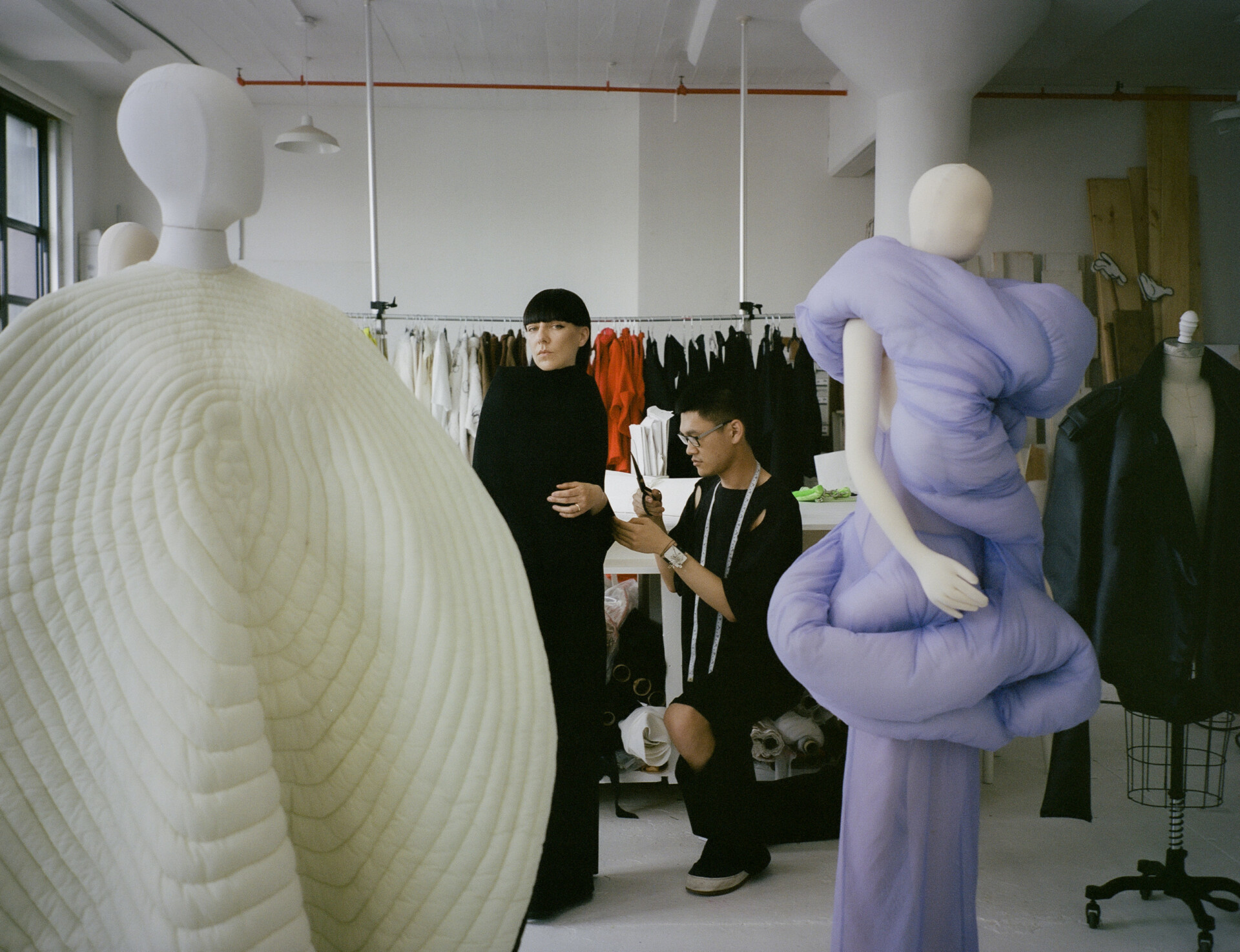
Photography by Felix Aaron.
S: How do you assess the potential your work has?
MB: In fashion, especially high-end, the question is valid; and for us, since the lockdowns, it became very clear how much we are part of a network of communities. As a small brand, we continued to make collections that then had to be produced. So we were able to help keep the network of factories, sample houses, graders, cutters, fabric vendors, etc. going. The big companies just skipped a season. My fondest memory is of my partner and someone from the team delivering mask cuts from archival materials to all five boroughs [of New York City] by bicycle. The seamstresses from the factories then sewed the masks in their garages and living rooms because of the lockdown. Through small projects like this, they were all able to stay employed. Being part of such a very personal network makes me proud. On the other hand, we have experienced much more direct communication with our customers. The community that has formed through the love of fashion and this particular aesthetic is hard for me to grasp. To experience fashion as a space for connection and communication is exhilarating.
S: And what gets you excited?
MB: The unknown and the new! Anything where I feel potential that it could become something that hasn’t been done before.
S: Can you describe an inspiration that led you down such an unknown path?
MB: I’d love to. Once, I found bananas that had turned black on the kitchen table exciting. That turned into a 3D print on sweaters and later on bags. The idea was of time passing, along with the many meanings of a banana – whether a bit kinky, Warhol, Maurizio Cattelan [whose 2019 artwork Comedian is composed of banana
taped to a wall] – and then the absurdity of telling someone about bananas.
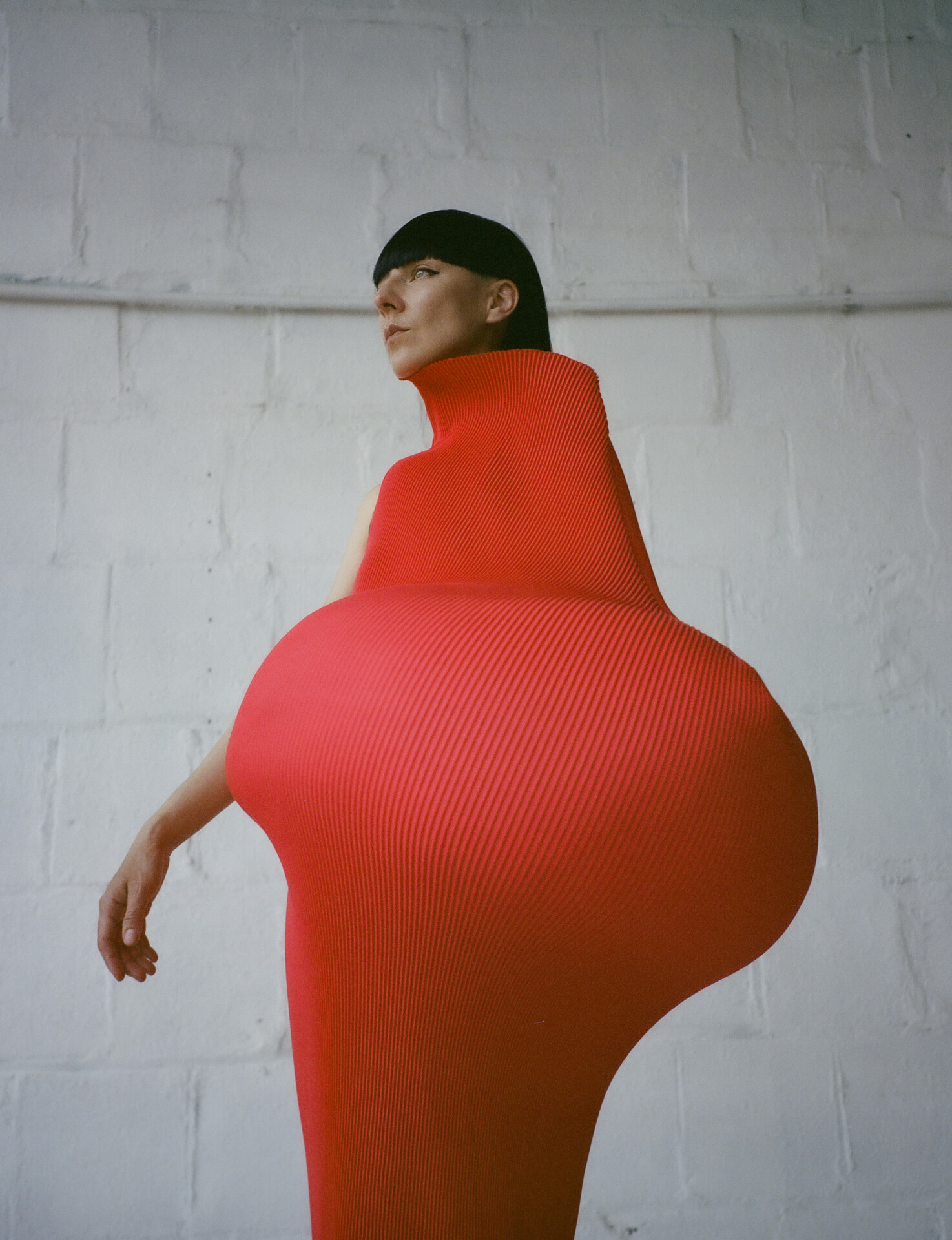
Photography by Felix Aaron.
S: That’s a nice example. Do you enjoy discovering a reference from the past and transforming it?
MB: It’s important to me to think with respect about history and the work that has been created so far. But when it comes to actively inspiring or rather motivating, I try to focus on the here and now. For me, a work or a design is good when the past, the present and the outlook on the future unite.
S: Where in your work are there images or memories of your childhood?
MB: Here in New York in my studio, it’s the sewing machines, fabrics and cuts. Everything has been with me for a long time.
S: Do you love searching or finding, or both?
M: The searching.
As featured in SLEEK 73 – PASSION. Available in print and digital hier.