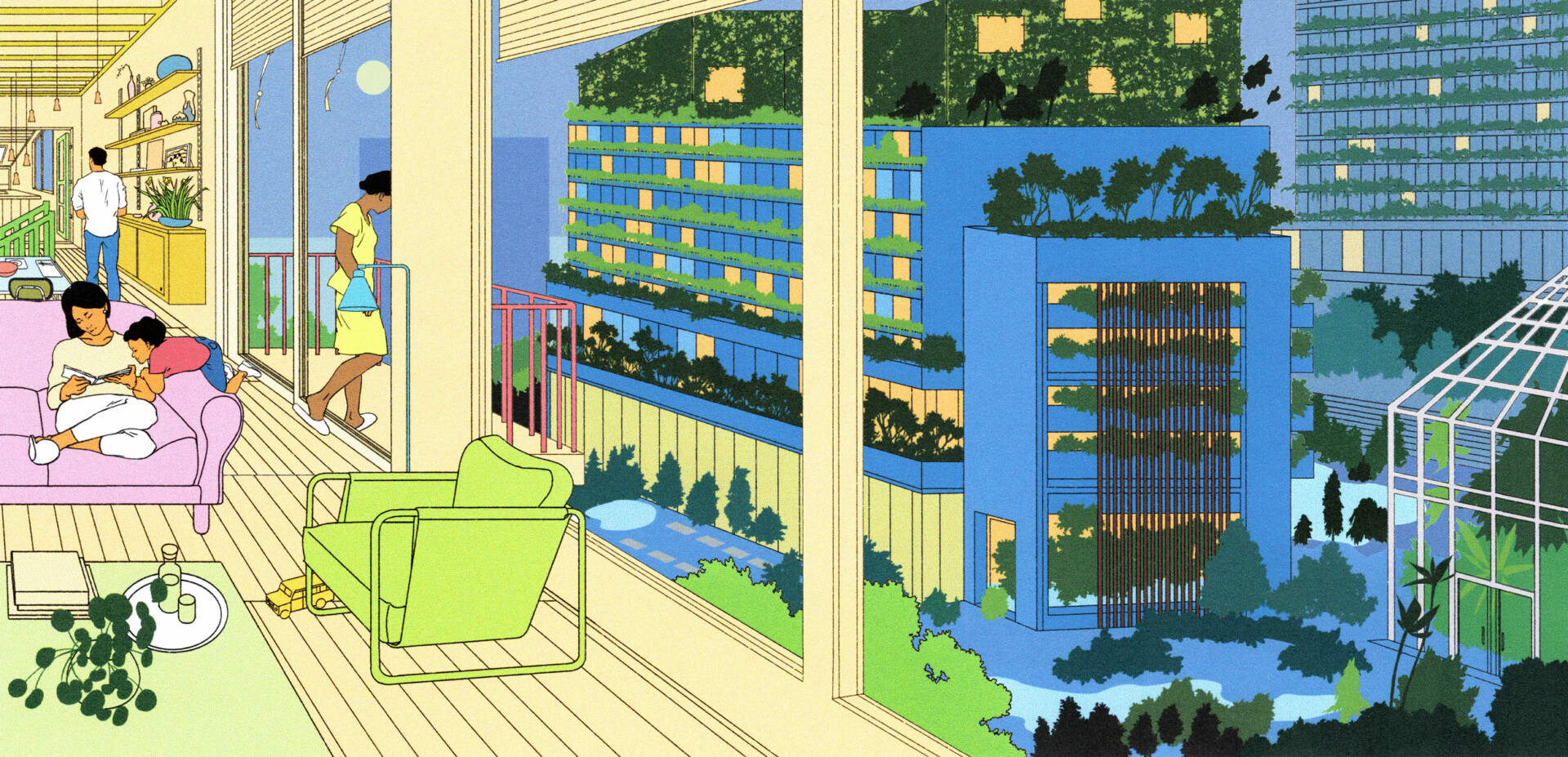
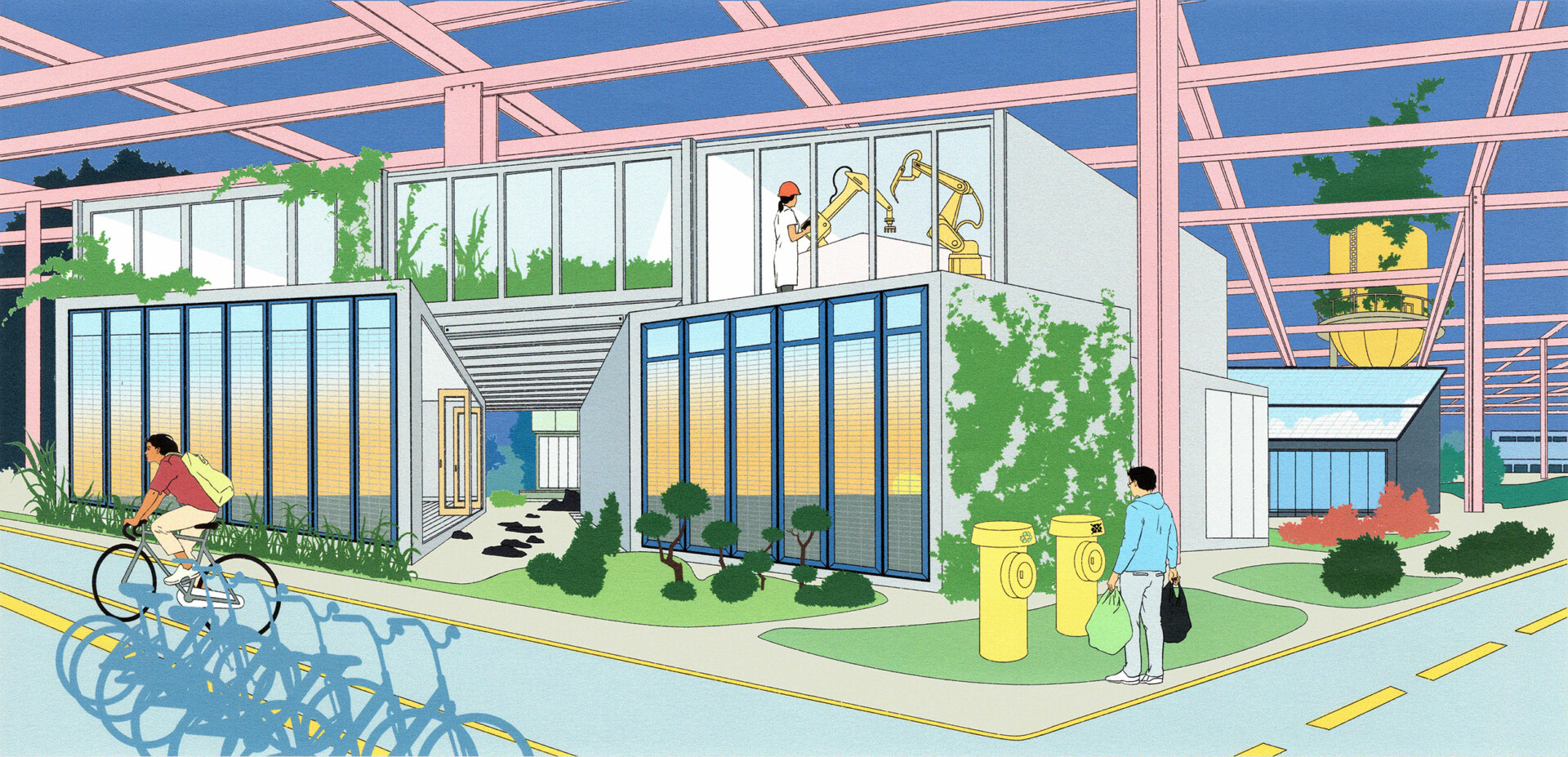
Garden City for The Ideal City 2040 by Manshen Lo
Sitting outside of his office in central Amsterdam amidst the urban din of bikes and birds, Bas van de Poel, co-founder and innovation director of the design and innovation firm Modem, explains that the future is a verb. “It’s not something that just happens to us,” he insists, “the future is being actively created at this very moment.” Together with SPACE10, a Danish R&D lab connected to IKEA, Modem seeks to bend the arc of the future towards sustainability with their collaborative utopian exhibition The Ideal City 2040. Operating against a background of profound societal future fatigue (personally, I’m exhausted by the prospect of 2023, let alone 2040), the exhibition offers much-needed solace by “giving people a glimpse of a potentially better future – or futures plural.”


Coastal City for The Ideal City 2040 by Sébastien Plassard
The Ideal City 2040, which emerged as a utopian visualization of SPACE10’s book The Ideal City (2021), brings together three artists from around the world to share their depictions of three distinct urban futures: French artist Sébastien Plassard portrays the Coastal City, Chinese artist Manshen Lo illustrates the Garden City, and Kenyan artist Wanjira Kinyua breathes life into the Solar City. What makes the visualizations so evocative is their distinct local character. Each artist brings their personal experience living in their respective bioregion to their work, rendering the technical urban solutions presented in The Ideal City book in vivid technicolor detail.
Bas emphasizes that the exhibition, and all of the projects pursued by both Modem and SPACE10, strive to connect the right brain with the left brain – the rational with the emotional. Simon Caspersen, co-founder and communications director of SPACE10, explains their intention behind complementing the initial book with a corresponding exhibition: “We chose to bring it to life so ordinary people could experience what our cities could look, feel, and sound like if we decided to create a better everyday life for people and the planet.” It’s one thing to hear about a solution and another thing entirely to recognize it as a legitimate possibility in the present moment. The exhibition makes a truly sustainable urban future feel within our reach. It makes a green future more tangible.
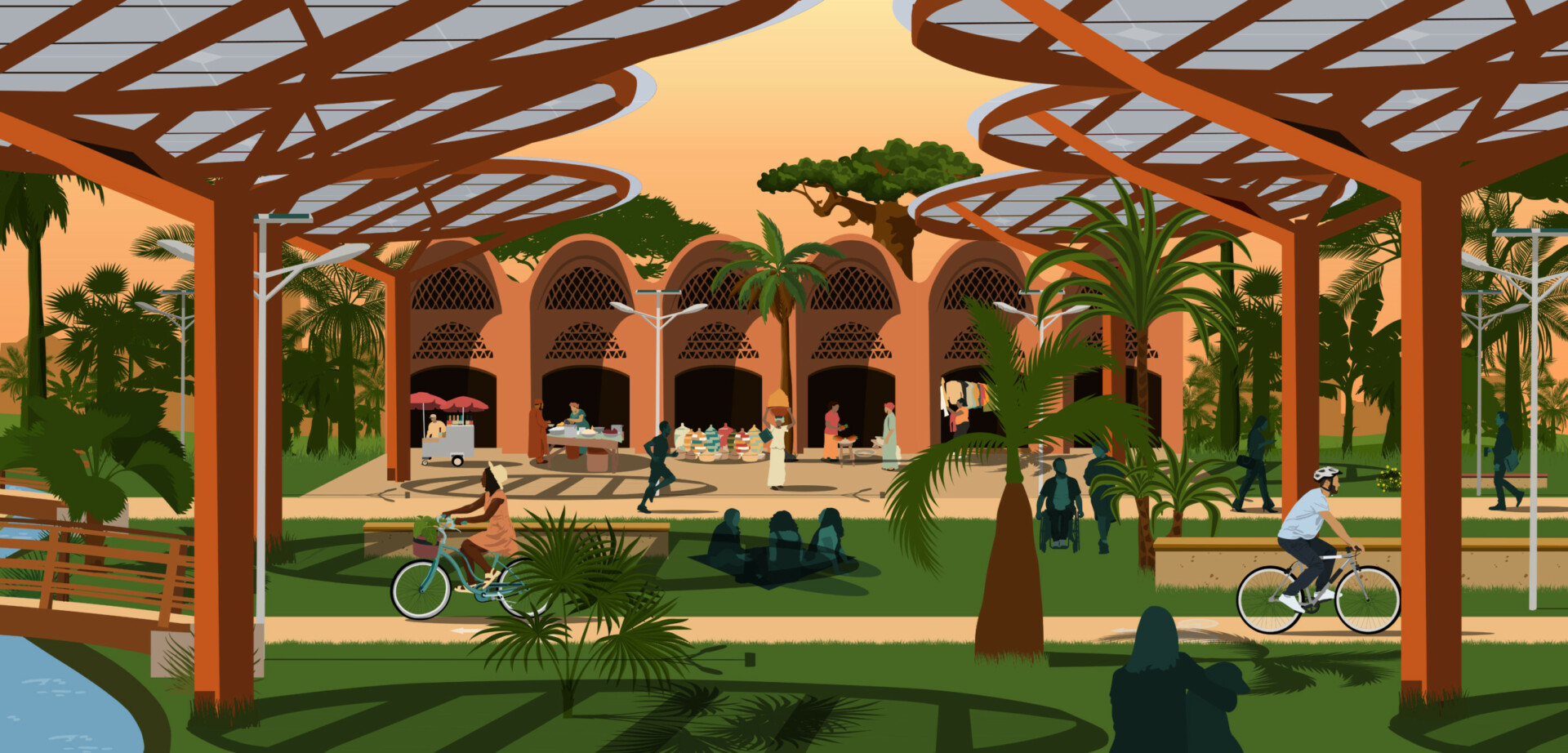
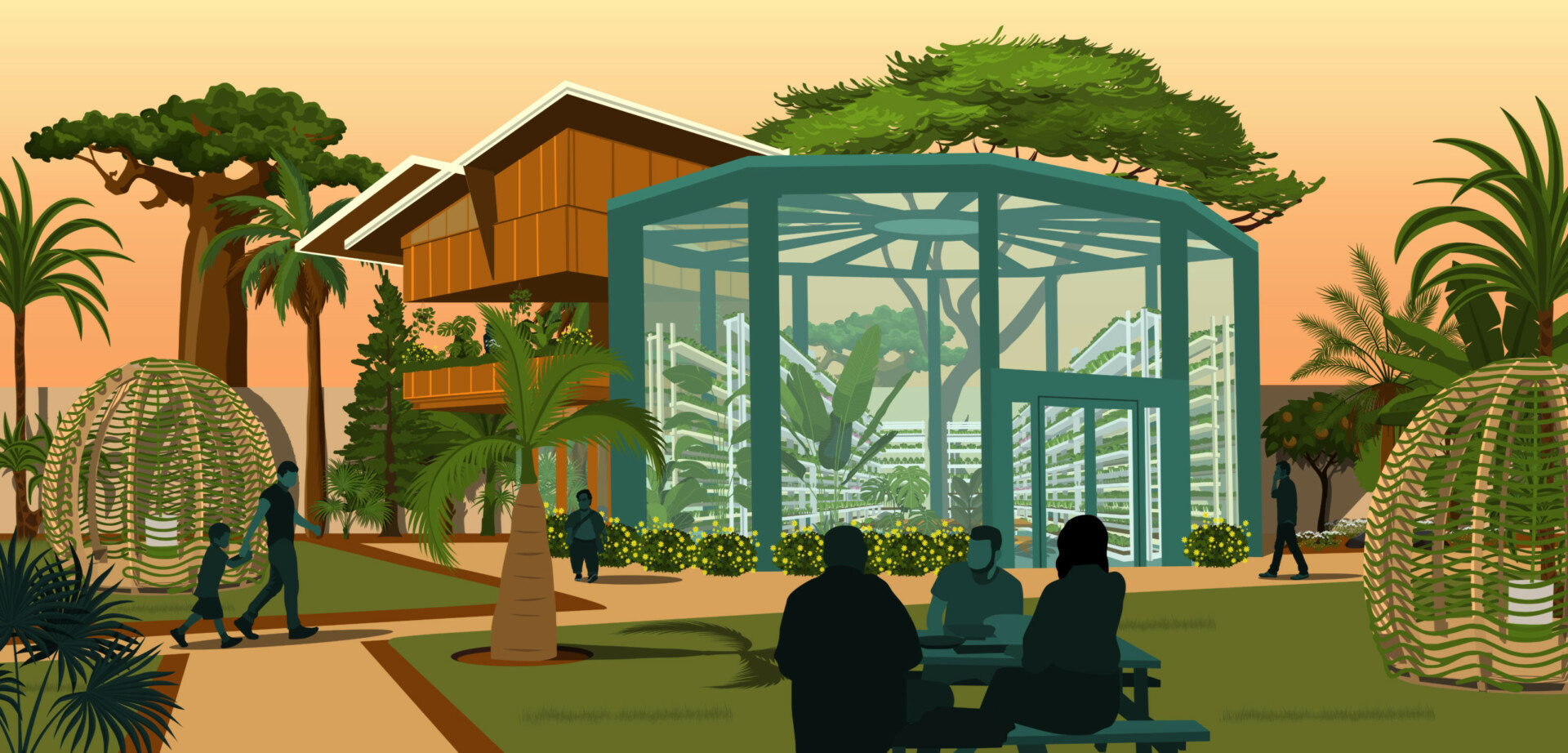
Solar City for The Ideal City 2040 by Wanjira Kinyua
Integrating digital and analog technologies, The Ideal City 2040 prioritizes the audience experience to a charming and nostalgic effect: what looks like a coin-operated set of urban binoculars turns out to be a portal to a virtual reality. Instead of peering into the distant horizon of your local cityscape, you are invited to peer into the not-so-distant future. Grounded in the father of ubiquitous computing Mark Weiser’s understanding of smart technology as intuitive technology, the exhibition is accessible to all generations. As Bas notes, “Both kids and elderly people could use it instinctively. There’s no friction – it’s basically a seamless experience, which I think is highly important, especially in the public context. If we had just opted to use a VR headset, it probably wouldn’t have been as intuitive for everyone.” Through these nostalgic binoculars, the future is nothing to wince at; it’s familiar and inviting – merely a more sustainable reformulation of landscapes we already inhabit.
"when I google 'future cities,' my algorithms present me with visions of sterile cities with chrome-like skyscrapers and polished white males in fancy suits in flying drones. There’s no community, no diversity, and no nature besides humans. That is not the future I dream of."
The Ideal City 2040’s accessible and climate-conscious formulation of the urban future is far from the only one out there – at this point, utopian space is still a battleground. Different visions are competing to shape the urban trajectory. As Simon points out, “the people who envision the future often end up shaping it – today, that’s often left to tech giants and the movie industry.” He elaborates, “when I google ‘future cities,’ my algorithms present me with visions of sterile cities with chrome-like skyscrapers and polished white males in fancy suits in flying drones. There’s no community, no diversity, and no nature besides humans. That is not the future I dream of.” In this context, envisioning the future from a bottom-up approach and prioritizing the resilience of ecosystems is a radical act. Instead of letting Mark Zuckerberg convince us that the Metaverse is the future, The Ideal City 2040 prompts us to consider it in terms more intimate and local: “we wanted to propose an alternative to this dominant vision of the future cities.”
This attitude is subtly subversive – throughout The Ideal City 2040, you’d be hard pressed to find an explicit reference to politics or ideologies like colonialism or capitalism, which are increasingly intertwined with climate change discourse. Instead of fighting the old, Bas explains, their attitude is decidedly future-oriented: The Ideal City 2040 strives to create the new.
Critically, creating the new in The Ideal City 2040 does not mean creating one fixed vision of how an urban landscape ought to be. By sharing three visually and technically distinct yet equally valid urban utopias, the exhibition unsettles the Western understanding that a “modern” city can only look, feel, or be one single way. Bas calls this kind of modernist universalism into question with reference to one of the buzzier terms in contemporary urban design, the “smart city.” “There is a certain arrogance in the Western perspective – that we alone hold the truth or the solution,” he says. “The notion of the smart city is a very Californian, Western approach to the city. It’s a very strategic term because it implies that our current cities are dumb – which is simply not true.” The smart city-as-technological city paradigm loses currency when it is foundations are questioned. The Ideal City 2040 asks what if ‘smart cities’ were taken to mean sustainable cities? Or even accessible cities, in which everything can be reached within a 15-minute walk?
While top-down visions of urban design executes grand visions that so often sacrifice accessibility and sustainability at the altar of ego – The Ideal City 2040’s bottom-up visions take their design cues from local contexts. As Simon explains, “Each speculative city is grounded in a specific bioregion of the world, which also influences the climate stressors that people are challenged by and the opportunities that each city has, which then influenced the suggested solutions for each city.” The song of the hyper-local brings Icarus down to earth. In The Ideal City 2040, modernist impositions of desire onto landscapes are replaced by designs appropriate to and deriving from the specific sites in question.