Carlo Capasa is the president of the Camera Nazionale della Moda Italiana (Italian Fashion Association). He is a long-standing member of various non-profit organisations that aim to promote the development of Italian fashion in the national and global market. In his new position, he focuses on sustainability and specifically on supporting emerging Italian design talent.
Christian Bracht: What drives you to care about the well-being and protection of our planet?
Carlo Capasa: Even as children, my brother and I enjoyed recycling fashion. I grew up in the Seventies with the attitude that we have to take care of our planet. I come from the south of Italy, so I am familiar with the issue of saving water. I grew up with the sea and nature, both of which are a natural part of my culture. When I joined the Camera della Moda in 2015, I really wanted to bring new perspectives to the fashion industry. We Italians have a particularly great responsibility because we are the main producers of high-quality fashion in the world. Italian fashion accounts for 41 percent of European production. It is an uplifting feeling to be able to say: Wow, we are so important in fashion! But it is also a big responsibility. At the start, we were mainly concerned with changing the culture within the companies and then the culture with the consumers. We managed to bring everyone to the table and that was a big revolution.
CB: Why revolution?
CC: Because usually in the fashion industry every brand works for itself and is jealous of the output of other brands. But sustainability is a topic that concerns us all; if we don’t co-operate on this, it doesn’t work at all. This means that everyone – from small producers to big retailers – has to pull together. From this idea, we as an organisation began the exciting journey of fundamental change. I vividly remember the first meetings with the fashion houses. Today, 92 percent of our production network in Italy is adhering to our guidelines, which is proof of a shared success. There is still so much to do, since there is much greater awareness in the industry than there once was.
CB: I like your idea that every industry can work on ideas that make the world a better place. Do you see sustainability as an important competitive advantage?
CC: Yes, of course! Italy plays an important role, but focusing only on Italy doesn’t make sense. We can be a driving force, but we must not forget that we are all together in one boat and this earth is the only one we have. So we have to be very aware that we have a contribution to make. Each one of us – whether in Italy or in another country – can show the way with work, with ideas, with actions. I will give you an example: the circular economy is the basis for sustainability when we think about products and fashion. This means that we already have to think about sustainability when we make products. When you design a garment today, you should already be taking into consideration the garment’s use at the end of its life. A new approach to creativity that involves a new way of thinking, a consciousness, also plays a central role.
"My wish is to move from fast fashion to democratic fashion. Democratic fashion is also about respecting the workers in the production chain right up to the end."
CB: How do you exchange ideas with other organisations?
CC: I exchanged ideas with all the other national fashion councils from the beginning, especially the French CFDA and the British Fashion Council. I told them right at the start, let’s act together… which was really not that easy. An intensive exchange developed, especially with France. We all agree that sustainability and mutual respect among people must always be at the heart of what we do. Our European culture is very much about respect for people, respect for the planet, respect for the environment, respect for what we are a part of and for creativity. When we talk about fashion, we always put creativity front and centre because it alone has the tools to be modern and to capture the times we live in. Marketing no longer dictates the rules of fashion. That’s why we have to protect and promote creativity in a very special way.
CB: How do we ensure that everything doesn’t just remain a commitment, but that your vision is realised and becomes a benchmark against which future thinking on the subject is measured?
CC: We give out the Sustainable Fashion Award every year. This is an ideal opportunity to put our projects in the spotlight. We invite all the CEOs and sustainability managers of the brands to this event to engage in conversation and exchange ideas. The results of these conversations are tangible rules and guidelines. Our main objective is to issue more and more guidelines that everyone can follow and understand. We want to create clarity, especially where the fashion industry’s carbon footprint is concerned – since this is the most important issue for the future of our planet. Here, too, we are getting involved by giving all brands guidelines that relate to the carbon footprint and saving the oceans. In Italy, this year we started to make every high-end luxury brand also responsible for the end of life of a product. So these are very real activities that are changing the perspective on fashion and sustainability.
CB Can I ask where you would wish us to be in five or ten years’ time?
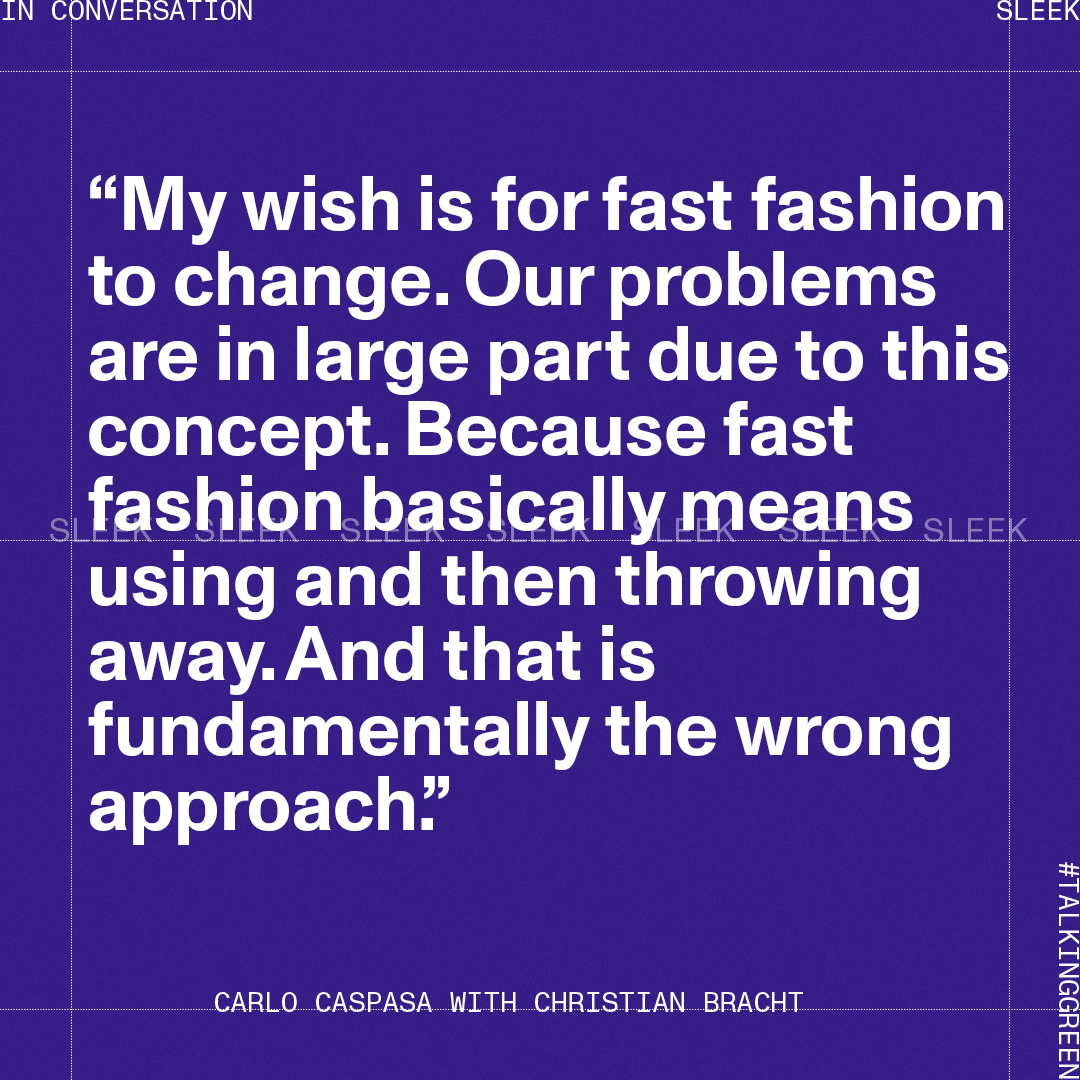
CC: My wishes are not focused on high-end fashion. My wish is for fast fashion to change. Our problems are in large part due to this concept. Because fast fashion basically means using and then throwing away. And that is fundamentally the wrong approach. I think it’s good that more democracy is coming into fashion. My wish is to move from fast fashion to democratic fashion. Democratic fashion is also about respecting the workers in the production chain right up to the end. We cannot go on like this and accept that 30 percent of the production of fast fashion is destroyed even before it is sold to the customers. A large part of this ends up in Africa. In the future, garments must be produced with a view to a long, useful life. That is my biggest dream. It’s strange, but I believe very much in us humans and in beauty and a new vision of fashion.
Wie in SLEEK 74 - IDENTITÄT vorgestellt. Erhältlich in gedruckter und digitaler Form hier.