Dressing is an intimate act so deeply intertwined with human experience. As is the very making of the clothes we dress ourselves in. Garments hand stitched, meticulously pieced together, carefully dyed. Some of the craftsmanship behind certain techniques dates back millennia. And yet, with the rise of faster fashion, where garments are offshored and outsourced to land where currency values differ and labour is cheaper, where production is at the expense of working conditions, we seem to have lost sight. Round the clock access to fleeting trends, near-instantaneous delivery, single usage and throwaway culture. Subsequently, the gap between the people making a garment and those wearing it grows ever-wider. We’ve lost touch.
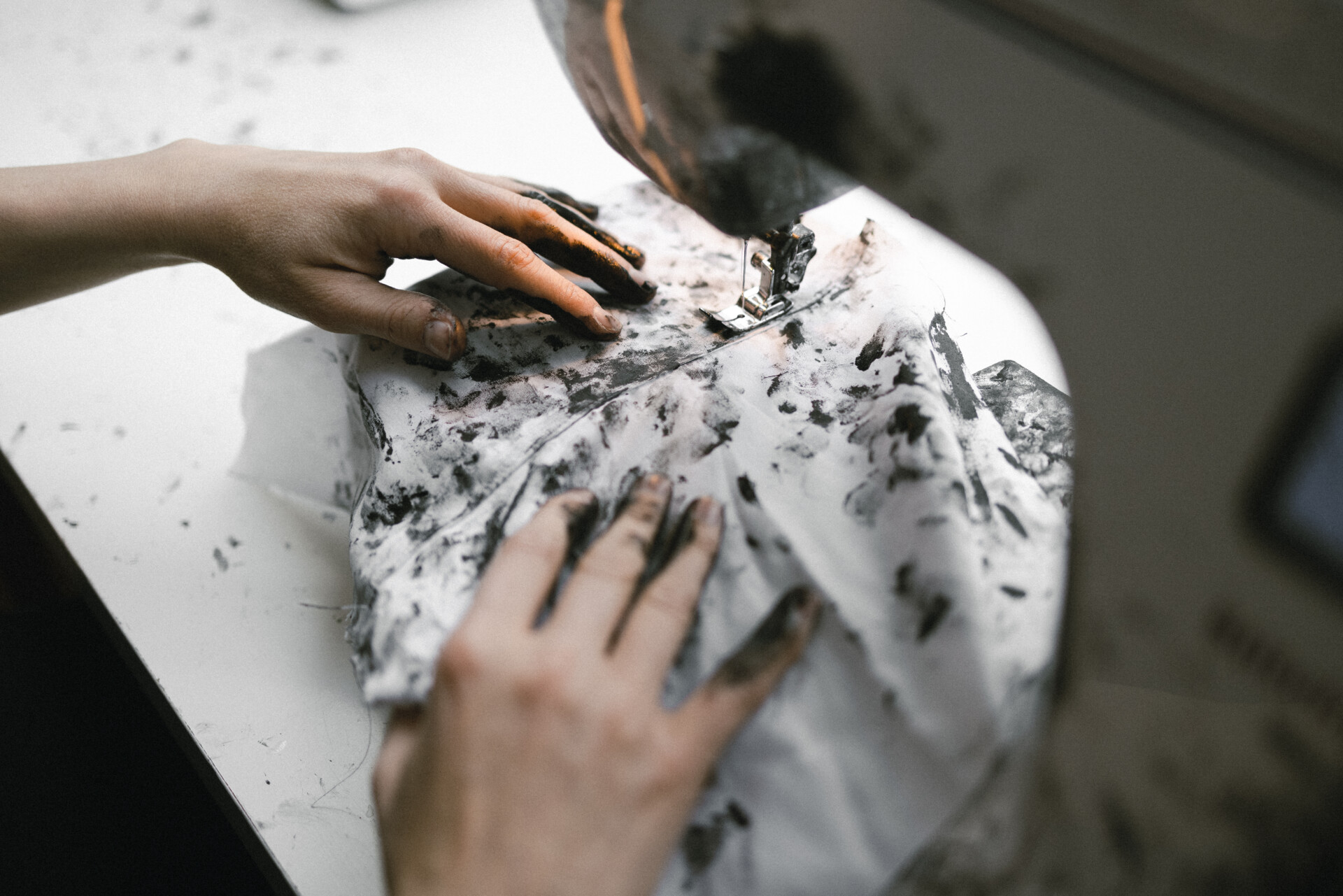
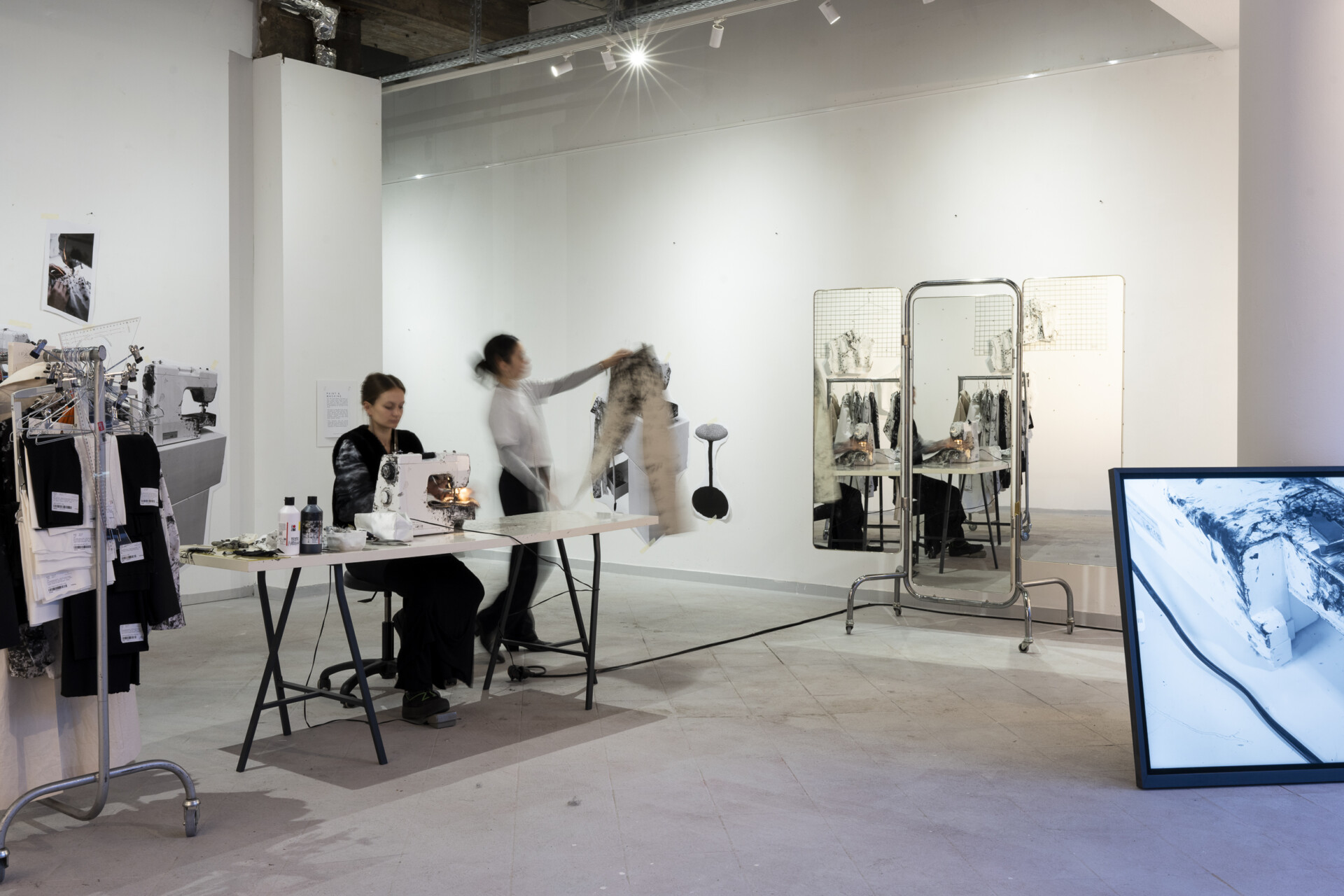
It’s on this gap that Berlin-based brand HUMAN TOUCH focuses, commenting on the disconnect between the excess of clothes that rely on human labour and their consumers by making the human labour that is so essential to garment manufacturing visible. Using paint-sewing to mark fingerprints onto clothing as it is made, each made-to-order piece hosts a unique amalgamation of printed fingerprints visually demonstrating how integral human touch is to the production of a garment. Through workshops, pop-ups, installations and performances, including an exhibition at Potsdamer Straße, HUMAN TOUCH looks to close the gap between the human making a garment and that wearing it.
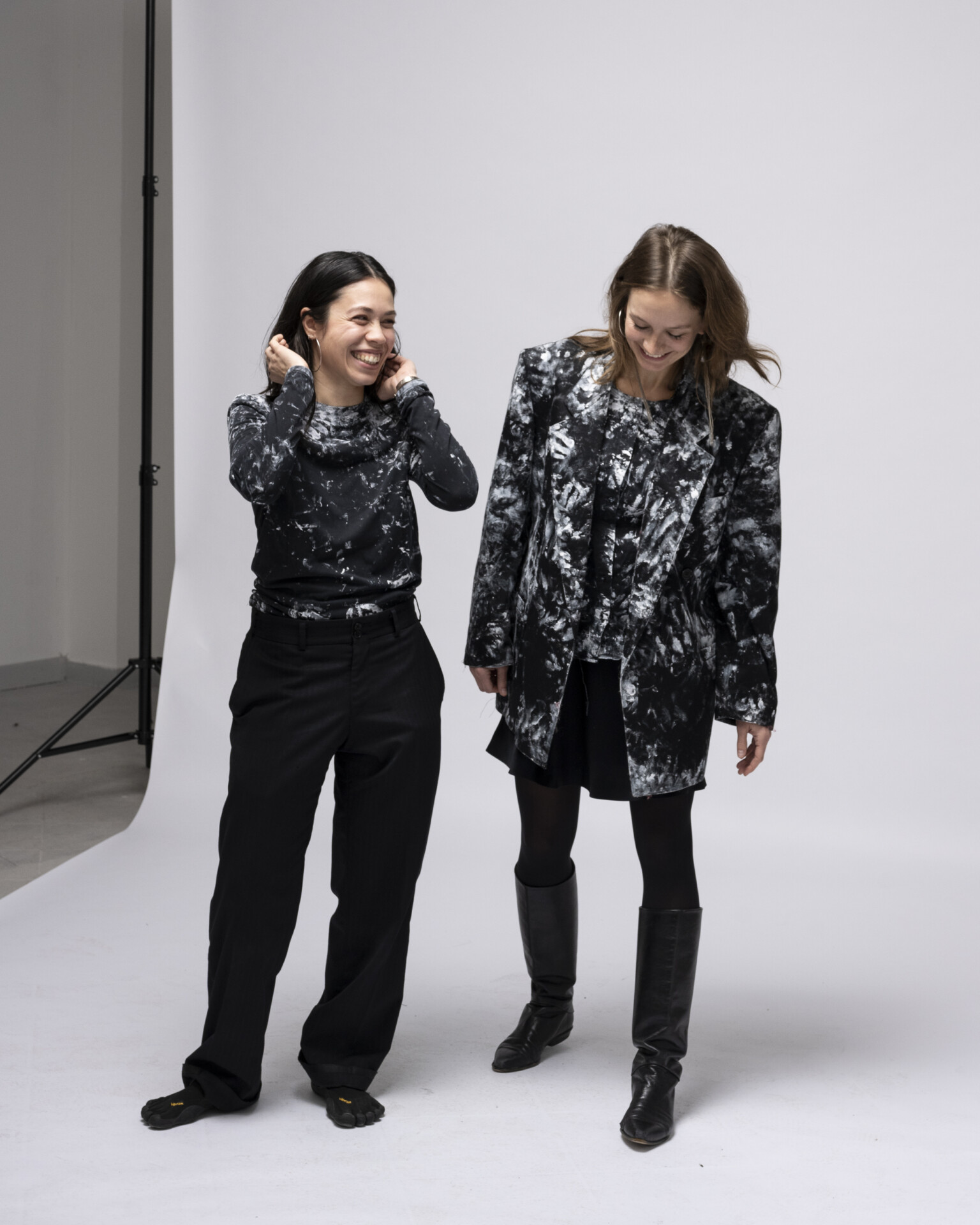
HUMAN TOUCH was founded in 2023 by Juliet Seger, a tailor, clothing engineer and sustainability designer, and Christina Albrecht, from theoretical foundations fathomed in 2020 during Juliet’s masters degree in Design for Change. What started as a conceptual project has evolved into a brand, launching at Berlin Fashion Week in February this year. Education remains the duo’s raison d’etre, but simultaneously, they hope to celebrate some of the fun and inspirational facets of fashion.
“HUMAN TOUCH will always be concept first and fashion brand second which is why we consider ourselves an activist brand,” says co-founder Christina Albrecht.
Using fabrics from second-choice wholesale suppliers, dead stock traders and local markets with a focus on natural fibres, regenerated cellulose and minimal fibre mixes, as well as using second-hand pieces for their upcycling line ‘Remedy’, Juliet and Christina are committed to creating as sustainably as possible.
ROSE DODD: Let’s start on the concept behind HUMAN TOUCH.
Juliet Seger and Christina Albrecht – HUMAN TOUCH: We’re trying to point at the disconnect between the omnipresence of clothes and the production processes that are fundamentally powered by human labour. At HUMAN TOUCH, we’re trying to close the gap between manufacturer and consumer. How is it that clothing is visible everywhere around us, regardless of an individual’s interest in fashion, and yet the origin of these pieces remains so opaque, invisible and, more often than not, probably irrelevant to the wearer? By making the invisible, the fingerprints of those behind the making of a garment, visible, we want to spark the fascination, respect and empathy that can equip us to make ethical purchase decisions and avoid the thirst-traps of our current economic system. HUMAN TOUCH will always be concept first and fashion brand second which is why we consider ourselves an activist brand.
RD: Where do you think the disconnection between the garment maker and garment wearer has come from?
HT: The biggest factor is the globalisation of the supply chain and the relocation of clothing production to countries with cheap labour (and poor working practices) resulting in a strict separation between communities that produce clothing and those that mass consume them. Countries like Germany or the UK used to have clusters of clothing factories. Many of these started reducing their volumes or closing down in the 1980s and later. With the crazy rise of fast fashion (dependent on cheap production abroad) in the early noughties and until today, these regional factories could not compete. Without a local industry, there is no need to train young people for it and henceforth, there is little to no opportunity to engage in tailoring and people generally aren’t trained in clothes making.
RD: And a great deal of specialised knowledge and skill went with the offshoring of textile manufacturing…
HT: As well as the need and hence motivation for technological innovation on garment manufacturing moved abroad. How a piece of clothing is made becomes a black box to the consumer.
RD: Can you think of any other cultural phenomena that might be relevant to the manufacturer-consumer disconnect and its conception?
HT: Another angle on the origin of the disconnect can be found in the perception of sewing as a task attributed to and suitable for women. In a world where women’s work is often perceived to be worth less, it is not a coincidence that sewing is often categorised as “low skilled labour”. As such, sewing has been taken less seriously as an occupation worth investigating and valuing from an anthropological standpoint.
It’s also important to note that due to where we’ve lived and worked we have a very Euro-/US-centric perspective when we talk about “the consumer” and the dynamics of clothing consumption.
RD: Acknowledgement that the fashion industry can and must do better is hitting the mainstream.
HT: What is quite interesting to us is that “mainstream” fashion as we know it now is built on the premise that sewing is low-skilled labour rather than a craft associated with a certain level of worth. While the technology itself is basically the same whether it’s within a sewing machine in Dhaka or in Paris, it is the system around it that dictates how much value is attributed to the physical output. In both cases the people who labour in the background are not too different from each other. It’s easy – and important – to point fingers and make statements about what and where companies and consumers are doing wrong but at some point, this must be followed up with actual attempts to break bad habits and find viable solutions – without this, hypocrisy becomes a risk.
RD: What separates clothing from other manufacturing industries?
HT: Mostly the human input. Innovative technologies are in development but it will be decades before any of these will become cheap enough to replace low-paid and technologically adaptable labourers on a mass scale. Of course, there are ways to automate parts of the sewing process, but it’s difficult to replace human dexterity.
RD: Tell me about how HUMAN TOUCH is structured. You’ve done some pop ups, performances and workshops too, right? What do you hope to achieve through such a model?
HT: The theoretical foundation and initial idea of paint-sewing was created in 2020 during Juliet’s Master in Design for Change in Edinburgh. In 2023, we joined forces to grow HUMAN TOUCH from a project into a clothing brand. Our aim is to avoid replicating the problems that everyone knows exist around the industry while still living and putting out there the inspirational and fun facets of fashion. To do this, HUMAN TOUCH does not follow this one business model based solely on selling goods through which volume sold signifies success. Rather we want to be flexible by offering made-to-order and upcycled products as well as in-person experiences like showcasing the paint-sewing technique in front of open or private audiences.
RD: What role does education play at HT?
HT: Putting garment workers under such existential pressure in order to produce amounts of clothing we will never be able to wear in our lifetime cannot be considered sustainable. By broadening the perspective on garment manufacturing and showing a deeper dimension behind it, we hope to spark interest and respect if not even a certain level of fascination towards how clothes are made. Perhaps consumers will feel more connected to the objects – not only to ours but to any piece of clothing. It’s a bit corny but it’s true – people have to attribute more value to physical products in order to be less wasteful. With the immense waste caused by the fashion industry it is necessary to find alternative and less resource intensive ways of consuming.
RD: If you could recommend one resource for education, where would you point us?
HT: Learning by doing is definitely the most fun way, perhaps even the most effective. Sewing technology is quite accessible in the sense that you can use just any sewing machine (you don’t need an expensive or new one) and you can make something that is of use to you, be it a repair or an object made from scratch. If you’re a bit impatient it’s easier if someone shows you how to get started, for example in a sewing class, but once you’ve got the general hang of it you can teach yourself how to make anything really, from a tote to a coat. Giving sewing lessons to children and sewing entire outfits with them made us notice how adults often tend to be more cautious not to make mistakes rather than just giving it a go.
RD: Let’s move on to the brand itself. Tell me about the design process.
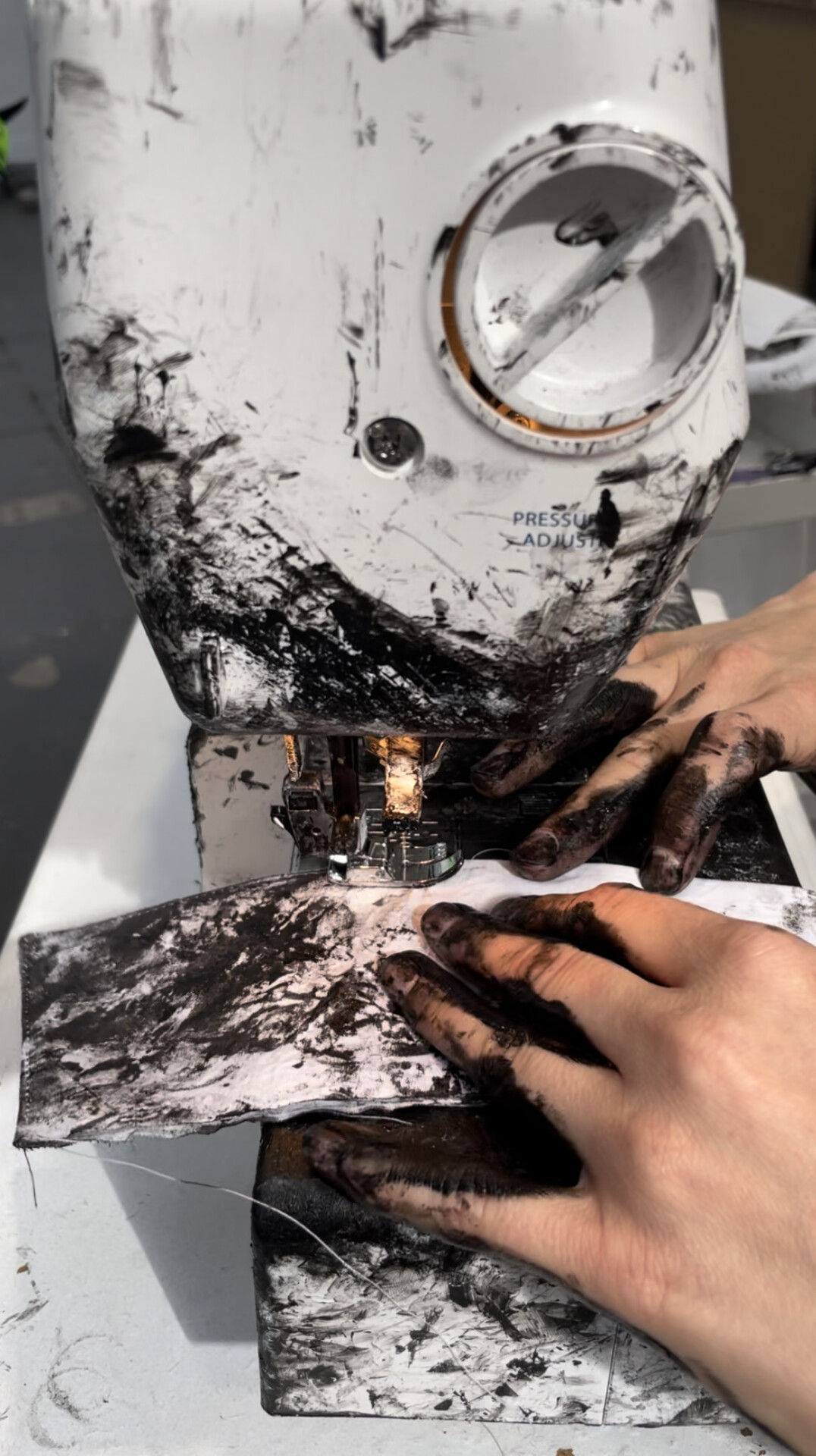
HT: Our design process is a very practical one. HUMAN TOUCH garments follow a normal sewing process with the difference that three to four times per minute the machinist dips her fingers in paint, therein directly printing the fingerprints from the manufacturing process onto the fabric. Areas of a garment that require more handling appear more densely painted. Overall the resulting pattern is quite dynamic, a combination of vague strokes and actual distinguishable fingerprints. To counterbalance the “messy” print design we choose silhouettes that are clearly legible: collared shirts, denim jeans, clean cut coats – items with clearly defined and recognizable tailoring details. Afterwards we heat the garment to fix the textile paint to the fibres making them wearable and washable.
Since the paint-sewing technique is new, we explore in practice which fabric surfaces are suitable or which shapes translate well. Our fabric comes from wholesale suppliers and dead stock traders. For sampling of individual pieces and prototypes we also buy at local markets that offer dead stock or second-choice fabric. We focus on natural fibres and regenerated cellulose, and avoid fibre mixes and synthetics when it doesn’t serve functionality.
For our upcycling line HUMAN TOUCH Remedy, we source second-hand and vintage pieces that suit our aesthetic vision and sew over the existing seams with the paint-sewing technique, sometimes doing repairs or adding stitching for design purposes. This is a fun way of experimenting with the paint on new shapes or materials but from a business perspective also allows to balance the more work-intensive and made-to-order original HUMAN TOUCH pieces.
RD: Since launching at Berlin Fashion Week in February this year, how has Berlin responded to HUMAN TOUCH and do you think it’s a city that aligns with your values?
HT: The fashion scene in Berlin is less formally established than in other cities like London, Paris or New York where a variety of commercially viable brands exist that create a pathway and network that a young brand can follow. That’s not a negative thing as it seems to allow for more experimentation. This translates to the style that comes out of Berlin which is, for example, not as formal as Paris or less commercial than New York. To us, Berlin has so far felt very welcoming and open which suits HUMAN TOUCH very well, as it is still growing and developing. Our brand launch during Berlin Fashion Week was testament to this and we felt in good company seeing other brands with very conceptual approaches transcending the mere physical objects.
RD: If you could describe the statement you’re trying to make at HUMAN TOUCH in one sentence, what would it be?
HT: Try to envision the invisible: the fingerprints of tailors, garment workers, machinists covering every piece of clothing you wear.