
Elnara Nasirli. Photography by Oktay Jaffar.
Art meets activism, and tradition meets technology in the work of Azerbaijani artist Elnara Nasirli, a rising voice in bio-art and ecological installation. Her practice explores the quiet intelligence of nature and the looming presence of a post-human future, often through large-scale works that blend living materials with sound, breath, and machine logic. In 2024, she was awarded the Blend Forward Award by Berlin’s BBA Gallery, a public prize sponsored by Lavazza, whose deep commitment to fostering cultural dialogue continues a legacy that dates back to the visionary advertising work of artist Armando Testa in the 1950s.
For Lavazza, coffee has always been more than a beverage—it’s a creative spark and cultural symbol. From the iconic Lavazza calendars of the 1990s, created with photographers like Steve McCurry, to its ongoing partnerships with institutions like the Guggenheim in New York and the Mudec in Milan, the brand continues to invest in the future of contemporary art. In Germany, this commitment recently took form in the Blend Forward Award, designed to uplift emerging talent and give visibility to new artistic voices.
As Susanne Wege, General Manager DACH & Poland at Lavazza Group, puts it:
“For us, cultural engagement means creating spaces where creative exchange can happen and artworks can come to life… At Lavazza, it’s clear: we want to actively help shape the future of art and culture – as a partner, a supporter, and a platform for people who tell stories through their art and bring others together – just like a shared moment over a cup of coffee can.”
In this conversation, Nasirli discusses dead trees that sing, artificial lungs for a future without forests, and the uneasy rise of AI as both creative tool and existential threat. The result is a vision of art as interface between nature and machine, science and emotion, beauty and loss.
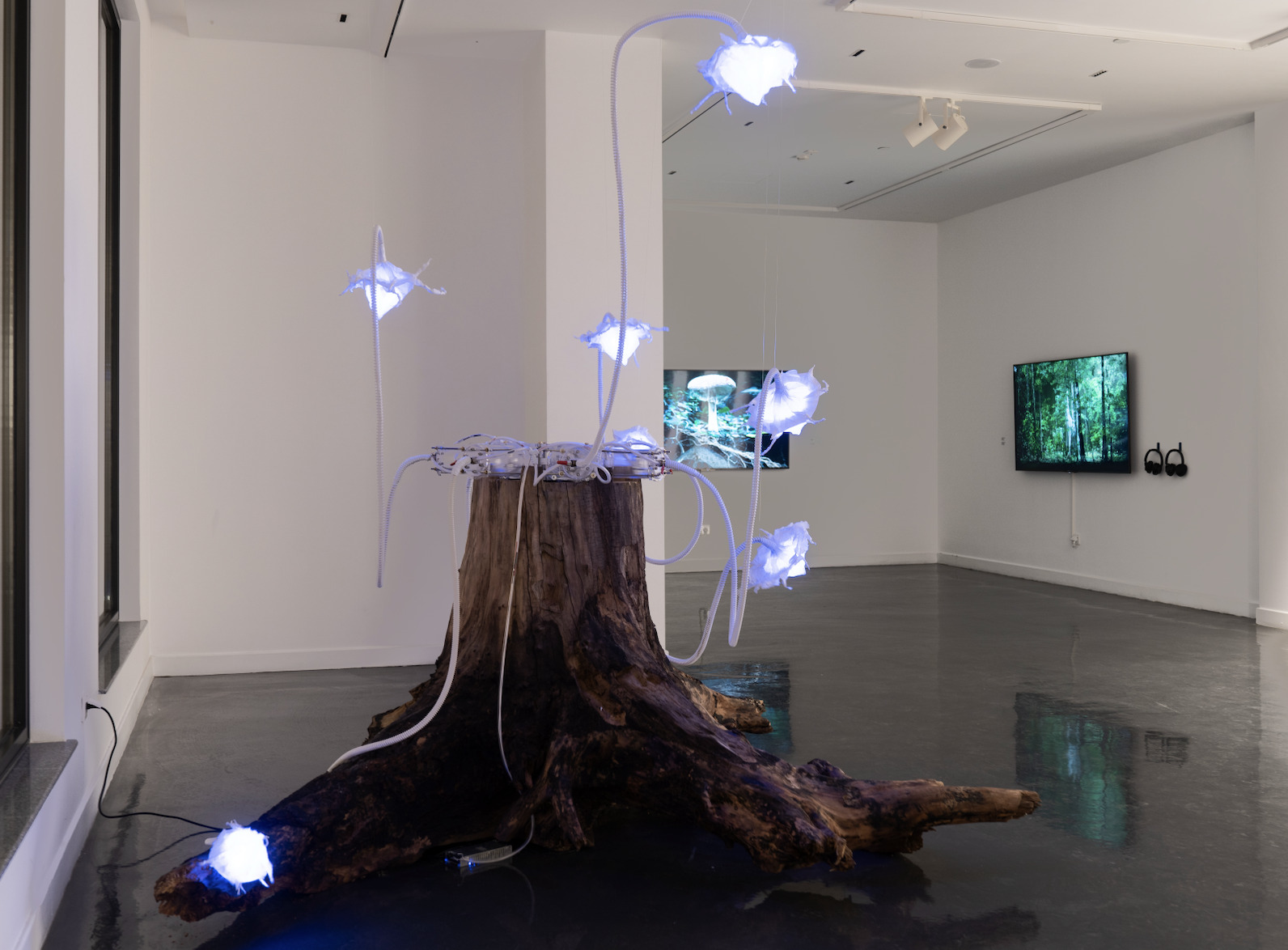
Air Oasis. Image Courtesy of Elnara Nasirli.
SLEEK: What’s the strangest material you’ve ever used in your work?
Elnara Nasirli: In general, I’d say fruit. I once created an edible painting in the forest using fruit picked directly from trees. It was meant to show that art doesn’t have to last forever. It could exist just for a few minutes—and that transience can be beautiful.
S: That’s a powerful idea. I also wanted to ask about your work for the BBA. Was that project created specifically for the exhibition?
EN: The tree installations shown at BBA grew from a series that began with Whispering Forest, originally exhibited in 2023 at MoMA Tbilisi. The trees came from my grandfather’s garden in Azerbaijan, as well as from the Abkhazia border in Georgia. They’d died naturally, and I wanted to bring them “back to life” through sound—each tree is connected to a live audio system that translates its bio-signals into music.
S: So it’s a very personal piece?
EN: Very. My grandfather’s mulberry tree was the first, and mulberry trees are deeply healing in my culture. People hugged that tree and told me it felt like home. That connection to emotion and memory is at the core of the piece. Each time I install Whispering Forest in a new place—Venice, Baku, Berlin—I use a tree from that specific region, like olive in Italy or teak in Germany. It’s important to me that these works stay rooted in the land they’re shown in.
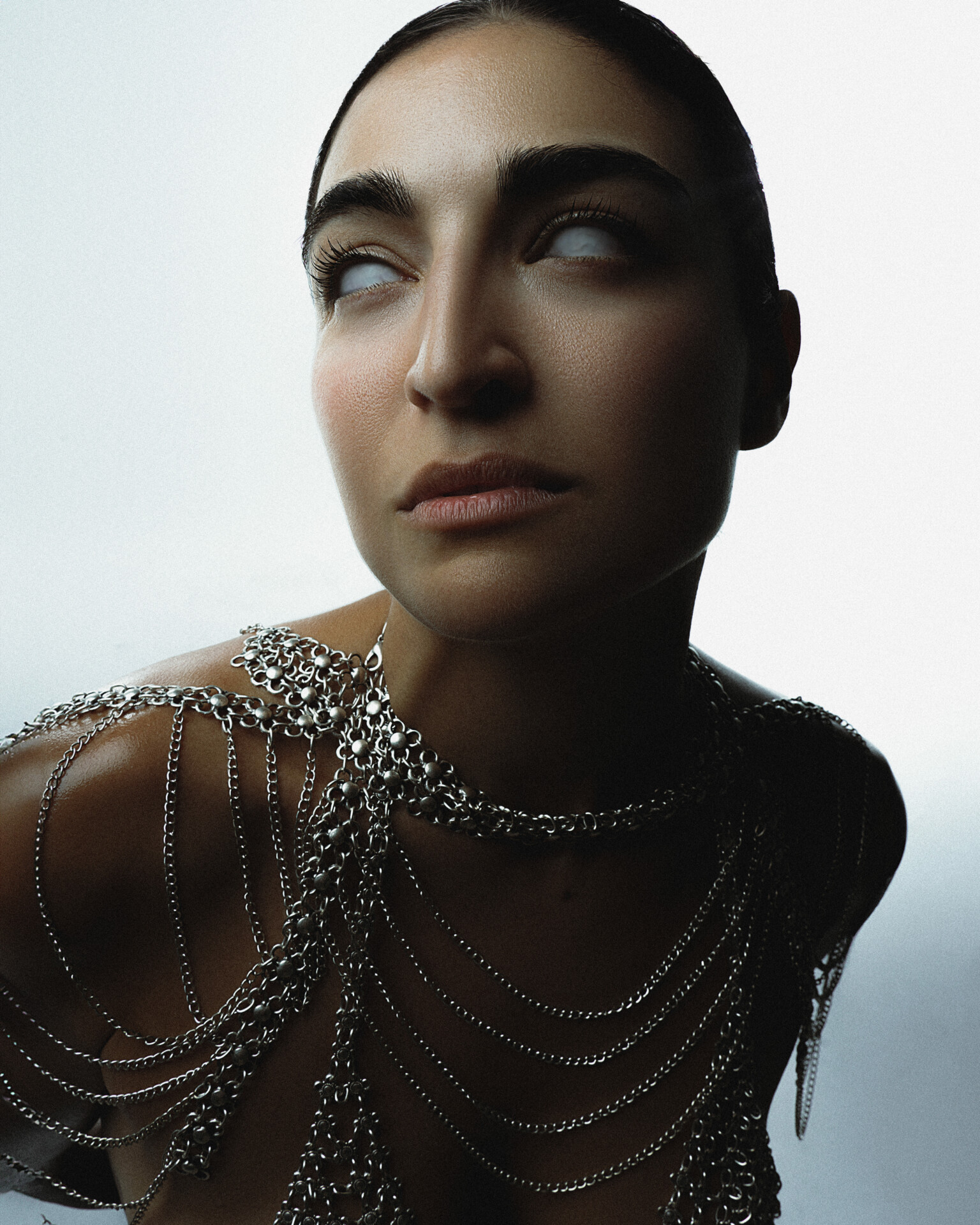
Elnara Nasirli. Photography by Oktay Jaffar.
S: Why is that site-specific element so vital?
EN: Because I research how trees communicate underground via mycelium networks. Some studies suggest they can share up to 50 “words” with one another. We still don’t understand exactly how they pass on knowledge—genetically, electrically, chemically. But I believe their ability to survive multiple mass extinctions is due to that deep-rooted communication. In my art, I imagine a future where even if trees die out, we might preserve their “last words” as data—through sound.
S: That’s haunting. Tell me about the second piece you showed, Air Oasis.
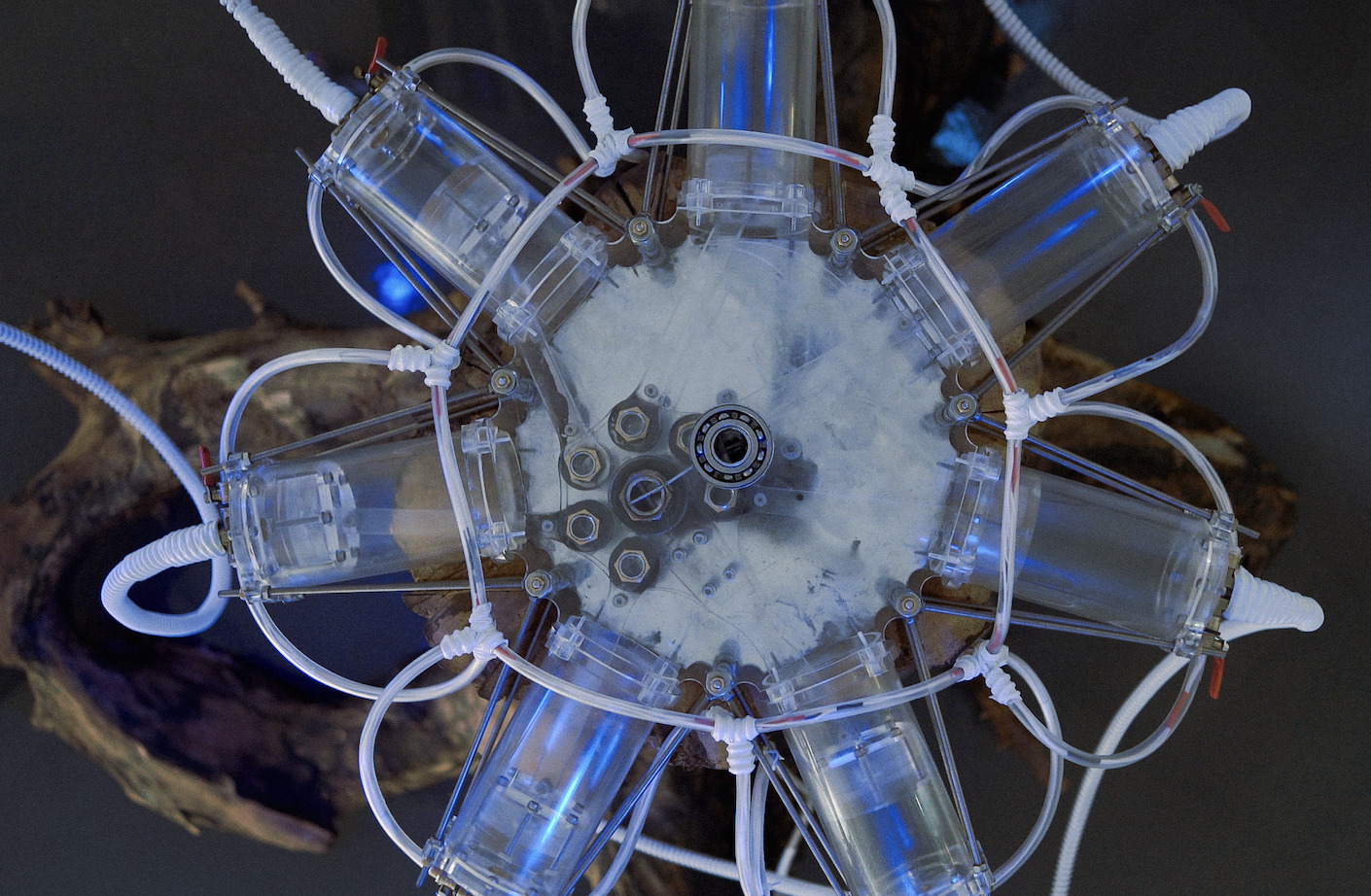
EN: That was built in 2024 for the UN Climate Conference in Baku. It imagines a future where trees are extinct and we rely on machines—artificial lungs—to breathe. It’s a breathing mechanism placed on a real tree trunk, blending organic and synthetic. There’s a dual meaning: technology may destroy our environment, but it might also be the thing that helps us survive. It’s meditative, almost floral, but the more you understand it, the darker it becomes.
S: Did you build the machines yourself?
EN: Yes, with a team, but all hand-built. The breathing tree at BBA was made using a teak tree from Germany, fitted and drilled specifically for the show. The apparatus was shipped from Azerbaijan.
S: Were you always an artist, or did you begin with biotechnology?
EN: I’ve done art all my life, but I only recently started exhibiting. I began with painting, but I felt something was missing. There had to be a stronger conceptual drive. Painting is about my internal environment. The installations are about the external—how I see the world unfolding. And it’s not good. I use art to voice that.
S: How do you combine abstract art with something so technical?
EN: For me, it’s intuitive. I have a creative vision, and then I find the technical means to realize it. Art is the mind, technology is the body. One idea feeds into the other.
Air Oasis. Image Courtesy of Elnara Nasirli.
S: Why was this work a good fit for the BBA?
EN: Because it’s site-specific, handmade, conceptually strong, and interactive. You don’t just look at the trees—you have to touch them to activate their sounds. It’s unusual. People are drawn in by curiosity, and then they experience this strange, emotional reaction to hugging a dead tree and hearing it sing.
S: That’s such a compelling way to reconnect people to nature.
EN: Yes. Most people in cities don’t touch trees. It’s strange behavior. But when they do, in the context of art, it shifts something. And the fact that each tree comes from the local environment—like an olive tree in Italy—makes it even more personal for viewers.
S: Is there a place in the world, besides your home, where you feel most at home?
EN: Berlin, culturally. But physically? The jungle. Indonesia. I feel safe there—connected.
S: You live in Baku now, a region affected by climate change. Do you feel called toward environmental activism?
EN: Definitely. I feel responsible for using my art to raise awareness. Most people are numb to environmental messages because we’re overloaded with them. But art can make you fühlen something. My installations are sad—dead trees, post-apocalyptic—but that sadness creates appreciation for life, for what we still have. If I can spark even a small behavioral shift, then I’ve done my job.
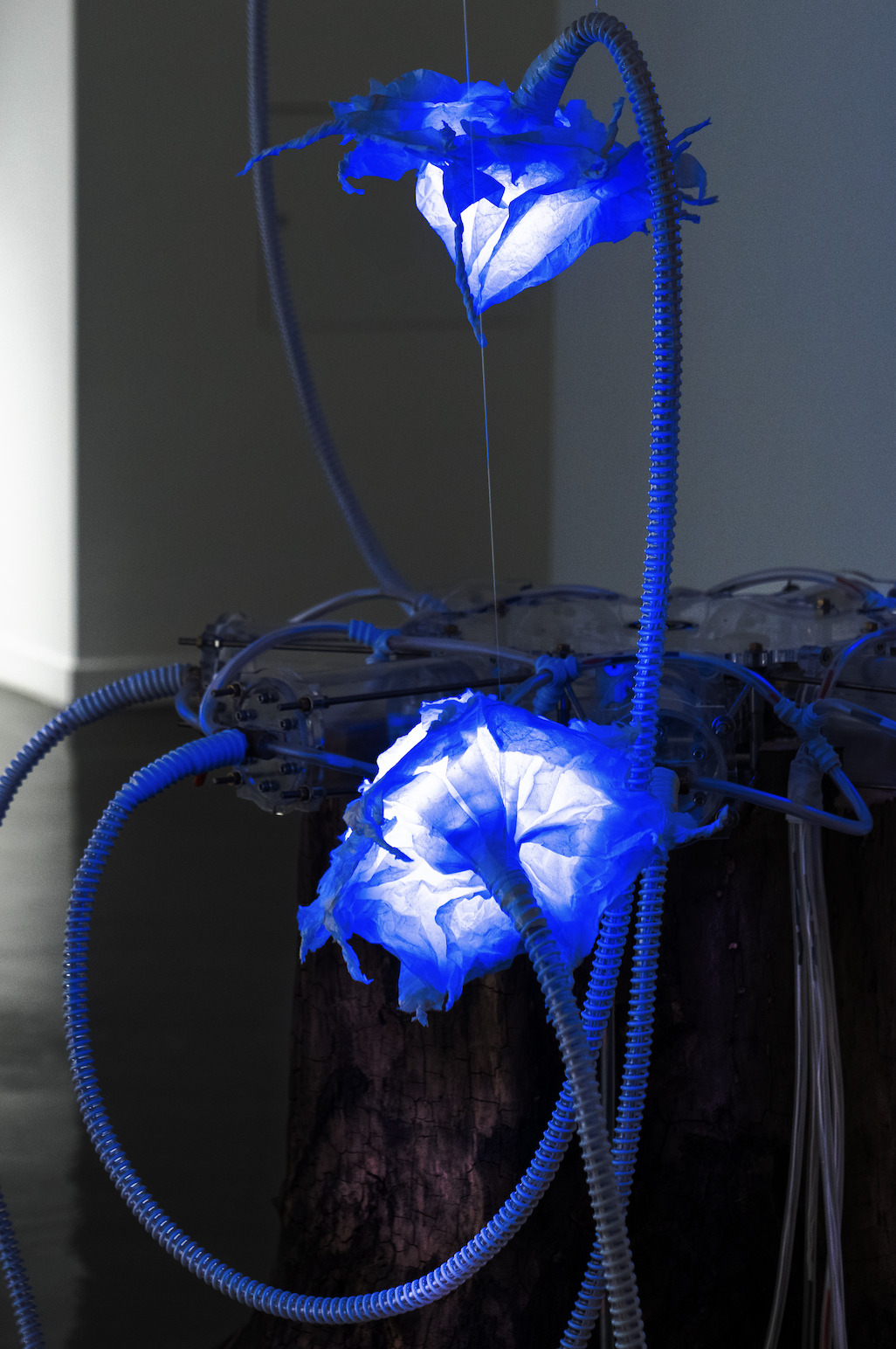
Air Oasis. Image Courtesy of Elnara Nasirli.
S: Your work shows beauty, even in its darkest themes. Do you think using beauty instead of fear could change the climate conversation?
EN: Absolutely. If the message and the visuals are both dark, people turn away. I use appealing aesthetics to invite people in. Once they’re close, I hit them with the concept. It’s a bit of a trap—but it works. They stop. They think. They feel.
S: And it builds curiosity. People want to know more once they’re drawn in.
EN: Exactly. The curiosity leads to pause, reflection—and hopefully action.
S: Let’s end on this. Your work Air Oasis: Breathcore7 imagines a future where machines sustain life. Do you feel a similar unease about AI in creative fields?
EN: Yeah, I think there’s a parallel there. I hadn’t really considered it before, but yes—AI is quietly taking over everything, and we’re not in control. It’s unsettling.
S: Totally. And it’s not just replacing jobs—it’s replacing identity. If AI can generate a pop star or a full art installation, what do humans do?
EN: Exactly. It’s terrifying. And even if we say, “Great, AI takes over and now humans are free,” how do we make money? Capitalism still exists. Are we meant to explore our souls now? Who decides what’s valuable? Yesterday, I read about a musician launching a completely AI-generated pop star. So now concerts might just be holograms. It’s surreal. How do we connect with something that isn’t human?
S: That’s the scariest part—it strips out the connection.
Nasirli: Yeah. I can’t fully wrap my mind around it. It’s exciting, yes, but also deeply disturbing.