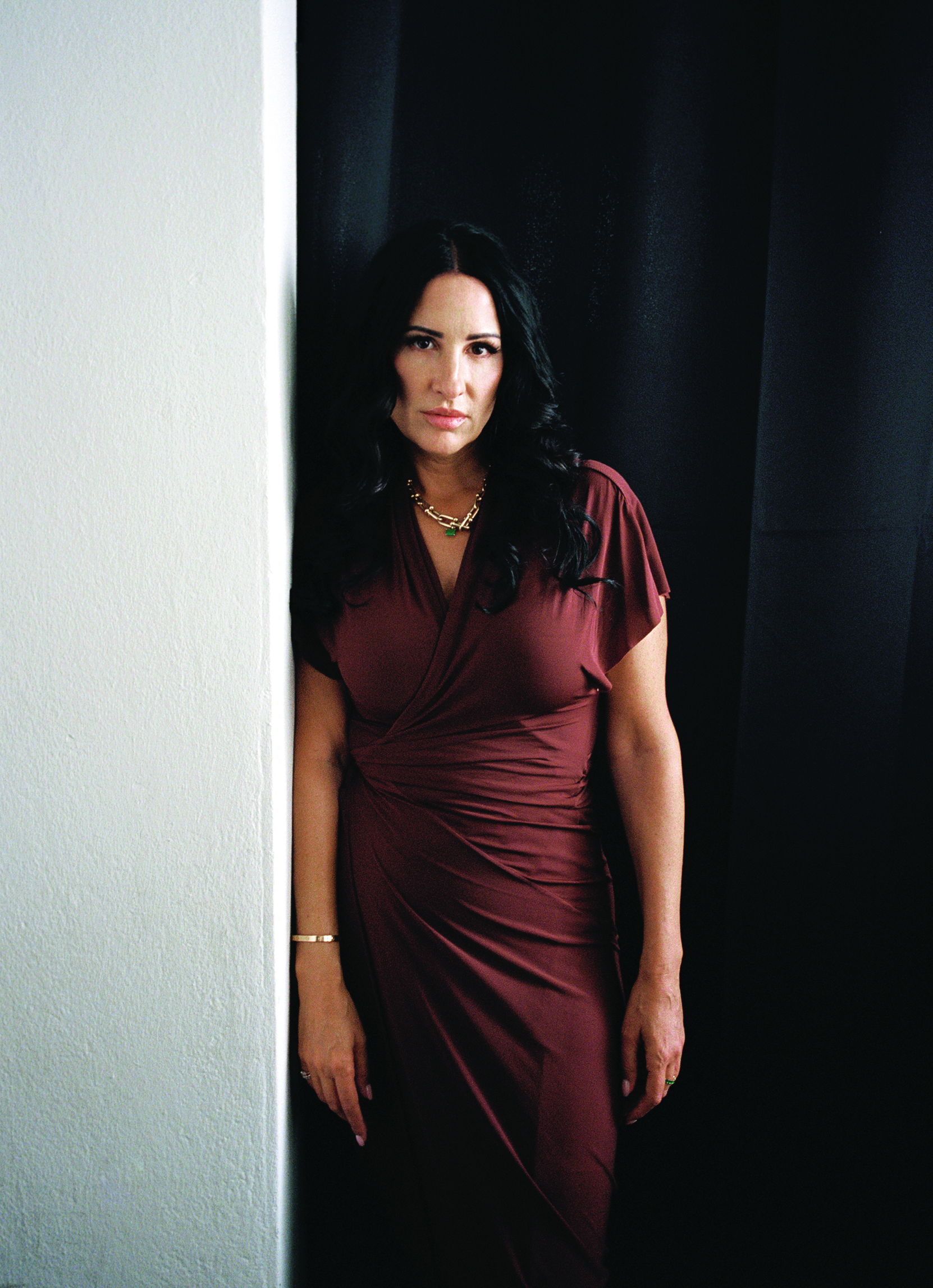
Photography by Nikolas-Petros Androbik
MINU BARATI moves between fictional storytelling and political subjects, between personal history and broader social contexts. The fact that these different layers are so closely intertwined in her work also has much to do with her own biography. Politics and social responsibility have been part of her life from the very beginning.
It was only over the years that Barati came to realise just how deeply this had shaped her. As a teenager, she had rejected her father’s story and his political work for Iran. “My life was here, I am German, Iran was associated only with pain,” she recalls of her attitude at the time. Today, she sees things differently: “The older you get, the less you can ignore how much it has to do with you.” The loss of one’s homeland, the longing for a place to which one cannot return and a sense of political responsibility are all passed down within a family. “We do, after all, carry these stories of our fathers within us.”
This realisation also became the starting point for Unsere Väter, which will be published in September. Together with three other authors, Natalie Amiri, Shila Behjat and Düzen Tekkal, Barati explores a generation of men who came to Germany in the 1960s and 70s and built new lives for themselves here. “Actually it was a project that came to us more than one we set in motion,” she says. In their conversations, the four women had repeatedly realised just how many stories, memories and extraordinary experiences had accumulated around their fathers.
The book is also about restoring greater complexity to migrant biographies. Their families’ stories do not fit the familiar narratives of migration. Instead, Barati tells of high expectations, education as a core value, political upheaval and a Germany in which her fathers’ generation encountered a society that was still directly shaped by its past. At the same time, her father remembers being met with great kindness and openness. These are the kinds of contradictions the book does not seek to resolve, but instead allows to coexist.
The writing process itself proved far more intense than Barati had anticipated. “I was completely overwhelmed by how emotionally draining it was,” she says. Unlike fictional writing, telling her family’s stories also meant bringing to the surface what had been left unsaid. Within the group, they joked that their texts existed “somewhere between settling scores and hero worship”. This very ambivalence became one of the defining experiences of the process.
Writing the book also changed the way she saw her own father. Many conflicts she had long understood simply as friction with her parents suddenly revealed just as much about herself and about “how one’s character is formed, how, over the course of one’s life, one becomes the person one is”. At the same time, she developed a new appreciation for what this generation had achieved: arriving in a foreign country at a very young age, without knowing the language, and building a life there. “A whole new sense of respect and love has grown from that.”
This ability to hold different realities at once also shapes Barati’s work. She is currently developing a dramatic political project alongside a light-hearted comedy. For her, there is no contradiction in this. The deeply distressing situation in Iran, where part of her family lives, and her everyday life in Germany naturally coexist. “The suffering of the people we advocate for is as much a part of our lives as the beautiful moments we are fortunate enough to experience every day in our own privileged and free lives.”
Perhaps this is exactly where the connection between Barati’s biography and her storytelling lies: in not viewing stories as fixed truths, but allowing their contradictions to exist and following them for long enough that a sense of lightness can find its way into the complexity.