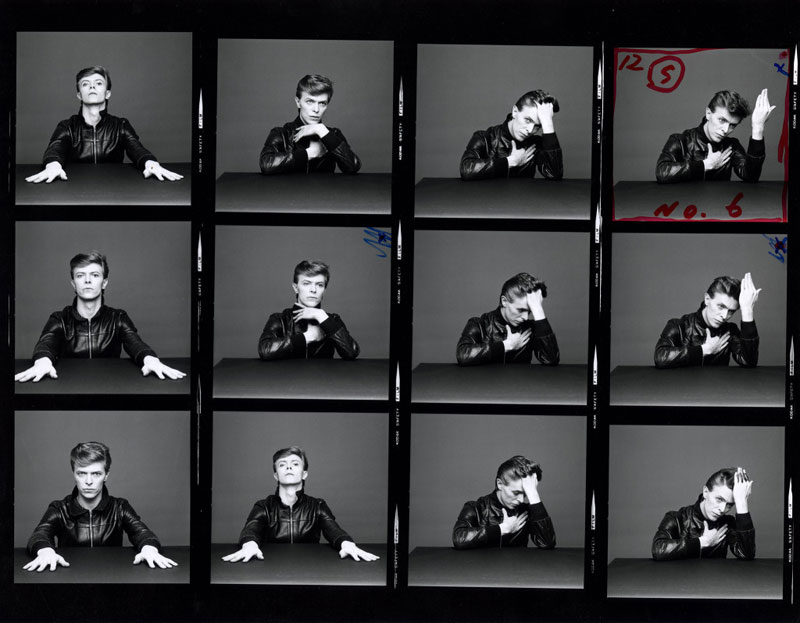
 Masayoshi Sukita , Heroes Contact Print (Piece No. 32), 1977. Copyright Masayoshi Sukita / The David Bowie Archive
Strolling around the David Bowie exhibition at the Martin-Gropius Bau, it’s hard not to be struck by the huge variety of creative outlets the singer was involved with. The singer’s interests extended as far as even creating his own “Verbaliser” that would put random phrases together for him to collage lyrics out of. The exhibition, which opened on 20 May and was previously exhibited at London’s V&A, gives a deep insight into Bowie’s time in Berlin (which produced his “Berlin trilogy” of albums), as well as his international influence on fashion, art, gender and, of course, music.
But how does the previous century of Berlin’s creative output affect its residents today? Who better to introduce the show to you than a modern-day Bowie? La JohnJoseph is a writer, performer and musician (under the guise of his “twin brother” Alexander Geist, who opened the Martin-Gropius Bau exhibition).
On Monday, my twin-brother Alexander Geist performed at the opening of the Bowie exhibition at Martin-Gropius-Bau. It was the hottest ticket in town and by proximity to his ego, I was able to attend. I was bundled into the service elevator with him and his band mates, his hairdresser, make-up artist and agent, and so began the whole warped world experience. The vernissage was the usual bricolage of bloggers, blaggers and septuagenarian benefactors, all less interested in seeing the exhibition than being seen at the exhibition. Understandably so, invites to the opening were excruciatingly difficult to get hold of, the guest list had been cut down at the last minute due to security concerns. The major activity of the evening though seemed to be snapping selfies in the many mirrored surfaces generously provided by the exhibition, and hashtagging the excitement to the less fortunate left waiting outside the museum.
Amongst the drunken circus of self-promotion and security guards, the exhibition was almost entirely impossible for me to experience. Thankfully, the museum kindly invited me back to see the show again, amongst actual human beings, the next day.
The exhibition is nothing if not immersive. It was the first time I can remember in which I completely lost track of time inside a museum show. Headphones are provided, but rather than guiding you through, the audio responds to your path and position, feeding you interview clips, songs and movie audio, relevant to the pieces you are viewing. As model/artist Lukas Von der Gracht noted when I saw him browsing the bric-a-brac, “The headphones are so sensitive, if you turn around to look at a cute boy they start to play you something else!” The exhibition is so relentlessly intense that, in all fairness, being denied the option to cruise the galleries is probably only for the best; lest one risk a complete psychotic breakdown in trying to grab a lustful tryst amidst the interactive back catalogue.
There are times when it does become almost cacophonous. Bowie’s hits are playing over the speakers, simultaneously he is speaking in your earphones, whilst you are watching him perform on an archive TV show, on a screen which is itself at the center of an installation of artifacts. To say it is a demanding exhibition would be an understatement, but the experience is unparalleled in the usually staid museum world. Filmmaker Imogen Heath, looking startled by one of Bowie’s fetching mustard-yellow ensembles said, “This is totally a show for the internet generation, isn’t it?”
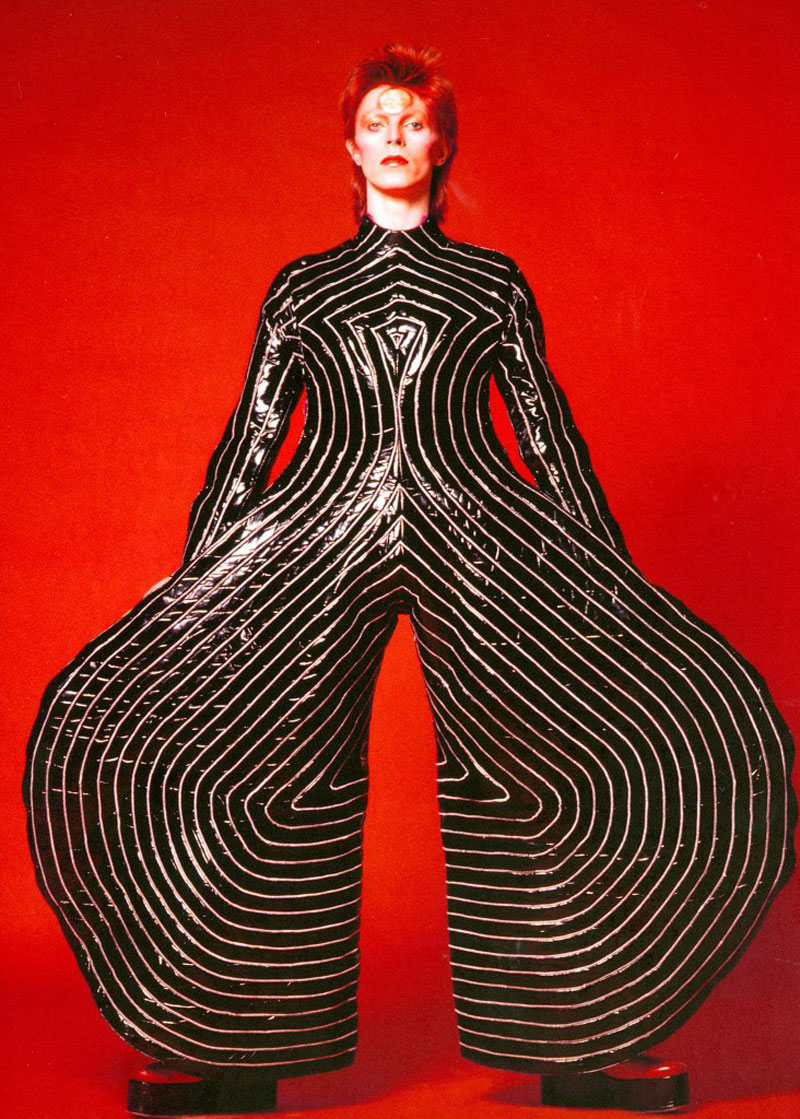 Striped bodysuit for the Aladdin Sane tour, 1973. Design by Kansai Yamamoto. Copyright Sukita / The David Bowie Archive. Photo: Masayoshi Sukita
At the very beginning of the exhibition, alongside an iconic Kansai Yamamoto jumpsuit, there lies a set of handwritten notes dating from the mid-nineties recording of 1.Oustide. In it Bowie talks of a younger generation who must “surf the chaos” of multiple layers of meaning and images; this remarkably prescient artifact could in fact be the curatorial brief for the whole show. Bombarded lovingly with audio and video, as we try to read the descriptive texts accompanying each display, there is something both archaeological and prophetic about this technologically–brokered experience.
Though he released an album as recently as last year, Bowie is not currently touring. Instead he has sent out this cybernetic panoply to promote his legacy and his current output, again he is inventing the future. This is where the real relevance of the whole enterprise lies I think, in the attempt to provide Bowie fans (and other, unspecified, culture vultures alike) with a strikingly contemporary retrospective. Spending an afternoon in the Martin-Gropius-Bau (and it does require a whole afternoon) is uncannily akin to walking through a physicalized cybersphere; the constant influx of sonic and visual information, old favourites and new discoveries dashed against each other. There’s even the odd pop-up-esque moment in which Bowie’s voice appears, unrequested, right in the middle of one’s favourite instrumental from Low. True to the internet era, it is likewise a very isolating experience. Wandering about with headsets will hardly inspire great dialogues amongst visitors, at least until they’ve cleared the gift shop.
Rather a mysterious community of wandering cult loners is created. A beautiful two-piece Freddy Buretti ensemble stands on a mannequin at the center of mirrored cube, onto the back wall of which a projection of Bowie, performing in this very suit on Top of the Pops in 1972, is thrown. The footage pans across fans in the studio audience as the installation catches the reflections of the exhibition’s visitors, throwing us all together momentarily in a transhistorical house of mirth. Transfixed stylist, Frank Wilde, a fan for several decades, remarked, “He’s living proof of individuality and eccentricity as a lifestyle.”
Further into the exhibition one finds oneself surrounded by ceiling-high projections of four different Bowie performances of “Heroes”, from four different decades. One of the most remarkable experiences, both visually and conceptually that the show provides, the quadraternity of Bowie’s technology dislocates us spatially and temporally. As wide-eyed and slack-jawed artist, Sophie Iremonger, commented, “Technology could not be put to better use than projecting huge David Bowie crotches across every possible vertical surface.”
But were we all just a bunch of reactionaries, longing for what was, over what is? Surely there are new voices to replace the Thin White Duke? I thought back to the vernissage, watching my brother give a quick pre-show interview. The interviewer asked, “Do you think you could be the new Bowie?” Alexander answered somewhat tartly, “I think the current Bowie is doing a perfectly good job as it is.” Certainly the other visitors thought so. I saw ladies of a certain age, rocking out discreetly in their sensible shoes, I saw skinny art fags all in black, delighted, scribbling in their notebooks, and parents toting toddlers, introducing them to their own childhood hero. Regarding a video of Bowie performing mime in a ludicrous tights-and-loincloth combo, one little one asked, “But Mummy, what IS he doing?” His enamored mother answered, “I have no idea at all, but isn’t it marvellous?” The love-stoned artists and singers, the models, the filmmakers and fans, we all had to acknowledge that, yes, yes it was.
 Album cover shoot for Aladdin Sane, 1973. Photo: Brian Duffy. Photo Duffy copyright Duffy Archive & The David Bowie Archive
Text by La Johnjoseph
“David Bowie” is showing at Martin-Gropius Bau from 20 May until 10 August 2014
For more on the exhibition, check out Sleek Magazine 42, coming soon…