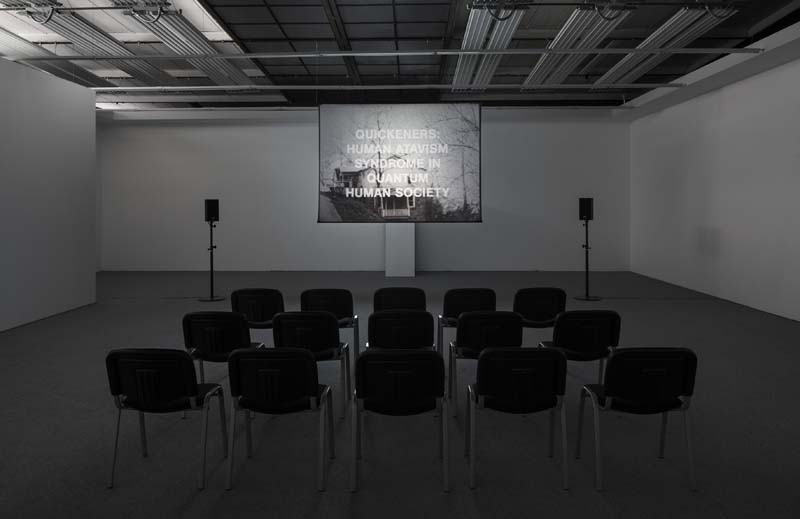
 Installation view at Johann König. Jeremy Shaw, Quickeners, 2014. Photo: Timo Ohler
“Quickening is defined as the first feeling of a foetus by a pregnant human woman. It is also defined as the death of an immortal by beheading.”
In “Quickeners”, Jeremy Shaw presents a 33-minute-long video of appropriated footage from the 1967 documentary film “Holy Ghost People”. The footage follows a West Virginian Pentecostal community in their ritualized practice of snake handling. It serves as the foundation for a narrative overlay, developed by Shaw, which mixes themes of science fiction with neuroscience and biological transcendence.
As the video begins, an analogue voice robotically describes the unfolding scene. Quantum Humans are evolutionarily linked to humans but, having disposed with their biological constraints, they are immortal. Coexisting in a unified Quantum Human Society, they are in constant neural synchronicity with the Hive. A small group of Quantum Humans have been suffering from a extremely rare disorder known as Human Atavism Syndrome – or H.A.S. This complex affliction resurrects societal traits and characteristics of Human Beings – which have now been extinct for over 400 years.
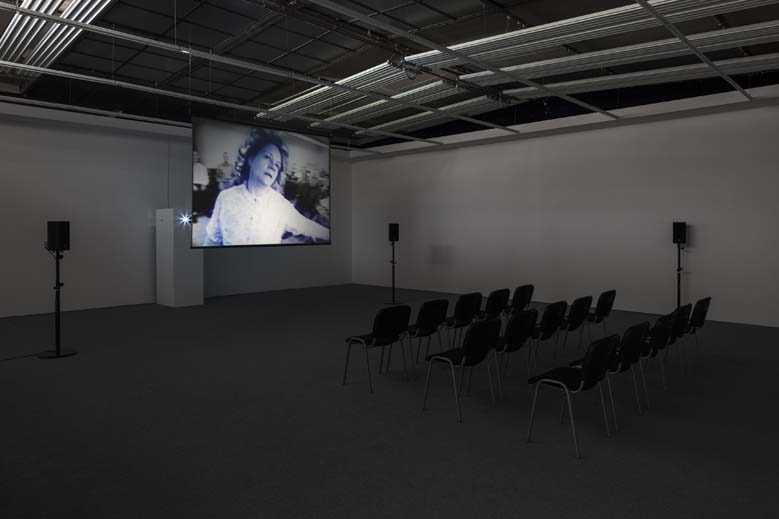 Installation view at Johann König. Jeremy Shaw, Quickeners, 2014. Photo: Timo Ohler
HAS suffers gather together in a small group, members of a religious congregation. Interviewed individually, they begin to share with us their intimate experiences of “Quickening”. Their dialogue is a mixture of ill-placed constants and vowels, necessitating on-screen subtitles to gain an insight into their diverse backgrounds. Common themes emerge – feelings of displacement, loss and alienation, a search for purpose and meaning. The sufferers’ only solace is in the ceremonial gatherings that culminate in the ritualistic practice of snake handling. The video climaxes in ecstatic dancing and convulsing as HAS sufferers engage in a “Quickening”. This is the moment of transcendence: the experience which violates all logic in the Quantum Human paradigm. It is a moment of bliss – exhausting and irrational. Droning techno slowly builds and subsides as the dancers surrender themselves to the atavism of praying and throwing snakes.
“That the instance of a quickening could result in a permanent disconnection from The Hive and the return of a Quantum Human to a mortal human form is… highly improbable”, concludes the narration.
“Quickeners” is a starkly black and white piece – bar a few washes or color flowing in moments of transcendence. It has the feeling of a dystopian sci-fi movie, but with a pop sensibility that prevents it from becoming dull or overly nerdy. Audio manipulation and the accompanying score are effective in generating a feeling of connection and awe as the film builds and fades.
“It is a film that I think I saw in art school initially, years ago. Then I bought a copy of it on Ebay. I think I had the film for five years, sitting here waiting to be used and so I finally had it scanned. It’s in the public domain now. It’s the first time I’ve taken something like that and reworked it. Normally I shoot my own films or videos,” says Shaw of his source material. “[I think] the past few works have been leading up to this, definitely. My earlier work was often about altered states, but from a very kind of, critical distance, a somewhat removed perspective, as opposed to any kind of an attempt to incite a phenomenological response. And over the past couple of years I have gradually become interested in that.”
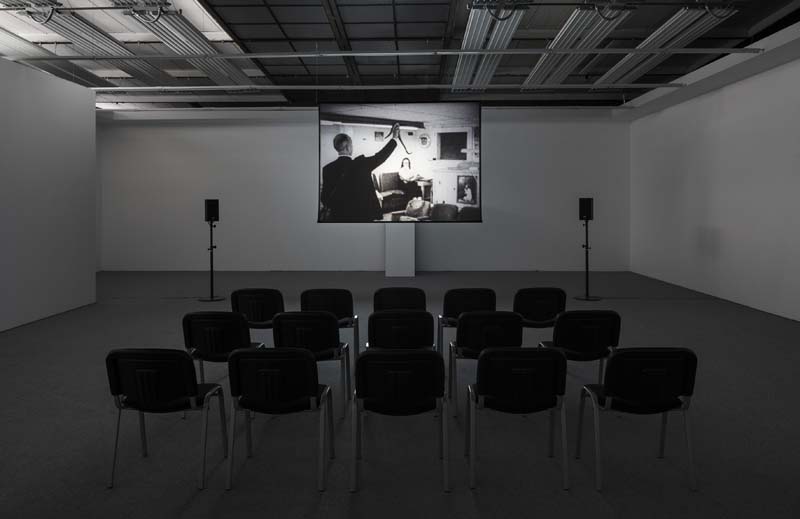 Installation view at Johann König. Jeremy Shaw, Quickeners, 2014. Photo: Timo Ohler
Shaw’s influences include “a book called “The Possibility of an Island” by Michel Houellebecq was influential, as well as Ursula K. Le Guin books and then Kurzweil’s idea of the Singularity. Reading a lot of contemporary theorizing on what is going to happen when man becomes singular, equal with machines.”
“I am excited by the language, by the possibilities of all these things. But I am never going to be an expert in any of them and I don’t think that’s my job. But I think proposing these ideas with my knowledge of a wide range of things: I think that is what an artist is there to do, a lot of the time.”
Shaw’s work proposes a speculative future scenario, mixing narrative with aesthetics that at times could have come from a music video. It crosses genre lines – partially sci-fi with a little nostalgic documentary for good measure. It is a work that certainly confounds, but is effective in its use of cinematic tools. Sound, colour, and even the objecthood of the video itself contribute to a considered piece that is enjoyable to watch.
Shaw’s work is in dialogue with emergent themes of a technological utopia (The Singularity), nodding to post- and trans-humanist ideas. This sort of progress brings with it the very human emotions of anxiety and hope. What is effective in “Quickeners” is Shaw’s ability to coax these emotions from the viewer – the story is an overlay the artist manipulates to make you feel. In the face of progress, what a human thing to create…
Text by Tomasz Kobialka
“Quickeners” is on show from 31 May – 28 June at Johann König, Berlin.
“Quickeners” was co-produced by Johann König, Berlin, the British Columbia Arts Council and the Centre d’Art Contemporain Genève for the BIM 14, with the support of the Fmac, the FCAC and the MONA MUSEUM.