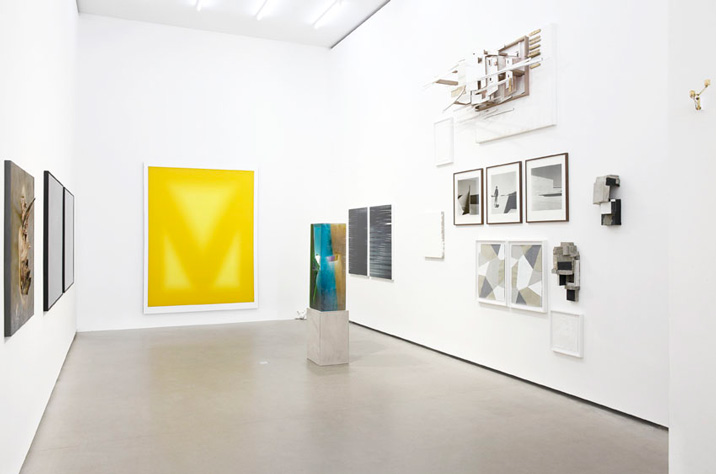
 “offen”, Installation view 1, 2015, Galerie EIGEN + ART Berlin, photo by Otto Felber
Since the fall of the Wall, east Berlin’s Mitte district has been through intense revamping. In the Nineties it was the fruitful ground for artist-run squats and the party scene, and year after year it quickly transformed into a hub for coffee culture and prominent galleries, yet change is still only just around the corner.
Set up in 1983 in Leipzig and in Berlin since 1991, the gallery EIGEN + ART has been part of the transition and in 2010 they opened an additional space, the EIGEN + ART Lab, with more focus on experimentation, maintaining thus the edge Berlin is known for. Also present throughout the changes was Christian Ehrentraut, who re-joined the gallery earlier this year after doing various other projects. We spoke to the director about his favourite upcoming shows, how to develop relationships with artists and why Mitte is still very alive.
I was expecting to see lots of 2D painting in your latest “offen” show but that wasn’t the case.
Not at all, the Summer Show is about exploring every direction involved in the whole process here at Eigen + Art. It is a group/community of sorts and this show allows the viewer to see each aspect, both in Berlin and Leipzig, plus the EIGEN + ART Lab plays a strong role too. It’s arranged as samples or chapters of a wider project. What’s incredible to see in this show, for me personally, is that when I first started at Eigen + Art in 2000, there they represented 12 artists, then I moved to my own gallery, but when I came back here 11 of the12 artists are still here – 13 years later – it’s extraordinary for a gallery to have that depth and history; it’s quiet a unique relationship. There are about 40 artists on show at “offen”; some familiar ones like Carsten Nicolai, Martin Eder and Christine Hill but mixed in with new artists like Bosco Sodi, guests as Zora Jankovic and the artist’s from the lab like Charlotte Dualé and Keiyona Stumpf.
Could you tell me more about the EIGEN + ART Lab? It seems the least well-known aspect of the programme.
It’s true, but it’s one of the most important parts, it works like a test balloon. It’s a place were young artists can try out ideas, play, experiment and create. Also you only know if you really want to work with an artist by doing it! This way, you can do that in a safe environment without pressure. There is also a curator’s program there too, in fact in September there’s a show curated by Thibaut de Ruyter and entitled “Digitale Demenz” (Artifical Intelligence). He will work with people like John Cale, Chris Marker and !Mediengruppe Bitnik. That’s the artist group that created an algorithm that places random orders from the Darknet and has the products sent to the gallery. I believe it was predominantly drugs and weapons and they had all sorts of legal issues. I think that’s a good example of how autonomous Galerie EIGEN + ART is.
Some people say Berlin is dead or dying, what have you noticed in the last 15 years that’s so special about this part of town – Mitte?
In my opinion it’s still very much alive, you can see how active Auguststrasse is. Despite the gentrification it still has so much discourse left to give, look at KW, their program really has an effect on the art world at large. Actually, at the moment, I’m re-reading Alfred Döblin’s “Berlin Alexanderplatz”, which is set in 1929, here in these streets but with the prostitutes, alcoholics and black-marketers, It’s funny, it seems removed but you can really see the remnants of these people and their lives in the back yards and alleys; it’s not as alien as one might think. There has been some very dark chapters in the life of this neighbourhood but it’s certainly by no means the end of the book.
Interview by Penny Victoria Rafferty
Mehr: Body and Distortion: Interview with Asger Carlsen
Mehr: Frances Stark in Chicago: Das Digitale Private ist politisch