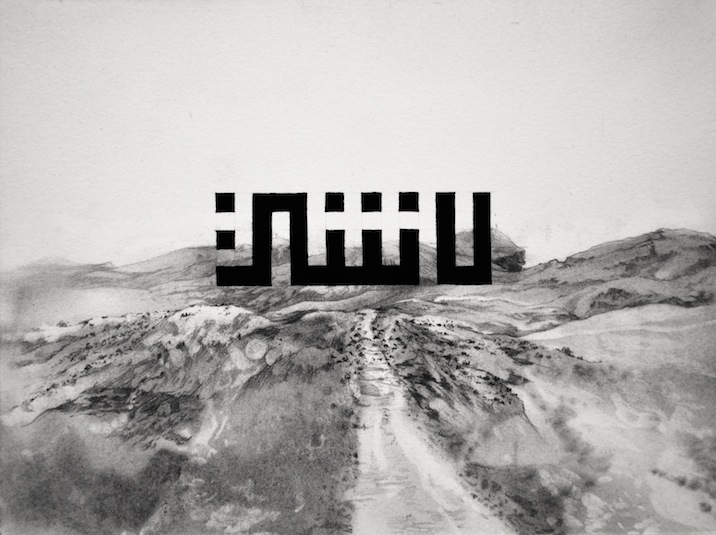
 Nidhal Chamekh, Entre les choses No.13, 2014. Graphite on cotton paper, 23 x 31 cm. Courtesy of Selma Feriani Gallery
While the Frieze London circuit might be the emblem of the fully international art scene, debates on equal national, cultural or even continental representation is something that’s notably absent in the Regent’s Park tent. Most of the galleries are western European and north American, as a remnant of the occidental art dominance of the 20th century; south America is to some extent represented by Brazilian heavy-weights like A Gentil Carioca and Galeria Fortes Vilaça. Asia has also for several years been taking a strong position, either through outlets of European galleries or with independent high-grossing independent galleries including Take Ninagawa and Gallery Hyundai. African representation, however, is the only one that appears to be loudly missing, which raises urgent questions about the remaining postcolonial geopolitical world order – where economic markets as well as critical and aesthetic value-systems are still structured according to the western imagination.
Thankfully, the coinciding 1:54 Contemporary African Art Fair responded to this with a strong cast of the best African and Africa-oriented galleries from around the world. Housed in the East and West wing of Somerset House, the name of the London-initiated fair refers to the diversity of the 54 countries that constitute the African continent, and has been acclaimed for presenting African art with a critical and professional approach. After a few successful years, the founder Touria El Glaoui took the fair on the road, passing through Brooklyn, NYC, last year and thus establishing an important reputation on the north American market.
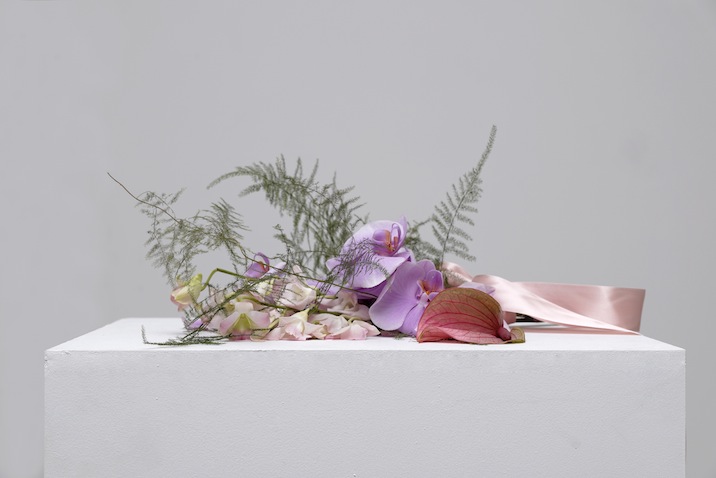 ‘Flowers for Africa (Nigeria)’, 2014, Flowers, Protocol written and signed by the artist, iconographic documents. Courtesy of Galerie Jérôme Poggi
The fair displayed African art stars as much as emerging practitioners. One of the entrances sported a splendid wall-based work by Ghanian artist El Anatsui, who’s known for his continuous study of the waste materials of his immediate surroundings. Overall, there was a multitude of discovering a specifically African materiality through Romuald Hazoumè’s contemporary masks, Amadou Sanogo’s painting on cheap cloths from local markets, or the incredible bead artworks by Qubeka Bead Studio, who captures scenes from the everyday through the enterprise of beading.
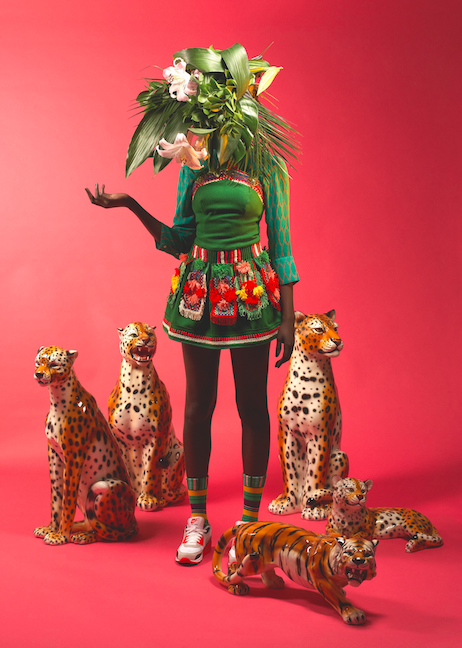 Namsa Leuba, Untitled I, Cocktail Series, 2011, Fibre pigment print, 69.56 x 84.1 cm. Courtesy of Art Twenty One
Far from being a showroom to please the art establishment, 1:54 featured artists challenging the way in which the west still exoticises contemporary notions of Africa. Swiss-Guinean Namsa Leuba, for instance, explores that theme through fashion photography that also transgresses the boundaries between art and design.
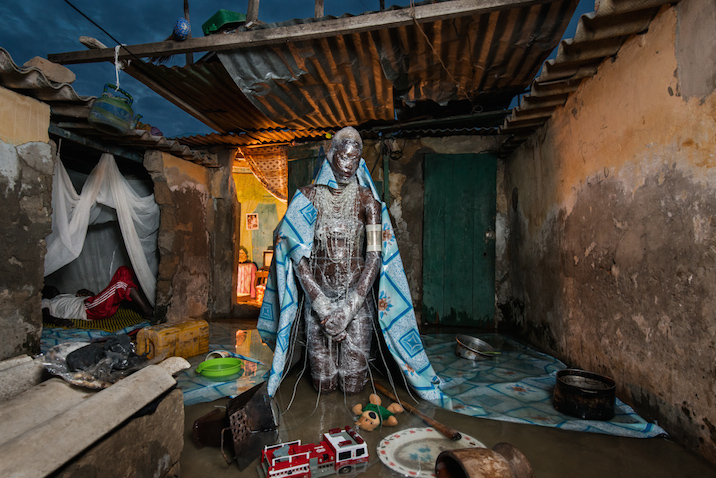 Fabrice Monteiro, Prophecy VII, 2014, Digital Print, 100 x 170 cm, edition of 5. Courtesy of Mariane Ibrahim Gallery
Other highlights included Lyndi Sales’ paper-cuts at Everard Read (Cape Town), Kimathi Donkor’s digital master painting at Edcross Fine Art, and Bobson Sukhdeo Mohanlall’s studio photography from the early 70s at Axis Gallery. However, the best exhibition was from Seattle-based Mariane Ibrahim gallery, which presented artists including Fabrice Monteiro and Ayana Jackson, whose oeuvre has long been cementing the African diaspora’s place in contemporary art history and beyond.
Text von Jeppe Ugelvig
Lesen Sie mehr über unsere Frieze Reichweite
Mehr: Frieze London 2015 in Pictures
Mehr: Frieze Projects: Asad Raza Creates Intimacy Through Mythology