How can you tell what’s fake and what’s real? Turns out that sometimes you can’t. With an estimate of around 20% of all artworks in museum possibly being fake, the market is rife with counterfeit masterpieces. This is despite the rise of technology making fakes easier to spot. Additionally, with the demand from museums being so high, it looks like art forgeries, and art forgers, aren’t going anywhere fast.
It has a long history. It started in the Roman period, when for lack of any original culture, the sculptors would copy the work of the ancient Greeks and pass them on as their own. This technique proliferated during the Renaissance with the rise of a demanding middle-class, before reaching a crisis point in the 20th Century. Perhaps due to the simplicity of their method in comparison, for example, with the Dutch school, the painters most popular for fakers were Picasso, Klee, Matisse, Giacometti und Dalí.
But who are the most famous art forgers? How were they caught? How long did they spend in jail? Let’s take a look at the ten most notorious forgers of all time.
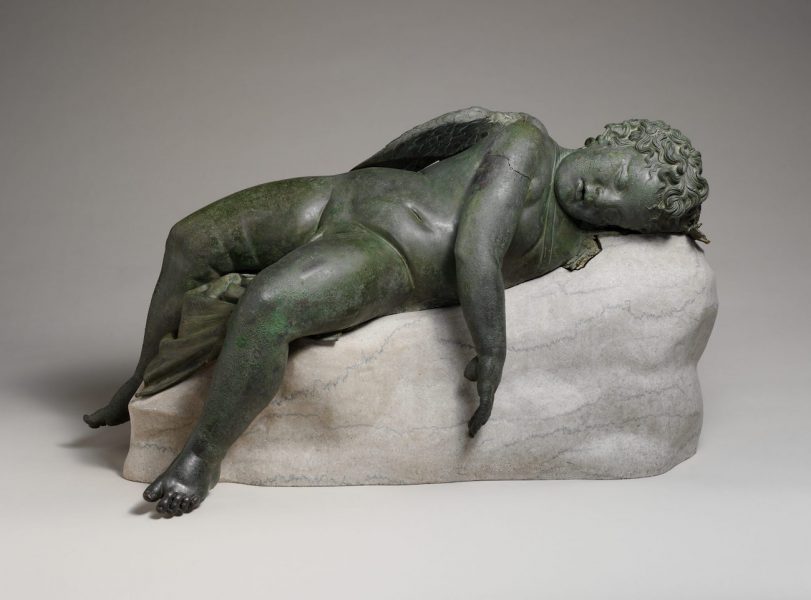 Roman Sculpture Of Eros Sleeping. Credit: The Met Museum
Michelangelo
Yes, that’s right: the guy who sculpted David. In fact, a forgery kick-started his career. Renaissance artists all learned their trade by copying others. Thus, Michelangelo copied Roman sculptors when making Sleeping Eros in 1496. Strangely enough, when it was discovered to be a fake, Michelangelo’s reputation was sealed. Only a true master could fake so well.
 “Vessel in the Form of a Seamonster,” by Reinhold Vasters. Made in the style of Hans Vermeyen. Date unknown.
Reinhold Vasters
A nineteenth-century German goldsmith, he was long dead before he was discovered as a forger. Originally contracted to make reproductions of designs for art historian Franz Bock, he soon found out he could make more money by selling fakes. Artists he faked included Wenzel Jamnitzer, Leone Leoni and Valerio Belli. This fakery was only discovered in 1970, 60 years after his death, during a major archive by the V&A museum.
 Elmyr de Hory. Source: GQ
Elmyr de Hory
With over a 1000 fake pieces to his name, Elmyr de Hory is one of history’s most prolific forgers. Arriving in Paris after WW2, his original intention was to become a reputable artist. However, after passing off a drawing modelled after Picasso to a British woman, he decided that being a fake merchant was the best way to solve his financial problems. He is most famed for being the subject in Orson Welles‘ last film F For Fake, a documentary that also turned out to be a fake in itself.
 Van Meegeren at Work. Source: WikiCommons
Han van Meegeren
Han van Meegeren wanted to be a real artist. But critics kept calling his work highly derivative. Therefore, in a way to get back at them, he replicated the work of the world’s greatest artists. These included Pieter de Hooch, Gerard ter Borch, and Johannes Vermeer. Amazingly for a trickster, opinion polls in 1947 placed him as the second most popular of all Dutchmen, behind only the then Prime Minister.
 A Fake Giacometti by Robert Driessen. Date Unknown.
Robert Driessen
This forger made his riches by selling off Giacometti works as his own. With an estimated jackpot of €8 million, he’s considered one of the wealthiest forgers in the world. He admits it’s easy copying the Swiss-Italian artist: “Long, thin figures, and an amorphous, crumbly surface. It isn’t difficult to make Giacomettis.” Avoiding the German authorities, he is still hiding out on a beach somewhere in Thailand.
 Wolfgang Beltracchi. Source: Achtzig
Wolfgang Beltracchi
The estimation for the amount of paintings the German art forger Beltracchi has faked is somewhere between 1000 and 1300. The man himself says that he has lost count. Described as the “forger of the century,” it is estimated that hundreds of his works are still in circulation. The authorities caught up with him in 2010, and he was sentenced to jail the next year. After being let out two years ago on good behaviour, he has made a promise not to keep on faking art.
 Tom Patrick Keating at work. Source: BBC
Thomas Patrick Keating
Thomas Patrick Keating was a forger with a cause. He started faking works in order to rail against “avant-garde fashion, with critics and dealers often conniving to line their own pockets at the expense both of naïve collectors and impoverished artists”. The one artist he perfecting in copying was Samuel Palmer, a nineteenth-century landscape painter. In a turn of ironic fate, counterfeits of Keating counterfeits are now on the market. As the Guardian reports: “If they manage to fool, they can claim £5,000 to £10,000.”
 The Recovered Mona Lisa. Source: Entrance Free
Yves Chaudron
Yves Chaudron is best known for his involvement in the infamous art theft of the Mona Lisa in 1911. The plan was concocted with Italian patriot Vincenzo Peruggia, who wanted to restore it to Italy. He made six copies of the painting whilst its location was still unknown and sold each of them to American buyers. With each painting worth $330,000, he made off with a pretty penny.
 The painting in question. “Vase De Fleurs,” by Paul Gauguin. 1891.
Ely Sakhai
Everything was going so well for Ely Sakhai, who had run a successful art forgery business for over fifteen years. Having purchased real paintings of masterworks, he would then order copies to be made of them. He would then sell both the frauds to Asia — with the attached certificate of authentication —while simultaneously selling the originals to American galleries. It all came to a head when the same work by Gauguin went up for auction at the exact same time by two different galleries. He spent over 41 months in Prison.
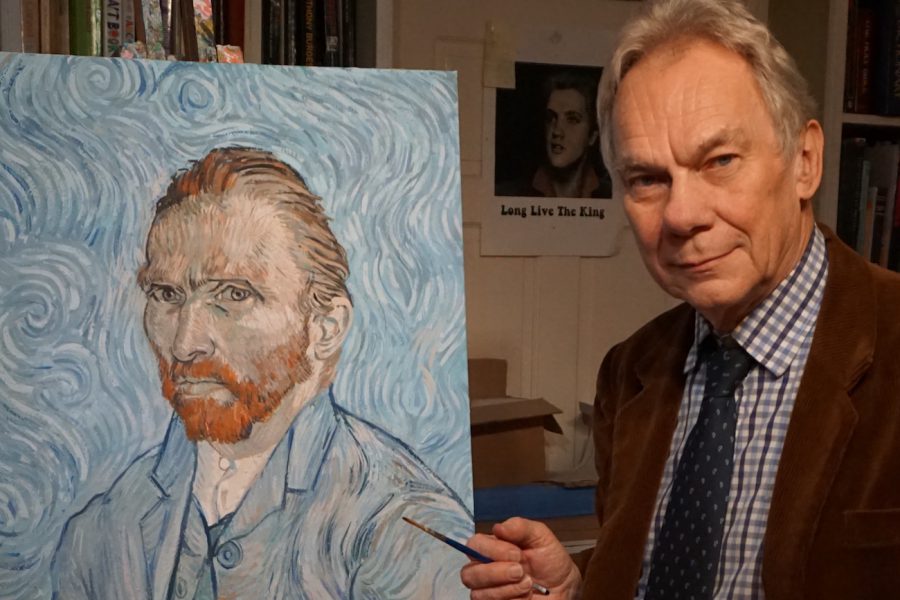 John Myatt with a replication by Van Gogh. Image Source: The Riverside Journals
John Myatt
He has been described as committing “the biggest art fraud of the 20th century”. Along with his accomplice John Drewe, he has faked over 200 different artists. Despite using techniques that have later been called amateurish, the two swindled Sotheby’s and Christie’s out of hundreds of thousands of pounds. Jailed in 1998, he only spent four months in prison. Now his authenticated fakes still sell for large amounts of money.