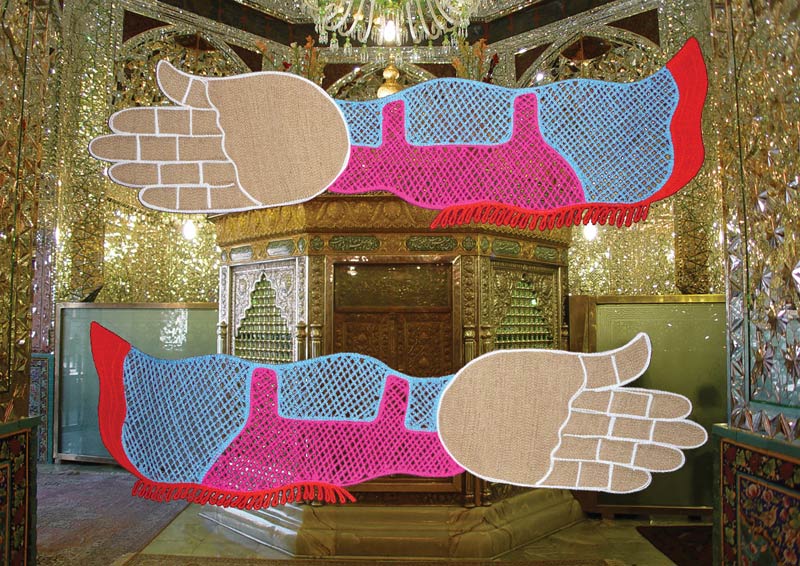
It’s A Trip: Several Propositions on Time Travel in the Work of Slavs and Tatars.
Advanced by Mara Goldwyn
“The future is certain, it is only the past that is unpredictable.”
Note: Slavs and Tatars is a faction of polemics and intimacies devoted to an area east of the former Berlin Wall and west of the Great Wall of China, known as Eurasia. The collective’s work spans several media, disciplines, and a broad spectrum of cultural registers (high and low) focusing on an oft-forgotten sphere of influence between Slavs, Caucasians and Central Asians.
1. Far Flung
The collective Slavs and Tatars meets conceptually in Eurasia – a geographical and affective remit still exotic and faraway for their Twenty First century audience. Travel and trans-portation represent a strategy in their ouevre (and, unavoidably, a practicality). By imagining the shortest distance between two distant points – as much conceptually as topographically – they succeed in making the remote intimate. Evidences of movement, displacements and migrations dot their figurative landscape, and they are not shy about commemorating what are ignored or erased localities – often with a plaque, a tongue-in-cheek historical pamphlet, or a shrine.
In their work, the hyperbolic savouring of the stranger and the stranger’s region “as an agent of attraction and repulsion” recalls a certain type of Nineteenth Century orientalist travel writing, armchair anthropology and contemporary aesthetic inquiry all at once, bringing the viewer into a contemplative, humorous, and subtly-but-tantalizingly un-politically correct encounter with the other. Yet the idea is to engage, not to gape; Slavs and Tatars exhibits resemble less an ethnological diorama than a teahouse. Artgoers are often invited to come in, sit down, recline on a tapchan-carpeted platform, peruse books, and while away moments in a nook of space and time that is gently stretched, transcending the parameters of what is commonly referred to as the present.
That is, Slavs and Tatars emphasize not just where the experience takes place, but also how and when; in an early manifesto entitled “Slavs”, the collective proclaimed, “Slavs do not ‘spend’ time. In the Slavic thesaurus, under duration there is no dollar sign. Time is not money because there was always plenty of the former but never much of the latter […] Now, though money is bountiful for the select few in certain Slavic countries, time remains somewhat antipodean to late capitalism. We do not measure time with colleagues, friends or family in barter-like terms of dinner, a coffee, or a drink […Slavs will] simply be present and ‘pass’ the time with you.”
They continue: “The vagaries of time are celebrated, ritualized and collapsed. What happened four years ago is mentioned in the same breath, and what’s more, with the same urgency as an event that transpired 400 years ago. So it follows that housing prices, interest rates, inflation and the like are as much a fault of Ivan the Terrible as Putin.”
So although the collective’s concerns shuttle geographically between Russia, Georgia, Azerbaijan, Xinjiang, Ukraine, Lithuania, Iran, Turkmenistan and many other regions and breakaway republics big, small and fractured, the more adventurous journey here is through time. Indeed, few of the above countries have been so-named for very long (see, for example, Love Me Love Me Not, 2010). A short or long trip to the past – or to the future – would bring one to a place just as foreign, but completely different.
2. Time Travelling Towards The East
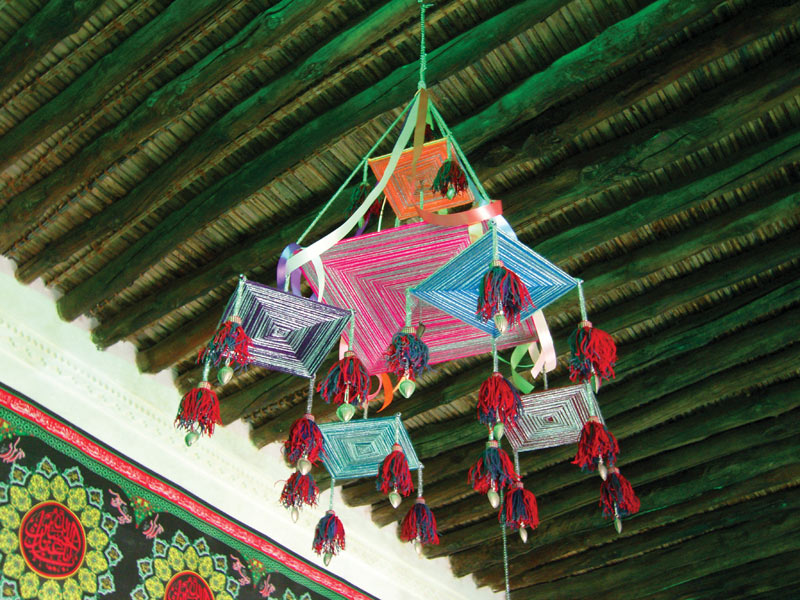
We imagine that Slavs and Tatars mount a DeLorean with a Polish pajak (straw chandelier, literally “spider”) hanging from the rearview somewhere over the flux capacitor, and drive toward the sunrise, like pilgrims to a shrine. At a certain velocity, the space-time continuum ruptures, yet they are still squarely Here and Now. Marty McFly hit the sweet spot at 88 miles an hour, but Slavs and Tatars achieve the feat of time travel within the present by moving excruciatingly, some might say erotically, slowly. Meanwhile the geographic coordinates of Here expand, contract, somersault over and roll themselves up like a Persian carpet, depending on who it is peering over the mountain. (See, for example, the 2009 installation and publication “Kidnapping Mountains” for meditations on the relativity of Here.)
The Eurasian peoples who are Slavs and Tatars’ subject of study and object of affection (including the eponymous figures, plus Kyrgyz, Ossetians, Uzbeks, Armenians, Abkhazians, Uighurs, Turkmen, Karachays, Mamluks, Azeris, Bulgars, Persians and Kipchaks) represent an implied conception of time and place which the collective mobilizes to understand the future: not its contents but its contexts. As the collective’s extensive graphic-literary output spanning flyers, posters, stitched banners, pamphlets, billboards, string-letter signs and floor stencils would attest, they are dear old friends of the aphorism. One such quip they sometimes use to crystallize their practice is the old Soviet joke, “The future is certain, it is only the past that is unpredictable.”
In an inverted fairy tale (which might be attributed to Slavs and Tatars themselves), Future, the ugly stepsister to the lovely but star-crossed Past, is actually the one fitting into the slipper that the handsome Present has left behind. In other words, as the Soviet past fades ever more into memory, what used-to-be grows ever more volatile and the new nations within the Slavs and Tatars area of interest mindlessly march toward the West, consumerism and a positivist “future”. Meanwhile, local cultures are increasingly in danger of being left by the wayside.
Now, Slavs and Tatars are no advocates of the rise of the rash nationalisms plaguing the regions in the Caucasus and beyond, but simply beckon toward attentiveness and awareness in the face of fading customs and the rise of the “modern”; they whisper, nudge, wryly joke, though never prod: perhaps the modern is not all it’s cracked up to be.