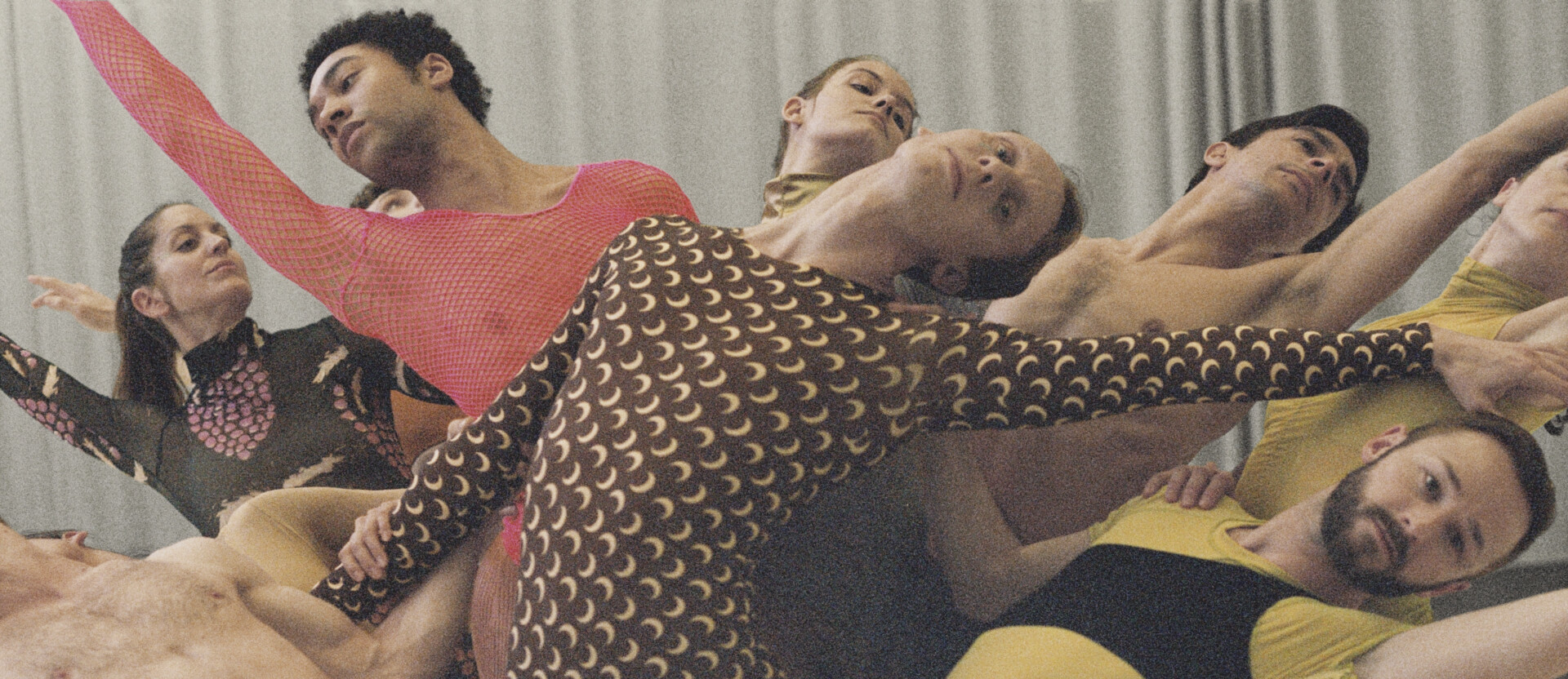
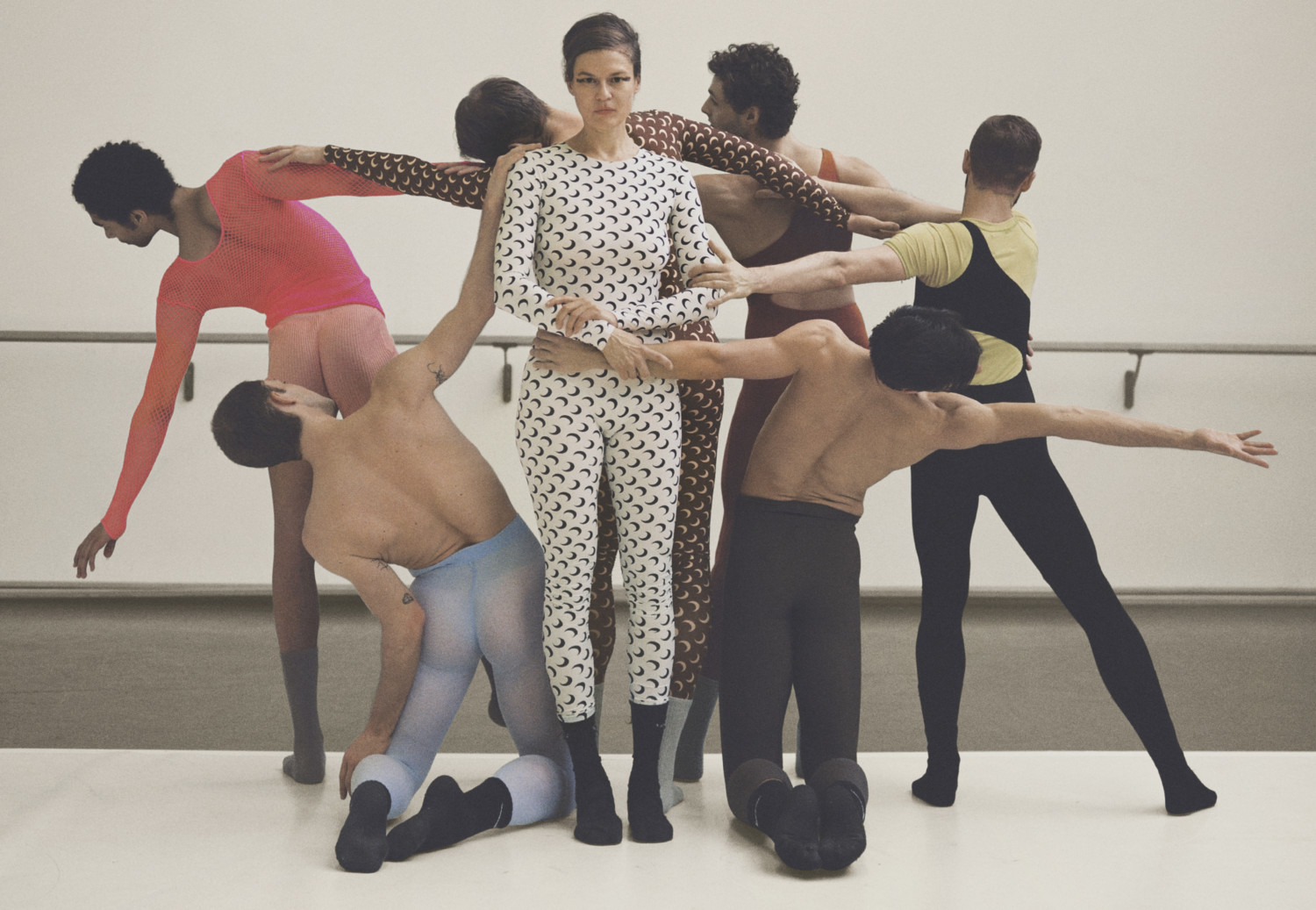
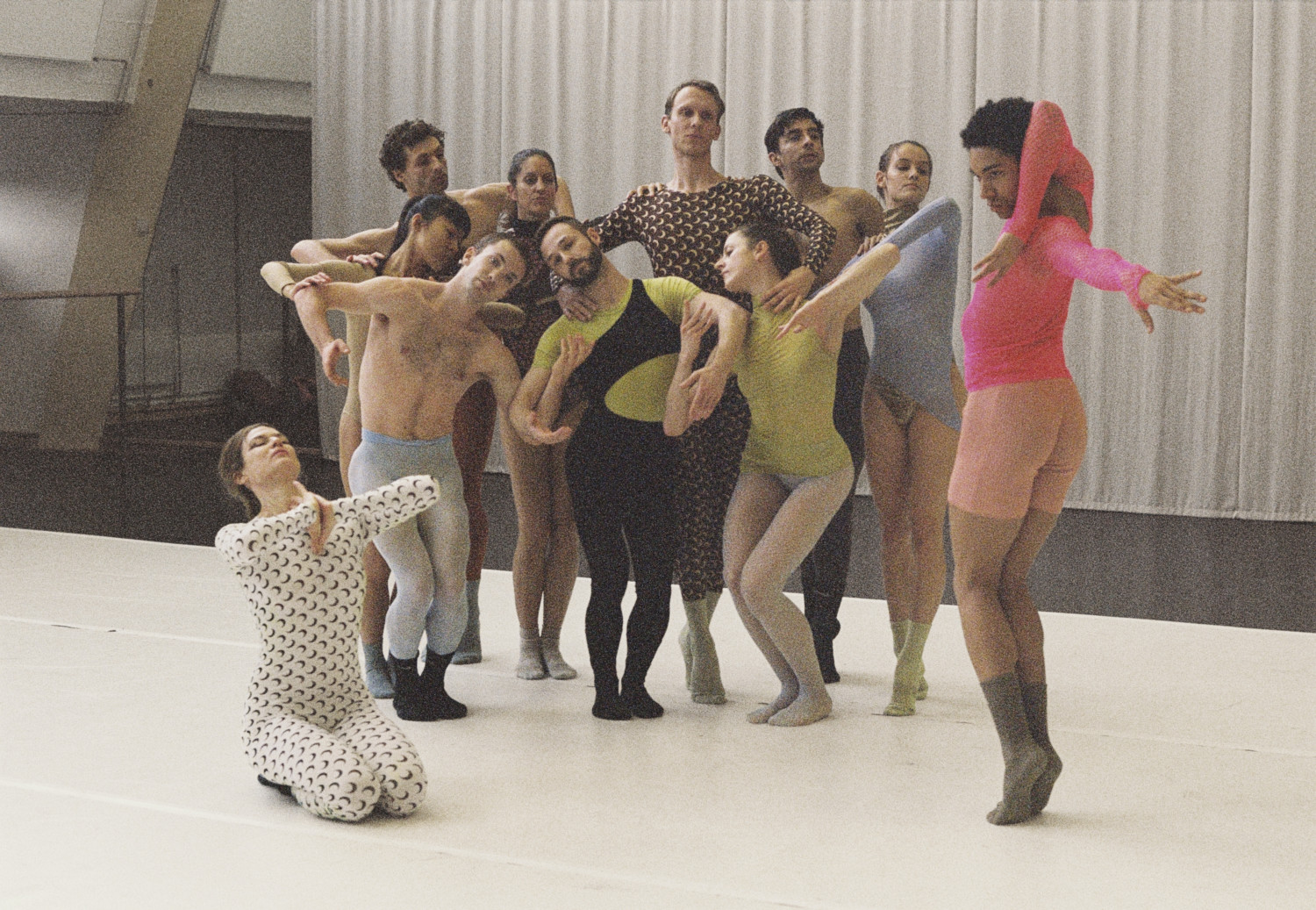
L: Sharon Eyal wears bodysuit by Marinne Serre R: Dancers wear tights by Falke, Kunert; bodysuits by Fantabody, Marine Serre, Stieglitz; shorts by Ioannes; T-Shirt by OIL. Photography by Carlota Guerrero
Dance is a language that anyone can speak. This makes it dangerous – as do its age-old associations with primal ecstasy and dissolution. See Suspiria (2018), Luca Guadagnino’s hyper-aestheticised remake of the 1977 Dario Argento horror classic, whose final dance sequence shreds the semblance of classical decorum to unleash the elemental forces below. But while dance has long been plumbed by popular culture as a portal to physical and psychological extremes, the main stages of classical dance – particularly ballet – have typically favoured the form’s aspirations to lyricism and grace.
Enter the choreographer Sharon Eyal. Eyal has created a disruptive new relationship between pop culture and classical dance that has brought her company L-E-V to the most famous venues across the world, including Sadler’s Wells and the Sydney Opera House. Without resorting to pulp or preciousness, Eyal pushes the body to extremes to explore a spectrum of emotion that is dark, obsessive and beautiful. With remarkable minimalism, pieces like OCD Love (2015), Killer Pig (2009), and Bill (2010) trawl the depths of emotion and expression to demonstrate how the body gives voice to the deepest human feelings: fear, love, obsession.
Half Life, performed recently at Berlin’s Komische Oper with dancers from the Staatsballet, opens with a male and female dancer on a bare stage and the dark pulse of Ori Lichtick’s electronic score. A woman marches in place, going nowhere, while the man beside her repeats a wide pelvic thrust. Excruciatingly slowly, they are joined by a group of dancers in close formation who appear almost naked. Hands stroke the throat, scrabble at the stomach, or lift to the mouth in a kind of nail-biting movement. Abbreviated, repetitive actions build and suddenly expand, revealing the body as a cache of compressed energy, capable of brilliant surges as well as compulsions.
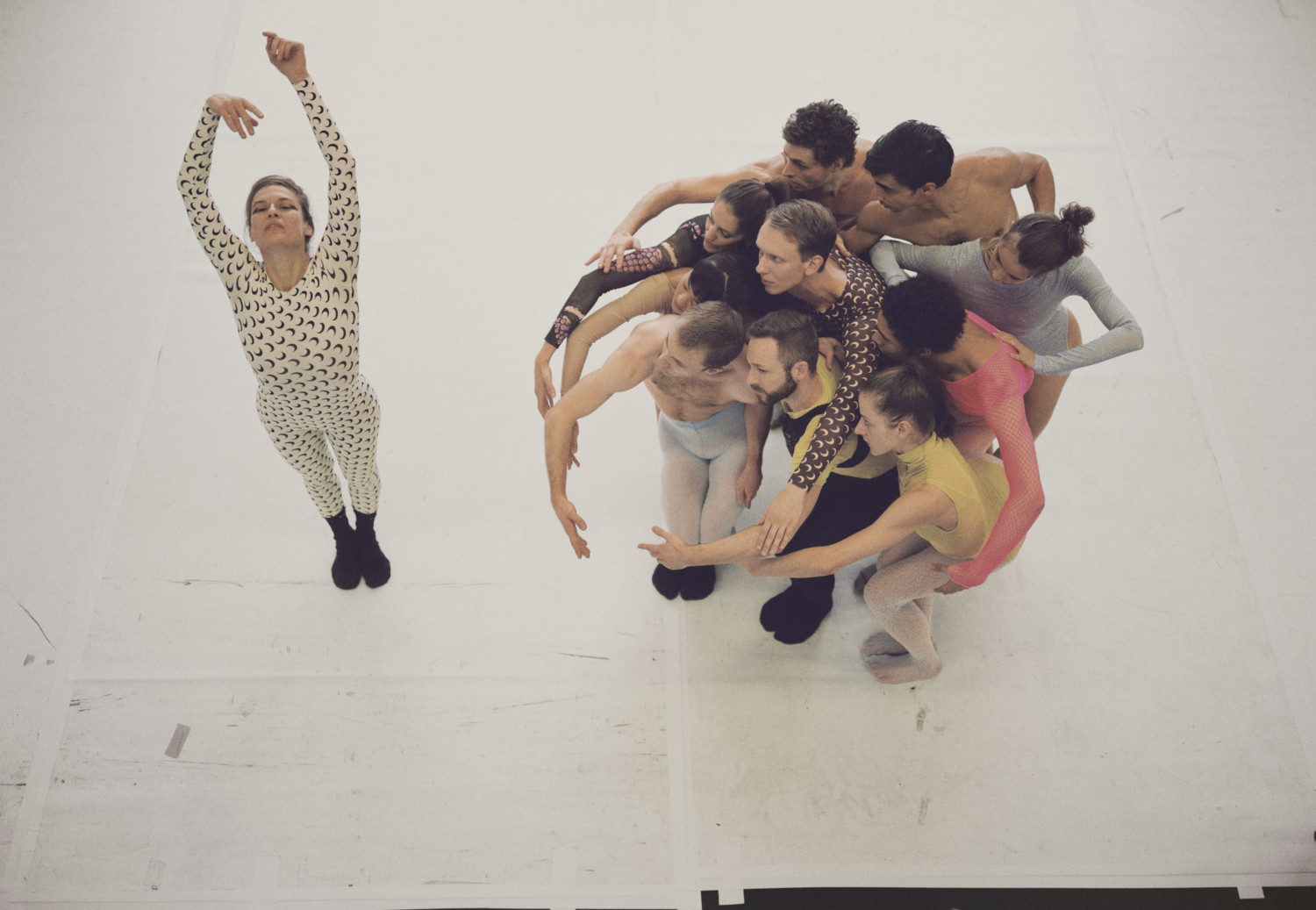
Although the dancers move together in close and eerie unison, like a single organism composed of many units – a Roman testudo or a swarm of bees – the character of each dancer comes to the fore and becomes the centre of the piece. This is important to Eyal. “I love to see people who are the same but very different,” she says. “The same timing, the same shape, the same idea, the same style, but very different. I love to see unison but crooked unison.”
Eyal trained in ballet as a girl before joining the Batsheva Dance Company to practice Gaga, an improvisatory movement language created by Ohad Naharin. Eyal founded her own company, L-E-V, with long-time partner and collaborator Gai Behar in 2013, presenting a dance style that is both old school and utterly new. The structure of Eyal’s pieces is classically contrapuntal but the presentation is almost futuristic: androgynously clad bodies are lit like sculptures or a spectral fusing of man and machine. “I believe that when you search into something very deeply, the subject doesn’t have to be something new – the approach has to be new. How you present it and how you share it,” she explains. Eyal’s distinctive aesthetic has not gone unnoticed. Last September, the choreographer collaborated with Dior’s Maria Grazia Chiuri on her SS19 Paris show, an event exclusively captured by photographer Carlota Guerrero.
But while Eyal is widely praised for revitalising ballet with modern subjects, she resists the notion that her work makes a conscious departure from the historical trajectory of classicism. Her work is not a corrective, but a continuum. “I love ballet and I love Gaga,” Eyal says. “Everything is dancing, it’s movement, it’s happening inside and outside the body. You cannot have one extreme without the other. I cannot connect to ballet or Gaga – I can connect to something bigger.” She doesn’t work with external references, but internal ones. Of her use of techno and house music associated with the clubbing scene she says, “Clubbing is just one way to get free inside of dancing. It can be clubbing, dancing at the beach. I think primitive is something I connect to more. Something old.”
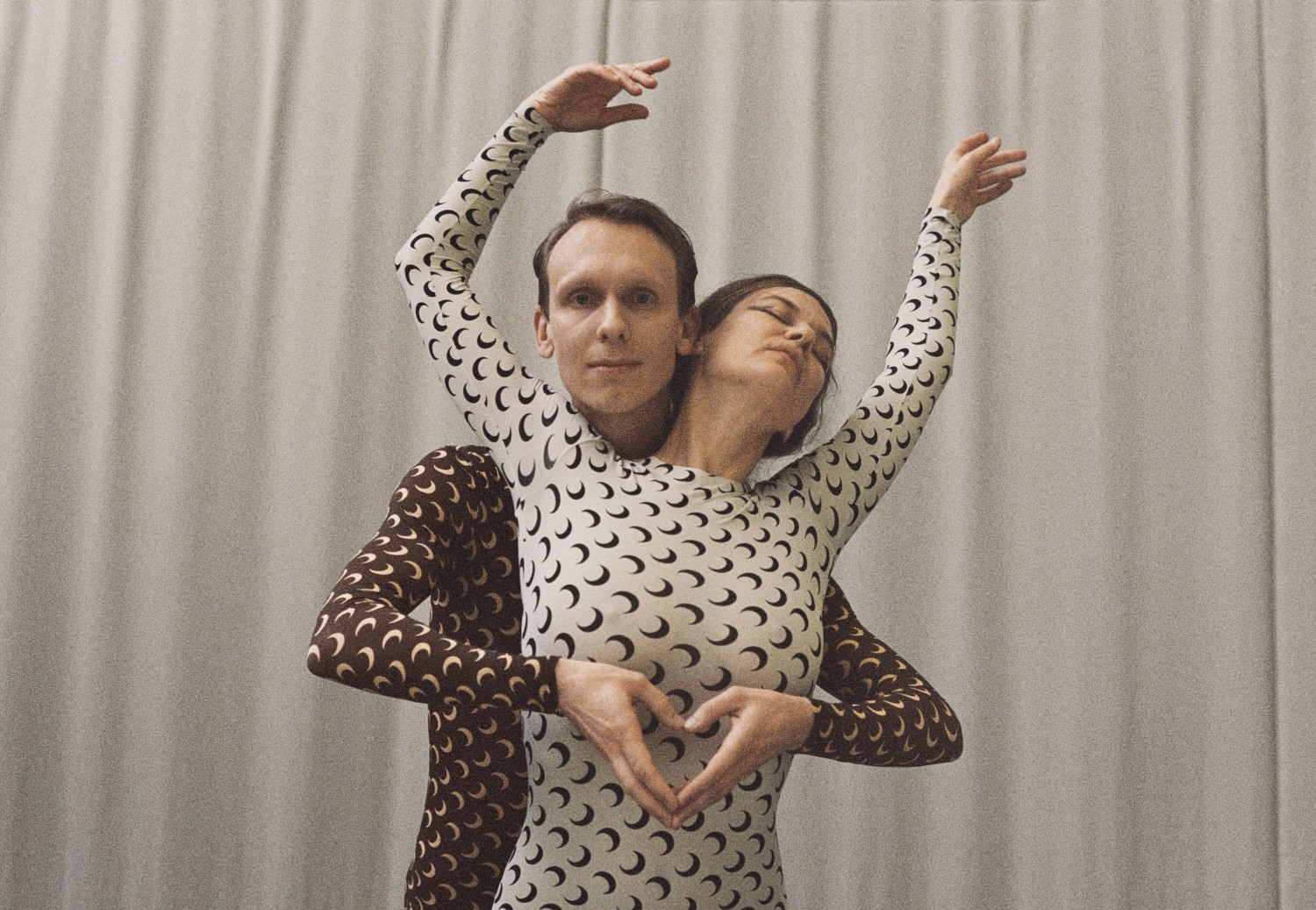
When the dancers in Half Life finally break out of their close formation, it is to perform perhaps the most classical moment in the piece. Fanned out at last individually on stage, the dancers perform a series of entrechat-dix, jumps with quickly crossed feet. Crossed hands flare behind the dancers’ heads, echoing an earlier movement, before rising and falling gracefully at their sides.The moment is pure Swan Lake, even if it’s set to a score that might belong in Berghain (Ori Lichtik, the musician Eyal has worked with for years, was a foundational figure in the Tel Aviv techno scene.) Techno and Tchaikovsky’s swan scenes share in a spectrum of minimalism that Eyal exercises for maximum effect. In her words, “You don’t need to do much to do.” Part of the way Eyal achieves the emotional intensity of her pieces is with repetition, which becomes a way to excavate emotion. Variations on a series of controlled, almost technical movements begin as tics and become increasingly virtuosic. They recall the rigours of ballet training as well as obsession and addiction, or the way we turn to ritual to assuage what we cannot control.
When I ask her how she begins work on a piece, she is patient but firm. “First of all,” she says, “it never begins. I work in the process of life. It’s ongoing – so I cannot say ‘beginning’. I can say ‘continuation’.” If they do not ‘begin’, Eyal’s pieces originate in her own movement. Over the phone, she explains that she improvises while her dancers film her. Using the video she cuts, moves and groups movements, which the dancers learn. Next is composition, where she builds layers and continues to edit. “My dancers laugh at me because we create so much more than we use. I’m about creating a lot and then cutting, doing less. I believe that when you do less you do much, much more.”
It’s not just all the jumps. It’s like therapy – you can’t help but feel all your feelings
Eyal knows how to use minimal means to achieve extreme intensity. “It’s important to find the maximum in a minimal way,” she says. “There are so many extremes in minimal places that we forget, so many layers in detail and repetition. I want to know what happens between the layers – the feelings between them.”
Performing Eyal’s work is demanding for both the body and mind of her dancers. “Sometimes they can’t sleep for a couple of days,” Eyal says. “Sometimes they can’t breathe.” After watching a rehearsal of Half Life, I spoke with Daniel Norgren Jensen, who danced in Eyal’s company L-E-V for two years and joined the Staatsballet earlier this year. “Every time before I perform this piece, I’m afraid I won’t be able to do it,” he says. “It’s not just all the jumps. It’s like therapy – you can’t help but feel all your feelings.”
When I ask Eyal why she thinks her pieces are so intense to perform, she tells me, “Something in the work is very demanding. You cannot hide behind the movement, and you cannot do just movement because then it would be stupid and empty.” She pauses. “It’s like you have to be a baby with an old soul. To be pure and without any mannerism but with the knowledge of someone really living life. Again, it’s extremity – it’s both sides.”
“Dancing like crazy doesn’t have to mean a big movement,” Eyal says. “It can be very intense inside, and that is dancing like crazy.” Movement originates in the things that move us, and honest movement requires honesty about emotion. Norgren Jensen describes performing Eyal’s work as “a reality check”, a profound exercise in self-awareness as much as technical skill. Real reality is paradoxical, and Eyal’s work embraces contradiction: fear as an expression of love, and desire as an expression of fear. Thrumming with robotic energy and eroticism, both Half Life and the double bill OCD Love and Love Chapter 2 (2018) expose the inner conflicts that afflict our shared desire for connection.
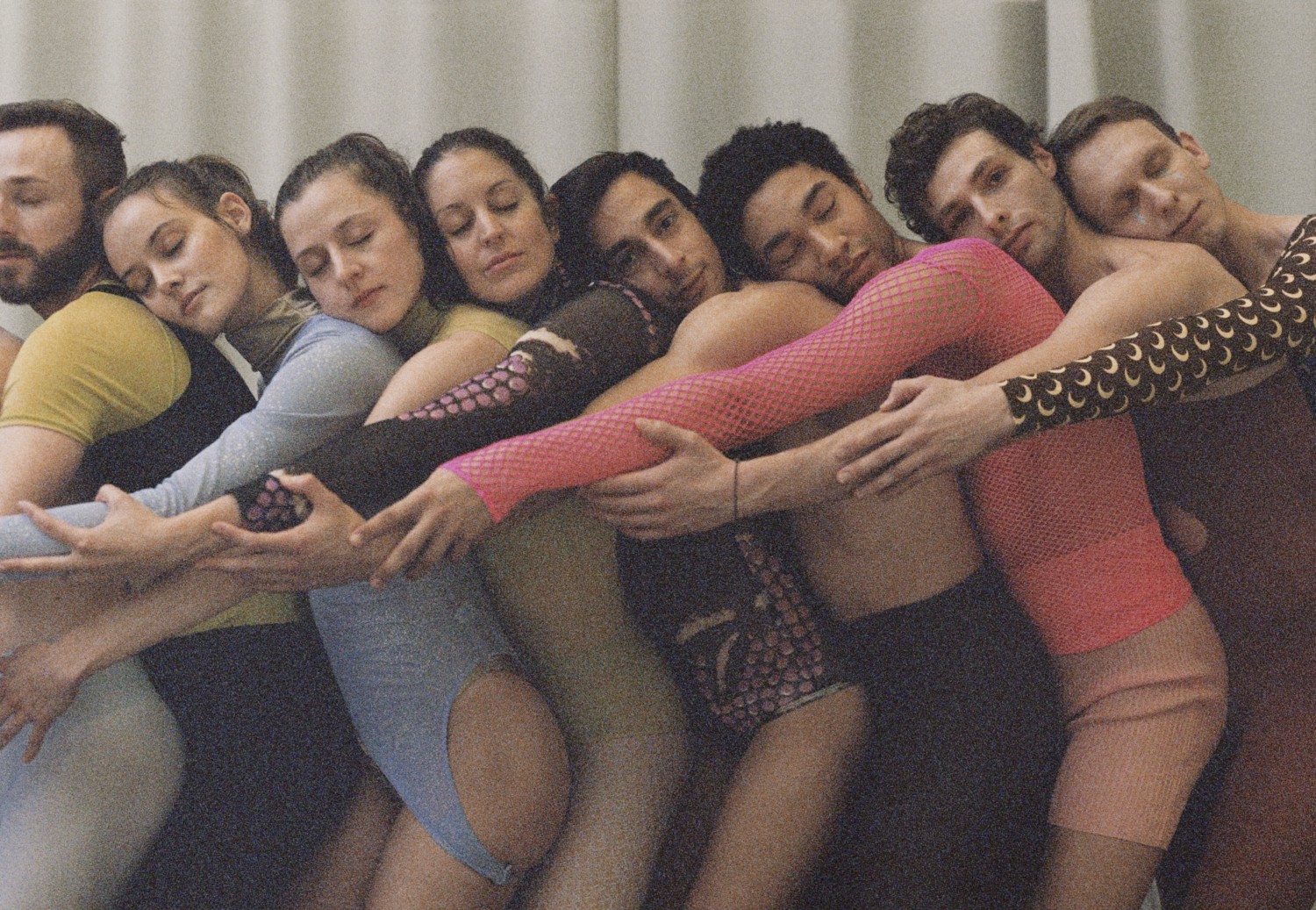
Minimalism and repetition are also ways to investigate the range within restriction. “Even the best dancers are restricted to a limited vocabulary of movement,” Norgren Jensen says. “Sharon understands that the range exists internally.” Small movements of the ribs, head, and hands repeat again and again. They accrue in one part of the body and express somewhere else. A tattoo of feet on the ground rises, becomes in a tic in the shoulders. “For Sharon, nothing is nothing,” Norgren Jensen explains. “With any movement, you’re always redirecting that energy back into yourself.”
Nothing is nothing – and nothing is ever the same twice. “For me a movement is never the same,” Eyal says. “The beauty is that even when it looks the same or you think it’s the same it never is. It’s always something else.”
At the end of our conversation, I told Eyal how, when the curtain dropped on Half Life, the audience stood and clapped in an extraordinarily physical way. We clapped with full force for a long time, as if to give back the intensity of what we had just seen. We couldn’t have done it, danced like that, but we wanted to return the energy the dancers had so powerfully transmitted. In the stalls and circle of the dark theatre, our bodies moved together and made a great noise. When Eyal speaks again, I can hear that she’s smiling. “It’s almost like you couldn’t dance but you could. Beautiful.”
Dieser Artikel erschien ursprünglich in SLEEK 62, out now.
Kredite
Fotografie: Carlota Guerrero
Creative Director: Victoria Gisborne-Land
Photographer Assistant: Hannes Meier
Fashion Assistant: Deivid Diniz
Hair and Make Up: Berenice Ammann
Hair and Make Up Assistant: Samantha Pottmeier
Retouch: Sipke Visser Frisian Retouching
Location: Deutsche Oper Studios
Tänzer:
Johnny McMillan, Ross Martinson, Mari Kawanishi, Sarah-Jane Brodbeck, Weronika Frodyma, Olaf Kollmannsperger, Sasha Males, Gregor Glocke, Filipa Cavaco, Daniel Norgren-Jensen