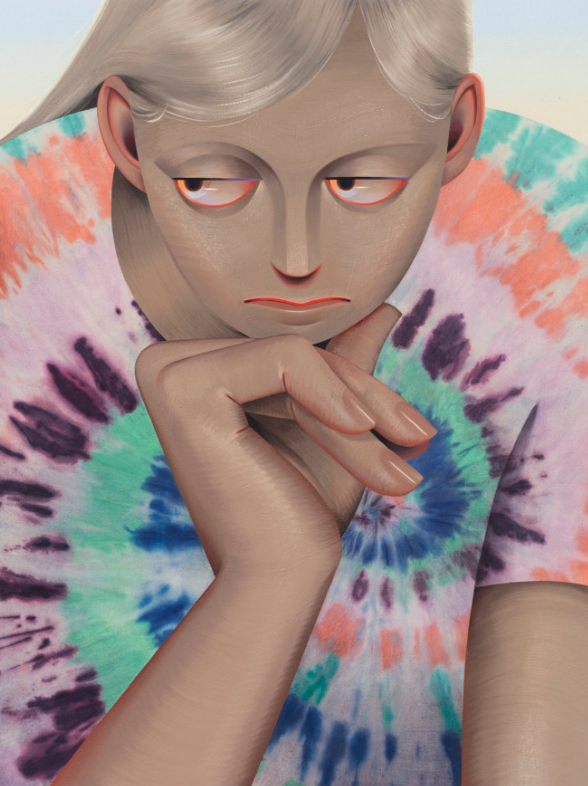
Robin F. Williams, Side Eye Tie Dye, 2019. Courtesy the artist and P·P·O·W, New York
I knew I didn’t want to move to New York City. That ambivalence hardened into numbing anxiety by the time, two months into the move, that I signed a lease and flew my cat over from Toronto. It would be easy to blame the city itself, but the truth is the problem was me: I wasn’t good at listening to that timid inner voice – you know, the one that gently nudges a sensible solution forward only to be shouted down by the furore of your ego.
That voice of reason knew that the rapid pace and workaholism of a tech job in the big city was the last thing I needed. Having mostly recovered from the subsequent burnout, I can see that, looking back. But after a decade spent slamming my head on the glass ceiling of Toronto a change was in order.
By the end of my first summer in New York, I was taking small doses of cannabis edibles daily to cope with the switch in pace. That is, I was microdosing: ingesting a fraction of an amount of a substance (typically a psychedelic such as LSD or mushrooms) in order to achieve a perceptible, but restrained, experience. A friend had introduced me to a neat and simple product: chocolate-covered espresso beans, each containing just 5 mg of Tetrahydrocannabinol. These weren’t old school edibles, concocted by enterprising stoners and home cooks fretting over vats of weed butter that got you zooted for a full 24 hours with one bite. Instead, beaning – as my friends and I jokingly referred to these very mellow trips – had a more practical result: a pleasant reduction in bodily tension and an intense sense of presence, with none of the loopiness associated with the edibles of my youth.
Lights were softer, smells less dank, subway delays less infuriating. Minor work disruptions became mildly amusing, and I became a more engaged co-worker: lucid, friendly, expressive. Menstrual cramps were no longer debilitating. On Saturday mornings, I’d get slightly lifted and meander the grocery store aisles, purchasing ingredients for elaborate charcuterie platters. Extreme weed heads might roll their eyes at it, but the barely-there lift that I got from the half dose was a revelation that verged on therapeutic. Some days, the bean managed my anxiety so well I could slide by the cops standing sentry over Times Square with machine guns on my way to and from the office and pretend it was all normal.
"Microdosing wasn’t my way of escaping the reality of the situation I found myself in, but of finding myself – and as a result, my own agency – within that calamity."
“The early research was always high-dose,” said James Fadiman, a renowned psychedelics researcher and author of The Psychedelic Explorer’s Guide, in a 2016 Huffington Post interview. “The fact that you could take psychedelics as a microdose didn’t occur to people. Dr Albert Hofmann, who discovered LSD, had been microdosing for at least the last couple of decades of his life. And of course, for thousands of years, indigenous people have been using low doses of mind-altering substances as well.” After administering self-study evaluations to hundreds of people, Fadiman’s general conclusion is that microdosing rebalances people. “They’ve improved their relationship to their body – or their body has improved their relationship to them.”
I’ve found this to be true, and I’d also add that microdosing has changed my relationship with drugs as well. Getting high used to be a recreational pastime in my teens, an opportunity to trip out and experience maximum sensation, but now I use substances with more regularity and to lesser extremes. In addition to regularly microdosing with cannabis using edibles and tinctures (a great alternative for those who want to cut back on smoking), I’ve also self-administered very low doses of acid and mushrooms. Getting high is no longer about feeling out of control of my body, especially while experiencing anxiety and depression – conditions that are now more common and acute – but rather more in control. My peers were coping using pharmaceuticals such as Klonopin and Xanax, but I was able to find some physiological refuge in plant-based substances.
The public narrative around microdosing has shifted over the last five years. Initially touted as a ‘creativity enhancer’ with the ability to improve focus by the productivity obsessives of Silicon Valley, microdosing is now a wellness trend embraced by everyone from harried office workers to busy mums, particularly as an alternative to antidepressants and as a deterrent to alcohol abuse. A study published in PLOS ONE journal earlier this year noted that there has been very little scientific research into microdosing, and that while drug studies over the years have “consistently found that psychedelics are among the least harmful substances, with far less personal and societal risks than legal drugs such as alcohol or tobacco”, research is still needed to determine whether chronic low-dose exposure involves still unknown risks.
Contemporary political trends in Western democracies across North America and Europe might be considered a risk factor for chronic anxiety, fatigue and depression. The rise of fascist and regressive political leaders, increased militarisation of security forces, climate crisis inaction and the commodification of our personal lives via social media, feels like the perfect situation in which it’s necessary to find tension relief. In Canada, where I now live once again, marijuana decriminalisation has exposed the extent to which drug re-education is required so that people might consider starting – and perhaps staying – on low and slow doses.
I’m not a scientist. I believe governments need to invest in more drug-positive research rather than operating from a stance of pure deterrence. But I am a person who began living in the most economically disparate city in the world’s richest country just months after the most corrupt US president in history took office. Microdosing wasn’t my way of escaping the reality of the situation I found myself in, but of finding myself – and as a result, my own agency – within that calamity.
This article originally appeared in SLEEK 64, jetzt erhältlich.