
Sun Ra in "Space is the Place" (1974). Dir. John Coney.
When a meme featuring avant garde jazz composer Sun Ra holding an image of tech entrepreneur—and questionable space enthusiast—Elon Musk with the caption “Whitey on the Moon” (referencing the Gil Scott-Heron song) showed up on my Instagram feed, I laughed hard. Accompanied by activist group Soap du Jour’s open letter to curator Christoph Tannert of Berlin’s Kunstlerhaus Bethanien (KB), the meme criticised the gallery’s current exhibition, Milchstrassenvekehrsordnung/Space is the Place, which has made headlines this week on account of its questionable curatorial framework and striking lack of diversity.
The anonymous group’s letter took issue with the show’s concept and its artist line-up: that is, the unlikely juxtaposition of Polish sci fi writer Stanisław Lem’s idea of a “Milky Way Traffic Code” from his 1982 novel Observation on the Spot, and Sun Ra’s galactic rejoinder to white supremacy, the 1974 Afrofuturist film Space is the Place—from which KB’s exhibition takes its name—to explore the notion of a new space age (Sun Ra is often credited with pioneering the early Afrofuturism movement via his consistent embodiment of the extraterrestrial as a place of refuge and liberation). KB tasked 22 artists, only three of whom are female and all but one of whom are white, with this formidable challenge.
According to the original curatorial statement, “The theme of the exhibition is linked to the hope, recently expressed by Elon Musk, that we are currently at the beginning of a new chapter in the history of mankind …” In response, Soap du Jour’s letter challenges the gallery’s “unwavering commitment to white Muskulinity” (a jab at the predominantly white male artist line-up and the entrepreneur himself) asking, “Which 22 artists could capably and competently reflect on what it means to dream of colonising the universe (à la entrepreneurial oligarchic capital) AND simultaneously manage to compellingly take on the great and visionary legacy not only of Sun Ra and his Arkestra, but also of Afrofuturism in general?”. Reacting to the critique, Tannert claimed that it took the exhibition out of context, and that curatorial freedom was as important as artistic freedom. He also invoked KB’s good institutional diversity record, which the activists had acknowledged in their letter as well.
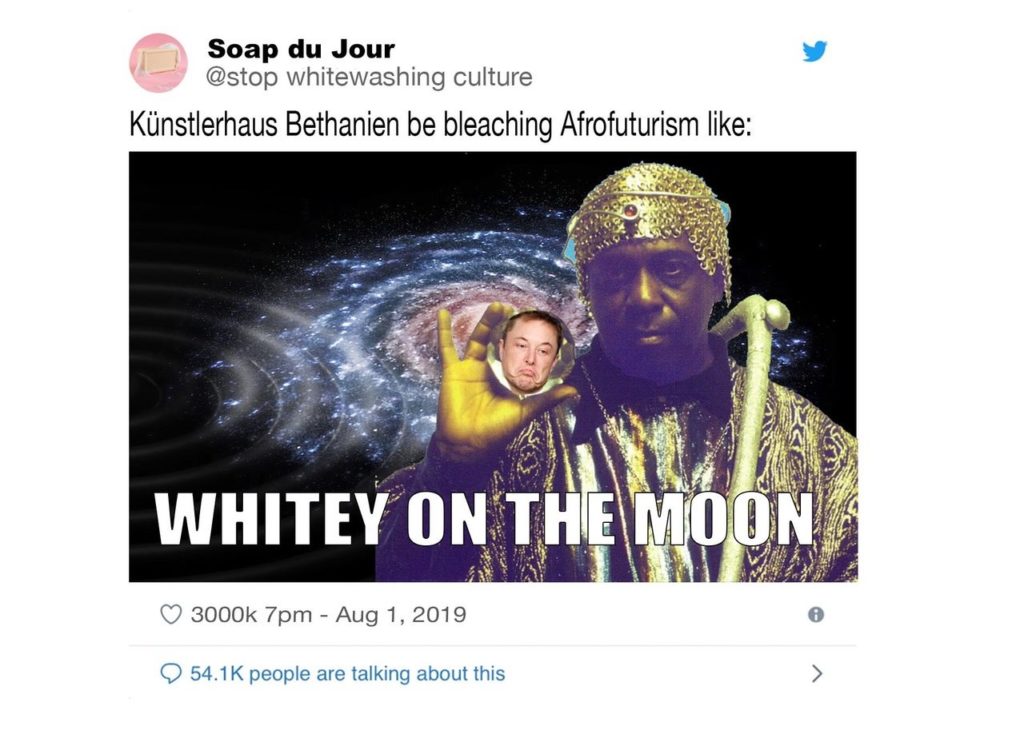
Image circulated by Soap du Jour alongside the letter via ArtNet.
Similar cases show that the KB controversy is nothing new. Just this April, Soap du Jour called out the organisers of Berlin Gallery Weekend because 75% of the platformed artists “happened” to be simultaneously male and white. Meanwhile, last autumn in France, an open letter signed by 300 artists and cultural figures waged similar criticism against the organisers of the annual photo festival, Les Rencontres d’Arles, pointing to the underlying structural dynamics that have favoured (white) male overrepresentation in the art world,
Even with a pair of the wildly popular “we-don’t-see-race” glasses on, Tannert’s curatorial concept is built on the shifting sands of an obscure variant of curatorial freedom. I say this because firstly, KB was impressively swift in swapping the curatorial statement as criticism mounted, which is not what curatorial confidence looks like. Secondly, the misrepresentation of Sun Ra’s legacy, and the underrepresentation of female and/or queer artists of colour who have kept that legacy alive reveals underlying dynamics that erase their contributions to wider futurist aesthetics.
"The ease with which (Afrofuturism) is conflated with neoliberal and essentially colonial visions which it is designed to transcend is alarming."
In the revised curatorial statement and press release for the exhibition available on KB’s website at the time of publication, American physicist Michio Kaku is now credited with the underlying premise of the exhibition rather than Elon Musk. Similarly, other words and phrases quoted by Soap du Jour in their letter, such as “Afrofuturism” or the “Black Panthers” can no longer be found. KB certainly regrouped in the face of criticism, which looks good on the critics but not so much on KB itself.
As far as references go, Sun Ra’s Space is the Place has always been a critical lens with which black people are invited to explore realities outside of oppressive socio-political and cultural circumstances. Space becomes a metaphor for a place free of white supremacy and the constant struggle against it: a liberated, utopian space as the place to be. The long and sustained engagement with this legacy (which I address below) has been a labour of love for many artists. In sharp contrast, KB presented two distinct readings of Sun Ra’s legacy in the space of a few days, none of which appears to have had any bearing on the curatorial project whatsoever. It is indeed Sun Ra’s legacy that has been taken out of context here by divorcing it from its liberatory connotations.
Admittedly, the debate I am speaking to here is not about the artists involved or the quality of their work, but about the exclusionary curatorial practices that continue to privilege white male artist line-ups. In contrast, the artists that have kept Sun Ra’s Afrofuturist legacy alive as a cultural aesthetic across literature, film, fashion and music have often been women of colour: Octavia Butler, Grace Jones, Missy Elliot, Janelle Monae, Selly Raby Kane, Nnedi Okorafor, Wanuri Kahiu, Frances Bodomo or Manthe Ribane might ring a bell. Importantly various artists have explored the Afrofuturist tradition across film, painting, performance and sculpture as well, including Ngozi Onwurah, Eddy Kamuanga Ilunga, Cyrus Kabiru, Wangechi Mutu, and Nick Cave, among many many others. All of these artists, like Sun Ra, have used the extraterrestrial to re-imagine blackness outside of the confines of planetary possibilities and realities.
Afrofuturism is complicated, and I often struggle with the blanket use of the term in popular culture and in art myself. To be sure, not all black or African futurisms can be classed as ‘Afrofuturist’, but if they are, credit (and exhibition space) is certainly due. While I acknowledge the effort to engage with the wider Afrofuturist legacy as it relates to the ‘new space age’, the ease with which it is conflated with neoliberal and essentially colonial visions which it is designed to transcend is alarming. At its most basic, Afrofuturism recalls “Black to the Future” the title of the seminal 1994 essay by Mark Dery that has since become a slogan for many. I am also reminded of Alisha B. Wormsley’s site specific installation in Pittsburgh, which faced removal for simply stating, “There are Black People In The Future”. Initially speaking to contestations around gentrification, Wormsley’s message lends itself well here: If there are no black people in your vision of the future, it is —most certainly—the past.