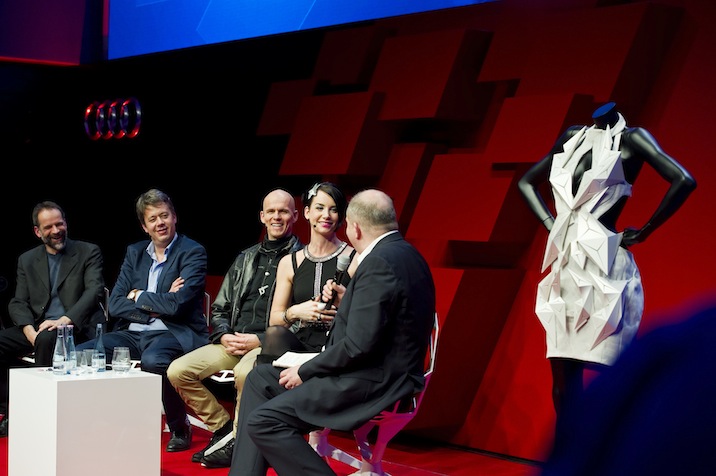
 AUDI Spark Nights / Technology with Moderator Jörg Thadeusz; Designer Anouk Wipprecht
Anouk Wipprecht is a Dutch FashionTech designer you might not want to mess with. She’s the creator of the Spider Dress, a garment designed with new technology that functions as an intuitive self-defence mechanism. Last year she was invited by Audi to develop a collection inspired by the Audi A4, which included clothes made with parking sensors and LED lights. Sleek met Wipprecht last night after her presentation for “Spark Night’s” latest inspirational session at the Audi City lab, to talk about mental wellness and creating fashion that communicates at a physical level.
SLEEK: You seem to be all over the radar, where do you live?
Anouk Wipprecht: I travel around. For two years I was based in Vienna, I’m now in California, but when I have an international client I usually travel. When I get a call for a new project they often aren’t sure exactly what they want, so I prefer to develop the concept closely with the client. For me, coming to Berlin to work together with Audi and their design team was very important. To see the car, the paint, and the finishes – those things inspire me to create. My designs are really personalized because I’m working in close collaboration with the client, that’s also why I don’t want to have a studio.
So they facilitate the design process?
Yes, but also I try to see what they have lying around on their desk or I try to figure out what they have in their trash; what they cannot use and I can.
Other then the LED lights we saw in your design tonight, have you used other car parts for this collection?
Well 3D printing is a technique for rapid manufacturing that they also use in the car industry. Also, we used the exact car paint of Audi and we sprayed the pieces in the garage where they normally spray the cars, that was cool. For another design we also incorporated parking sensors from the cars, so as soon as you walked up to them they reacted.
It looks like complex process to fit your 3D rendering with the technology that will do what you want it to, have you encountered setbacks in the development process?
The high power lights. In the design that you saw, the lights were 60watt high power LED. It was a little bit mysterious in the beginning to get car lights into a wearable design. These lights normally have a really big cooling block for example. I did a lot of research on how to make it smaller. The whole Audi collection though was developed in about two months. So it was a really fast process, which was a challenge. What kept us up to speed was to come together as a team and use 3d printing or rapid manufacturing techniques. Regarding technology, we worked with Monomango Berlin who helped us getting things to fit with projection mapping. Audi provided great feedback as well, which had a big influence on the Designs and how they look now, I learned a lot about finishing touches and raising quality standards.
 AUDI Spark Nights / Technology with Moderator Jörg Thadeusz; Designer Anouk Wipprecht standing next to her dress
 AUDI Spark Nights / Technology with Moderator Jörg Thadeusz; Designer Anouk Wipprecht
How did the collaboration start?
Audi saw some of my designs and they were interested in working together. We started by considering in which aspect my identity could coincide with the DNA of Audi. They have their own brand identity and I have my design style and methodology, it was very interesting to see where we matched.
Did that change the way you worked?
I really based the design of the collection on the car, the A4, so I took some of the design elements from the car and put it in the collection. If you see the spider dress, from my older designs, it’s very organic very natural; but Audi is very abstract, very badass.
Have you worked with other fashion designers?
No, I have not; I’ve only worked with engineers or architects. I do teach a lot of fashion designers though; for example how to work with electronics or with technology, because that’s a different drill. The fashion industry has its own system compared to that of technology so it’s always interesting to educate people on how they are similar but also different.
You mentioned earlier that you hope in the future that 3D soft breathable fabrics can be 3D printed because at the moment you have to work with plastic. It seems that plastic could be a better material for accessories, have you thought about designing any?
Actually I’m busy at the moment designing a few accessory pieces with Berlin-based label ElektroCouture, her name is Lisa Lang. We are trying to create something with my design style and her technology and also using Bluetooth, LEDs, 3D printing, and, as technology gets smaller, computer boards. One thing that we haven’t solved yet is the battery but we can make things based on solar power. That is one thing that we are talking about at the moment. Within half a year I should have some pieces coming out in collaboration with ElektroCouture.
What other projects are you working on?
I’m also interested in wellness from a mental perspective. That’s why work a lot with personal space, for instance. I’m also developing research in cooperation with Ars Electronica for children with Asperger’s on the autism spectrum, because they have problems with communication and I create garments that help with that. Working with children is important to me because they are the new generation; they are the designers and architects of the future.
Text by Magdalena Torres
The Sound Edition of “Spark Nights” will take place on 18 February 2016 at Audi City Lab Berlin
More: Gypsy Sport AW16 at New York Fashion Week
More: Be Inspired by these Cape Town Transgender Fashionistas