
This year, BMW released the BMW Concept 8 Series, which combines peerless design with breathtaking speeds for an unparalleled driving experience. This unabashedly modern and athletic model is slated for a 2018 release. To celebrate, SLEEK will be presenting a series of features around innovative design and speed. In this first installment, we’ll be showcasing six designs which push the boundaries of speed in different but equally intriguing ways — including, of course, the groundbreaking BMW Concept 8 Series.
We live an accelerating present, in which profound technological advances are the norm. Each year brings new innovations that are faster and more advanced than those preceding them. It’s incredible to imagine that we’re now taking over 1000% more photos each year than we were at the turn of this millennium, and that every two minutes, we take more pictures than ever existed in the 1800s. Computer processing has come along, too: today’s 4.0 GHz Intel Core i7 is 84 times faster than the year 2000’s 1.5 GHz Intel Pentium 4. We produce 3,733 times more data every year, which we can download faster: a 5 minute MP3 would have taken an astonishing 12 minutes to download on a 56 Kbps dial-up connection, compared to a single second today. We’re moving faster than ever, and in 2017 our pace of living feels particularly breathless.
Inspired by the conceptual speed of the BMW Concept 8 Series, we’re taking a closer look at six design innovations from 2017 that capture the speed of the present moment. Although entirely different in their execution, each of these technology-driven projects foreground speed and agility to an almost dizzying degree. Whether we’ll be bounding along on superfast sneakers, paying for our groceries with a single glance, or cheerily cruising through a Hyperloop, each innovation redefines what it means to move.
Nike ZoomX VaporFly Elite
 Nike Vaporfly Elite. Image: Nike
While most of us would be satisfied completing a marathon at all, world-record-holder Eliud Kipchoge managed all 26 exhausting miles in just 2 hours and 25 seconds. Helping him along the way were his bespoke Nike ZoomX VaporFly Elite, a super lightweight running shoe designed specifically for lightning-fast marathoning. Weighing in at just 6.5 ounces, the supershoe features a tapered heel to prevent drag, ZoomX cushioning, and a lightweight carbon-fibre midsole to drive the runner towards the finishing line. The only problem: it could be too good. Some critics even claim that the shoe gives marathon runners an unfair advantage.
Zaha Hadid’s Naples High-Speed Station
Zaha Hadid Architects have never shied away from ambitious projects, and the new Naples station is bang on brand for the starchitecture firm. Fifteen years in the making, phase one was finally completed in June. This impressive new “gateway to the South” aims to link the two historically distinct sides of Italy via a high speed rail network. Located next to Mount Vesuvius (of Ancient Pompeii fame), the serpentine structure was designed to mirror the volcano’s flow of lava. This is amplified by its interior structure, which is elevated by a bone-white steel rib cage. Along with its curved concrete and glass cladding, the building is uncompromisingly future-oriented.
Face++ facial recognition AI
 Face++ interface. Credit: Face++
For those who prefer their futurism a little more Black Mirror, there’s Face++. This facial recognition software tracks 83 distinct points on your face for precision identity verification. Advancements in AI and deep learning mean that your face can now be identified in even the grainiest of images. The Beijing-based startup has already licensed its product to several Chinese apps, including mobile payment app Alipay, where you can verify payments with your phone camera. While Face++ is already speeding up secure transactions, its potential invasiveness has also ignited fierce debates about privacy.
MIT’s Swish Chair
 SWISH as a Prototype. Credit: Carlo Ratti Associati for Cassina.
Developed by Carlo Ratti, director of MIT’s Senseable City Lab, the Swish chair is the world’s first “programmable stool” — and it certainly hasn’t compromised on style. Designed entirely by algorithm, each of the 27 individual wooden pieces interlock via a complex interplay of hinges and joints. The slats can kinetically adjust into different shapes with all the dexterity of a gymnast. Because of the complex geometry of the chair’s moving parts, it would have taken a human designer an unimaginable amount of time — and no doubt much frustration — to create the same product. With the algorithms, however, it was a walk in the park.
Hyperloop One
Although many of our initial glimpses at Living in the Future have been pretty underwhelming so far, Hyperloop One hits much closer to the mark. Dropping vehicles into an underground tunnel with an electromagnetically levitated pod, a vacuum sealed tube will then propel users to their destination at speeds of up to 670 mph — as fast as a commercial plane. Designed to alleviate the heavy congestion of LA’s highways, Hyperloop travel will also completely eliminate pedestrian collisions. Hyperloop One’s first test track was completed back in March, and vehicular tests officially began in May.
BMW Concept 8 Series
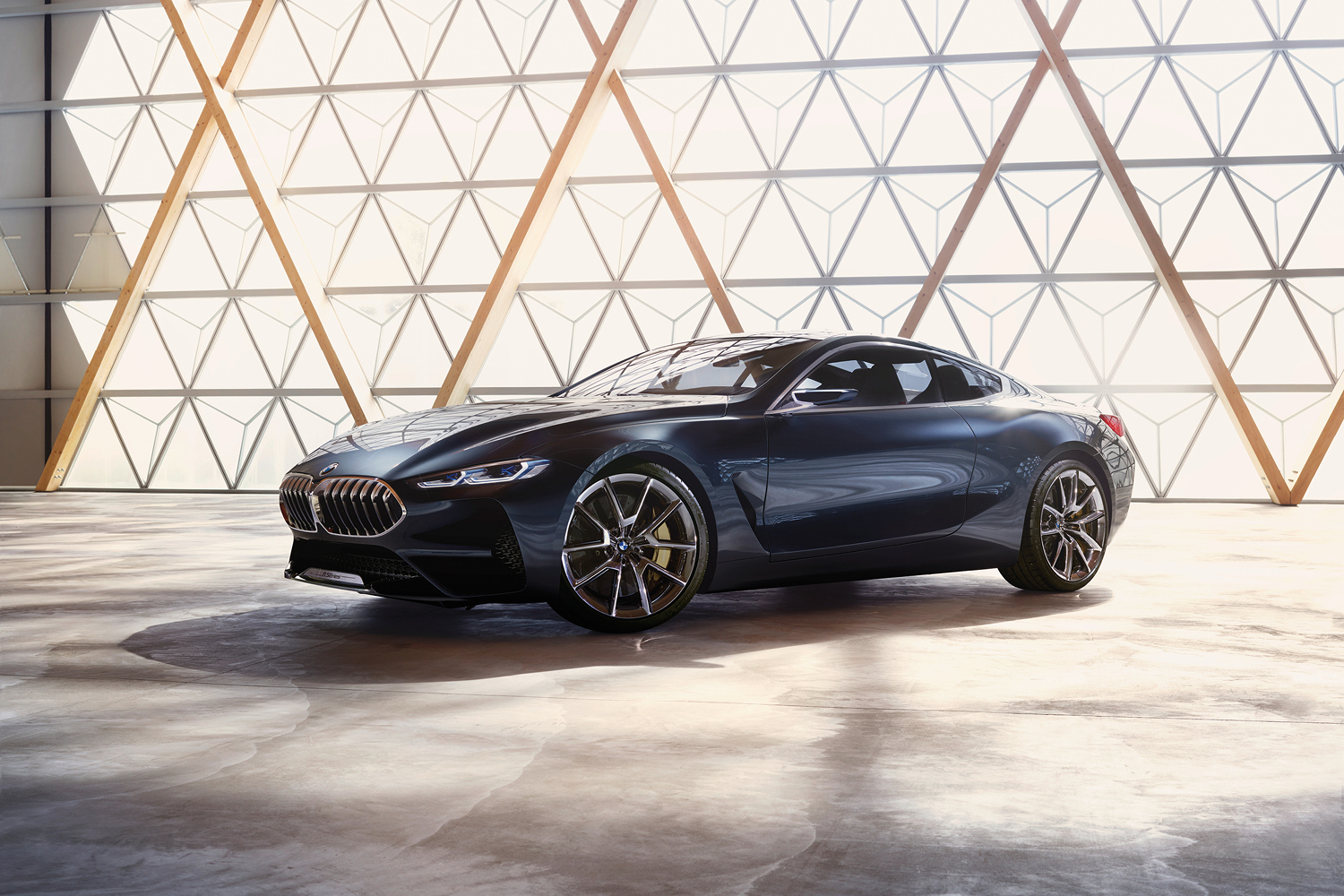 BMW Concept 8 Series. Image: BMW.
The BMW Concept 8 Series is uncompromisingly focused on speed. The new concept car from BMW is both muscular and lightning-fast, taking its cue from BMW’s extensive heritage in motorsports — and, of course, the iconic 8 Series, which ruled the road from 1989 to 1999. The BMW Concept 8 Series continues this heritage of sports performance; the car’s low silhouette is boldly athletic, from the long bonnet to the dynamic flanks. Its low-slung silhouette and contoured air vents give it an unambiguously race-car feel. The interior, meanwhile, is sculpted from carbon fibre and red-stitched Merino leather, and aggressively points to a single direction in the distance. The BMW Concept 8 Series will have you hurtling towards your destination before you’re able to catch your breath; 2018 can’t come soon enough.