

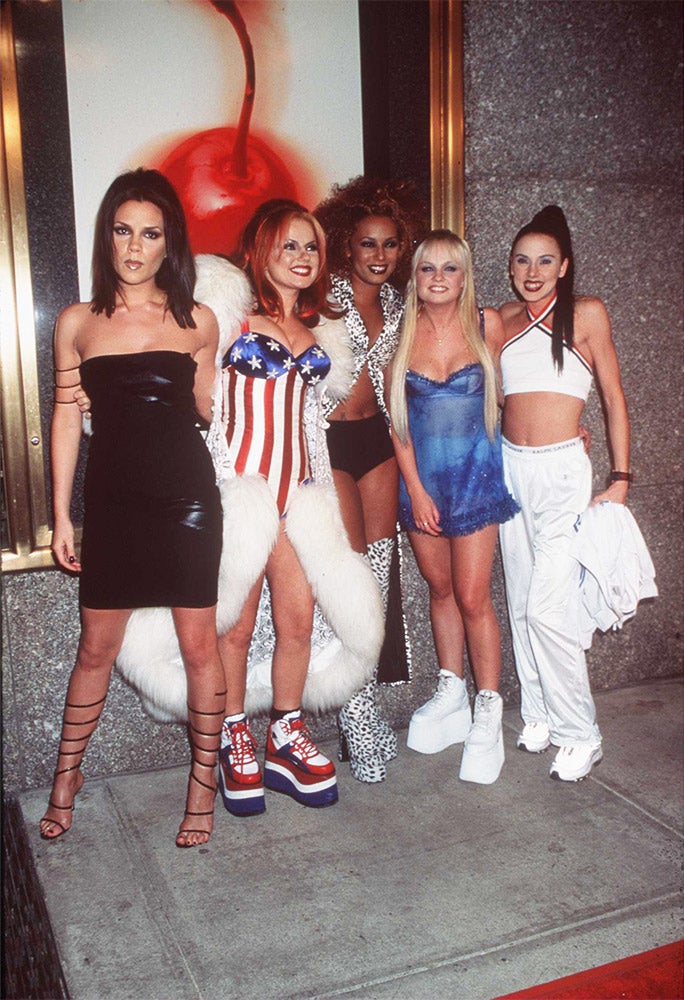
The Spice Girls courtesy of Getty.
There are few footwear brands that boast the same cultural legacy as Buffalo. Feeling its first taste of widespread popularity in the ‘90s, the footwear label—known for its comically chunky, platform sneakers—is synonymous with a self-fashioning that is relentlessly anti-fashion and anti-establishment. The brand’s resurgence in popularity today, marked by its recent foray into the US market, and worn by celebrities including Gigi Hadid and Billie Eilish, is captured in its current slogan “#notliked”, exemplifying its non-conformist ideology. And while political uncertainty is a defining feature of 21st century life, Buffalo boots nod to a time free from angst and disillusionment. Arguably, it’s this that makes them the footwear of choice for ‘Brexit Britain’ in particular.
The manufacturer, so entwined with Britain and Britishness—it even named its sub-label Buffalo London for the relaunch of the Buffalo Classics boot in 2017—actually has its origins in Cold War Germany. Founded in Frankfurt in 1979, Buffalo Boots GmbH was originally a retail business for the shoe-of-the-moment: the cowboy boot. At international fairs, Buffalo started to offer a wider range of styles, helping to expand its reach and brand awareness.


Left: Courtesy of O32c. Courtesy of @billieeilish.
In 1995, the Frankfurt-based shoemakers created a “sport shoe line which, with its platform sole, was highly innovative in the international market.” The Buffalo Classic, as it was initially called, became its signature shoe alongside its edgier cousin, the colossal platform sneaker: the Rising Tower. Coinciding with the techno explosion in Frankfurt and the grunge movement in the UK, the release of the boot chimed with the general feeling of the zeitgeist: one of newfound optimism and rebellion. Made up of a 5cm platform, a real leather upper and a hard wearing rubber sole, the chunky trainer-come-boot was both practical and durable. Unsurprisingly then, it was the obvious footwear of choice for a generation of millennials stomping to chart topping hits by The Prodigy until sunrise.
While there hasn’t been a decade since their release that Buffalo boots haven’t been re-appropriated by a subculture as part of their identity—from grunge to goth to techno to punk to the 2010s hipster—it was the Spice Girls who were responsible for their vertiginous rise to mainstream fame, specifically forging the now inextricable link between Buffalos and Britishness. The group wore them on shoots, in music videos and on stage, becoming poster girls for the brand. No doubt this helped reinforce its progressive image of gender fluidity, freedom and fun. These were the years of Blair’s Babes, oppositional cultural politics and the flourishing of third-wave feminism. Much in the same way that Geri Halliwell’s iconic Union Jack dress became emblematic of Cool Britannia, Buffalo shoes came to symbolise a newfound female empowerment, and of the “girl power” revolution spearheaded by the Spice Girls. With their robust shape and unisex appeal, the boots were far from feminine in the classic sense.
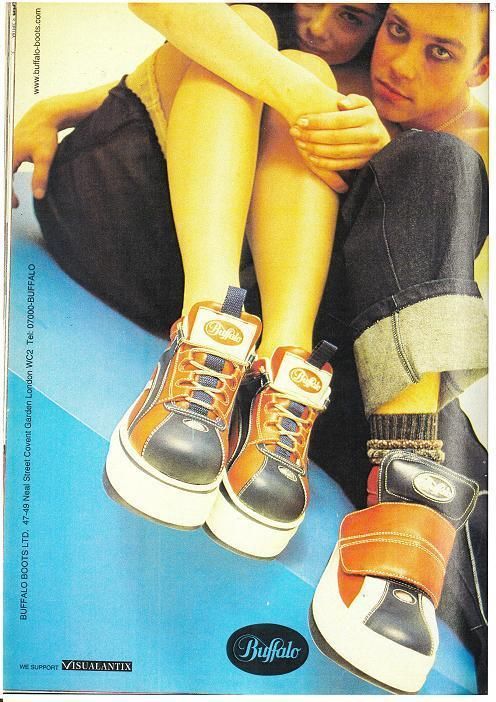
Fast forward 20 years and the boots are back in fashion, this time in a climate that is markedly different than it was under New Labour. Since the end of 2017, new selected Buffalo Classics models have been released each month in strictly limited editions. Additional collaborations with Junya Watanabe, Patrick Mohr, Opening Ceremony and most recently, Buffalo London’s collaboration with O32c, prove how enormous the fashion potential of a platform trainer is. Such high fashion credentials have cemented Buffalo as one of the frontrunners in the footwear industry today.
So, what is it that makes the shoe so appealing today? With the nostalgic return to other ‘90s era trends such as cycling shorts, unitards and the dad trainer, it seems that we turn to the past when we’re pessimistic about the present. But more than just another shoe in the ugly trainer trend, I think that Buffalo boots symbolise something bigger: a yearning for stability, opportunity and a sense of belonging. Being seen wearing the characteristically clunky silhouette has become something of a status signifier that hints at a disavowal of trend-setting high-street style, a desire to free oneself of fashion fads and a rejection of the current power structure.
Since the vote to leave the European Union in 2016, the atmosphere in the UK has been subdued at best; depressing at worst. As the general elections looms on 12 December, and feelings of angst, betrayal and confusion heighten, Buffalo shoes remind wearers that having two feet firmly on the ground is never such a bad thing.