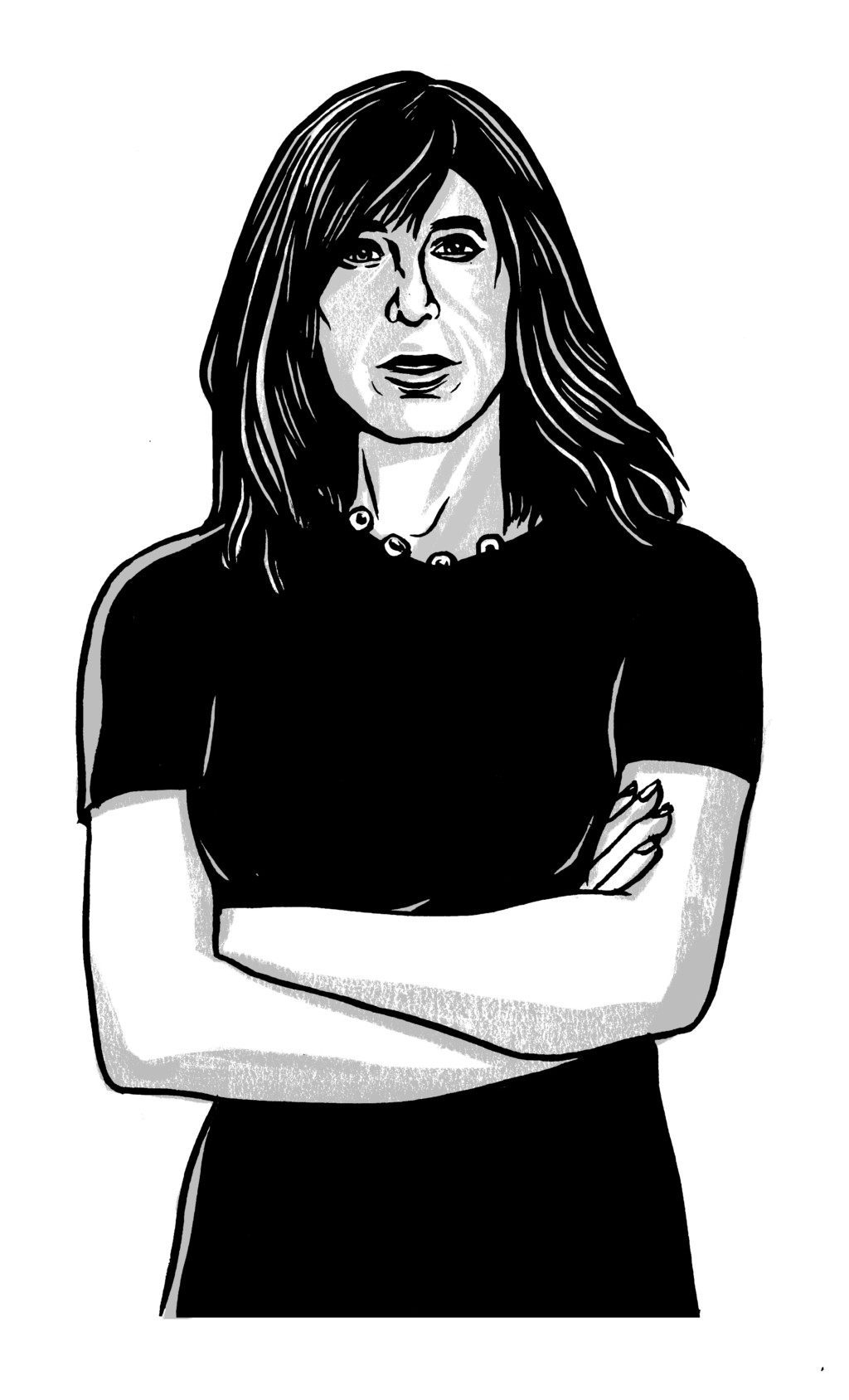
I was in Providence, Rhode Island, the day of Christine Blasey Ford’s testimony, when everything stopped. A newspaper writer who happened to be on a plane live blogged the reactions of people throughout the cabin – “Woman in 19C, crying” – and women from all walks of life who’d suffered sexual assault called in to C-Span to disclose these horrific events, in a flood of support. “I’m a 76-year-old woman who was sexu- ally molested in second grade. This brings back so much pain,” a woman from Missouri began. If you followed the tweets and retweets, which would all be eventually archived, it seemed like the theme of the day was catharsis. Which must have been true, because that night Trump, the media sensor supreme, declared Blasey Ford to be “a very very fine woman … A credible witness … Very good in many respects.”
So, it’s surprising to look back and see that Brett Kavanaugh’s testimony occurred on the same day, because as I and others remember it, Thursday, 27 September was the day of catharsis and tears, a day that the media now immediately describes as the apotheosis of the necessity of the #MeToo movement. It was just a few days
later that Kavanaugh’s angry, indignant response set in and the worm turned. The Alt-Right media waged a campaign about the veracity of Blasey Ford’s “second front door” allusion, how it wasn’t trauma at all, because she’d received the permits in 2008 when she was renting out part of her house to install a back door in her bed- room. By 2 October, Trump gleefully mocked Blasey Ford, barely repressing a mince in his voice as he repeated her replies, “I don’t know, I don’t remember,” to several questions, and even the so-called moderate mainstream media began to wonder if Kavanaugh’s unseemly partisan rage wasn’t, in some sense, justified, because after all, he’d been accused of sexual assault and he’s the father of daughters. And that was that. Men yell, women weep. The rich implications of #MeToo, not to mention the future of constitutional law in the US for possibly decades, was reduced to a comforting gender stereotype.
"In the face of these spectacles, there is nowhere to stay but away."
In the face of these spectacles, there is nowhere to stay but away. Kate Newby, the artist whose work I’ve been thinking about recently be- cause she’s such a subtle and interest- ing artist, seems to know this implicitly. Her work, deliberately modest and local, amounts to a willful avoidance of horror. Born in Auckland, New Zealand, in 1979, for the last decade or so Newby has worked as a kind of journeyman-artist, travelling between exhibitions and residencies all over the world, staying long enough in each of these places to devise a visual lexicon from what she discovers. She folds the exhausting condition of perpetual transience, common among artists and writers, and incorporates this itinerant life into her practice. This strikes me as optimistic and brave. Newby is best known for the way she inserts found materials into incongruous places, although recently she’s begun making tiny sculptural objects onsite. She was in Norway while I was in Providence, and she’d been baking small ceramics on trays, like chocolate chip cookies, in her Airbnb apartment.
About a year before that, we emailed practically every day when she was in residence at The Chinati Foundation in Marfa, Texas. She’d ar- rived via New York. She’d never been to the Southwest US, and the first thing she did was take lots of photo- graphs. There’d be a show at the end of the residency, but she didn’t know yet what it would be. In one of the pictures, she’s holding her palm out to display 10 little boot nails. Later on, she reports that she’s started picking up glass, worn smooth by the desert, and learning a cowboy technique, known as sling casting, that involves the use of a firepit. While in Marfa, she attends an ecology workshop and she recalls a guy named Lynn telling her, while they were considering dirt, “You can tell a lot just by looking.” This remark seems to sum up the most important part of her project. It’s a de- scent, I thought at the time, into deep observation.
Before she left Marfa, the pieces of colored glass would move onto paper as splodges of color on a thick vellum card poster for her final show. Present- ed in February last year, it was called Swift little verbs pushing the big nouns around, a line that she’d found in an Eileen Myles poem she’d been reading. “I need experiences and situations in order to generate work,” she emailed from Marfa. “Something in front of me. I get a lot out of this idea of the work doing something … that I lose control of it at some point. It’s so cold here and I just heated up a frozen turkey pot pie.”
That line about heating up the turkey pot pie stuck with me all this time, more so than anything out of the media flow. It seemed like something I could believe in. I still don’t know what became of the boot nails.
This article originally appeared in SLEEK 61, out now.