Whether it’s by drawing on local histories or through her meticulous engagement with form, Claire Barclay explores the narrative potential of objects. As a maker, Barclay’s fascination for investigating our emotional and bodily response to materials motivates her poignant reflections.
Sleek spoke to the Scottish artist to discuss her career’s beginnings and current trajectory through her new work currently on show at Tramway, Glasgow. Barclay shared her musings on site-specific artworks, history, technology and craft, revealing the ideas that underpin her work.
SLEEK: You studied on the famous Environmental Art course at Glasgow School of Art. How were those years formative to your practice now?
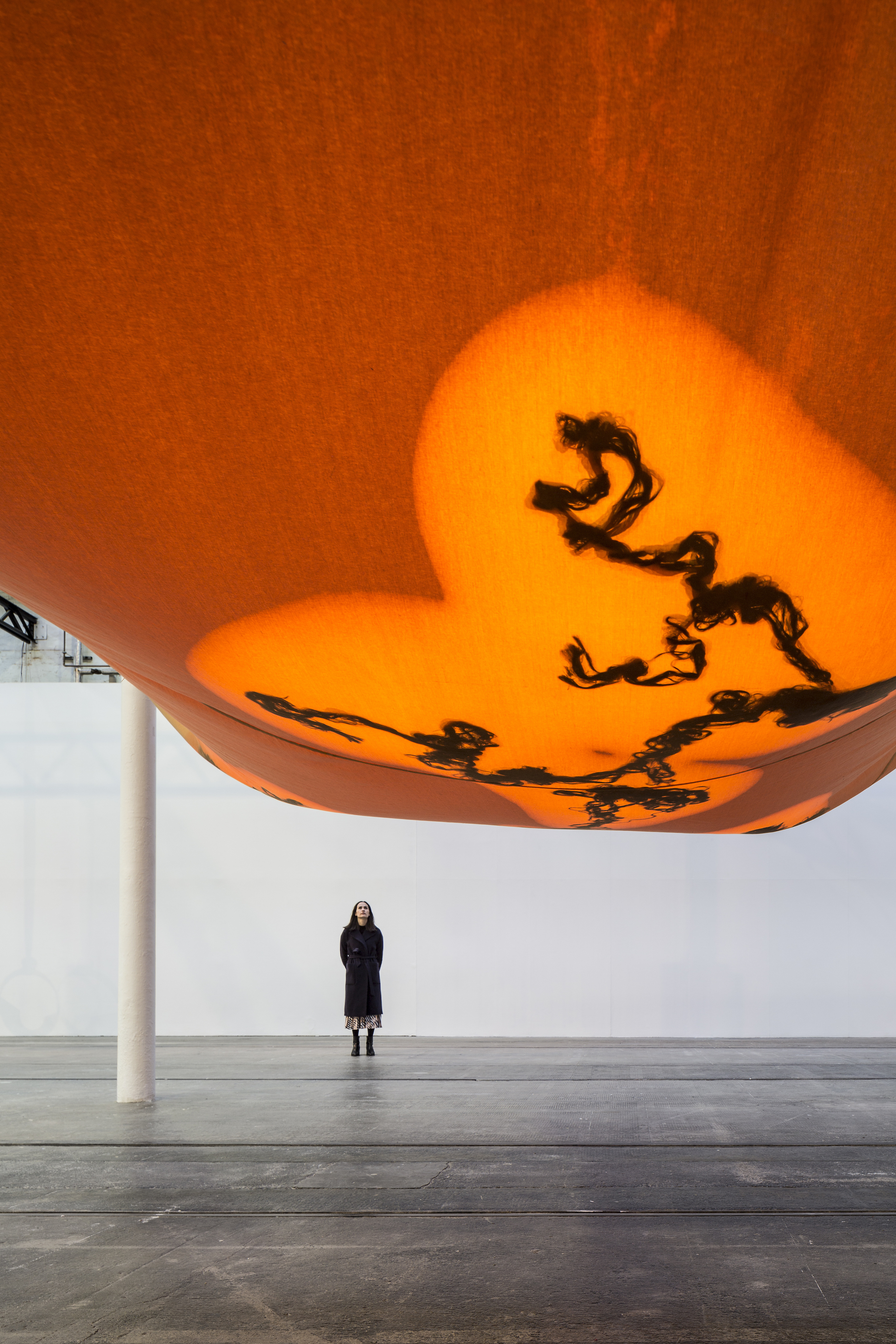
Clare Barclay: Our whole training was very much about putting context at the centre of everything, so you start with context. Sometimes it’s quite an involved process, other time it’s quite loose. Sometimes it’s elements of the architecture I’m responding to and sometimes it’s the history of the wider location. Here, in a way, I have used the space as a white cube, but it is also responding to the post-industrial heritage. The site offers a kind of filter for my own ideas and practise that I’m bringing to it and in turn I’m adopting elements of its context. My experience at GSA is very much something that has stayed with me.
You’re represented by Stephen Friedman Gallery. How did you initially form a relationship with them?
I hadn’t been out of art school for long when I first met Stephen Friedman and David Hubbard. I remember them coming to my flat when my living room was also my studio. They are a great gallery to work with because they don’t put pressure on me to make my work more commercial.
History plays a clear role in your work. Could you talk a bit about the museum and how your fascination with historical and anthropological artefacts feeds into your conceptual ideas about where cultures come from in the first place?
Quite often I start with going to local museums and looking at artefacts. I’m interested in the ambiguity of museum objects – when you’re not sure of their origin or function. Like a lot of artists, I’m trying to pinpoint things that are universal and almost quite primal within ourselves. A lot of the motifs and forms in my work are what I might describe as pared-down. The arch shape that I’ve used a lot in the show here and recent shows, for example. This could relate to the human body and at the same time, it could relate to simple domestic objects like bowls. If anything, I’m trying to find the commonality within these different components.
Your modes of display are opposed to those of a typical museum. There are no plinths or vitrines, and instead it feels like more of a theatrical space. How does this element of suggested performance operate within the work?
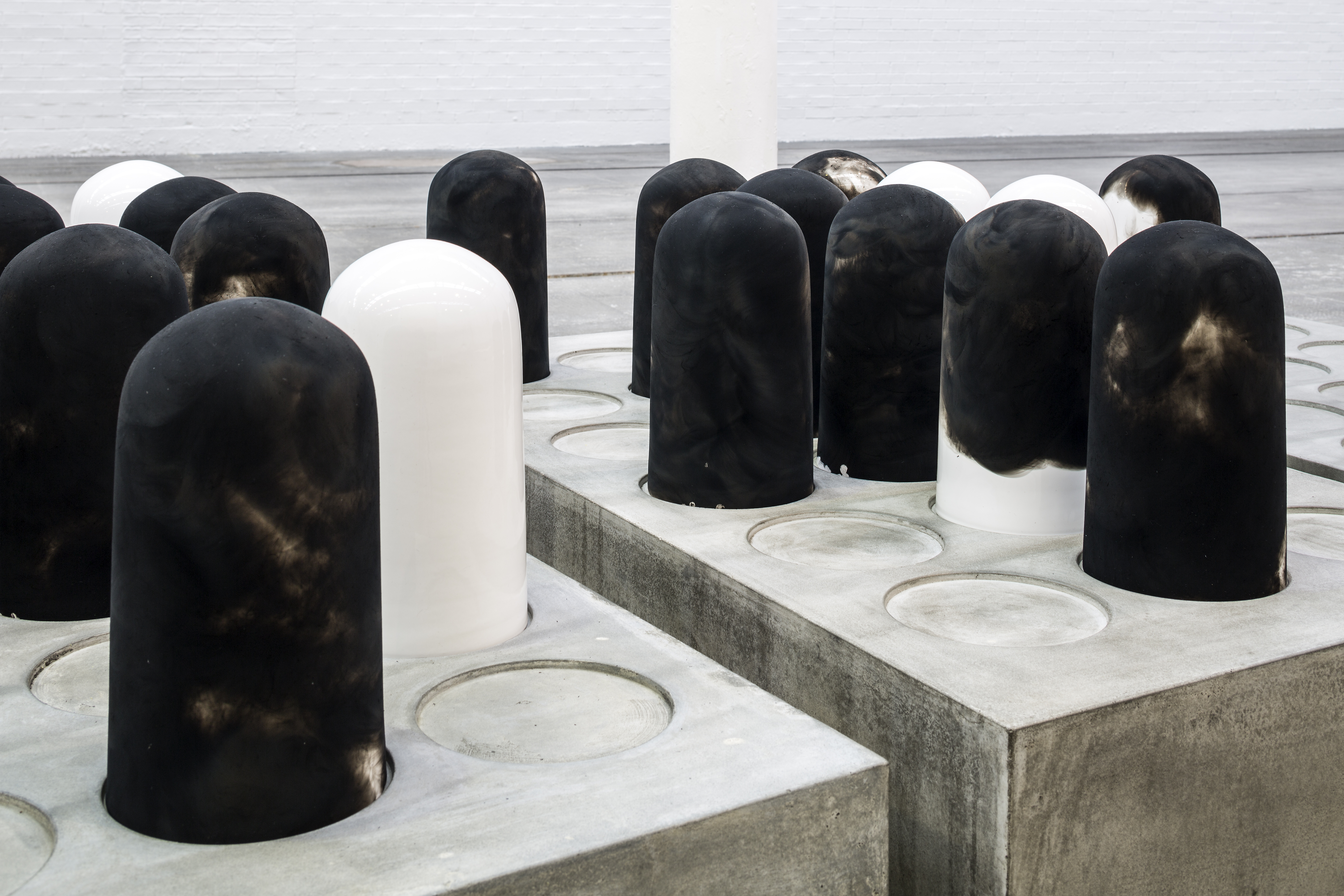
What I’m trying to do is make objects and put them in situations where the potential drama of them is highlighted. Sometimes it operates within the combination, so something hard and sharp might be nestling up against something that might yield or puncture. With that you create a certain amount of tension, but it’s suggestive of scenarios as well. I’m trying to talk about human emotion through inanimate objects and play with the way that we are very keen to anthropomorphise everything. Often the simpler the forms and motifs, the more we tend to do that.
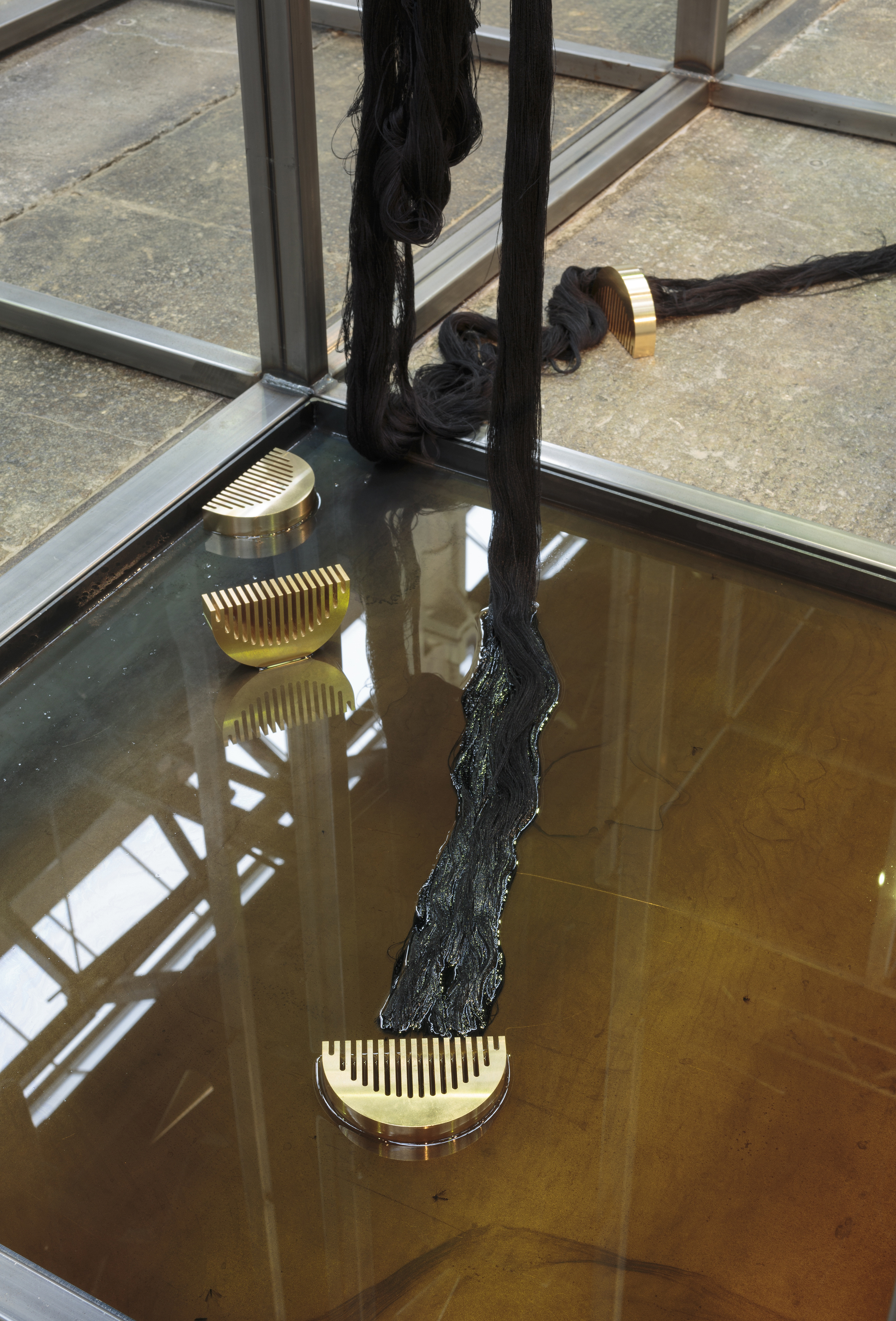
Much of your work has an archaic feeling to it, however, the work also seems to reference the hyper-consumerist culture of the present. For example, the highly polished brass elements could be spear heads or palaeolithic combs. On the other hand, they could be highly designed luxury products. Could you comment on how these various components drawn from the past and the present are able to co-exist in the work?
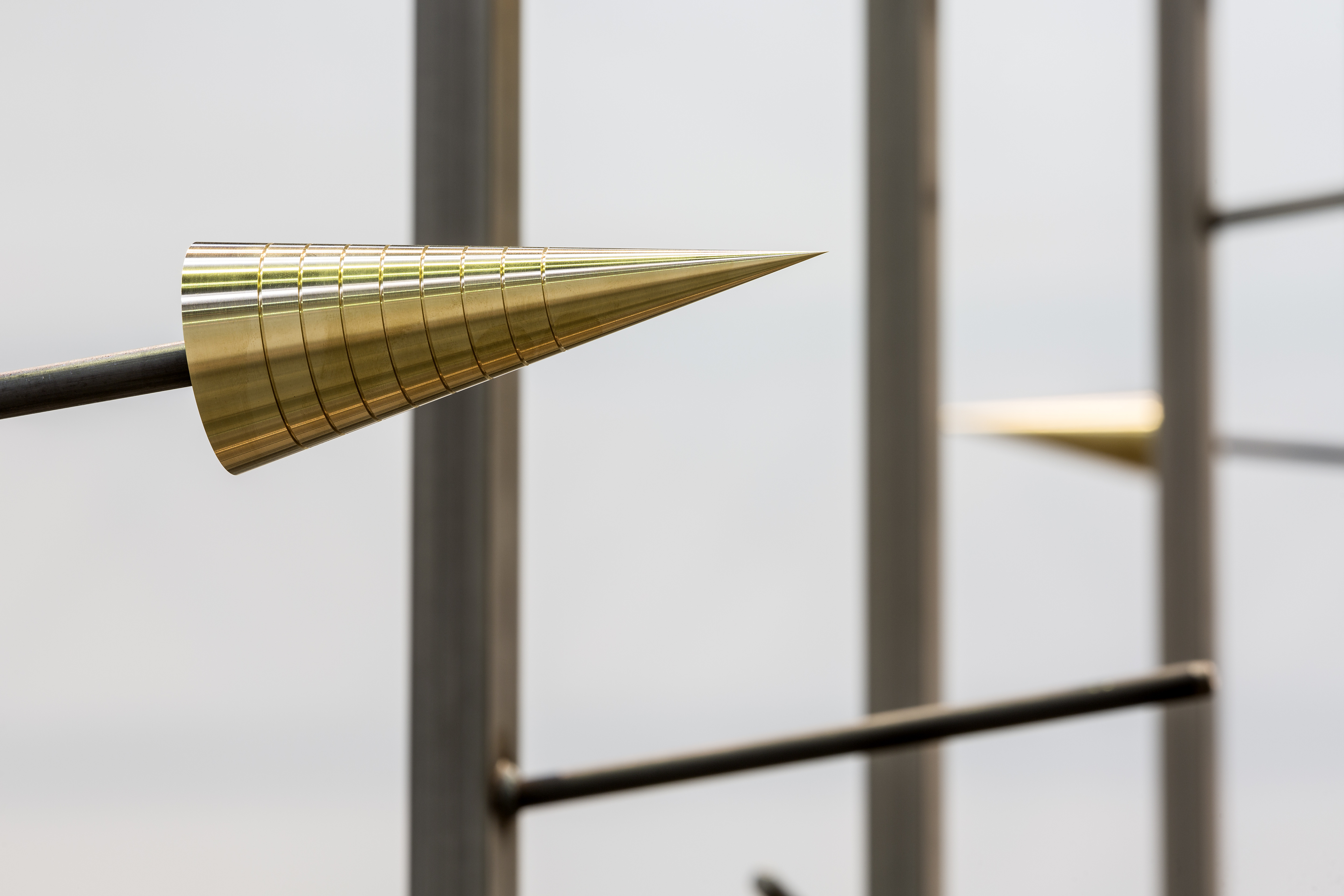
It’s a suggestion that there is this thread that has transcended time and culture. I often make things that might reference some sort of heritage in the use of materials that we associate with the past, but they are also brand new as they’ve all just been made. There’s no sign of wear and yet there’s the sign of the threat of wear. The suede is soiled with the grease or the threads are saturated with the oil. There’s a sense that you’re meant to see that these things are not authentic. It’s not as if I’m using really old oily bags or worn down wooden used tools. How we glean our meaning from artefacts is often from the signs of human interaction. Whereas, these things are devoid of that as they’ve only just come into being.
Could you talk a bit about the role of curation within your work and the decision making process during installation?
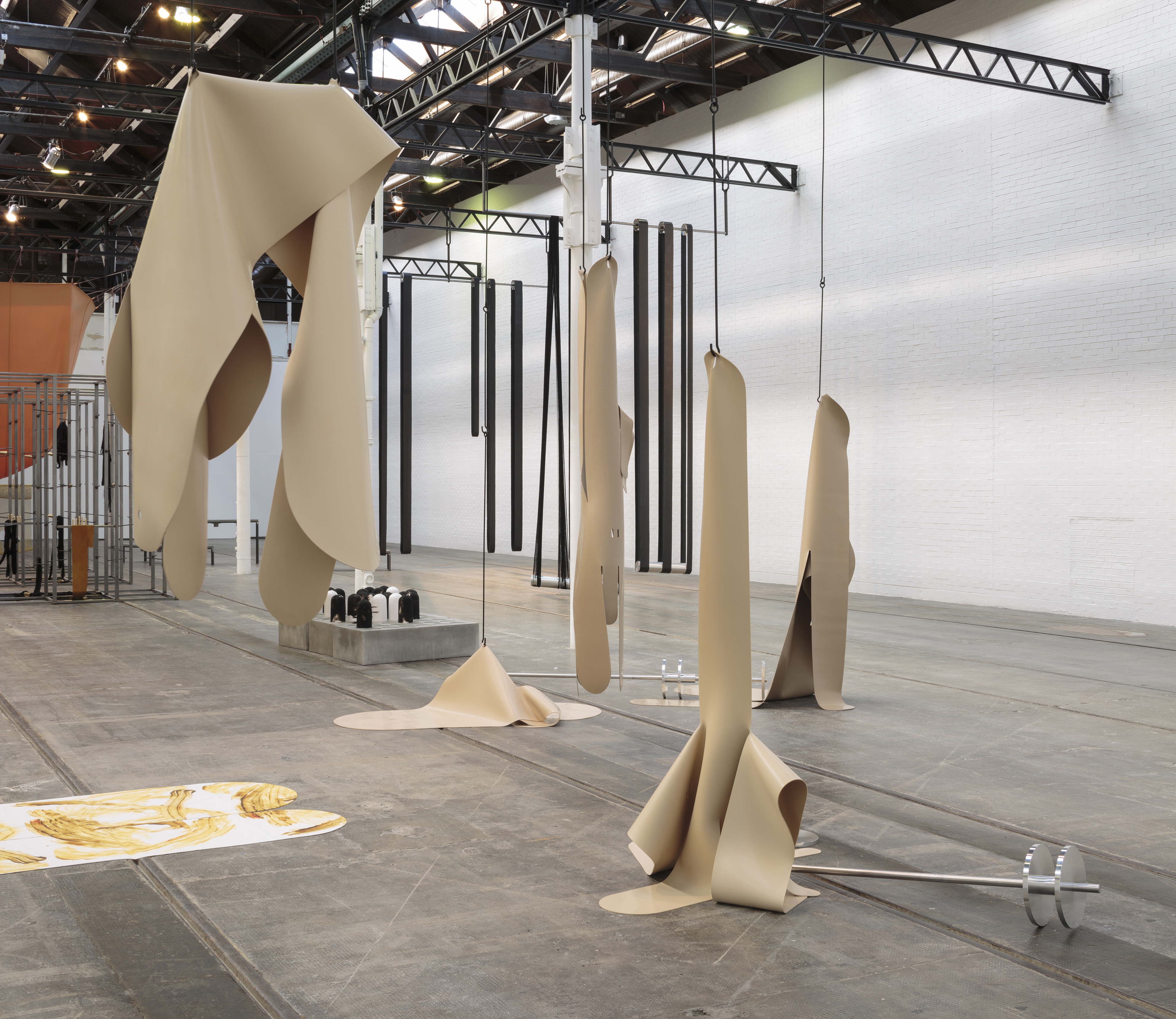
I started describing it as working with a mood in mind rather than a plan. You’re trying to use your gut feeling and intuition in order to bring things together. It’s a play between things being aesthetically pleasing and also awkward. It’s these kind of oppositions that are kind of guiding the decisions that I make. Quite often it’s dictated by the scale I’m working with. Sometimes it’s to do with the body and there’s an ergonomic aspect to that. Sometimes it’s decided by the need to create some kind of effect within the installation. Sometimes I decide I want to build a structure that almost fills the room, or something that will cut across the room and mask the natural light.

When I was thinking about how you engage with materials the words “fetishistic” and “forensic” came to mind. What do you think about those two words to describe your approach to materials?
I think I’ve always had an interest in the idea of a fetish object and I would use that to describe a lot of my work. Forensic is interesting, but I think it is maybe more “anthropological.” Anthropologists are trying to understand things from within rather than as an outsider. “Forensic” or “anthropological” give a sense of understanding through doing. When you make you realise there is a cerebral element to craft and hands-on production. There is that way that the material, the environment, the tool and the body are all working in unison. You’re not necessarily conscious of that all the time.
Could you talk about the relationship between the hand-crafted and the technologically fabricated?
For me the most highly crafted elements in the show have been the parts made by the metal machinists at the engineering company I work with. They are highly skilled at what they do but they are making these things with the help of machines. People don’t necessarily associate the precision-machined object as craft. All the things I’m doing are very hands-on, but I’m not artisan in my approach. Our presumption of what we see as skill in making is very interesting. Is the show relating to the idea of a fading industrial heritage here in Glasgow? The people here have a very strong attachment to the industry in terms of identity. That’s something that, in a general way, is a struggle. But I suppose I’m trying to offer up other ways of interacting with making processes and looking at material. The conversations I have with metal machinists have revealed we have a lot of common ground. We’re coming from different angles; I’m an artist and they’re a business usually making functional parts for industry. Our commonality is in the question of where we will go from here and how we will continue to make things.
Claire Barclay’s “Yield Point” is at Tramway, Glasgow, UK, until 9 April 2017
Tramway is a leading international art space which commissions, produces and presents contemporary arts projects in Glasgow. For more information visit www.tramway.org