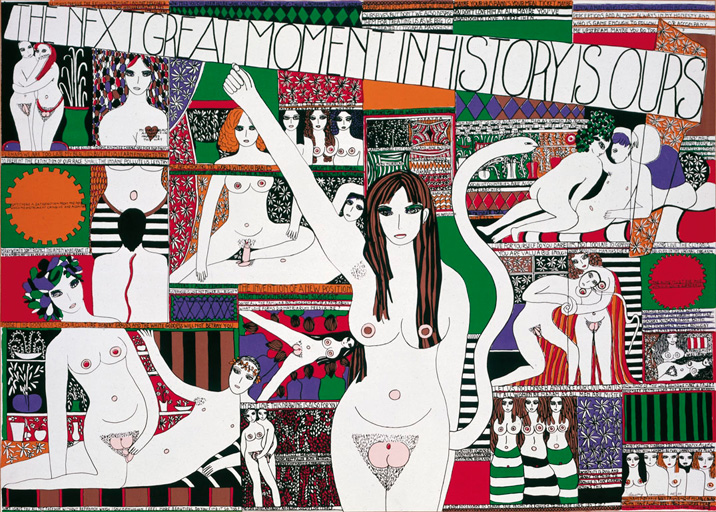
 The Next Great Moment In History Is Ours, 1970. Courtesy the artist, Air de Paris, and Peres Projects, Berlin. Photo: Joachim Littkemann
Perhaps the fact that it can never properly be defined is what makes Dorothy Iannone’s art so explosive. Born in Boston in 1933, she was the long-term lover of Dieter Roth and belonged to the Fluxus community without ever being a Fluxus artist herself. Her art is naive without being innocent, corporeal and intimate without being pornographic, intelligent but non-academic. It’s precise, obsessed with detail and at the same time impulsive, and it operates across different media. From 1968 Iannone combined video and sound recordings with painting and sculpture for her “Singing Boxes”. Another mixed-media work was “Aua, Aua” (1972), with a song lamenting the loss of her lover Dieter Roth. Meanwhile a particular strength of her work is its literary component: the cool flatness of the two-dimensional body is brought to life by tender, precise and often ambiguous or humorous language, without the need for specific facial expressions. It also often remains unclear who is actually speaking, even as the words are virtually “tattooed” on to the figures.
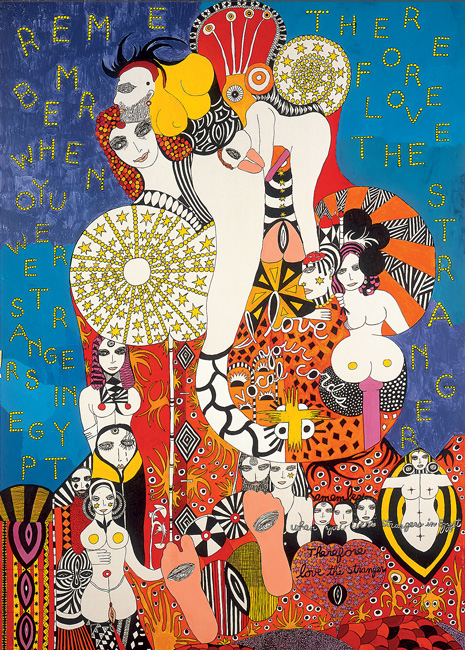 Dorothy Iannone, Love the Stranger, 1981. Private collection Schweiz. Copyright Dorothy Iannone, Photo: Friedrich Rosenstiel.
Equally idiosyncratic and playful is Iannone’s allocation of gender roles in her often sexually explicit representations of man and woman. In most cases, the woman is in the centre. She is proud, strong, feminine, sensual and decidedly heterosexual. These are erotic heroines: notable examples are her 1970s interpretations of mythological or historical women figures, such as Cleopatra or the Amazon queen Penthesilea.
In later years, influenced by her relationship with Buddhism, Iannone assimilated the idea of the “ecstatic unity” of husband and wife. But before then the gender of her figures can be seen to be blurred at the moment of sexual arousal: the woman’s swollen labia are like male testes, the nipples transform into penises (“I begin to feel free”, 1970). Ten years later she had taken the conjunction of man and woman so far that both, to a certain extent, shared the same body (“Let The Light From My Lighthouse Shine On You”, 1981).
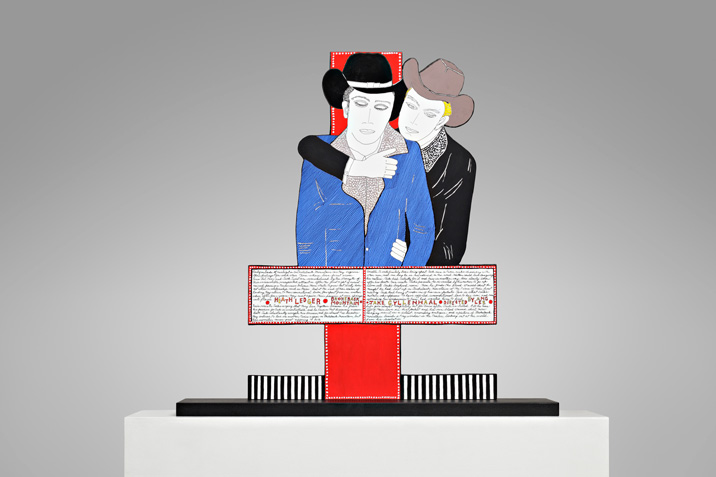 Dorothy Iannone, Brokeback Mountain, 2010. From the series ‘Movie People’. Courtesy the artist, Air de Paris, and Peres Projects, Berlin. Photo: Hans-Georg Gaul.
Those looking closely at Iannone’s work soon notice that her primary driver is affection, rather than the obscene. The uninhibited and the ecstatic meet precision and discipline, the black outlines are drawn conscientiously and accurately, the chest and pubic hair carefully arranged and executed, jewellery and hair draped decoratively. Among the works that have emerged in recent years, the colours have become brighter, the hair more blonde, the lines more delicate and draughtsman-like.
For Iannone it’s never about using obvious sexuality as a provocation, but rather as a way of entering into an arena of free artistic self-expression and unconditional immediacy, with all that this implies. Even before her painting brought her to the limits of censorship, she was fighting on other fronts in the name of artistic freedom: in 1961 she was arrested on entry to the United States when she tried to bring in a copy of Henry Miller’s “Tropic of Cancer” (1934) which was at the time classified as pornography. Prior to her embarkation, she had requested the import of the novel with the declaration, “For my own pleasure”. In so doing, she laid the foundation for a high-profile court case that the former literature student won and thereby ensured that the censorship on Miller’s work was lifted.
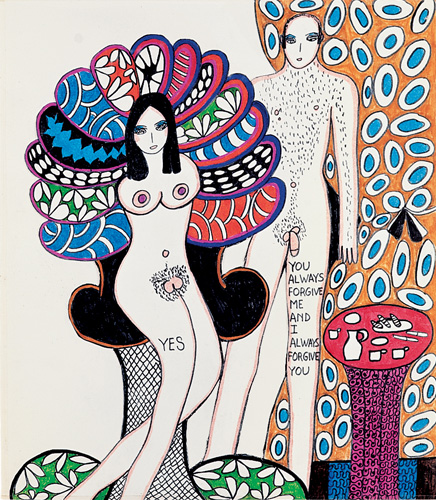 Dorothy Iannone, Dialogues X, 1968/69. Sammlung Aldo Frei. Copyright Dorothy Iannone. Photo: Jochen Littkemann
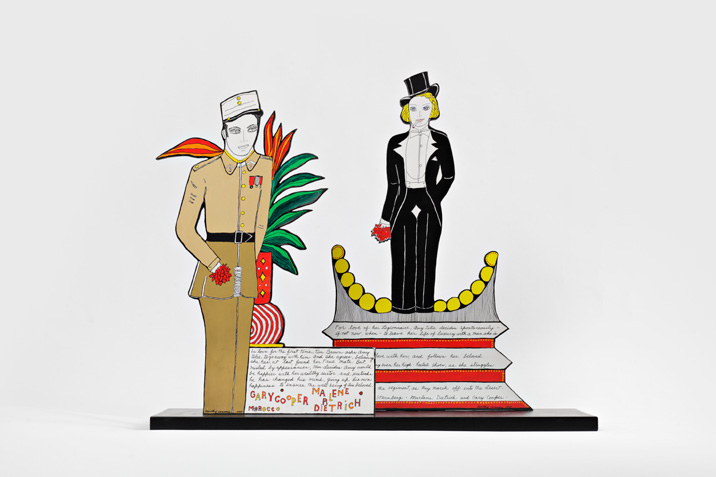 Dorothy Iannone, Morocco, 2009. From the series ‘Movie People’ Courtesy the artist, Air de Paris. Paris, and Peres Projects, Berlin. Photo: Hans-Georg Gaul
Iannone has consistently pushed her work to the limits, and there have been consequences to her honesty: in Bern in 1969, the director of the Kunsthalle Harry Szeemann and some of the exhibiting artists in the “Exhibition of Friends” decided to defuse Iannone’s works by placing brown tape over the genitals; in 1972, her artist’s books were confiscated upon her entry to the United Kingdom. She has always made herself open to attack – as a lover who can be hurt and abandoned, and as an uncompromising artist who cannot be sidetracked by either censorship or financial adversity. Just like her figures, who often wear their genitals outside of their clothes, as if pinned-on like medals, she exposes what is most intimate to the public.
In a letter that was read as part of the 1979 performance “Iannone’s Yoni” in the Studiogalerie Mike Steiner in Berlin, she turned to the audience and announced: “Tonight, I give myself to you. I’ll show you my poetry and my passion and unnerve you with the simplicity of my language. Don’t say no. Think it over. Remember, though, that I was not afraid to say what I wanted to say.”
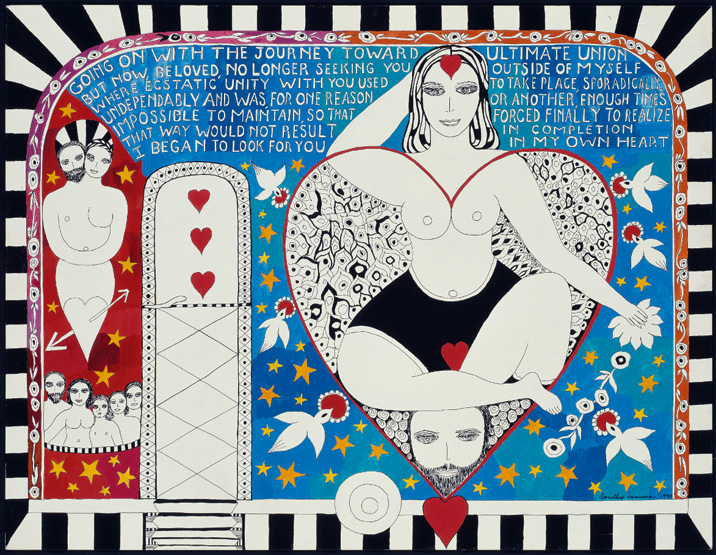 Dorothy Iannone, My Caravan, 1990. Private collection Jürgen und Anette Ruttmann. Photo: Ilona Ripke.
Text by Marie-Sophie Müller Taken from Sleek Magazine 41: What & Why? Check out more stories from our print issues