 Photo © Stuart Griffiths
There certainly is, including the fashionable Sunday Painter Gallery right next to Peckham Rye train station, which opened in 2008 and offers affordable studios and exhibition space. Will Jarvis and Harry Scoging Beer started the project on a whim, with little experience but plenty of optimism. While the duo claim not to be making money with their space, it has developed in other ways: “We are seeing a growing strength in who we can ask by the weight of stuff we have done in the past.” Recently Will and Harry gave new media/online gallery Bubblebyte.org a physical space to celebrate their first anniversary. “It was stressful but no one would ever try anything new if all the problems were evident from the start,” explains Harry. The duo see the space as a physical portfolio, which pushes them and their exhibited artists, like Ben Wheele and Jesse Wine, forward.
“You’re a recent graduate from an art school trying to start a business – who’s going to take you seriously?” Will wonders. Hannah Barry would be one such person – she was so impressed by the boys’ DIY spirit that she asked them to exhibit at Bold Tendencies a couple of years ago.
Peckham’s new popularity comes just as some are asking whether east London – the bar-, condo- and hipster-filled region where, 20-odd years ago, artists in search of cheap studio space led the vanguarde of gentrification – is dead.
North of the City and east of Old Street, rents have been hiked, corporations have moved in and the formerly creative zones around Shoreditch no longer seem like the remote, gloomy and underground places they once were. Peckham, meanwhile, largely remains its salt-of-the-earth self. It has limited going-out choices, and its cheapness fuels ideas.
“I find Dalston and Peckham are a mirror of each other,” says Suren Seneviratne. “There is something more about Peckham though – it seems like people aren’t trying that hard here.”
Once, students would commute from east London to their south London art schools but now the east has become a place for many to avoid. “I get anxious crossing the river,” says Mitchell Bridges, a member of the art collective Emotion Driven Process Based Parallel Identities, who also works at the South London Gallery. “I’m going over the Tower Bridge, I’m freaking out!”
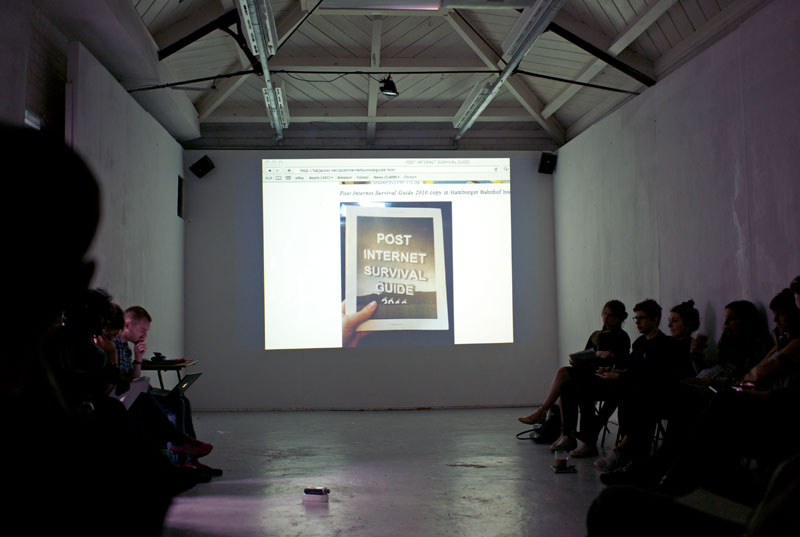
It’s easy to imagine that discussions like that happen in and around Peckham, along with rather more sophisticated ones. In a darkened room at Goldsmiths College on the Saturday when Sleek visited, for example, there’s a conflab being held on the meanings of “post-internet” and “object oriented ontology”: terms in the art-critical vernacular that are too new to really define. Opinions on “assumed network culture as reality of everyday life”, the consequences of network society, and the relationship of objects, are heatedly exchanged among the 25 or so people here. Post-internet, a discussion which started in New York, has now arrived in Peckham, of all places. But what does it mean?
“Many of the galleries and projects we know in Peckham are trying to embody the ideas of post-internet structurally, rather than simply trying to produce or exhibit them with traditional models,” explains John Hill of LuckyPDF.
Perhaps what that means in concrete terms is that the nature of Peckham art, the things themselves and the way they are made, is about connecting gallerists and squatters, institutions and graduates. It’s a grassroots, off-piste, under-the radar approach to the game. “The space between graduating from university and showing in galleries is really interesting and exciting,” says Sarah Jury of The Pigeon Wing. “It’s a real struggle for artists and they become really inventive. That’s where agency really happens.”