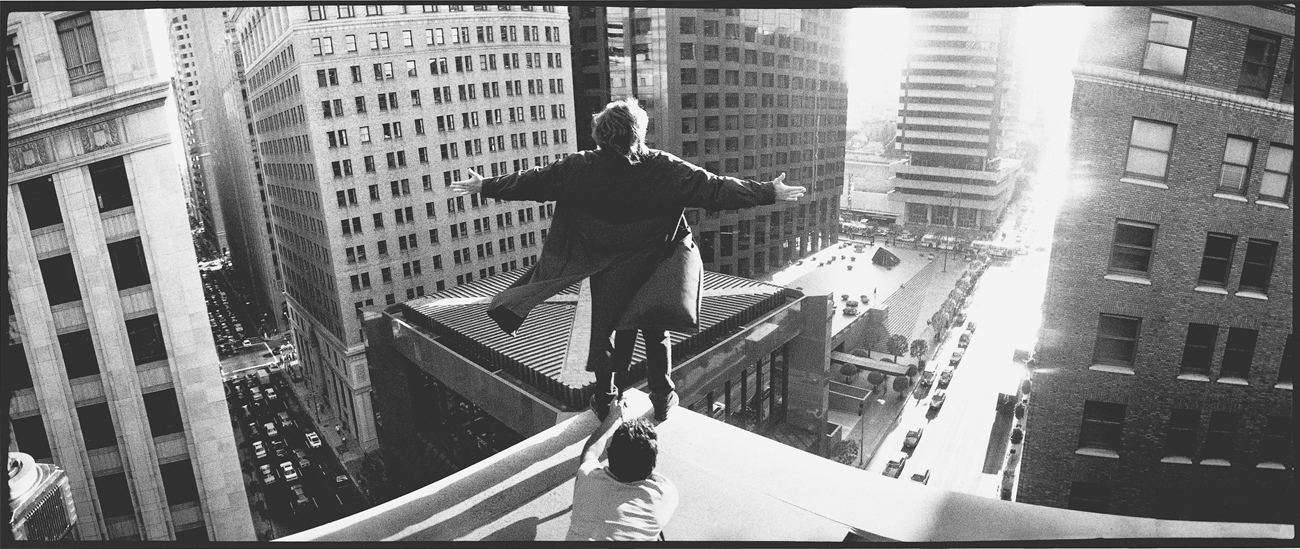
 Fearless (1993) by Jeff Bridges. Image from hollywood.com
In an age where photography is more accessible than ever, the sentiment that anyone can become a photographer is surrounded by controversy. Protective to the point of possessive are those who see themselves as photography connoisseurs. This group is quick to dismiss newcomers, believing that while anyone can own a camera, not everyone can use one.
This defensiveness and indignation has become clear in the flood of online discussions surrounding the newest wave of it-girl photographers – namely, Kendall Jenner and her BFF Gigi Hadid. With internet trolls commenting that the pair have done nothing to hone their craft, speculators believe many of their opportunities (most recently, photographer credits in campaigns for LOVE magazine and Versace) are merely a result of celebrity status. Considering the pair has spent years studying lighting, composition and camera angles on the other end of the lens, the skepticism surrounding their talent, or lack thereof, is a little unfair.
Whatever your opinion on the supermodel shutterbugs may be, they certainly aren’t the first to make the move behind the lens. Here, we’ve compiled a list of celebrity photographers who came before this duo and defied expectations with their phenomenal photos.
 Tron (1982) by Jeff Bridges. Image from hollywood.com
Jeff Bridges
The Dude began shooting seriously on the recommendation of his co-star, Karen Allen while on the set of Starman. A keen photographer in high school, Bridges revelled in the idea of bringing his former passion together with his current job and began snapping away between filming. Playing his photographic talent down, he is quoted as saying, “It’s just something I do to relax between takes. Some knit, I take photographs.” Favouring a Widelux f8, however, is a clear sign of his seriousness. This is no point and shoot, snap happy camera – it’s actually quite the complicated piece of equipment, and its lack of focus requires users to know their stuff. In 2006, Bridges published a hefty sized photo book entitled “Jeff Bridges: Pictures”, chronicling his experiences behind the scenes of 20 years worth of films and acting as a personal and professional diary.
 From Romanticism by Lou Reed. Image from artribune.com
Lou Reed
Although Lou Reed is best known as being the lead vocalist and guitarist in the avant-garde rock band The Velvet Underground, he was also a keen photographer and had three photo-books under his leather studded belt. Using photography as another means of storytelling, Reed was interested in “causing and recording emotion through action and interactive sequence”, and felt that photography was a more intuitive form of expression than songwriting.
Intrigued by a process less calculated than lyric writing, Reed’s method of storytelling through photographs has resulted in a strong body of work that completely juxtaposes the rock and roll lifestyle he chronicles in his music, especially in his final photo book, “Romanticism”. Black and white landscape images reveal a softer, calmer side to the artist – taking him out of his brilliantly gritty environment in New York and into the emotive beauty of nature.
 Selma, Alabama (Boy Holding Flag), 1965 by Dennis Hopper. Image from dennishopper.com
Dennis Hopper
Having made a reputation for himself as being a difficult person to work with after his debut film appearance in Rebel Without a Cause, Dennis Hopper was essentially blacklisted as an actor. For seven years, he couldn’t find work – but instead of allowing his creativity to slowly seep out of him, Hopper fixed his attention on a new form of art. Like Bridges, Hopper was encouraged by his friend and co-star James Dean to pick up a camera. From that moment, he put all of his time and energy into documenting life outside of the Hollywood bubble. Focusing on the social change in the States at the time, a young Hopper photographed Martin Luther King, Jr.’s 1963 March on Washington and 1965 civil-rights march in Selma, Alabama, as well as receiving acclaim for his intimate portraits of Andy Warhol, Roy Lichtenstein and Jasper Johns. Inferring that photography kept him sane during his state of flux, Hopper once stated: “I never made a cent from these photographs. They cost me money but they kept me alive.”
 Brian Jones and Mick Jagger by Linda McCartney. Image from agonistica.com
Linda McCartney
Even though Linda Eastman was well practiced in photography before she ever met Sir Paul, she is often lauded as nothing more than one of the Beatles’ wives. However, her appetite for photographing never faltered under her newfound status as a celebrity, and she worked hard to be taken seriously as a creative in her own right. Certainly discontent with the idea of shrinking under the shadows of her husband and his band mates, Linda pushed herself as an artist and became the first – and only – person to have a photograph of herself as well as one she had taken on the front cover of Rolling Stone.
 From Strange Ritual by David Byrne. Image from pinterest.com
David Byrne
While Talking Heads front man David Byrne exudes confidence onstage, he has admitted to having second thoughts about displaying his photography. “I was afraid to exhibit for a long time. I thought people might give me a show because of my name – or slag me off for the same reason,” he once said. “It’s good to see that photography publications are picking it up on its own merits and not trying to compare it to my music.” Eventually plucking up the courage to show his work, Byrne went on to produce the notebook-style art book “Strange Ritual”, containing photography that exhibits ambiguous religious undertones. Intrigued by the banal aspects of life, his work is also often referred to as documentary – although it rarely features people.