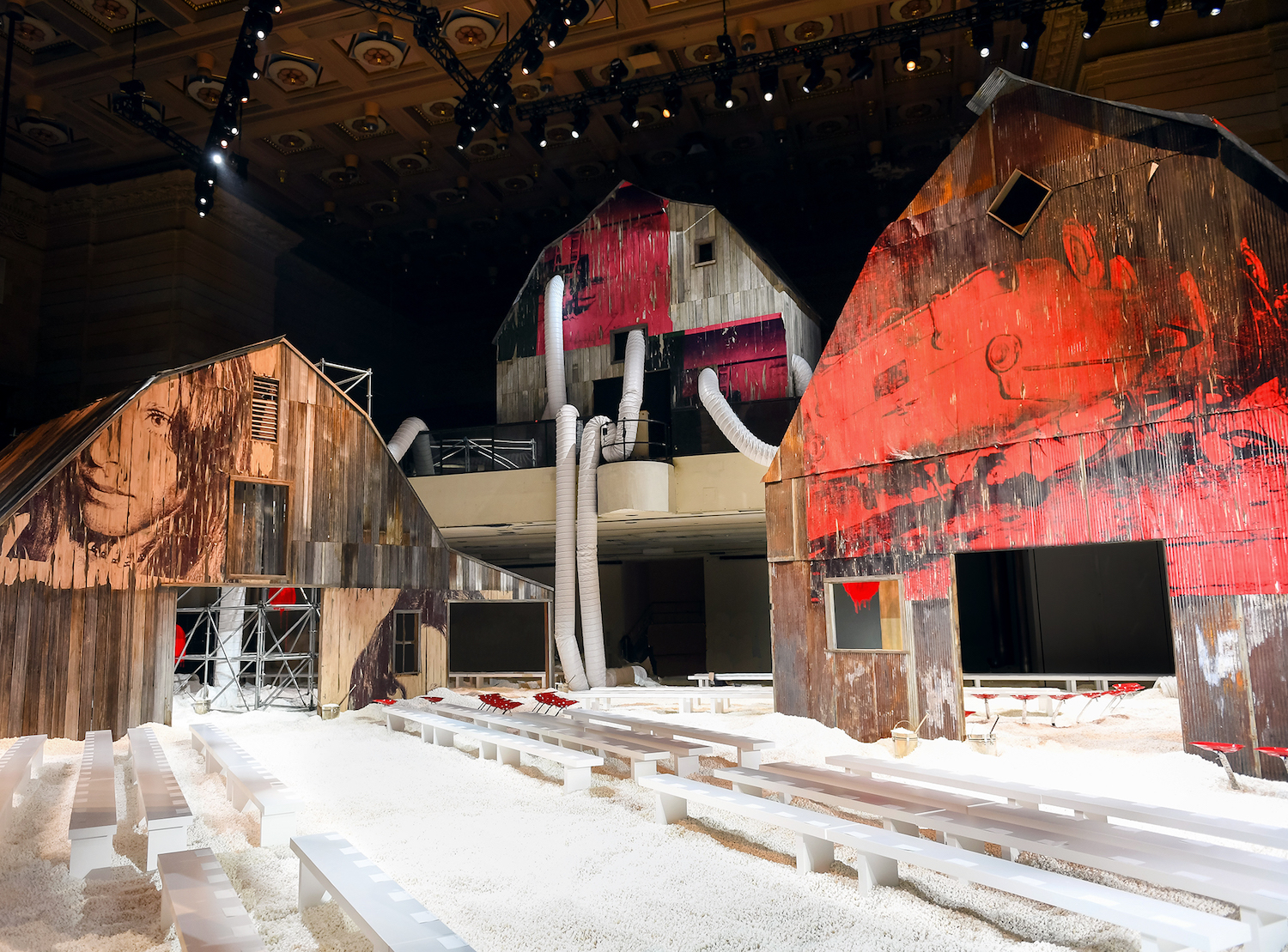
There is no doubting the powerful impact Raf Simons has had in his first three seasons at Calvin Klein. His work for the brand has continued to reinforce his warped vision of a modern-day America through a meeting of worlds old and new. But AW 2018 saw Raf up the ante even further. While maintaining that his collection was meant to inspire hope, there was more than a whiff of dystopia about the post-apocalyptic barns pasted in Warhol prints, alongside which dresses made from silver survival blankets shuffled down a popcorn-covered runway.

Moreso than the gowns made out of burlap sacks and Gucci-esque balaclavas, it’s the popcorn that’s got tongues wagging online. 6.2 tonnes of the stuff blanketed the floor of the New York Stock Exchange (which, it has to be said, is already a loaded location). The popcorn was intended to be emblematic of snow and of Hollywood, America’s cultural engine – guests were also given individual bags of popcorn to spectate the show in true cinematic style.

The popcorn also evoked the American Dream: the idea that anything is possible, even filling a room ankle-deep in edible snacks without consequence. Except, of course, there are consequences; Simons has been eviscerated on social media for the flagrant food waste on display. Of course, any examination of modern America would be incomplete without some excess — but was Simons critiquing this excess, or just contributing to it? Certainly, both elements were at play. In the world Raf Simons created for the AW 2018 show, he was able to show the tangible distance between fashion and reality, but also between rich and poor, fed and hungry. The gulf between the haves and the have-nots, between the privileged and the marginalised, is bone-deep in today’s America. But the popcorn carpet still leaves us to question whether Simons had a responsibility to highlight these differences without contributing to conspicuous food waste.

The irony of the Calvin Klein food waste becomes richer when you consider one of the collection’s main influences was “Safe”, a 1995 thriller by director Todd Haynes. (In a surreal turn of events, the post-show clean up was carried out by men in white masks and goggles, another oddly fitting tribute to the film.) “Safe” is a film that tackles the effects of an environmental illness on a suburban Californian housewife (played by Julianne Moore), whose symptoms range from nosebleeds to vomiting and aggressive convulsions. The disease she’s plagued with is the “real” (but often disputed) “Twentieth Century Disease”. Suspected sufferers of this condition display acute hypersensitivity to just living in the real world, and inhabiting our environment. Arguably the popcorn carpet deepened this symbolism, and was meant as a comment on the world’s noxious environment both politically and environmentally — which would certainly seem at odds with the material excess and waste involved in mounting the show itself.

Ultimately, the questions boils down to: in our current climate, can 6 tonnes of food waste be justified by theatrical spectacle? Indeed, houses like Chanel are renowned for their sense of spectacle — but they’ve also been known to apportion some of their lofty budgets towards staging their shows ethically. When Chanel transformed Paris’ Grand Palais into a supermarket for their AW 2014 collection, all of the food used to stock the shelves was distributed to charities after the show. Calvin Klein were tight-lipped when we reached out for comment about the disposal of their edible set; given it had been trampled by the guests, we can only assume the popcorn got binned by the truckload.

In the show notes Simons states, “more than anything else, this collection is about freedom”. While he exhibited his own creative liberty, perhaps a more fitting word would be “privilege”. Calvin Klein’s popcorn nod to capitalist culture didn’t just highlight the economic privilege of the Western fashion institution; it also demonstrated the fashion world’s privilege to turn a blind eye to the environmental issues which plague our world. Calvin Klein is certainly not alone in this regard; excess in the industry is well-documented. Fashion can often feel like a sheer manifestation of gluttony, from the impact of fast fashion on the environment, to the eye watering wealth displayed on the runway. It has sparked a word-wide debate on the future of the fashion industry, and what responsibility designers have in incorporating sustainability into their craft. Fashion is an incredibly useful tool for protest, solidarity and change, but without a necessary shift towards sustainability, we are only fuelling worn out clichés surrounding the industry. The catwalk should be setting the standard for the world to follow; designers should feel the weight of responsibility when deciding how to show their collections. So while a room of popcorn may seem like a fun day out at fashion week, the message it condones is one we do not need in 2018.

American sociologist Herbert Blumer once proclaimed that clothes speak, they don’t listen. Indeed, the soundtrack for Calvin Klein AW 18, “The Sound of Silence” by Simon and Garfunkel, contains the choice lyrics “people talking without speaking, people hearing without listening”. If fashion still isn’t engaging in dialogue, designers should at least make sure their work is saying the right thing.