February 28 marks the 88th birthday of the highly esteemed architect Frank Gehry. Widely considered the greatest living architect, his work has proved mightily influential on many designers throughout the 20th and 21st century. From his humble beginnings in Toronto, Canada, to becoming associated with the controversial Los Angeles School of architecture, his unique buildings adorn skylines from California, Bilbao and Hong Kong. His style arises from postmodernism, yet it is easy to see his far-ranging classical knowledge persisting throughout his structures. Frank Gehry’s buildings are both experimental and transformative while still making sense within the context of their area. His bold designs have led to Vanity Fair calling him “the most important architect of our age”.
But perhaps a better way to see why Frank Gehry is such a legend is by looking at the buildings themselves. So without much further ado, Sleek presents his ten best works.
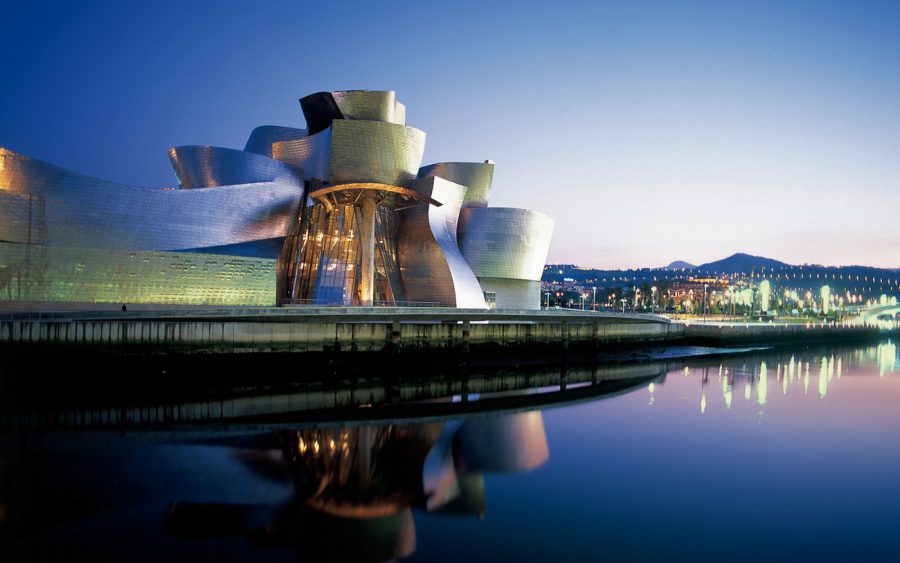 Photo by Edwin Poon
Guggenheim Museum Bilbao
Arguably the most famous building of the past 20 years, the Bilbao Guggenheim was a major event in the history of contemporary architecture. As Paul Goldberger wrote: “The building blazed new trails and became an extraordinary phenomenon. It was one of those rare moments when critics, academics, and the general public were all completely united about something.” The building went on to generate over $500 million dollars for the local economy, and was even featured in the James Bond film, The World Is Not Enough, signalling a true pop-culture crossover event.
 Photo by Till Niermann
Peix (Fish), Barcelona
Frank Gehry has always had an obsession with fish. As he says: “I was watching the beauty of carp swimming in a pool in Japan and thinking about how elegant and architectural they were.” This is exemplified by his Olympic design for the city of Barcelona. Resting on the beachfront, the Fish is one of city’s most beloved landmarks.
 Photo by Carol Highsmith
Walt Disney Concert Hall, Los Angeles
Blending in perfectly with the city of L.A., Gehry’s design for the Walt Disney Concert Hall has aged wonderfully. Sat atop Bunker Hill, it is a deeply democratic space, with no suites or gallery boxes. As The La Times writes: “Ten years after its debut, it remains the city’s greatest room.”
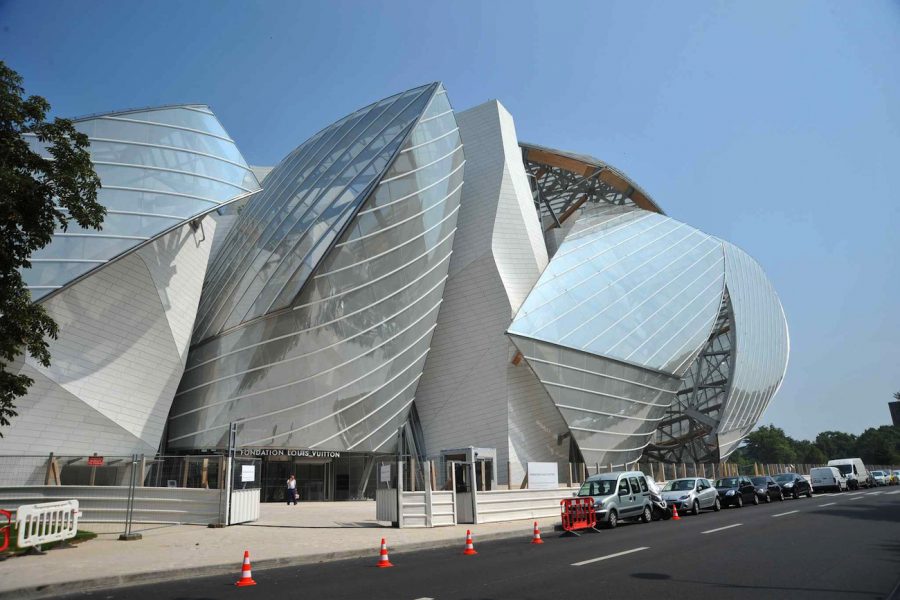 Photo by Cau Antoine
Louis Vuitton Foundation, Paris
An art museum and cultural centre, sponsored by Louis Vuitton, the building shows Gehry’s commitment to fluid design. The building’s appearance, due to its many diverging planes of glass, actually changes depending on the time of day. As he states, this was done “in order to give the impression of something ephemeral and continually changing”.
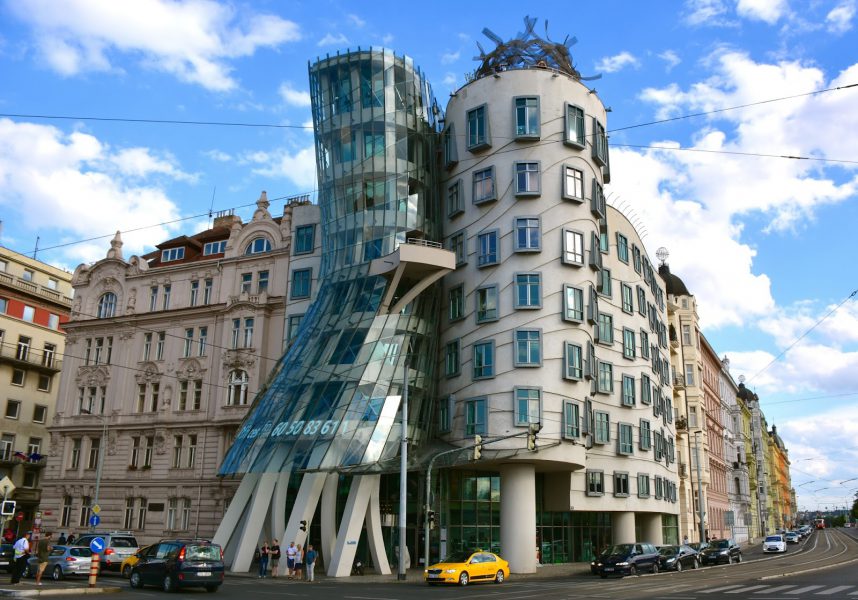 Photo Credit: Coloring Without Borders
Dancing House, Prague
Originally criticised upon its release for clashing with the baroque and gothic style of the city, the Dancing House has now become one of its most popular landmarks. It was originally called Ginger and Rodgers, as its deconstructionist shape resembles the two famous Hollywood dancers.
 Photo by Vaclav Vincalek
Hotel Marqués de Riscal, Elciego
This five-star hotel is truly befitting of a postmodern king. Gehry’s design is his usual mish-mash of jagged shapes, angular walls and criss-cross windows; making a stay here as awe-inspiring as it is pleasant.
 Photo Credit: legacy.pitchengine.com/
Lou Ruvo Center for Brain Health, Cleveland
A centre dedicated solely to brain-related diseases, Frank Gehry finished the $70 million project in 2010. Its design reflects its function; for example, the facility for preserving memory is comprised of white stacked boxes.
 Photo Credit: thewholenicole.wordpress.com
Pop Culture Museum, Seattle
When constructing a museum to house the largest collection of Jimi Hendrix memorabilia, it’s only fitting for the exterior’s design to resemble a smashed guitar. While the design of Seattle’s Pop Culture Museum baffled some critics, Lauren Skelton called it an “apt representation of the American rock experience”.
 Photo by Ydam
Maggie’s Centre, Dundee
The first building Gehry ever designed in the UK, his contribution to the Maggie’s Centres project won him “Building of the Year” from The Royal Fine Art Commission for Scotland.
 Photo Credit: panoramio.com
Cinémathèque Française, Paris
Previously housing the American Centre in Paris, this structure is far mellower than many other buildings on the list. Eschewing his typically flashy style, Gehry opted for a subdued design as a sign of respect to the historic Parisian architecture surrounding it.