On his ambitious quest to capture perfection through painting, German artist Gerhard Richter has effortlessly shifted between photorealism, abstract expressionism and pop art, proving time and time again that painting is anything but dead. In honour of his 85th Birthday on 9 February, here’s a selection of our favourite works from one of the most influential and renowned artists living today.

Photo by Werner Gensmantel via nmn.de
“SEASCAPE (CLOUDY)”, 1969
For his landscape paintings, Gerhard Richter drew inspiration from Romanticism. He was very fond of German painter Caspar David Friedrich, an influence that is particularly palpable in his seascapes. Like most of his landscapes, “Seascape (Cloudy)” is based on several photographs collaged together into one single image.

Photo via oceanandmartin.com
“1024 COLOURS”, 1973
Gerhard Richter’s first colour paintings, created in the mid ’60s, were related to Pop Art and directly based on commercial colour charts. He later began to approach the selection of colours in a rather systematic way, and eventually created “1024 Colours” based on a coincidental and highly complex colour grading system. In 2006, he explained: “This way, I could avoid creating a colour scheme, or any result that might be representational, and only had to determine the format of the painting, the proportions of the grid and the quality of the material. The paintings created in this manner tend towards total perfection and convey the idea of a practically endless number of possible pictures.”

Photo via my9arts.es
“CANDLE”, 1982
You might recognise this work from the cover of Sonic Youth’s album “Daydream Nation”. For photorealist paintings like this one, Richter blurred his motives using brushes, squeegees or his hands. In his notes, he wrote: “I blur things so that they do not look artistic or craftsmanlike but technological, smooth and perfect. I blur things to make all the parts a closer fit.”

Photo via sothebys.com
“ABSTRACT PAINTING 599”, 1986
In the late ’70s, Gerhard Richter started to create abstract paintings, which he described as “fictive models, because they make visible a reality that we can neither see nor describe, but whose existence we can postulate.” “Abstract Painting 599”, which is one of Richter’s personal favourites, sold for over 46 million dollars to an anonymous buyer in 2015, making it his most expensive painting yet.

Photo via sothebys.com
“VENICE”, 1986
In “Venice”, Gerhard Richter merges his two most prolific painting styles by adding expressionist brushstrokes to a blurred photorealist painting, proving once again that he is, as the New York Times once put it, an “artist beyond -isms”.

Photo via studyblue.com
“MAN SHOT DOWN I”, 1988
In his Baader Meinhof series, Richter dealt with the German left-wing terrorist group RAF that carried out numerous bank robberies, kidnappings and bombings during the ’70s. The series includes paintings of the group’s initiators after they committed suicide in their prison cells as well as other press photos related to their deaths. In an interview from 1989, he commented on the grief-evoking atmosphere of the paintings that caused outrage from many German news outlets, saying: “There is sorrow, but I hope one can see that it is sorrow for the people who died so young and so crazy, for nothing.”

Photo via nrpberlin.de
“BETTY”, 1988
This painting of Richter’s daughter turning away from the viewer recently made news when the German minister of interior affairs Thomas de Maizière pulled out a copy of it during a speech. He used it in order to illustrate Germany’s “obsessive preoccupation with its past” and the country’s inability to find its own identity within the present.
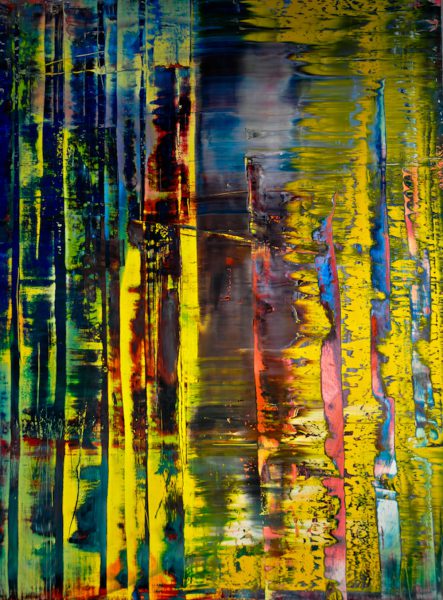
Photo via Pinterest
“ABSTRACT PAINTING 780-1”, 1992
The colours in this Abstract Painting are exceptionally bold and beautiful, and the gradient in its vertical lines almost makes it seem iridescent. Richter stated in an interview that his abstract paintings often turned out completely different to what he’d planned, and that he frequently altered them.

Photo via Pinterest
“SEPTEMBER”, 2005
From afar, “September” looks like a smudged abstract painting. Upon approaching the fairly small canvas, however, it becomes evident that it depicts the tragic moment of a plane hitting the Twin Towers on 9/11. By keeping the work’s title vague and its elements hard to decipher, Richter makes us relive the moment of slow realisation that we felt when we saw the images of the collapsing Twin Towers for the first time and shows how deeply they are engraved into our memories.

Photo via Wikipedia
“COLOGNE CATHEDRAL WINDOW”, 2007
The Cologne Cathedral is one of Germany’s most popular tourist destinations. Richter, who lives and works in Cologne, created this stained-glass window waiving any fee. Consisting of 11,500 squares of glass in 72 colours, the window creates mesmerising shadows on the walls and floors of the Gothic Cathedral.
“New Pictures” by Gerhard Richter is on display at Cologne’s Museum Ludwig from 9 February until 1 May 2017