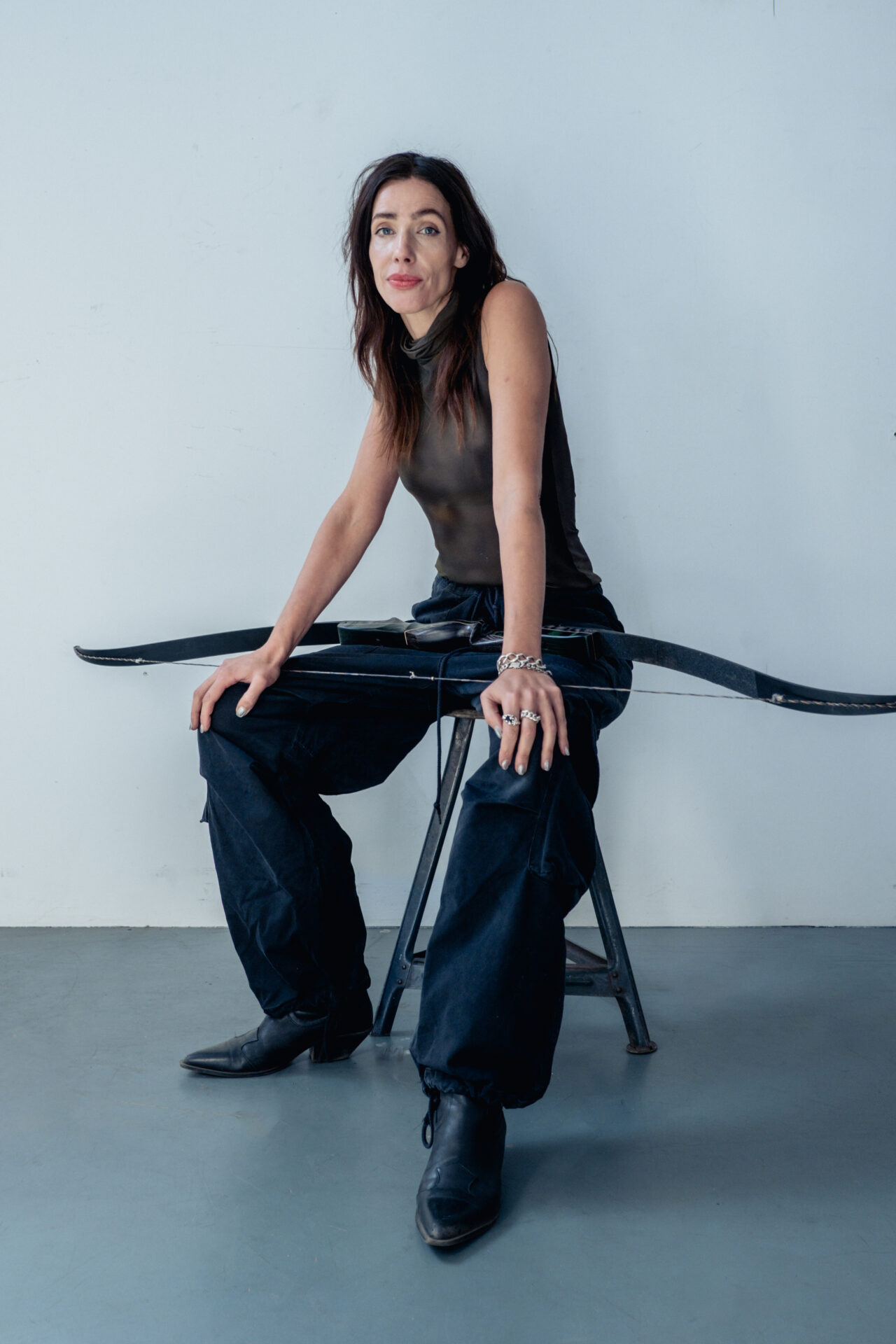
Just off the Dreiländereck in Kreuzberg, between kiosks, bars and many cigarette butts on the floor, artist Hannah Hallermann built an oasis of serenity and creative expression — Studio HAHA. The atelier can be found at the back of a yard where red squirrels are dancing across wooden beams and the sun turns waving chestnut leaves into dancing shadows on the floor. The place is home to multiple artists, including welders and carpenters. And the studios make the place feel like a retreat from the city’s busy chaos and noise, or rather like an island of creativity inside the rough waters of Berlin.
Hallermann herself is no exception to this double-sidedness — she is an extension of it. She’s contradictory, restless, politically engaged but suspicious of it too, financially pragmatic but romantic about life, violent and tender, precise and accidental, a mother who still parties, a sculptor who suddenly finds herself sewing, someone who wants to be informed but refuses to become numb. As her solo-show SEWING is coming up on September 9th as well as the joint exhibition UNRUHE at MaHalla, running from September 8th, SLEEK met with Hannah Hallermann to talk about art, sewing and the balancing act of living a life true to yourself, between the calm and the storm, on her island of serenity in Kreuzberg.
Photography by Lilly Wetzel.
FINN HAGEN Ambiguity plays a central role in your work, so let’s play a little bit of this or that: Marina Abramović or Brancusi?
HANNAH HALLERMANN Brancusi.
FH Party all weekend long or detox and self-care?
HH Party all weekend!
FH Club Mate Zero or Iced Caramel Frappuccino?
HH That’s a tough one, but Club Mate Zero is actually one of my favourites. When there’s a tough day at the studio, I also love the full Mate-sugar-bomb.
FH Precision or accident?
HH Both.
FH I take it! Let’s talk about your upcoming work. You are doing an exhibition for Berlin Art Week called UNRUHE. Are you a restless person?
HH I have a lot of energy. Many focus points and ideas put me in the best state of mind, so Unruhe can be something good. And I never stopped raving, I need to dance. I just have to balance the chaos out so it doesn’t exhaust me.
FH So that’s how you got acquainted with the project? Can you tell me more about the exhibition and what the term means to you?
HH The group exhibition at MaHalla is about “Unruhe” — restlessness, but also unease. I believe Unruhe as a term carries somewhat of an animalistic touch. I instantly think of the movie Melancholia by Lars von Trier, an apocalyptic movie where he films animals seconds before a shock or dangerous situation. They can feel the floor trembling and to me, this is representative of current times — the ground we are standing on is shaky. I feel like that since the pandemic started, so the theme was immediate for me.
Photography by Lilly Wetzel.
FH What pieces will we be shown there?
HH I am showing the Giant Adjuster, a large work from my Adjuster series. The object itself, the adjuster, is inspired by these leather blinders that racing horses wear. So it’s a tool of power — a blinder gets fitted to you by someone else, for the convenience of whoever’s holding the reins. One sanctioned view, one direction, one perspective — I guess that’s my biggest fear. And with all the information right now, with the wars, I often feel overwhelmed. So I put hinges where the leather was rigid, and the fixed thing becomes movable. I earn that power back. Because as an artist the question always remains: How do we deal with it?
FH Is that something you practice in your life? For example, cutting off social media, distancing yourself from the news, when it all just becomes too much?
HH I have to readjust all the time. Making art, to me, means engaging with the conflicts around us and staying informed. But I also want to listen to what’s coming from the inside — that’s where the ideas stem from. Both directions are necessary. It’s a hard balancing act, because I don’t want to go numb. And I know I get to decide what I see, what I don’t, and what I refuse to look at. Not everyone has that choice.
Photography by Lilly Wetzel.
FH Would you say the negativity fuels you in a way? I think as a creative it can be challenging to build art from a space of utopia, shutting everything out. Is this your way of creating something meaningful from it?
HH I wouldn’t say that negativity fuels me, tension does. Challenges keep me awake. Though for me, shutting everything out wouldn’t be a utopia. It would be a vacuum. And you can’t make anything in a vacuum.
FH You also have a solo exhibition coming up, next to the group showing at MaHalla. Do you prefer solo or joint exhibitions?
HH Mhh, depends on the context. Group shows can create great conversations. But the magic of a solo show is that I set the subject and build an entire cosmos around it. That’s also why I love seeing other artists’ solo shows — you get to be fully immersed in someone else’s vision.
FH I’ll take you up on the solo exhibition, the series is called SEWING. Do the social justice questions we talked about and your creativity come together here?
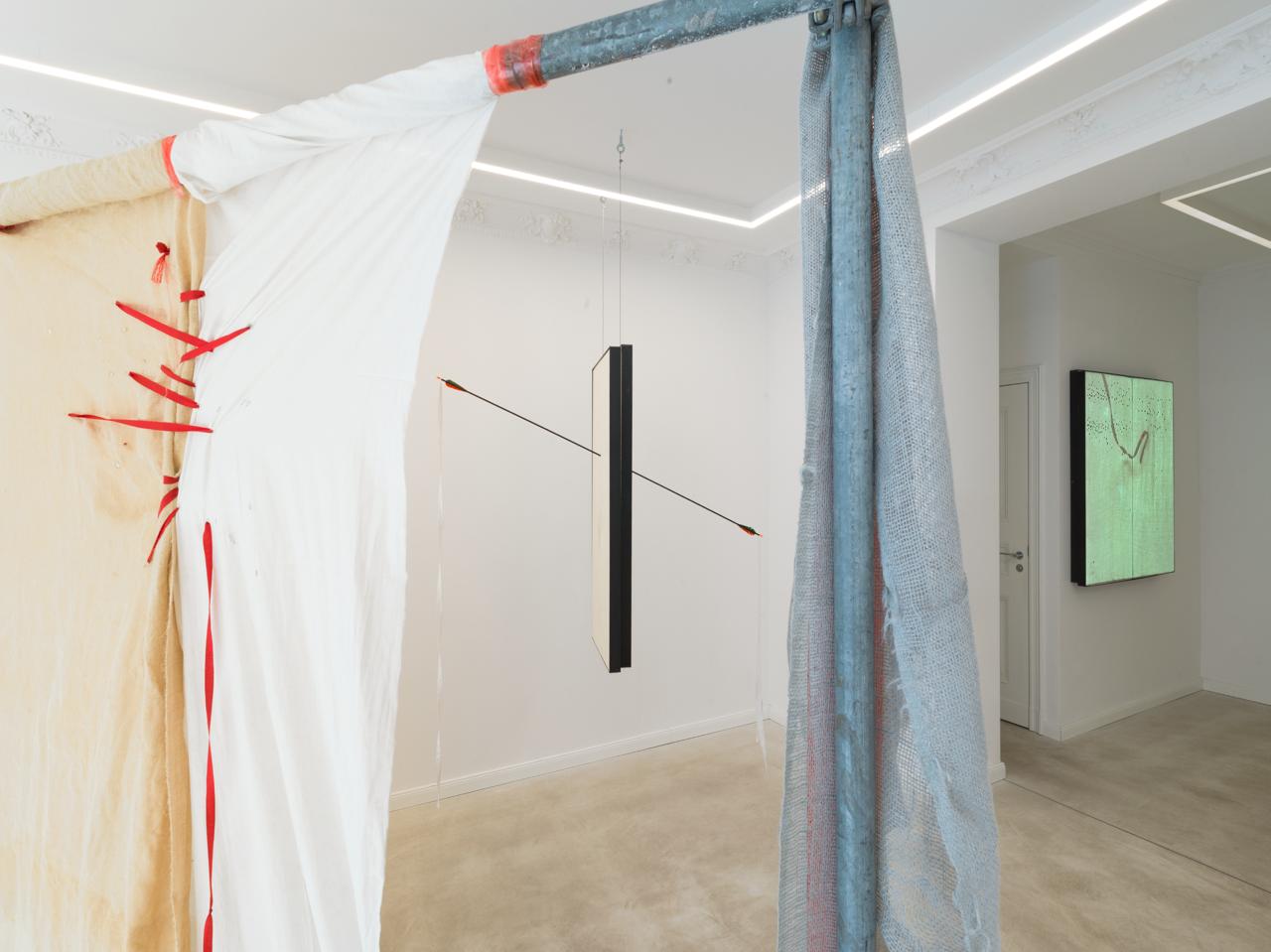
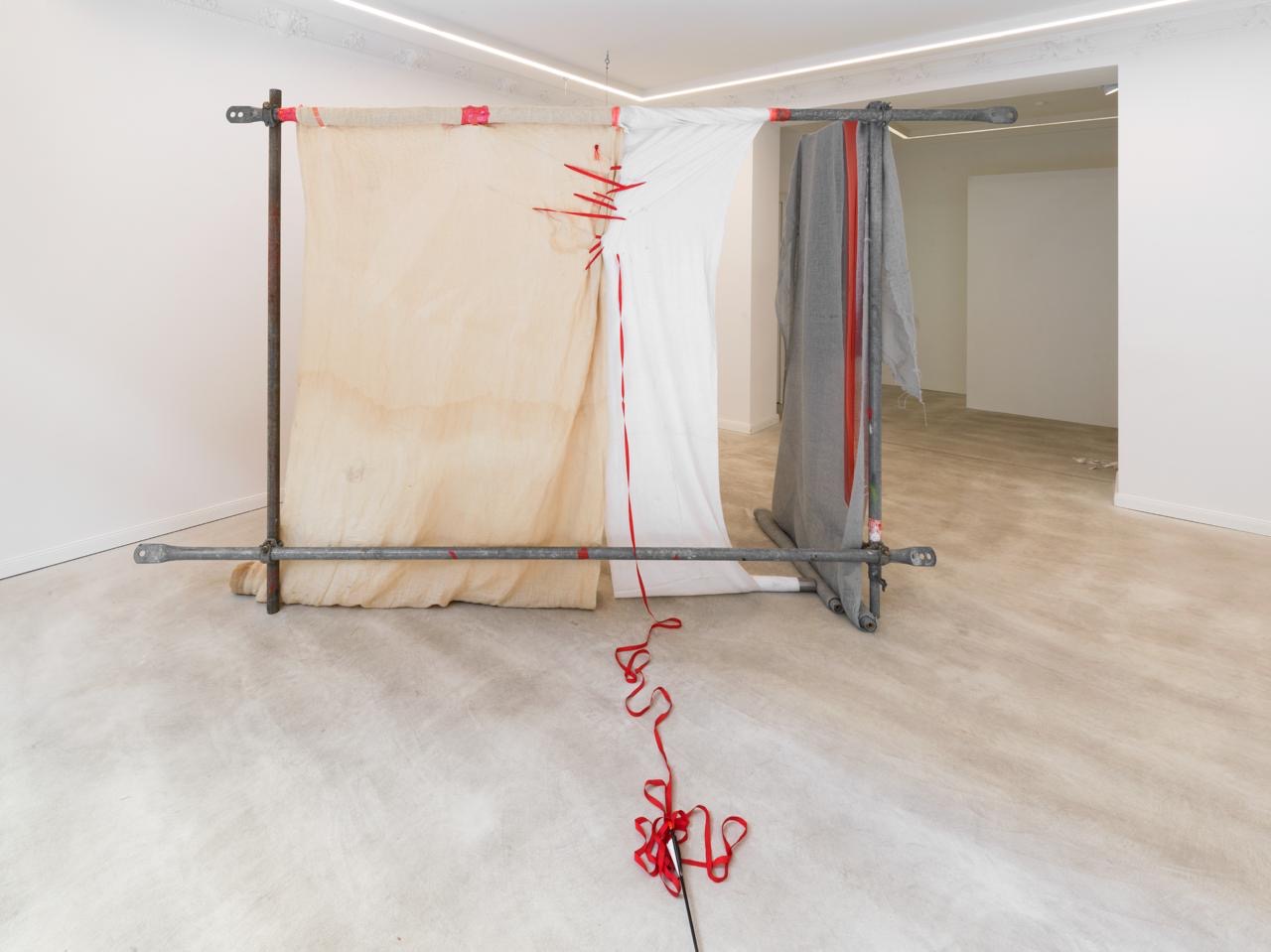
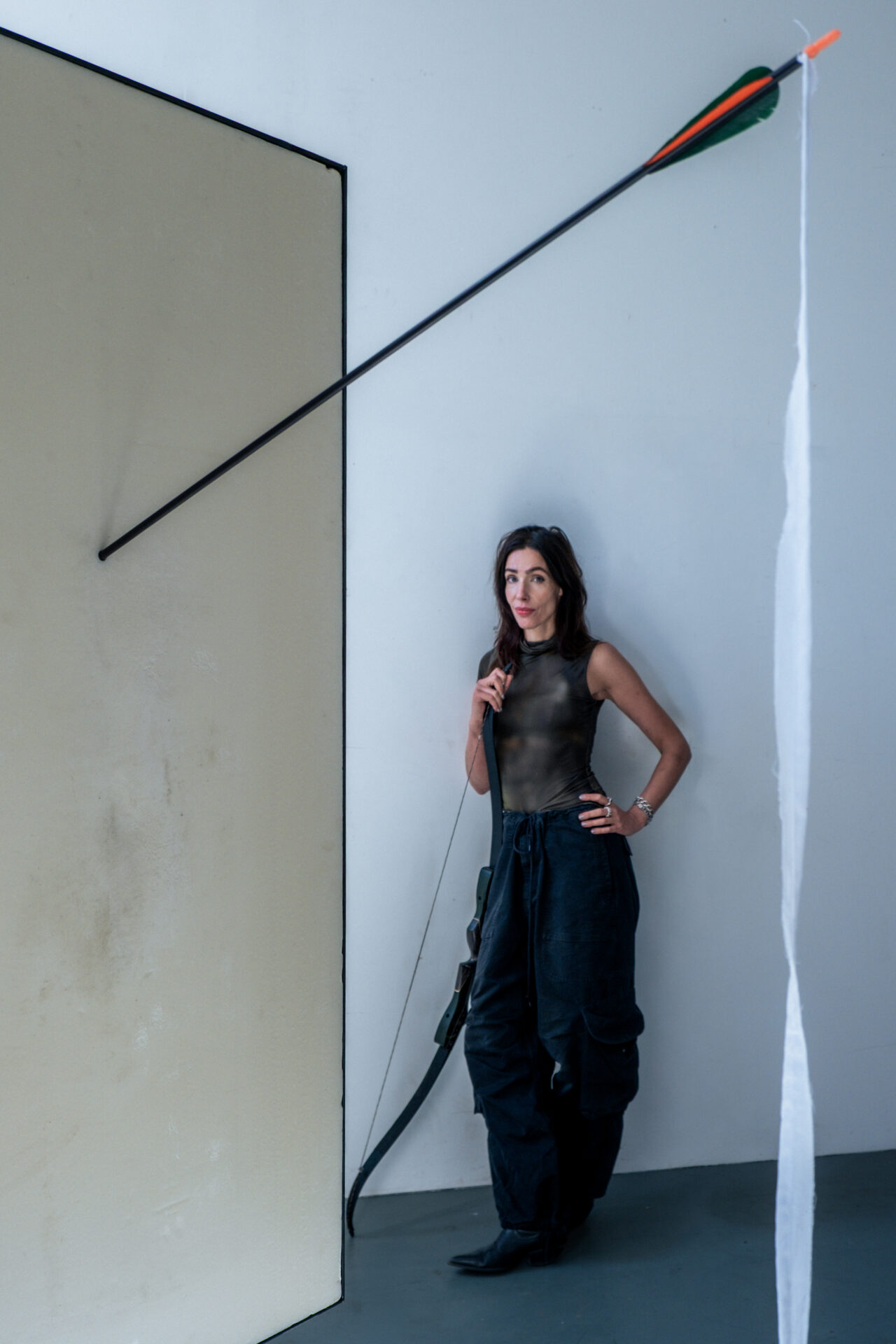
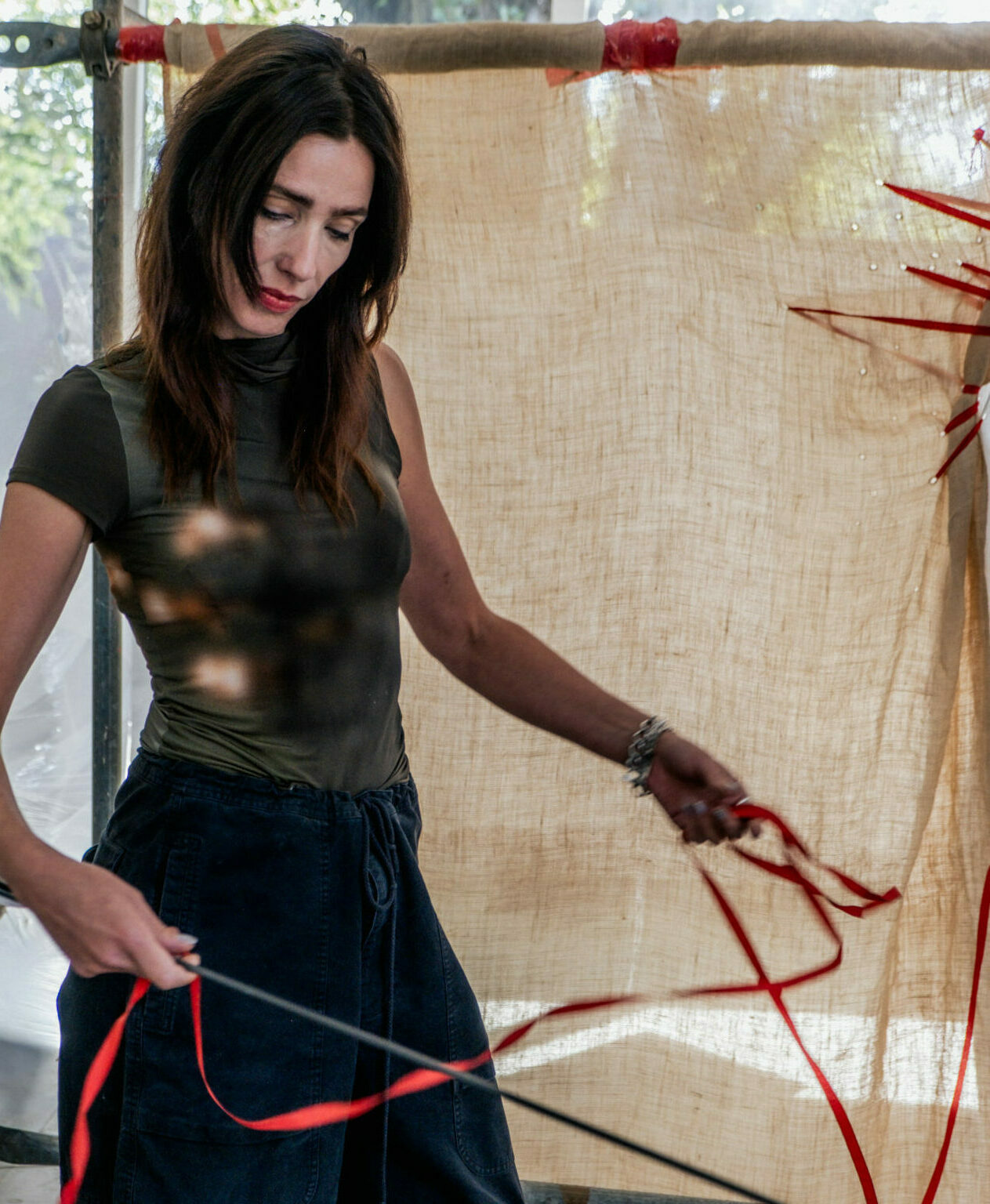
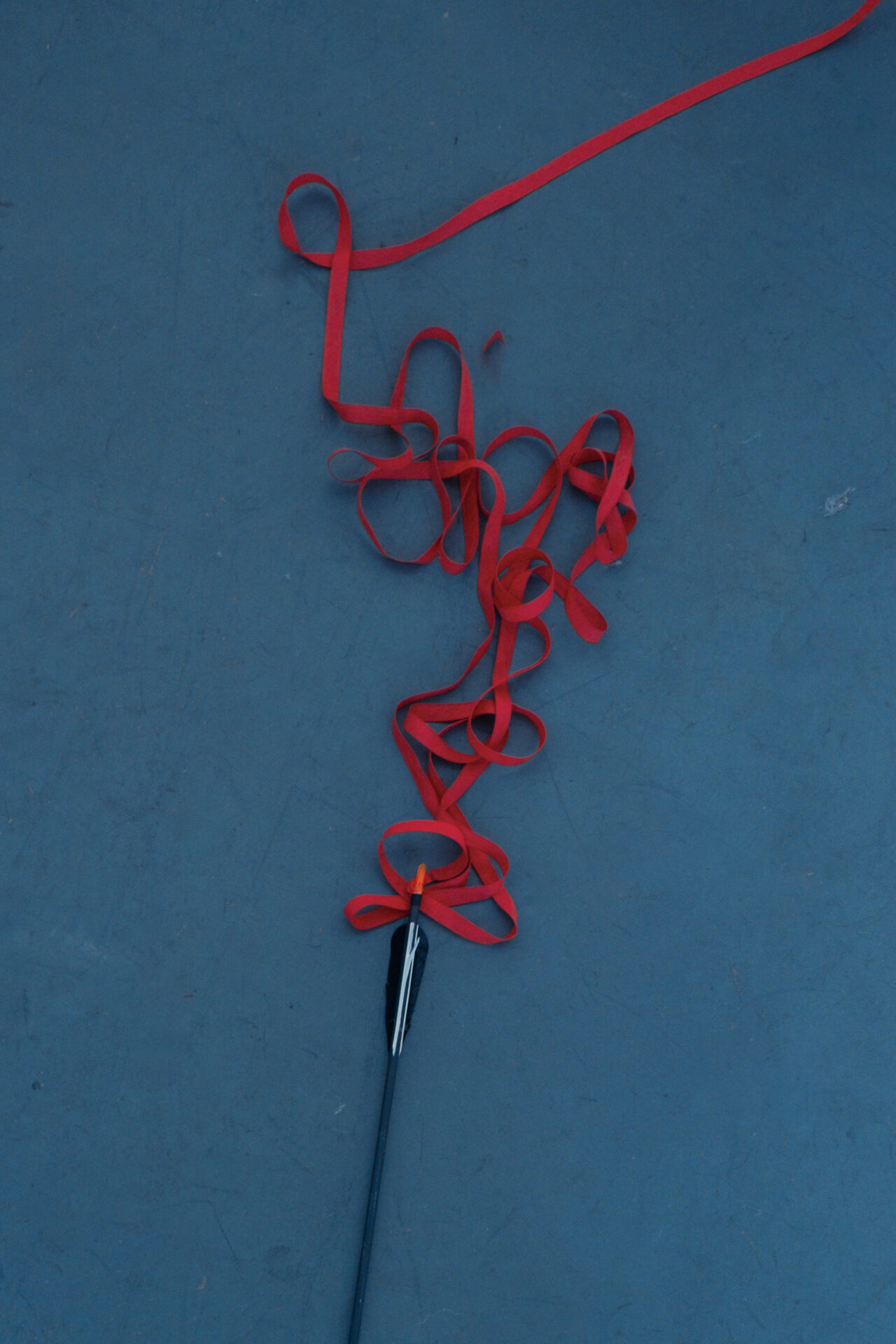
HH Absolutely. I work with a lot of tools, the hammer for example. And it always becomes a question of how you make use of it. With the hammer, I can build you a house but also smash your face in. The tool that’s present in SEWING is my bow, a tool for hunting and killing. I instead took it to sew with the arrow, using it as an instrument of connecting. Needle and arrow at once.
FH So you are an archer. What intrigues you about this practice?
HH I got into archery maybe eight years ago, it’s a fantastic way of playing with tension and release. Even though archery has its origins in hunting, it is also used for Zen practice. What fascinates me is the surprising tenderness of letting go. The softness doesn’t cancel out the violence. And I’m quite addicted to the sound of the arrow piercing through the air.
Photography by Lilly Wetzel.
FH And to get back to your pieces, how do you integrate this hobby? Tell me about the results.
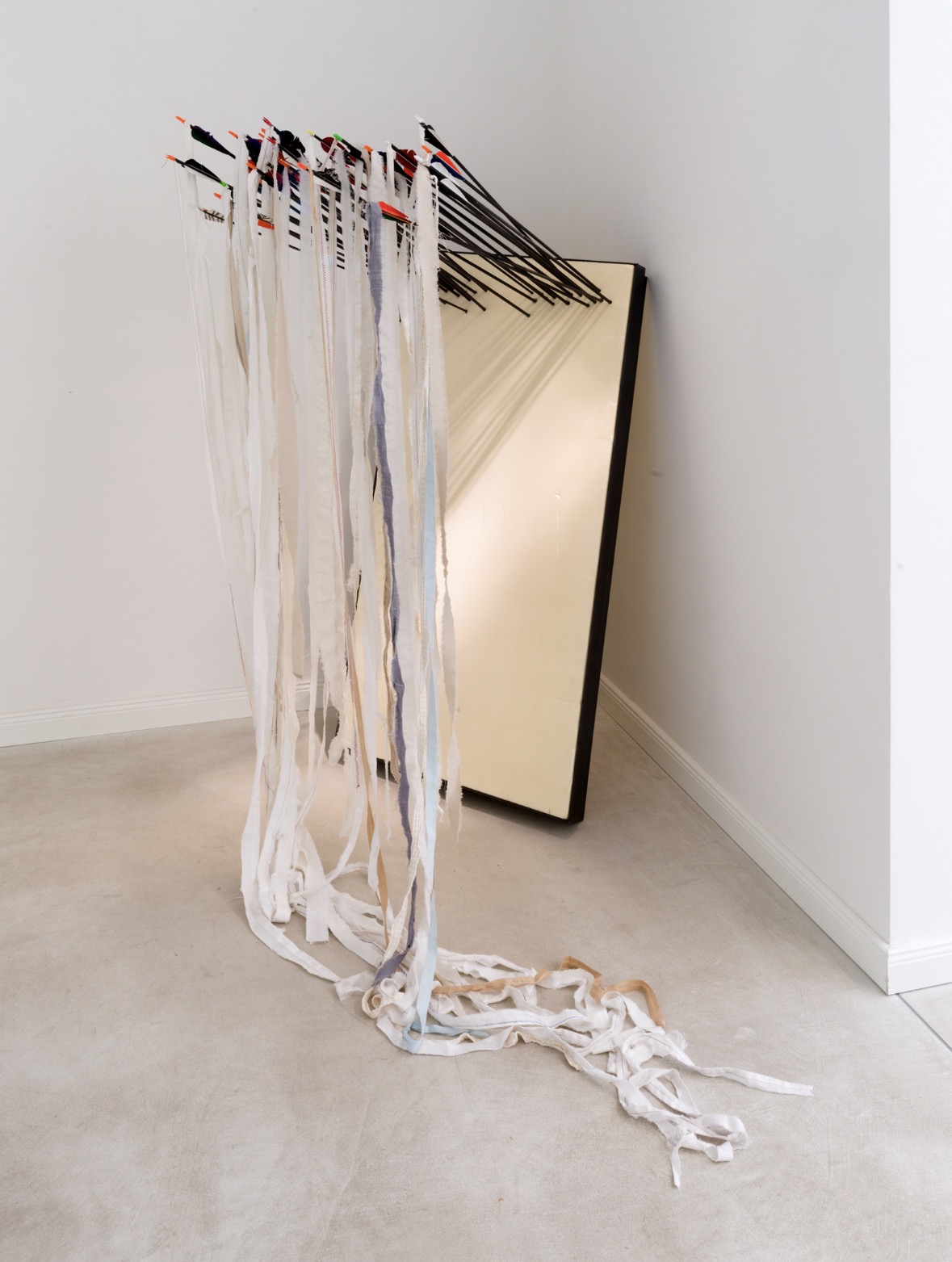
HH In SEWING, there is a series of sculptures, a performance leftover and a short video of an arrow sewing. The arrow becomes the needle — and the bow is what pushes it through the fabrics. The fabrics come from my Jewish family in Nuremberg and carry a story that I am fond of: During the war, windows were shattered by a bomb that was dropped near my family’s house. The explosion ripped the curtains apart. And my great aunt then took those curtains to mend them. She embroidered floral patterns over the traces of destruction. I inherited the same resilient mindset. So for this exhibition I called my family, and luckily I come from a family of messies, who archive everything. The cool thing is that I got to use those original fabrics for my art, which they kept. I would say this is my most personal show yet.
FH So the strength of women is a central aspect of inspiration to you?
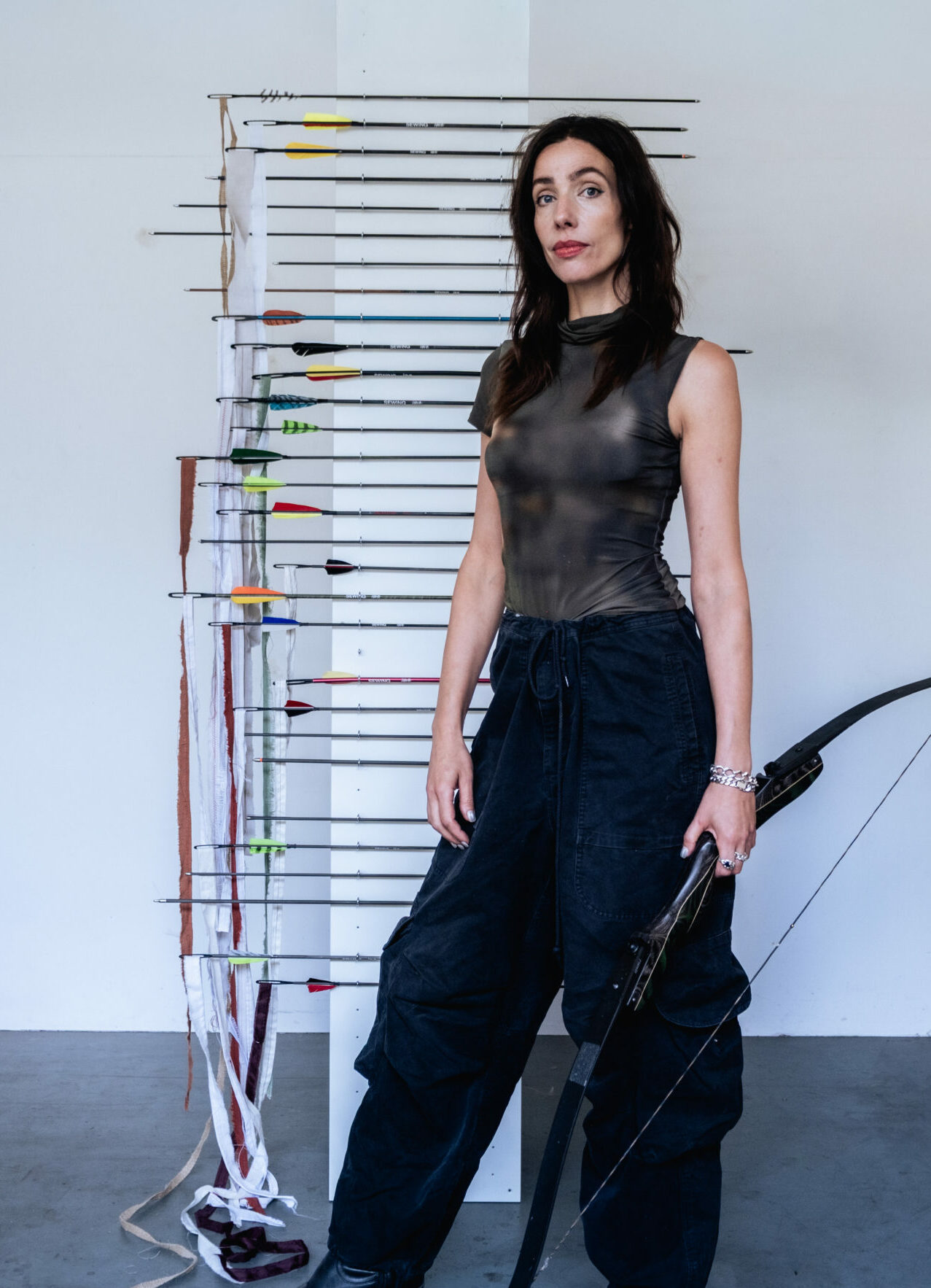
HH Yes, the women in my family always taught me to hold a stance. I’m always a little tired when the art world talks so much about social change. Then you talk with your champagne glass at the VIP opening; but I want to do something and take action. That’s why this particular exhibition is also a charity project, through which we aim to raise €100,000 for women’s shelters in Berlin and programmes working with perpetrators to prevent violence. For €500, you can acquire an individual work, with the full amount going directly to the organisation you choose. We have been collecting arrows from private people and shooting clubs; there are children’s arrows, intricate feather designs, bold ones and also unassumingly quiet arrows that have been fixed by previous owners. So we transformed those into oversized needles, which will be sold.
FH I love how multilayered your work is. How do your visions come to life? Do you start with a blank canvas or plan everything out on mood boards in advance?
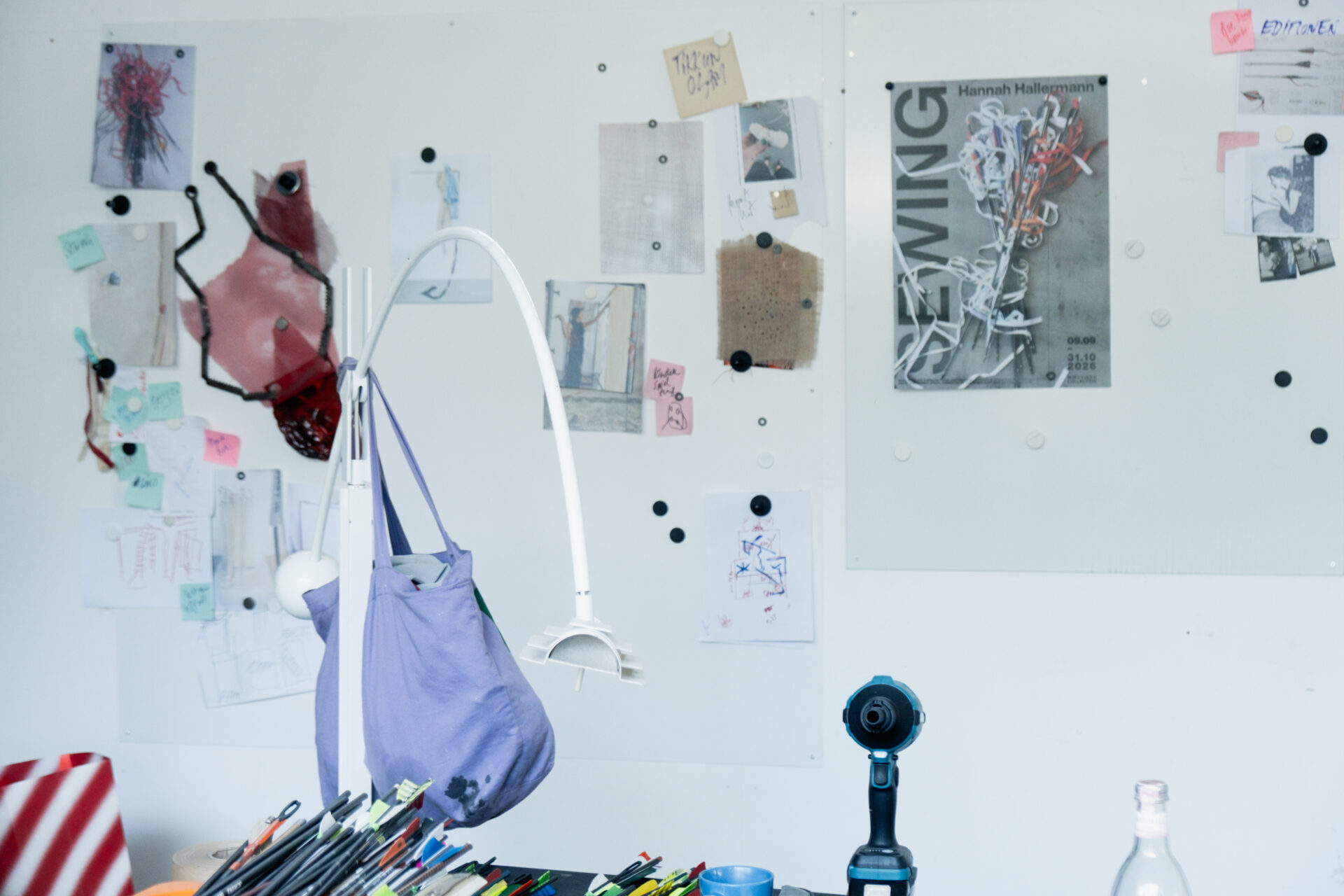
HH The process always differs. I get inspired by the small things in life, reading a lot, being in my thoughts, observing my surroundings. Also, emotions can be inspiring, like the feeling of overwhelm leading me to the adjuster. But for this series the process shifted, as I wasn’t thinking so much about tools. I became the tool. It was interesting because usually my studio is filled with welding machines and suddenly I found myself surrounded by fabrics. The place totally transformed. So ultimately I go with the flow of inspiration rather than planning art out.
Photography by Lilly Wetzel.
FH Do you have a favourite material that you use?
HH I’m a heavy metal girl, I just love metal. The smell, its forgivingness, its pliability.
FH As someone whose life is so intimately connected to their craft, can art give purpose?
HH I think art is dope because it can do everything and it can do nothing. Art is purposeful and fun when it’s taken seriously enough by people to have a conversation about radical ideas, but also not too serious with people trying to put hurdles in your way like in politics. Creativity is a passion, you have to live it.
FH To be a bit indiscreet: Can you live from it? There is this romanticised idea of artists; that they can create freely, outside the economic system. Is making art still lucrative in 2026?
HH Making money by sculpting is a fucking hustle. And I would always tell young women: talk about money, it is important, because we feed into the patriarchy if we don’t. But money is never the driving force behind artistry. I will also start a tenure at the art academy in Kiel soon, which I am genuinely proud of.
FH To copy from a fellow journalist: Adriano Sack once asked you about a previous exhibition’s work: “Können die was?” I would like to ask you again concerning your newest pieces: can they do something?
HH They can do everything and nothing at the same time.
FH Should art be able to do something?
HH No, it doesn’t have to. I believe the viewer fills the pieces’ vessel. And the artwork isn’t finished until someone brings their own reading to it. The recurring theme that interests me is tensions, poles, navigation of action in political abandonment, which I think is an antifascist practice and tool: staying open to different readings, holding a contradiction without resolving it. And antifascism can do something.
FH So art and psychology are always intertwined?
HH Always. After doing my A-Levels I wanted to study psychology. But the day I graduated I moved to the south of France with my former boyfriend and started interning with an artist. Ultimately I applied to Villa Arson and studied art there. I am not from a rich background, but they funded my studies throughout the entire five years. And so art has always empowered me. The same day I went to the phone booth, called my parents and said: ”Hello, I’ll study art now and will be back in five years“, and then hung up.
FH If I brought you a journal and asked you to write a piece of advice for your future self, what would that be?
HH Trust your powers.
FH And what’s the worst thing about certainty?
HH That it’s an illusion, there is no certainty.
SEWING is open to visitors until October 31st
UNRUHE is open to visitors until September 13th.
To get more information and to participate, visit hannahhallermann.com, contact the Miettinen Collection, or get in touch with Studio HAHA.