 Philip-Lorca diCorcia. Photo by Till Janz and Hendrik Schneider.
Twenty years ago Philip-Lorca diCorcia’s “Hustlers” series pictured male prostitutes on Los Angeles’ Santa Monica Boulevard in highly staged environments, reframing some of the conventions of documentary practice. Before the series was shown at Sprüth Magers Berlin, the photographer discussed the work with Sleek.
Sleek: Back in 1990, what took you to Los Angeles to start the series?
Philip-Lorca diCorcia: Well, for one thing, LA was very different to what it is now. Working on this series was a conceptual decision, doing it in LA was a practical decision. These guys, they stand on one side of one street in Hollywood. They are kind of on display, which was something I thought was good at that time. That, and everything can be done out of the trunk of your car in LA. New York City is so impossible getting around and doing your thing. At the same time, there was a certain social dynamic that involved AIDS, people I know, Reagan and the government, that all seemed to wrap up with the idea of these guys at the lowest end of the social scale.
What was your process in finding the locations and the subjects?
The thing is that this particular area where the series was shot is not a particularly big area, and at first I wasn’t really sure what you could get away with – like working on the street, without the police, and without having a permit or things like that, so I would work solely in motel rooms at the beginning.
The section of Santa Monica Boulevard is about four or five blocks long, and I would pull over in my rental car and just ask them. I’m not sure there was an economic necessity on their part to say yes to me, but I’d go there and tell them that I am going to give them $30 to take their photograph, and that’s all I want. That’s an easier way to make $30 than what they usually do.
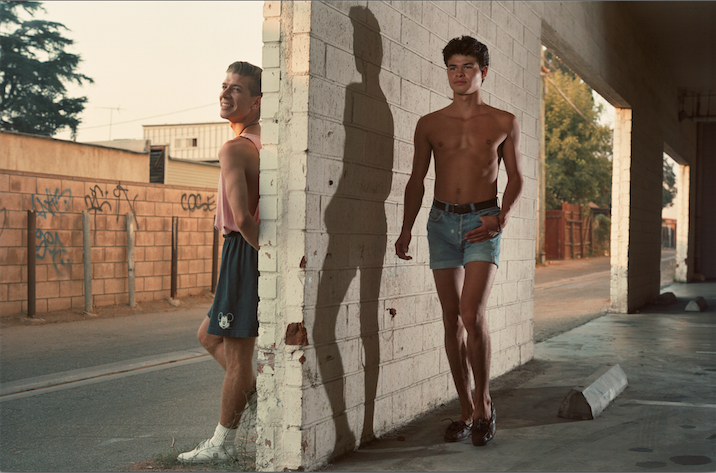 “Tim Morgan Jr., 21 years old, Los Angeles, California, $25 / Joe Egure, 18 years old, Los Angeles, California, $25”, 1990-92. Copyright Philip-Lorca diCorcia. Courtesy the artist and Sprüth Magers Berlin London.
While the locations were staged, how important was it for you to use real male prostitutes and not actors or models?
A good many of them have their lifestyle written on their face. I don’t think you could just do this with anyone. A lot of them have or did take drugs. It’s a big part of that scene. It was about being in Hollywood, and the fact that male prostitutes, as opposed to female prostitutes, present themselves as characters – the Village People, the soldier, the sailor… On the surface it’s all play acting.
You created controversy by the way you titled the images – the hustler’s name, age, where they are from, and how much you paid them – almost making them a commodity. Why did you do that?
It was a kind of taxonomy of a type. They are products. And I was also paying them with money that came from a very conservative government from that time, which by the way they made me sign something saying that I would not use the money for something that was “contrary to”, you know, “commonly held American values” or something like that. And I signed it. I never got into any trouble about it though. I think they just never found out.
Interview by Amy Binding
Work by Philip-Lorca diCorcia is included in the “Eyes on the Street” show at the Cincinnati Art Museum, Ohio until 4 January, 2015
Taken from Sleek Magazine 42: Fun & Games
 “Major Tom, 20 years old, Kansas City, Kansas, $20”, 1990-1992. Copyright Philip-Lorca diCorcia. Courtesy the artist and Sprüth Magers Berlin London.