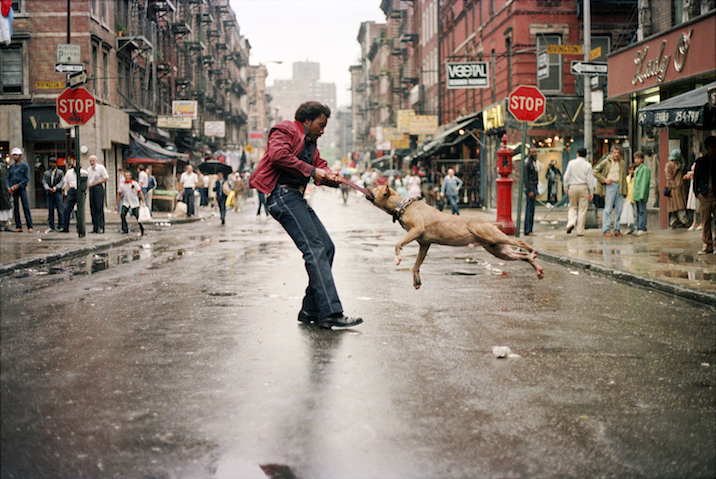
 Jamel Shabazz, Man and Dog, The Lower East Side, NY, 1980. Copyright and courtesy the artist.
As a young man growing up in Brooklyn’s Flatbush neighbourhood, Jamel Shabazz witnessed some of the most monumental occasions in recent American history: the civil rights movement, the Vietnam War, the birth of hip hop and later, the crack epidemic that took the lives of several of his subjects. At 15, Shabazz learned from his father how to bear that witness from behind the camera, a skill that led him to capture the iconic images in “Reflections from the 80s” now on display at the Hardhitta Gallery in Cologne, Germany.
Taken between 1980 and 1988, the photographs in the exhibit capture not only the artist’s hometown but also his development both as a person and as a photographer. Freshly returned to New York from a two-year stint with the U.S. Army in Germany, Shabazz frequently set off with his camera to document the lives of the people around him – and ended up shooting an autobiographical work that remains influential today, with photographs a part of the permanent collections at the Whitney Museum of American Art, the Smithsonian Museum of African American Art and The Bronx Museum of the Arts.
 Jamel Shabazz, Radio Man, Flatbush, Brooklyn, circa 1980. Copyright and courtesy the artist.
How did you get started with photography?
My father taught me. He tried to have me go against the grain and do more documentary-type photography. He taught me the technical aspects, the science of light and speed: how to capture things in motion.
These photographs are all from the early parts of your career. Why these pictures now?
It was really complicated to choose the selection for this exhibit. These photographs are all very close to me. Every one has a great meaning.
“Man and Dog,” for example, is one of my most popular images. I took it on Manhattan’s Lower East Side, down on Orchard Street. I spent so much time here, it was one of my favourite locations that I’ve shot over time and it looks nothing like this anymore. It’s changed so much there over time that this photograph becomes more like part of a visual diary.
That and “Determination,” are two photographs that my father really approved of. With these, he could see that I was paying attention to his lessons, I was able to apply the aperture and shutter speed. The motion in these pictures creates a contrast to the snapshot-style portraits, like the family portrait in “Bittersweet” or the swagger of the young man posing in “Rude Boy.”
They’re all a visual diary of my journey that I just happen to capture with film and I’m sharing.
Many of these are from your old neighbourhood. What was your relationship to the subjects?
I’ve never shown “Rude Boy Style” before, but in this, you can see my neighbourhood in Flatbush. This is my house in the background. When I moved here in 1972, we were the second black family on the block in an area that was previously Hasidic Jews. We had a synagogue right down the street, which you can see in the background.
I took this at a time in my life where I was shooting a lot of black and white, a stage in my development when I was developing my own images so it became important to me. Oftentimes I photograph subjects by themselves but at this time, I wanted to create a body of work that shows the relationship between a subject and something that is special to him and in this case, it’s the Yamaha.
Environmental portraits make up a large portion of my work. I like to tell a story. The subject by himself is fine, but the vehicles help to tell a greater narrative of who the person is. Like in “Undercover.” It focuses on a narcotics officer, working at a barge right by the waterfront on the East River, posing with his car. I spent 20 years as a New York City corrections officer and the majority of the photographs were taken on my way to and from work, this one included.
 Jamel Shabazz, Determination, Brooklyn, NY, 1980. Copyright and courtesy the artist.
What other themes are you working with in this exhibit?
Children having fun in a really unorthodox way. Improvising, having fun. It’s a time of innocence. Back then, I focused my lens a lot on young people. I don’t do it now but as a young photographer, I never hesitated in photographing children because I saw a lot of hope and promise in them. I wanted young people to know that I see their beauty. By taking a photograph, and seeing them as a human being, seeing that inner self, that made a difference for a lot of people. During this time, other photographers never focused their lens on the invisible people.
It was a visual diary but at the same time, I wanted to mentor young people, I didn’t want them to make the same mistakes that I’d made in life. The camera was that master key. Without that camera, I couldn’t confront people. Most of these people I photographed were strangers. If I saw a group of young people on the street, I saw the beauty inside them. I tell people today: I want to record your legacy.
Back in the 1980s and 90s, my photographs were sometimes the only pictures a person might have of himself, they were tragically the face of so many young people who passed away, like the young man in “Rude Boy,” who was killed violently shortly after this picture was taken.
During the same time I had my camera with me, I also had my chessboard with me and I would teach them chess, and in teaching them chess, I would teach them conflict resolution, decision-making and strategy. That’s what it was about for me: sharing. Fortunately, when I was younger, I had older men mentor me and they said, all we want from you in return is to pass it on to someone else. It’s about passing on the gifts that were given to me.
That’s what my journey as a photographer is about. We’re on the path of life. My camera is my compass. All these are the people on the path of life.
Jamel Shabazz, “Reflections from the 80s” is on show at Hardhitta Gallery, Cologne until 28 March 2015. Signed editions of the “Reflections from the 80s” catalogue are available on Sleek-Art
Text by Courtney Tenz
More: an interview with Nan Goldin