First garnering attention in the late 1980s, “Vanitas: Flesh dress For an Albino Anorexic” (1987) is perhaps the most highly recognised work for Prague-born Canadian artist, Jana Sterbak. Composed of 50 pounds worth of raw flank steaks, the manikin dress has since become a notable reference having been popularised by Lady Gaga at the 2010 MTV Music Video Awards. In spite of the work’s tertiary links to pop culture, the artist’s interest in fashion, the human body and textures of character appears to be the foundation of Sterbak’s retrospective, “Lifesize” which was at the Lehmbruck Museum in Duisburg, west Germany.
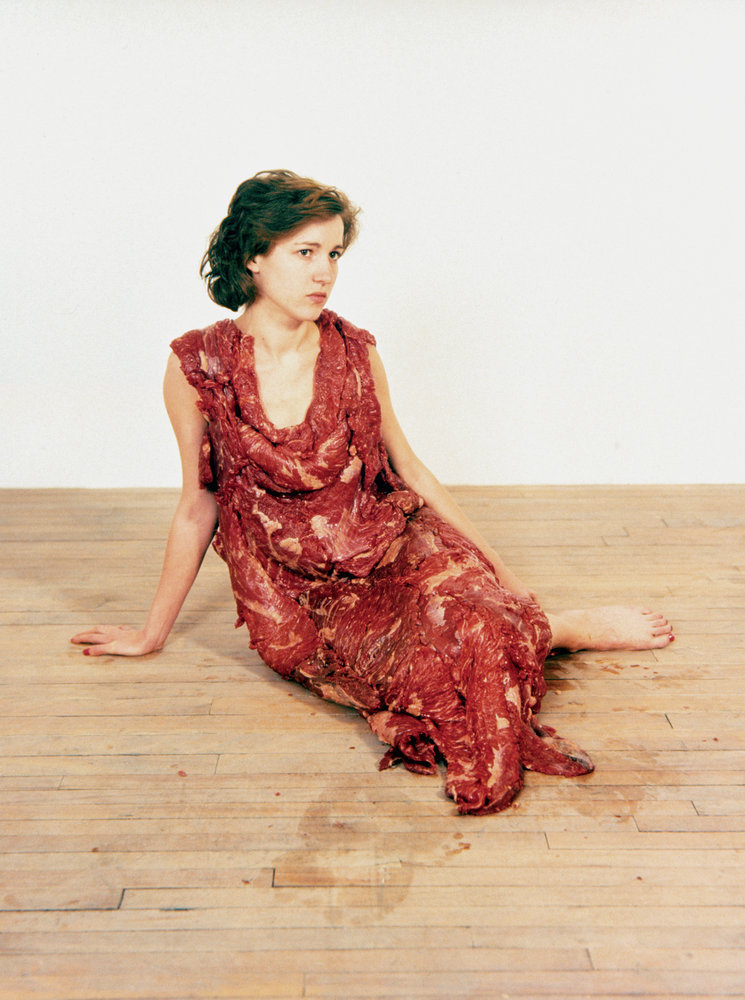 Jana Sterbak “Vanitas Flesh Dress for an Albino Anorexic”, 1987. Centre Pompidou, Paris, © Jana Ster
What is most striking about Sterbak’s body of work is the consistent interest and research in the possibilities and restrictions of movement — in particular, how transformative processes greatly affect what our bodies are capable of. Both ‘”Remote Control II” (1989) and “Sisyphus III” (1991) are perfect illustrations of this as well as the artist’s eye for mobility in design. The works are sculptural in their approach, yet serve functional purposes; very much standout pieces in her lifetime collection of work.
The former is a roaming remote-controlled caged girdle – almost childlike in its navigational possibilities;- at the heart of this piece is the desire to explore and find humour, if not freedom, in commandeering space. In the same frame of mind, the latter work exposes an alternative will of self-determination. It cleverly draws inspiration from Greek mythology, biology and textiles.
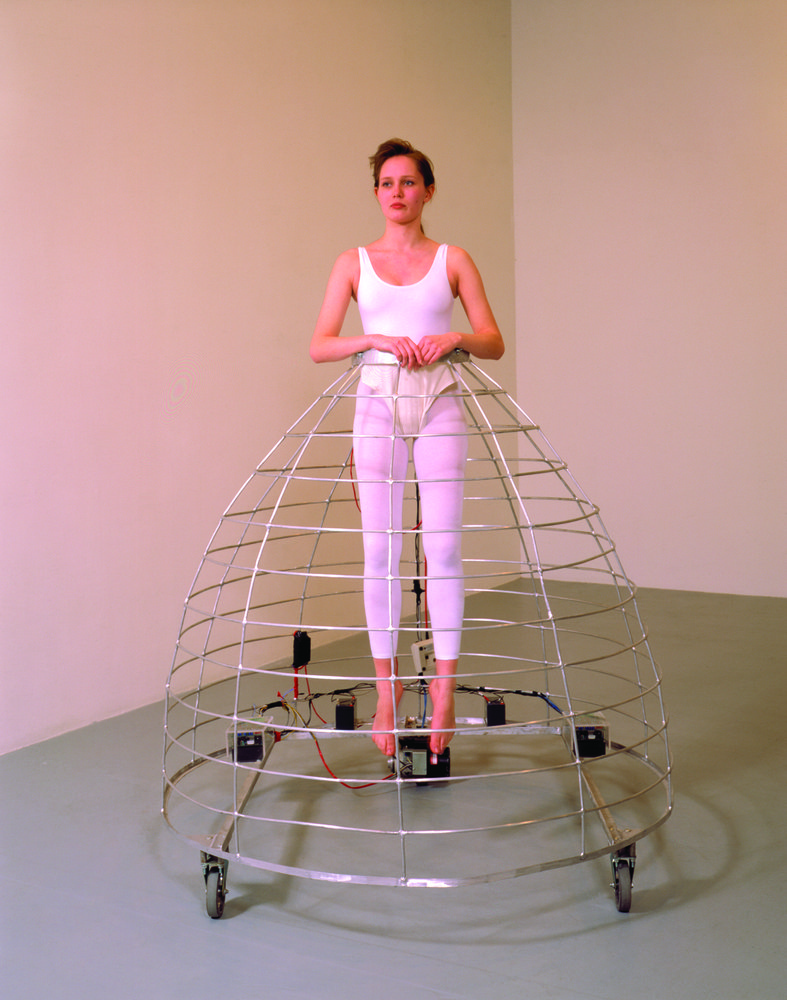 Jana Sterbak “REMOTE CONTROL”, 1989. Foto: Alison Rossiter, © MACBA Collection, Barcelona
The aluminum caged structure reveals how movement can free as well as imprison the body. For a modern-day Sisyphus, what was once a boulder is now a mounted base that rocks back and forth condemning the user to remain upright at all times. In both instances, the will to break a cycle of movement, yet simultaneously cover new ground is heavily dependent on an action versus reaction basis. If we take this interpretation as an objective understanding then for Sterbak, then our appreciation for movement relies upon the deconstruction of components that make movement possible.
Be it the body or the remote operated cage, their functional purposes are possible due to an internal order of kinetic systems— a command results in an action. “I want you to feel the way I do …” (1984-85), “Absorption” (1995) and “Hot Crown” (1998) further explore this dynamic by reacting to the presence of a human body. The first and the last use steel mesh sculptures in the shape of a dress and a crown that glow and ignite heat in response to an observers’ proximity to the object.
 Jana Sterbak, Sisyphus Sport, 1997. Photo: Gregor Sailer, © Jana Sterbak
As a viewer, the enjoyment of the work is a direct result of your involvement and engagement. “Absorption”, however, largely reflects the natural evolutionary process. Inspired by an imaginary story in which Sterbak transforms into a moth, the Kafkaesque paper-mache construction looks into genealogy and the necessity of adaptative forms in order to survive. The space to cocoon and re-invent yourself is a very convincing theme to explore within Sterbak’s visual work and writings.