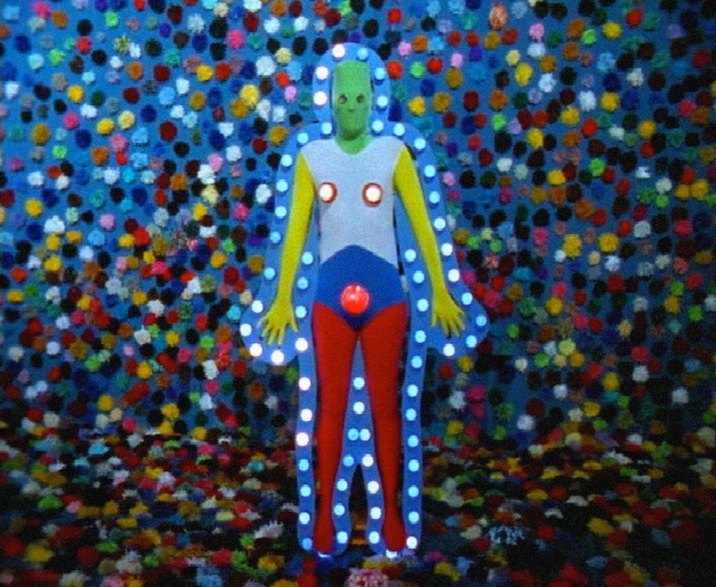
 VALIE EXPORT, “Syntagma”, 1984, film still. Courtesy of the artist. Provided by sixpackfilm
At insitu, “Jonny” follows “Vic” in a continuing series of exhibitions based on fictional characters. Whereas “Vic” was cold and wanted to impress, “Jonny” is highly sensual and is out to seduce. Have you ever been seduced by art? Maybe you’ve gotten all excited at the sight of naked Greek statues, or been simply lured by the colours of a Monet. Contemporary art, starting off with Marcel Duchamp’s urinal, seems to have ruined the seduction, with the idea becoming more important than the beauty for the eye. Unless you have a penchant for mental orgasms, the seduction rate of a concept is rather small.
Does contemporary art make you wet? a friend once asked me. Slippery, maybe, he contemplated, but wet? Even the highly erotic Instagram of self-named “slutty art critic” Jerry Saltz often features mostly pre-contemporary art work. Yet, if you think about it, Duchamp’s “Fountain” with that hole down below and its female curve, is a highly erotic object. And what about Andy Warhol’s “Kiss” or “Blow-Job” films? All this might be too much in your face to seduce. And do we really need that leaf covering Venus’ pussy for our sensations to run wild?
 „Jonny“, exhibition view, insitu 2015. Photo: Markus Georg
In the bigger realm there is the Enlightenment to blame, which made ratio and logic more important than the experience derived from the senses. This is why we are inclined to look for the text on an exhibition wall, or a label before even glancing at the art. And that’s exactly where things start going wrong (or right) when visiting insitu’s newest exhibition, “Jonny”. It’s too fucking dark to read the flyer. You see, insitu is a underground space. There’s a reason why the darkrooms of sex clubs like Ficken 3000 are in the basement and why contemporary art spaces are on ground or upper levels.
 Distruktur (Melissa Dullius & Gustavo Jahn), “5 truly false clues (prologue of the film
Éternau)”, 2006, film still. Courtesy of the artist.
For the sake of “Jonny”, insitu finally seems to reconcile with its underground nature, no longer illuminating the exhibition brightly, but leaving it in the dark. The night, so Rebecca Solnit wrote in The New Yorker, “in which distinctions and definitions cannot be readily made is the same night in which love is made, in which things merge, change, become enchanted, aroused, impregnated, possessed, released, renewed.” Also “Jonny” is not primarily about seeing art: it teaches you how to feel it.
At insitu, “Jonny” is waiting for you under a silvery ceiling. Its fictional persona might be created by the minds of insitu’s curatorial team, yet, upon stepping in is like entering a fantasy in which you are the main driver. In other words, “Jonny” is in the womb, waiting for you to give birth to it. You can do so on the pulsating tunes of “baby come on” and “born to be bad” (Melissa Dullius & Gustavo Jahn, “Distruktur”, 2006). Meanwhile “Jonny” twitches with random contractions (Viking Eggeling, “Diagonal-Symphonie”, 1924), manifesting itself on multiple screens while flickering in a happy togetherness, as if playing throw and catch. Insitu doesn’t call “Jonny” an exhibition, it’s a “production” – it’s a film in your head for which you have to press “play”.
 Distruktur (Melissa Dullius & Gustavo Jahn), “5 truly false clues (prologue of the film
Éternau)”, 2006, film still. Courtesy of the artist.
 Lotte Meret Effinger, “Supernature”, 2014, film still. Courtesy of the artist.
If “Jonny” has one dominating colour, I would call it pink (Lotte Meret Effinger, “Supernature”, 2014). But beyond its sound, rhythm and colour, it has a penetrating smell. It smells like the perfume of Yves Saint Laurent’s “Opium”, described by nightclub singer Grace Jones as the “warm musky breath of lovers in blissful post-coital sleep”, mixed with the perspiration of feet in high heels (Sylvie Fleurie, “Twinkle”, 1992), the lingering scent of cigarette smoke (Elisa Pône, “A cigarette with god”, 2010), the plastic odour of dish soap bubbles (Nancy Buchanan, “These Creatures”, 1979), and the burning of gunpowder (Ivan Argote, “Geometria”, 2012).
 Nancy Buchanan, “These Creatures”, 1979, film still. Courtesy of the artist.
 “Daisies”, 1966, film still.
And is “Jonny” wet, you might ask? “Jonny” is soaked from a heavy tropical rain, moist with the no-holds-barred sweat from a wrestling match, and soggy with a salivating desire of the mouth (Valie Export, “Syntagma”, 1984), only for its dripping material to then become finally frosted in the form of stalactites (George Petrou, “Never Met”, 2011).
 George Petrou, “Never Met”, 2011, film still. Courtesy of the artist.
Text by An Paenhuysen
“Jonny” is at insitu, Berlin, until 19 December 2015
More: A New World: How Japanese Photography Reshaped Conceptual Art
More: Ann Veronica Janssens Forges the Possibility of Infinite