 Henning Strassburger by Christoph Mack and Kerstin Brätsch by Winnie Au
Kerstin Brätsch is a painter known for her experimental, collaborative approach. Far removed from the clichéd image of the solitary artist-genius, she has worked with Adele Röder as DAS INSTITUT, and with New York sculptor Debo Eilers as KAYA, a fictional young girl under whose name they staged low-cost art auctions as performances. From digital paintings rendered on foil to sculptures that become surfaces, Brätsch reflects on her medium while tearing it apart, using it as just another signifier in a chain of mixed media references. Based in New York, she originally hails from Hamburg, and today her work is part of many prestigious collections, including MoMA in New York. For this issue we asked Henning Strassburger, fellow German citizen and painter, to interview her. Not only do they speak the same language, but they share a similar aspiration of redefining how painting is conceived in the digital age. Getting them together, then, seemed like a good idea. Here are the results.
SLEEK: From my perspective it appears that you step back from your work and let it have its own autonomy. One way I’ve seen you do this is through your collaborations. It’s as if you bring your work to life and set it the task of standing on its own two feet.
Kerstin Brätsch: My collaborative work allows me to create third entities. In the KAYA project, for example, which I collaborate on with Debo Eilers, we are merging our individual practices into a type of four-armed monster. Generally speaking, I am interested in the question ‘Does painting have a body? and, if so, is it a social, physical or psychological one?’ All these aspects are addressed in different layers within my work as a painter. In the “Psychic series” for example [abstract paintings from her 2007 show examining spirituality], I wanted to paint energy forms, or ‘power heads’ that assert themselves as temporary truths, in both a pictorial and performative sense, whereas in the Mylar works [works that are variations of earlier paintings on Mylar foil], I was interested in the material changeability of an image. By the layering of three individual sheets, new combinations are always possible, yet they still give off an air of corporeality.
Is it possible that through this approach, painting could redefine itself as a form of performance?
Of course. In a way it is always staged. I’m aware of that – there’s an auratic and an anti-auratic perception, and what is seen as authorship is also treated as performative. For example, if Debo and I stage a live auction in which Debo paints a picture behind the scenes or underneath a stage, which I then sign with my own name, people will assume something like, ‘Kerstin Brätsch, the painter, is now signing the painting.’ And at that moment it carries my signature, even though Debo painted it. It’s performative in the literal sense, because it’s a live auction with particular rules. Visitors bid for the pictures, but bidding might start at two dollars and end at 50 dollars, or start at 50, go up to 500 and then back down to 20, with the painting finally being sold for 5 dollars. With KAYA, we play with these expectations. For us it’s about shaking up these fixed notions and questioning them.
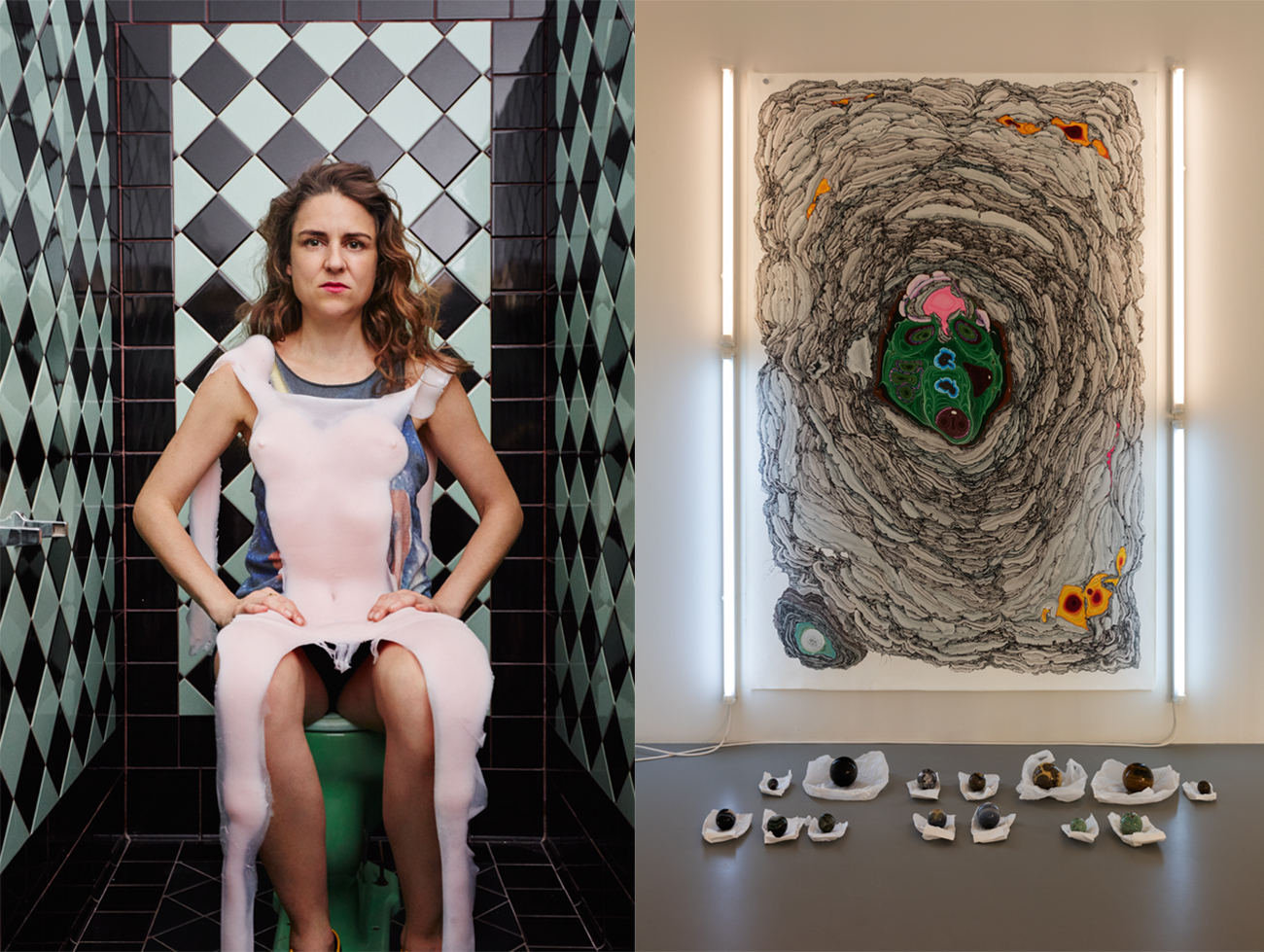 Kerstin Brätsch by Winnie Au and “Full-Fall presents Kerstin Brätsch (Poli’ abu’s Cure)” Image by Andrea Rossetti
In your recent series, the “Unstable Talismanic Renderings”, the work seems to acquire its conceptual content by undergoing these processes. It’s almost alchemistic.
Exactly. On one hand there is this contentual acquisition; on the other there is a disintegration and neutralisation. It’s difficult to find an appropriate language for these processes, since lots of unnameable things also happen. These works were done in collaboration with the master marbler Dirk Lange. After Dirk and I have spent hours applying drops of colour onto a watery surface it’s no longer just about two people – you somehow mutate into a third being. But nothing is completely left to chance, we’re trying to construct an image by manipulating the process of dropping. It’s a Sisyphean task, and actually this is self-contradictory. While painting can be taken apart and reassembled, there is something very procedural in the marbling process, something alchemistic, yes. Gravitation, cohesion, adhesion; it’s as if you’re collaborating with universal forces. I don’t completely remove myself, I am part of these processes.
In terms of technique, is the constructed glass-work brushstroke similar to the painterly brushstroke? The latter is arguably the smallest element in its aesthetic universe.
In the hands of a painter, a brushstroke takes a few minutes, whereas in stained glass it takes four weeks. So it isn’t just about the brushstroke being converted into another medium, the entire temporal aspect is transformed. Numerous glass sheets are laid on top of each other, cut out and aligned, then they are baked in a furnace, sandblasted and flame polished, and finally glazed in lead. You could say it’s like the fossil of a brushstroke, created with the help of a glassmaster who becomes an extension of my hand.
Do you apply the same principle to your Mylar works?
The Mylar works involve a different method, but they are also based on a fundamental reconsideration of the brushstroke. The three part Mylars, for example, contain three superimposed polyester sheets that can be layered interchangeably, enabling the image to constantly reconfigure itself. Through this staggered arrangement of the layers, the image gains a humanoid quality – something mask-like, something pertaining to expression. The film sheets can also exist as single surfaces that can be fed into the KAYA project.
So here, too, a small construct can beget a complex one.
Yes, an extended body, as it were. Indeed, at this moment painting again acquires a claim to be corporeal.
Do you have a studio in New York?
Of course. My paintings have to be created somewhere!
 Kerstin Brätsch studio by Winnie Au
And how does it function? Is it like a creative laboratory?
Yes. It’s very important for me to have a place where I can concentrate.
What sort of music do you listen to when you’re working?
At the moment I like “Excavation” by Haxan Cloak, “Ghettoville” by Actress. And right now I’m listening to Club Cacao, an American friend of Debo and mine, who lives in Berlin. I’ve had Autechre’s “Chiastic Slide” on repeat for weeks, too.
And is there a book you’d recommend?
I’m currently reading “The Argonauts” by Maggie Nelson. The book challenges what it might mean to live without fear in terms of society, family and relationships. It contains theoretical and gender-political references and quotes, intertwined with Nelson’s own poetry and autobiographical excerpts. It’s an embodiment of the transitive. It’s a fantastic book that you have to read.
I will!
Portrait WINNIE AU
Interview HENNING STRASSBURGER
Taken from SLEEK 51 – order here