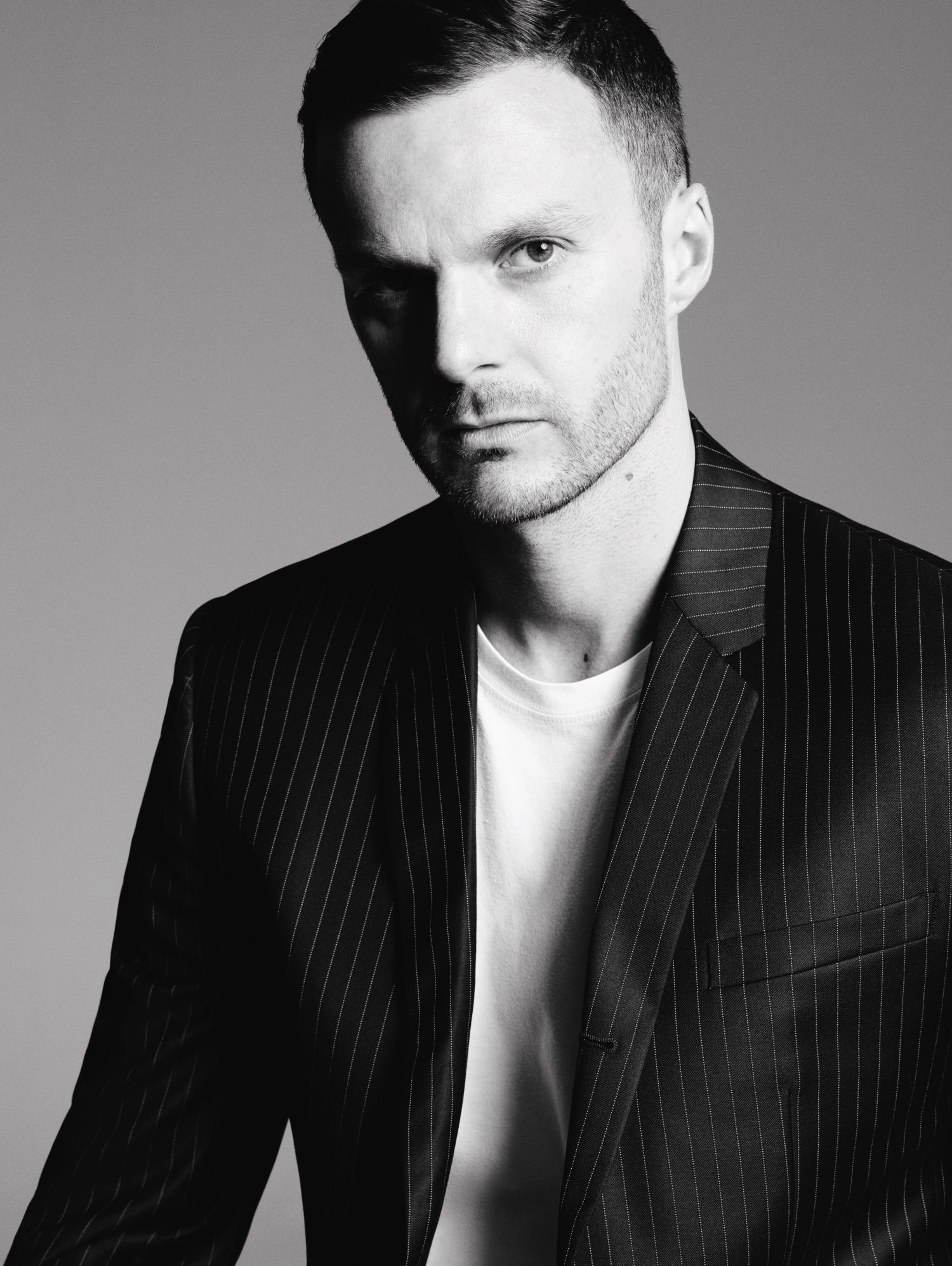
Kris Van Assche is at the helm of one of fashion’s most prestigious menswear labels where his 500 Euro-a-pop-jeans keep flying off the shelves. But things haven’t always been like this: His appointment as Dior Homme’s creative director was initially overshadowed by comparisons to his predecessor, Hedi Slimane. There were also misunderstandings with the media, which caused the Belgian to focus on his work rather than worry about maintaining a high profile. And then there was KRIS VAN ASSCHE, his eponymous label which he had to fold last year. In conversation with Sleek – two days after showing his much lauded fall collection for Dior – the 39 year-old Belgian talks about overcoming these difficulties and arriving at a state of creative bliss.

You seem to enjoy keeping a relatively low profile, and don’t give many interviews. Why is that?
I love a good interview because they can help explain the story behind my work, and prompt interesting discussions. But why do these conversations have to focus so much on me and my private life? It’s not as if I’m a singer or a movie star. Why aren’t people talking about the clothes? There are times when these personal details can help people to understand the narrative in what I do. But it’s also ambivalent: You want people to get it, but you don’t want them to know everything.
Are you trying to manage people’s perception by revealing certain aspects of your work while keeping other parts secret?
It’s about getting your priorities right. What’s important to me are the clothes I create, the quality of their designs and the creative process behind them. These days it seems like people are taking less time to concentrate on things like that. After all, we’re living in the Instagram-era. Don’t get me wrong, I enjoy Instagram and I have no problems with other people enjoying it; it’s fun to look at while you’re taking a ride in a cab or something. But it shouldn’t be the main platform for promoting a collection because fashion doesn’t always just fit into a square box – there’s more to it than that. Today, we’ve become obsessed with creating images that can stand out among thousands of others, and that’s not always a good thing. And I feel the same way about my private life. Interviews shouldn’t be about me dancing on tables. They should be about my clothes.
With that in mind, what role does someone like A$AP Rocky have in the narratives you weave? He pops up in your Instagram a lot.
For me he’s the muse, the pop star. He has a big public profile, and I admire the way he handles it. Compared to my personal image, his is much more tied to his work as a musician, yet he’s always so elegant and polite. He’s also really smart, too. And it’s just fun to work with him as well, because he has such a good fashion taste, and always picks the right pieces. When he came to the show two days ago, I had a whole selection for him, and he picked the exact thing that I thought he might like. So yeah, I love A$AP Rocky.
Another artist you’ve worked with is the ceramicist Kristin McKirdy, who designed some of the accessories for this year’s spring/summer collection. What it is about her work that you found interesting?
Well, over the last five or ten years I’ve tried to educate myself about design outside fashion. During this learning process, I’ve come across French ceramics from the Fifties, like Chambost, which I’ve also started collecting. And as result I’ve also found out about contemporary ceramicists like Kristin McKirdy, whose work immediately appealed to my tastes. Not only is her pottery inspired by these Fifties pioneers, she’s taking that style in new directions, too. And I could really relate to that. When designing for a house like Dior, its legacy is inescapable. So the trick is to work that heritage into something that’s relevant to today.
How did you end up working together?
We met and I said, “Listen, I’m totally crazy about your work, I have no idea how we can collaborate but let’s talk”. So we started chatting, and it transpired that she was very superstitious and into good luck charms like wishbones and fox tails – that sort of thing. I was intrigued and told her to go for it. She then made these objects that you would actually hold in your hand, like a good luck charm meets stress ball kind of a thing. And that was it. When I work with people admire, I try to let them be as free as possible, because that’s the most interesting part of collaborating with someone. You’re missing the point if you’re giving the other person just a tiny frame to move in.
It’s interesting that you mention that, as you seem to have a very different approach to creative work yourself.
Well, opposites fascinate me. I don’t want to be surrounded by people who are too similar to me. Of course I want them to work to my rhythm and I want them to be organised. But style-wise and inspiration-wise I need to be confronted with different ideas.
Ceramics aside, do you collect anything else?
I have two artworks by Rinus Van de Velde in my house. They’re really something. Huge. I had to alter a wall so I can fit them in. I wouldn’t do that for many artists. But I wouldn’t call myself a collector, because it’s a word that seems tied to the idea of investment. And I’d be a very bad investor because I buy things instinctively, and not by asking a consultant which one is going to be really expensive in 20 years. I have no idea about that sort of thing. But I’m fortunate that I can surround myself with beautiful stuff because of the life I lead.

In 2015 you quit your own label after ten years. What’s changed since you decided to focus exclusively on Dior Homme?
I’m no longer working in such a schizophrenic manner. All my ideas just go into one place. You could see this in my spring collection, but it was even more noticeable in the one that I presented two days ago. What it doesn’t mean is that I won’t ever have my own label again. But for now my attention is focused on Dior. That’s what changed. Do I work less? I wish. Do I have less fun, less creativity? No. Do I regret shutting down my own brand? Yes, of course.
You’ve overcome a lot of obstacles in your career. From being one of the youngest students to enroll at the Royal Academy of Art in Antwerp, to starting your own brand after six years as an assistant to Hedi Slimane and then coming back to take over as Dior Homme’s creative director, you seem to relish a challenge. Would you describe yourself as a fighter?
In what sense? Are you referring to my mental strength?
Yes.
Well in that case: ok. At the time, I felt like I was too young to be at the Academy, and I felt the same way when I started working as an assistant in Paris. And looking back, I was probably too young when I launched my label as well. Being so young, I didn’t have the experience that I should have had. If I’d been 25 when I started school in Antwerp, I would have probably got much more out of it. Does that mean I regret doing those things at such a young age? Not at all. To come Paris and to not worry about where you’re gonna sleep requires the freshness of youth. And to have no worries when I quit my assistant job to start my own label at 28 years old… Maybe I was driven by courage or craziness – who knows? But whatever it was, without it my life would have been different. And maybe one day I’ll re-launch my label. And if I do my life will change again.
What about the “Dior man”, is he defined by courage?
I like to think that at Dior, we cater for a range of men. But for shows, there’s this imaginary character that I have in my mind, a guy I relate to a lot. He’s been there throughout the years and he just evolves and grows with everything I learn. And is he courageous? Of course.
But what does that mean in 2016?
It’s about taking care of yourself, especially when there are so many bad things happening in the world. Some would say that’s a superficial attitude, but I think it’s courageous. Culture is what differentiates us from barbarians.
The idea that men should be taking care of themselves is relatively new. Brands like Dior Homme have come a long way from operating on a license model to offering customers a whole lifestyle. How does this affect the work of a designer for a couture house that has a fan base ranging from business men to young obsessives?
That’s a million dollar question.
I was hoping you could answer it.
Every collection is an attempt to answer that question. That’s the whole point, and it was the same when I arrived at Dior over nine years ago. I took over the men’s division of a high-end fashion house whose look had been copied by everyone, the cheapest brands first. It’s then you start asking existential questions: What’s our reason for being here? Why are we putting on new shows? How do we appeal to both our “classic” customers as well as our full on fashion devotees? How do all these things fit together? And today, we’re still asking these questions, because the answers are always changing. Each season is an attempt to find a new solution.

In the show notes for the collection that you just presented, you refer to “traces of memory and traditions that still exist but without nostalgia. This is the hybridisation of now.” Can you elaborate?
Hybridization refers to taking different elements from different periods. Whether it’s Nineties skating or Eighties New Wave. It’s about taking those and molding them into new clothes, so that they are never just straightforward reiterations of those styles, but something new. These days it seems as if some people are content to just look back into the past, back to formative periods such as the Fifties and Seventies, and declare that things simply were better back then. But isn’t this retro fascination exactly what we dislike about our parents? We’re living in a period where working in fashion is almost insane. We have to be more optimistic, more youthful, more hopeful and all that. And we all have to do our part. In fashion, that’s about taking certain elements from the past without treating them with an excessive amount of nostalgia. It’s about taking memories and things from days gone by and pushing them forward by using them for the future.
How about you – are you always focused on the future or do you allow yourself a bit of nostalgia?
I don’t like looking back. Even when I had my own label I didn’t keep old collections because I could only think about what I wanted to do better. I have a big warehouse where I store all my previous designs, but the truth is I’ve never even set a foot in it.
But it’s there.
It’s there and it has tons of clothes, tons of archives.
Who’s looking after it?
A very sweet assistant. Which is good because I really don’t want to go there. So, yes, I guess for me as a designer, it’s all about the future.
What is the most rewarding thing about your job?
That I’m fortunate to be able to tell the stories that I want to tell, and to have this platform to do so. In terms of creativity, then, I’m very happy, and that really is the most rewarding thing.
