 “Concetto Spaziale” (1962) by Lucio Fontana, courtesy Mazzoleni, copyright Fondazione Lucio Fontana, Milan
Lucio Fontana, the heavyweight of Italian art once claimed: “My discovery was the hole and that’s it. I am happy to go to the grave after such a discovery”. Radical for the forties, his overtly masculine gesture of penetration became the framework of “Spazialismo” or the Spatialism movement that was initiated by Fontana and his contemporaries in 1947. His research drew on cutting edge scientific concepts which interpreted space, emptiness and infinity and are now the subject of the collaborative show “Fontana / Melotti: Angelic Spaces and Infinite Geometries” at Mazzoleni in London.
Fontana is lauded for forging new stylistic paths in Italian art theory, specifically sculpture. In a series of manifestos including the “White Manifesto”, spanning the 1940s and 50s, they asserted that matter should be infiltrated by energy to achieve dimensional, dynamic forms of expression. This was symbolised by hole-punched surfaces and sliced planes. In his series “End of God”, the ostentatious egg-shaped canvases ridicule the rigid conventions upheld by classical masters; quite literally bending, breaking and punching holes through the Italian canon.
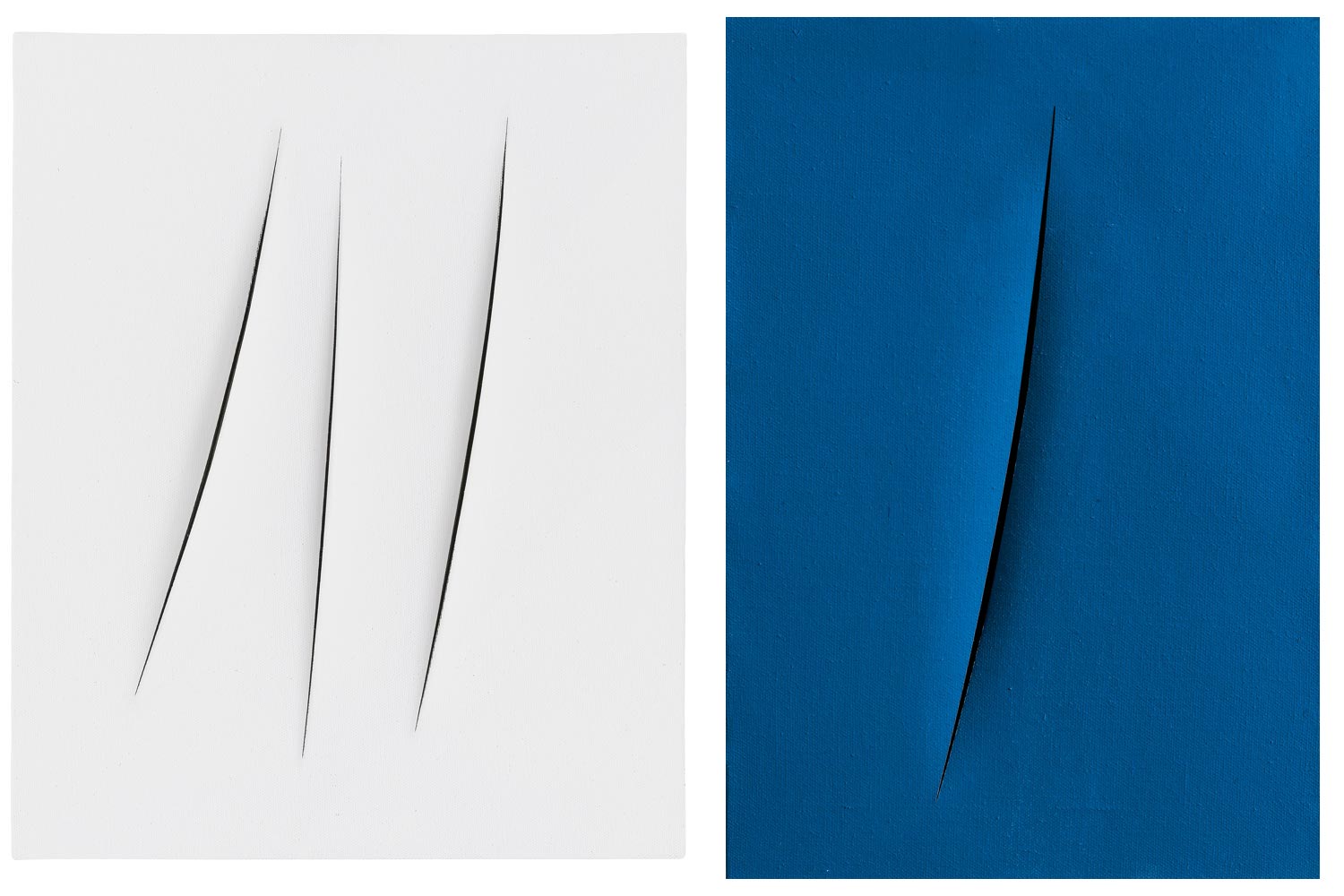 Left: “Concetto Spaziale”, Attese (1967), right: “Concetto Spaziale, Attesa” (1961) by Lucio Fontana, both courtesy Mazzoleni, copyright Fondazione Lucio Fontana, Milan
Fontana’s much fabled “Concetto spaziale” (Spatial Concepts), began in 1949 with the “buchi,” or holes series that comprised of a set of canvases lacerated with stigmata-like markings. Through the spatialist lens, these punctures transformed a two-dimensional form into a three-dimensional space. Fontana sought to dismantle, stretch and surpass the physical and metaphysical proportions of the canvas. The irreverent act freed his sculptures from a history concerned with weightiness. Spatialism also took its cue from the Italian Futurists’ fixation on technology, where Fontana was conscious of the advancements that were rapidly changing the world around him, including: electronic communications, missile technology and nuclear energy. These influences have since evolved and forked into what we’ve come to know as the environmental art, performance art and Arte Povera movements.
Mazzoleni now brings into view Fontana’s fascination of the eternal and infinite in “Fontana / Melotti: Angelic Spaces and Infinite Geometries”. Presented alongside his work, is his contemporary Fausto Melotti, who was a creative comrade until Fontana’s death in 1968. The exhibition also includes a study of the invaluable pedagogy they received during their training in Milan from Adolfo Wildt, whose selected works also frame the show.
 “Concetto Spaziale, Attese” (195) by Lucio Fontana, both courtesy Mazzoleni, copyright Fondazione Lucio Fontana, Milan
 Left: Lucio Fontana Concetto Spaziale 1962, courtesy of Fondazione Lucio Fontana and Fausto Melotti, Untitled, 1976, courtesy of Archivio Fausto Melotti. Right: Lucio Fontana, Concetto Spaziale, Attese, 1967, courtesy of Fondazione Lucio Fontana. Fausto Melotti, I Maggio, 1971, courtesy of Archivio Fausto Melotti
Lucio Fontana became more than an intense painter as his affinity for the cosmic unity of space grew. Fontana’s radical method could carve meaning out of emptiness. When Fontana physically slashed a material, it unearthed a new metaphysical and actual space underneath. In the artist’s own words, “I make holes, the infinite goes through them, light passes through them, there is no need to paint…”
“Fontana / Melotti: Angelic Spaces and Infinite Geometries” is on display at London’s Mazzoleni from 28 September until 18 November
Images courtesy of Mazzoleni