 Advertising project for Belga cigarettes by Rene Magritte and Poster design for Belga cigarettes by Studio Dongo. Image from blog.imagesmusicales.be
Rene Magritte, the Belgian surrealist, known for his sharp wit, neat style and interest for the banal, is an inexhaustible source of inspiration to museum curators. Since the beginning of the 2000s at least five shows have been dedicated to Magritte, with the most recent at Centre Pompidou in Paris seeking to pose the artist as one of the greatest artist-philosophers of the 20th century. Though the statement may be a bit far-fetched, what leaves no doubt is the fact Magritte is one of the most influential artists of the last century. Here we trace the artist’s lasting influence across different creative disciplines.
 “The Son of Man” and “Time Transfixed” by Rene Magritte. Images from wikiart.org
MAGRITTE AND POP ART
With his bowler hat, sturdy coat and a sensible scarf, Magritte himself looked like an embodiment of the bourgeois lifestyle. Yet, the trivia of the everyday existence was one of his favourite subject matters. Painter of hats and apples, hammers and fireplaces, Rene Magritte foreshadowed pop art with its fascination for the banality of the petit bourgeois lifestyle. For instance, the critique of the middle class existence in the works by Richard Hamilton and Eduardo Paolozzi stems from Magritte’s portrayal of the dull. However, just like the pop art icon Andy Warhol, Magritte is as critical of consumerism as fascinated by it. After all, the artist kept working for his advertising agency Studio Dongo long after he became a world-famous artist.
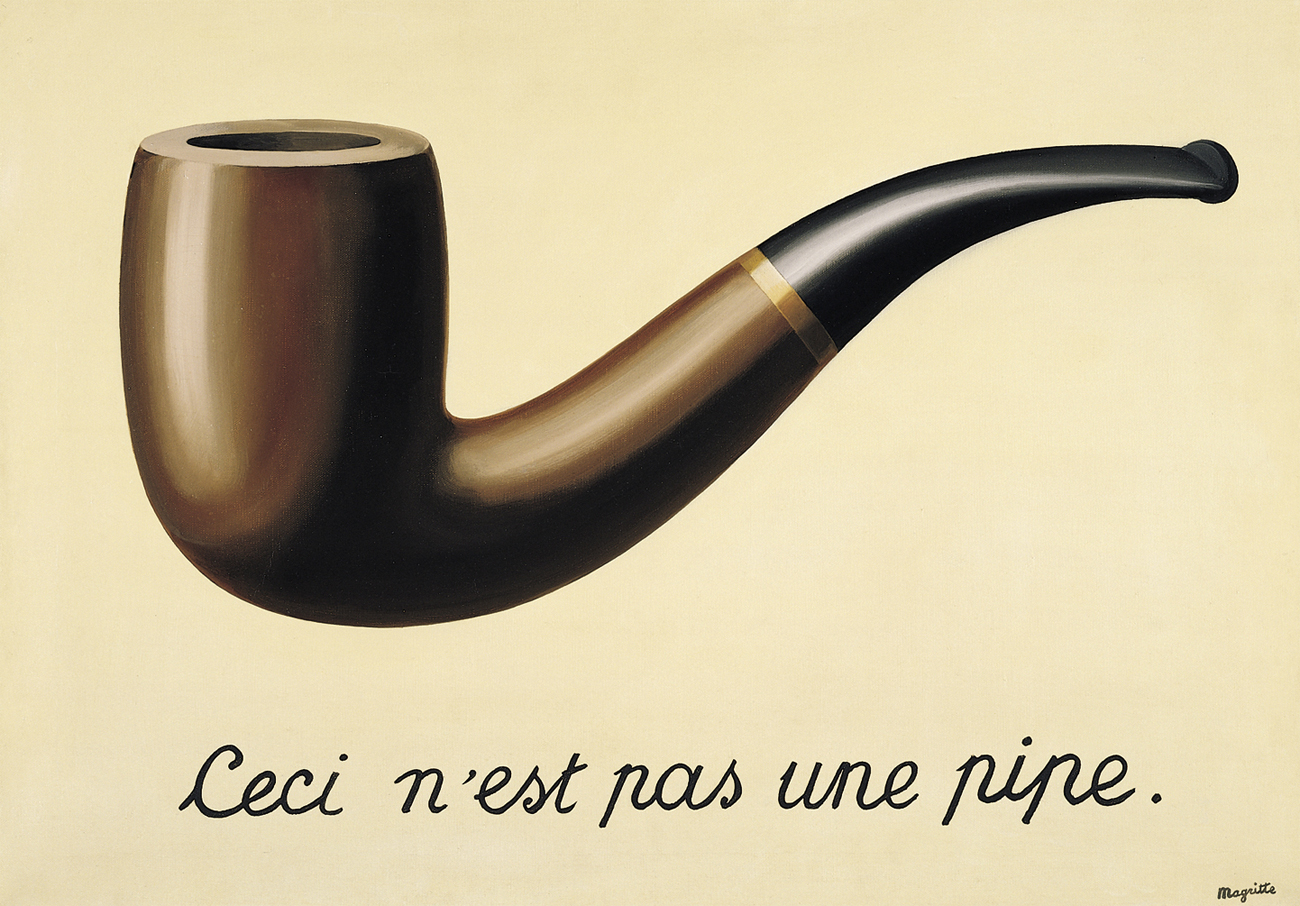 “Ceci n’est pas une Pipe” Rene Magritte. Image from theguardian.com
MAGRITTE AND CONCEPTUAL ART
In 1929 Magritte finished his “Treachery of images” that included writing “Ceci n’est pas une pipe” under the elaborately drawn pipe. By doing that not only did he raise many an eyebrow but also propelled the conceptual art movement. John Baldessari and Jasper Johns cite Magritte as one of their major inspirations. It was Magritte who played with words and images, divorcing the representation from the represented and questioning the obvious, long before Jasper Johns; American flag.
 “The Rights of Man” and “Hegel’s Holiday” Rene Magritte. Images from biblioklept.com and tumblr.com
MAGRITTE AND POSTMODERNISM
The doubt, the style-fusion and the absurdity are the three pillars postmodernism rests on. But no one other than Magritte played with meanings and merged allusions from the very start of his artistic career. His painstakingly drawn landscapes are inhabited by surreal characters, on his paintings leaves turn into trees and birds into flowers, while philosophical allusions are put next to trivial motives (remember his ‘Hegel’s Holiday’). Even his early paintings herald the cult of doubt that invades the art of the second half of the 20th century.
 “The Human Condition” by Rene Magritte and ” ‘Ceci n’est pas une Chambre” by Mary Katrantzou. Images from wikiart.org and vogue.com
MAGRITTE AND FASHION
Fashion world appreciates wit and extravagance, which is why Magritte’s work has been re-worked and re-interpreted by fashion creatives. In 2009 Comme des Garçons’ outlandish shoes were inspired by Magritte’s “The Red Model”. In 2011, Mary Katrantzou borrowed from Magritte for her “Ceci n’est pas une chambre” collection. Even the Viktor & Rolf have cut their couture dresses to resemble the distorted silhouettes of Magritte’s characters, while Martin Margiela once covered his models’ faces channelling Magritte’s “Lovers”. Magritte has shaped the visual culture of today in such an insidious manner that only the future generations will be able to tell to which extent.