 Mondrian, “Composition with Large Red Plane, Yellow, Black, Gray and Blue” 1921, courtesy of Gemeente Museum Den Haag
For the entire year, the Netherlands will celebrate one of their most famous painters – Piet Mondrian. 2017 marks the centenary of the Dutch movement De Stijl, which Mondrian was a founding member of. De Stijl, also coined by Mondrian as Neo-Plasticism, was created by a group of painters and architects who focused on the reduction to the essential forms and colours. Inherently non-representational, the supporters of this movement only used the primary colours and the three primary values black, white and grey in squares and rectangles, divided by straight horizontal or vertical lines. Influenced by Cubism, the results were effectively progressive, radically abstract and deliberately unconventional.
Mondrian’s iconic paintings, which he called “compositions”, are undoubtedly the best known representatives of Neo-Plasticism. For this reason, the Gemeente Museum in The Hague devoted a special exhibition to him. “The Discovery of Mondrian: Amsterdam | Paris | London | New York” showcases his work in the cities he lived in throughout his life. Exploring his colour composition, the show highlights his huge impact on culture over the last 100 years. Here, we trace how the artist’s lasting influence changed the course of art, music, architecture and fashion for ever.
 The Mondrian Dress by Yves Saint Laurent (1965) and Prada’s AW collection (2011), courtesy of Gemeente Museum Den Haag
Fashion
Perhaps as famous as the painter’s canvases is the Mondrian Dress by Yves Saint Laurent. Originally part of a collection of 1965, in which YSL paid homage to several different artists, the Mondrian dress grabbed so much attention that the collection has been dubbed the “Mondrian Collection”. The conceptual design of the garment reflects the movement: unadorned, abstract and simple. The results look like a wearable canvas.
Mondrian’s compositions have also influenced Peter Rozenmeijer’s woollen coats from the 1980s and Nike’s 2008 Dunk SB Lows. For her AW11 collection, Miuccia Prada, who is a big fan of the Mondrian Dress, also paid tribute to the concept and incorporated the design into her own line.
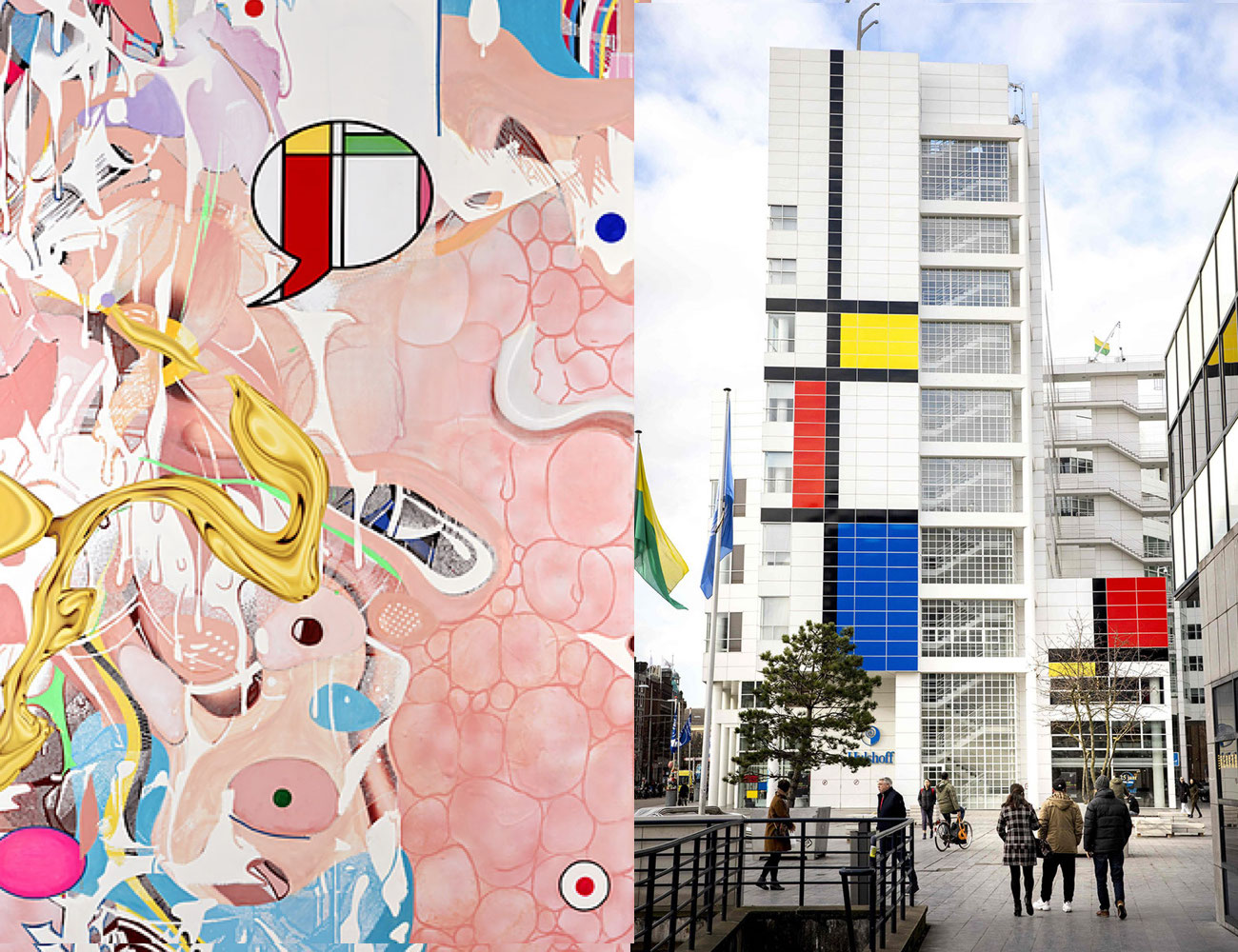 Misha Milovanovich “KikiPlasty” (2014), courtesy of the artist, and a Mondrian painting on the City Council of The Hague, image from faithistorment.com
Art
Roy Lichtenstein is not only famous for his original prints, but also for his adaptations of other well-known artworks. In 1964, he created a pop-art version of Mondrian’s colour composition by replacing the grey areas with his characteristic Ben Day dots. This approach takes the idea of the painting even further by abstracting Mondrian’s rectangles into discs of colour.
There are many other painters who have found inspiration in Mondrian, one of them being Misha Milovanovich. The Serbian artist has explored many different mediums and themes to deliver insights into the human distortions of desire through the lens of pop culture. She has used Mondrian’s imagery for her prints as well as her paintings.
However, the biggest recreation of a Mondrian painting to date emerged a few months ago. As part of the yearlong celebrations in The Hague, the City Council recreated a tall replica of one of the painter’s compositions, made out of thin stick-on plastic sheets.
 Rumyantsevo Station in Moscow, courtesy of Lebedev Studio
Architecture
The elements of De Stijl were not only applied to painting, but also to architecture. Architect Gerrit Rietveld was part of the movement and developed the Rietveld Schroder House in Utrecht in 1924. The Eames House, also known as Case Study House No. 8, in California was designed in a similar way in 1949. Home to Charles and Ray Eames, it consisted of two rectangular blocks – a residence and a studio. Just like Mondrian did in his paintings, Rietveld and the Eameses also stripped all unnecessary adornment off the facades of the houses in order to highlight certain elements using only vertical and horizontal lines and primary colours. They achieved a balance through asymmetry.
More recently, the Moscow metro station Rumyantsevo, which opened in January 2016, adapted Mondrian’s compositions. It combines an art deco typeface of the station name with a De Stijl decoration all throughout the station, featuring two major European movements of the early 20th century. The metro station Salaryevo has also been designed in a similar manner.
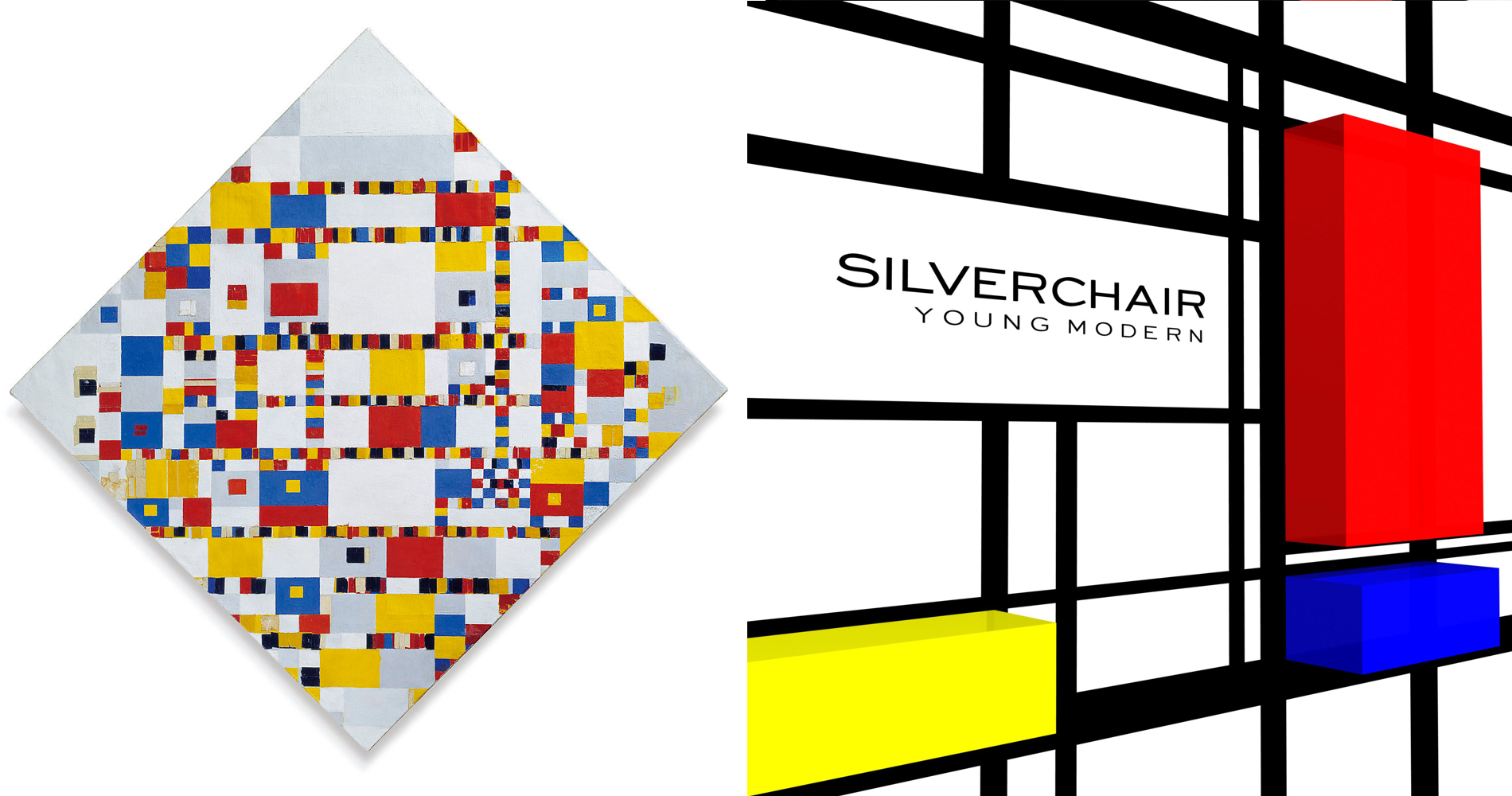 Mondrian “Victory Boogie Woogie” (2014), courtesy of Gemeente Museum Den Haag, and Silverchair’s record album cover for “Young Modern”, image from charms.co
Music
Mondrian loved exploring the night lives of the cities he lived in, especially in Paris, London and New York. He was a big fan of jazz and his last unfinished painting, “Victory Boogie Woogie” from 1944, is an homage to that. Since then, several musicians have connected his passion to their own music. The American R&B vocal group Force MDs released a music video to their hit “Love is a House” in 1987. In it the four band members dance and sing in the white rectangles while the colours of the smaller parts change in the rhythm of the song. The colour compositions have also inspired many record covers, such as a 3D adaptation for Silverchair’s “Young Modern” (2007), a Tetris-like interpretation for Coldplay’s “X & Y” (2005), or a more hidden red-white-and-black design for The White Stripes’ album “De Stijl” (2000). With 100 years worth of extensive cultural influence, Mondrian’s work remains as important as ever. And such iconic art is sure to shape many more generations to come.
“The Discovery of Mondrian: Amsterdam | Paris | London | New York” at the Gemeente Museum Den Haag runs from 3 June to 24 September 2017